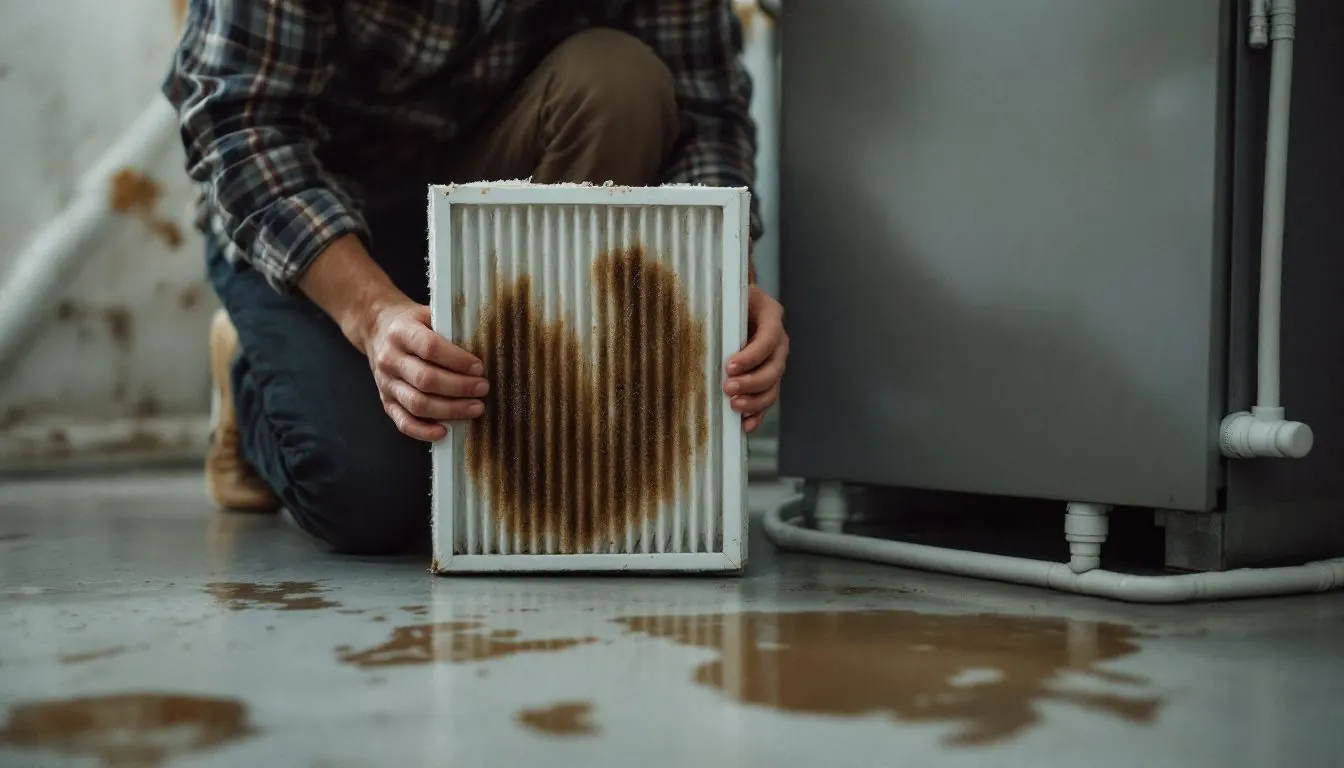
Why is my furnace filter wet? Liquid water is reaching it from one of four places: an overflowing AC coil pan above the furnace (summer), a blocked condensate trap, hose or pump on a 90%+ furnace (winter), a leaking humidifier on the return duct, or a return duct sweating in a cold attic. Room humidity alone cannot soak it.
Pull the filter and note which edge or face is wet and whether the heat or the AC was running. Those two facts separate the sources, using the makers’ manuals and the IRC coil drain rules below.
| Where the filter is wet | When | Furnace | Most likely source | Check that confirms it |
|---|---|---|---|---|
| Bottom edge soaked, water in the blower compartment | AC running | Upflow with the coil on top | Coil drain pan overflowing | Water standing in the coil pan; float switch has shut the AC off |
| Bottom edge wet, filter dirty, water after the AC stops | AC on, or just off | Any with a coil | Frozen coil thawing faster than the pan can drain | Frost on the large copper line at the coil |
| Bottom edge wet, water near the plastic trap | Heat on | 90%+ (two PVC pipes) | Clogged, unprimed or cracked trap; sagging hose; frozen line; failed pump | Sludge in the trap; pump reservoir full and silent |
| Upstream face wet, trail down the return duct | Heat on, humidifier calling | Any with a return-mounted humidifier | Humidifier drain blocked or kinked; loose feed fitting | Streak starts under the humidifier; no flow from its drain hose |
| Return grille filter wet, drips from the duct above | Cold weather | Return duct in an unheated attic or crawl space | Indoor air condensing inside a cold return duct | Duct colder than the dew point in the second table |
| Rusty or sooty water, CO alarm or corrosion in the cabinet | Heat on | Any gas furnace | Heat exchanger or venting problem (Carrier: less common, more serious) | None for an owner: shut it off, book a combustion inspection |
Which paths can carry water to a filter that sits below the coil?
Gravity decides it. On an upflow furnace the filter sits in the side or bottom return at the base of the cabinet, below everything that holds water. Goodman’s *CVC96 installation manual places it in “the central return register or a side panel external filter rack” on upright installs, and puts the furnace “upstream or in parallel with the cooling coil,” so the AC coil and its pan sit directly on top.
Paths A and B pool in the blower compartment and wick into the filter’s bottom edge. Paths C and D run down the return duct and wet the face the air enters from.
Is a wet filter in summer always the AC coil pan above the furnace?
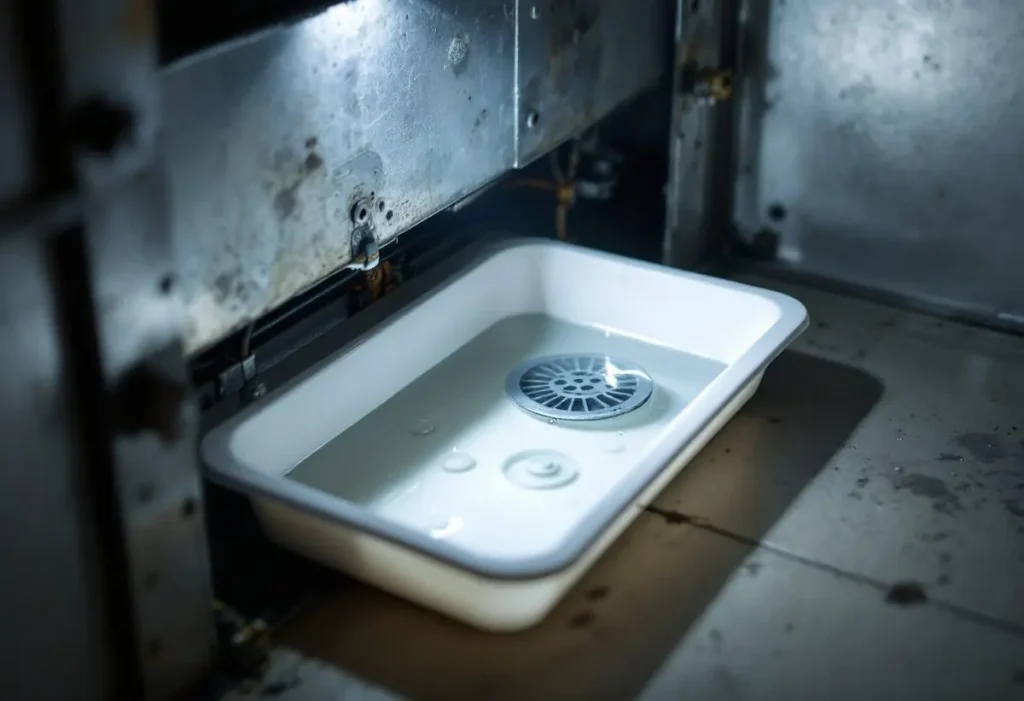
Almost always, if the AC was running on an upflow system. IRC Section M1411.2 says cooling coils “shall not be located upstream from heat exchangers unless listed and labeled for such use,” so the coil pan sits on the furnace and an overflow drains down through the cabinet toward the filter.
Code expects that overflow. IRC M1411.3.1 requires a backup wherever a coil overflow would damage the building: an auxiliary pan at least 1.5 inches deep, a separate overflow drain, or a UL 508 water-level switch that shuts the equipment off. A switch stops the AC but not the water already spilled. Clearing the line itself is covered under a clogged AC drain line.
If the filter is wet and dirty, check the coil for ice. Trane says “a dirty air filter can be to blame for a frozen evaporator coil,” and a thawing coil can outrun its pan; see why an AC freezes up.
Why does a 90% furnace wet its filter only when the heat runs?
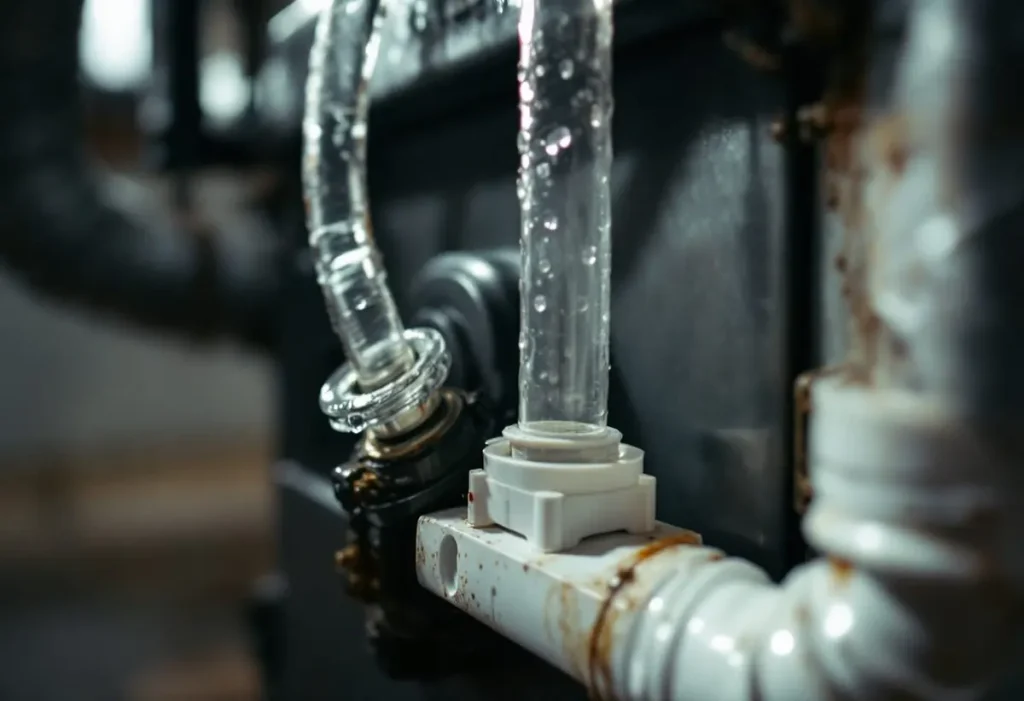
Because a condensing furnace makes water every time it fires, and only a trap, a hose and sometimes a pump keep it out of the cabinet. Carrier estimates a 60,000 BTU/h furnace at full input produces “roughly 0.7 gallons of water vapor per hour.” PNNL’s Building America guide puts the condensate at pH ≤3.
Goodman’s *CVC96 manual names the weak points: the trap “must be primed at time of installation,” the line needs “a 1/4 inch per foot downward slope toward the drain,” the hose must not “sag or trap water,” and lines exposed to freezing need protection. Any failure backs water into the cabinet and down to the filter. Trane notes a standard efficiency furnace “only has one heat exchanger, and will not produce the same condensation,” so path B is a condensing furnace problem; the full list is on our furnace leaking water page.
IRC M1411.4 requires a condensate pump in an attic or crawl space to stop the appliance when the pump fails, and M1411.5 requires an auxiliary pan under Category IV appliances where a stoppage would cause damage. Your inspector applies the locally adopted edition.
Stop line: if the water is rusty, the cabinet is corroded or a CO alarm has sounded, shut the furnace off. Carrier warns a cracked heat exchanger “can allow combustion gases, including carbon monoxide, to enter the airflow.” The technician should run a combustion analysis and a supply air CO reading, then inspect both heat exchangers.
Can a whole-house humidifier on the return duct soak the filter?
Yes. Aprilaire’s Model 600 instructions say it “can be installed on either the supply or return plenum,” and a return-mounted unit sits upstream of the filter, so a leak runs down the return onto the filter face.
Aprilaire lists the Model 600 water feed rate at 3 gph, drained through a 1/2″ I.D. hose that must keep “constant downward slope” to a floor drain. We calculated that 8 hours of run time sends 24 gallons through the unit, so a kinked hose floods the return fast. Trane lists the usual faults: “a clogged humidifier pad, clogged or cracked drain line, or loose connections.”
Aprilaire also wants the bypass damper set to “SUMMER” for cooling season. Drain and plumbing details are on our whole house humidifier installation page.
Can high indoor humidity make a furnace filter wet by itself?
No. Water condenses only on a surface colder than the air’s dew point, and a filter in the return airstream sits at room temperature, well above it. HVAC Brief calculation using the NPL Magnus formula: even at 60% relative humidity, 72°F room air does not condense until a surface drops to about 57°F.
| Room air | 30% RH | 40% RH | 50% RH | 60% RH |
|---|---|---|---|---|
| 68°F | 35°F | 43°F | 49°F | 54°F |
| 72°F | 39°F | 46°F | 52°F | 57°F |
Humidity wets a filter only when the duct around it is colder than those numbers. A sheet metal return through a 20°F attic in January is far below a 46°F dew point, so indoor air condenses inside it and drains to the lowest point, often a ceiling filter grille. EPA’s fix is to keep humidity “below 60 percent (ideally between 30 and 50 percent)” and insulate cold surfaces; for ducts, see duct insulation.
What happens if the air filter stays wet?
It starts a mold clock. EPA says that if wet materials “are dried 24-48 hours after a leak or spill happens, in most cases mold will not grow,” and that “absorbent or porous materials” may have to be thrown away once moldy. A fiber filter is that kind of material: replace it after fixing the leak rather than drying it.
Goodman’s manual says filters “must comply with UL900” standards; pick the replacement size and MERV from our HVAC filters guide. A filter that came out black rather than wet is a soot or service life problem, covered in why a furnace filter turned black.
Frequently asked questions
Why does my air filter keep getting wet?
A filter that is wet again within days has a repeating source, so match it to the season. In cooling season suspect the coil pan, which IRC M1411.3.1 backs up with an auxiliary pan, overflow line or UL 508 switch. In heating season suspect the 90%+ furnace trap or a return-mounted humidifier; an Aprilaire Model 600 feeds 3 gph.
Why does my air filter smell like wet dog?
A musty smell from a damp filter usually means microbes are growing on it. Carrier says musty odors near a leaking furnace “often result from water accumulation and subsequent microbial growth.” EPA says moldy porous materials may have to be thrown away, so replace the filter, find the leak, and dry the cabinet within 24 to 48 hours.
Why is my HVAC filter wet when the AC is off?
Water that appears after the AC shuts off is usually a frozen coil thawing. Trane links frozen evaporator coils to dirty air filters, and the melt can outrun the pan above an upflow furnace. Change the filter, run the fan alone until the ice is gone, and have a technician check airflow and charge if it ices again.
Can I dry out a wet furnace filter and reuse it?
No. Disposable pleated and fiberglass filters are porous, and EPA says moldy porous materials may need to be discarded because mold fills their crevices. Goodman also requires UL 900 compliant filters on its *CVC96 furnaces. Replace the filter after fixing the water source and check the new one after a week of run time.
How we researched this
On 9 November 2026 we read the Goodman *CVC96 furnace installation instructions, Aprilaire Model 600 instructions, IRC Section M1411 (2021 Seattle Residential Code reprint), Carrier and Trane leak guidance, EPA’s mold guide, PNNL’s furnace guide and NPL’s dew point note. The top search results cited no manual or code; we excluded a filter retailer’s cause ranking quoted by one. Car filter questions were left out: no vehicle source was read. Dew points and humidifier volume are our arithmetic.
Sources
- Goodman Manufacturing. “Installation Instructions for *CVC96*BA and *MVC96*BA Two-Stage Gas Furnace.” https://cdn.shopify.com/s/files/1/0748/4745/3475/files/GCVC96-Install_11e55e78-9b7a-49aa-bc24-d8f803e9a9af.pdf. Accessed November 2026.
- Aprilaire. “Model 600 Series Humidifier Installation Instructions.” https://documents.alpinehomeair.com/product/Aprilaire%20600%20Series%20Installation%20Instructions%2001.08.pdf. Accessed November 2026.
- Seattle Department of Construction and Inspections. “2021 Seattle Residential Code, Chapter 14: Heating and Cooling Equipment and Appliances (IRC M1411).” https://seattle.gov/documents/Departments/SDCI/Codes/SeattleResidentialCode/2021SRCChapter14.pdf. Accessed November 2026.
- Carrier. “Furnace Leaking Water: Causes, Signs, and Solutions.” https://www.carrier.com/us/en/residential/hvac-resources/furnaces/furnace-leaking-water/. Accessed November 2026.
- Trane. “Furnace Leaking Water.” https://www.trane.com/residential/en/resources/troubleshooting/gas-furnaces/furnace-leaking-water/. Accessed November 2026.
- U.S. EPA. “A Brief Guide to Mold, Moisture and Your Home.” https://www.epa.gov/mold/brief-guide-mold-moisture-and-your-home. Accessed November 2026.
- PNNL, Building America Solution Center. “Combustion Furnaces.” https://basc.pnnl.gov/resource-guides/combustion-furnaces. Accessed November 2026.
- National Physical Laboratory. “Dew point and relative humidity: units for saturation and condensation.” https://npl.co.uk/resources/q-a/dew-point-and-relative-humidity. Accessed November 2026.
Leave a Reply