Can you leave baseboard heaters on all the time? Yes, if each one is thermostat controlled, keeps the 6 inch clearances its maker prints, and has a working safety limit. “On” means the thermostat cycles it: a 6 foot, 1,500 watt unit costs 27.2 cents for every hour it actually heats.
Marley Engineered Products opens its 2500 series baseboard manual with the condition that matters: “Baseboard heaters must be thermostatically controlled for efficient, safe operation.” A heater with no thermostat is the one setup not to leave on. Adding one is breaker-off work, and wiring a baseboard heater thermostat explains why only a double pole model opens both hot wires at OFF, while a single pole unit on a two-hot circuit leaves one leg live.
What does a baseboard heater actually do when it is left on around the clock?
It switches on and off. A line voltage thermostat closes when the room drops below setpoint, the element draws full nameplate watts, and the contacts open once the room warms. When those contacts stick shut the heater never shuts off, and when they never close it stays cold, two of the faults sorted in electric baseboard heater not working. DOE describes electric baseboards as “zonal heaters controlled by thermostats located within each room,” and says the heat is 100% of the electricity, so there is no high or low efficiency setting.
The setpoint changes how often the element runs, not how hot it gets, so the claim on top ranking pages that a high setting left for days is itself a fire hazard does not hold up: at 68 F or 75 F it is the same element at the same wattage. A blocked heater is stopped by a separate safety limit, covered below. Here is how thermostat contacts and setpoints work in any system.
What does it cost to leave a baseboard heater on for 24 hours?
At most $6.54 a day for a 6 foot, 1,500 watt heater at the August 2026 US average of 18.16 cents per kilowatt hour, and only if the thermostat never opens. Wattages below come from Marley’s 2500 series submittal sheet; prices from EIA Electric Power Monthly Table 5.6.A.
| Heater (Marley 2500, 240 V) | Watts | Amps | Per hour heating, US avg | 24 h at 100% run, US avg | 24 h, Washington | 24 h, Maine |
|---|---|---|---|---|---|---|
| 2 ft (2542NW) | 400 | 1.7 | 7.3 cents | $1.74 | $1.40 | $3.08 |
| 3 ft (2543NW) | 750 | 3.2 | 13.6 cents | $3.27 | $2.63 | $5.78 |
| 4 ft (2544NW) | 1,000 | 4.2 | 18.2 cents | $4.36 | $3.51 | $7.71 |
| 6 ft (2546NW) | 1,500 | 6.3 | 27.2 cents | $6.54 | $5.27 | $11.56 |
| 8 ft (2548NW) | 2,000 | 8.4 | 36.3 cents | $8.72 | $7.02 | $15.41 |
HVAC Brief calculation: watts from the Marley 2500 series submittal x residential price from EIA Electric Power Monthly Table 5.6.A, August 2026 (US 18.16, Washington 14.63, Maine 32.11 cents per kWh).
Real bills land lower because the element runs part of each hour: at half the hour the 6 foot heater costs $3.27 a day, at a quarter $1.63. The run share is set by the room’s heat loss, which is why the watts per foot and room heat loss math matters more than the hours the switch is on. Your state’s rate is in our monthly electricity price tracker.
Is turning baseboard heaters down when you leave cheaper than holding one temperature?
Yes. DOE’s Energy Saver thermostat guidance calls the idea that a heater “works harder” to recover a common misconception: “the lower the interior temperature, the slower the heat loss.” DOE puts the saving at “as much as 10% a year” for a 7 to 10 F setback lasting 8 hours a day.
Electric baseboard sets back easily: each room has its own thermostat, and DOE flags only steam and radiant floors as slow to recover. For a trip, the City of Madison, Wisconsin tells residents to “leave the heat on in your home, set to a temperature no lower than 55ºF.” A mechanical Lux LV thermostat bottoms out at 50 F on its dial, so most baseboard thermostats can hold that floor. The thermostat reads room air, not the pipe inside an exterior wall; our page on the temperature at which pipes freeze has the numbers.
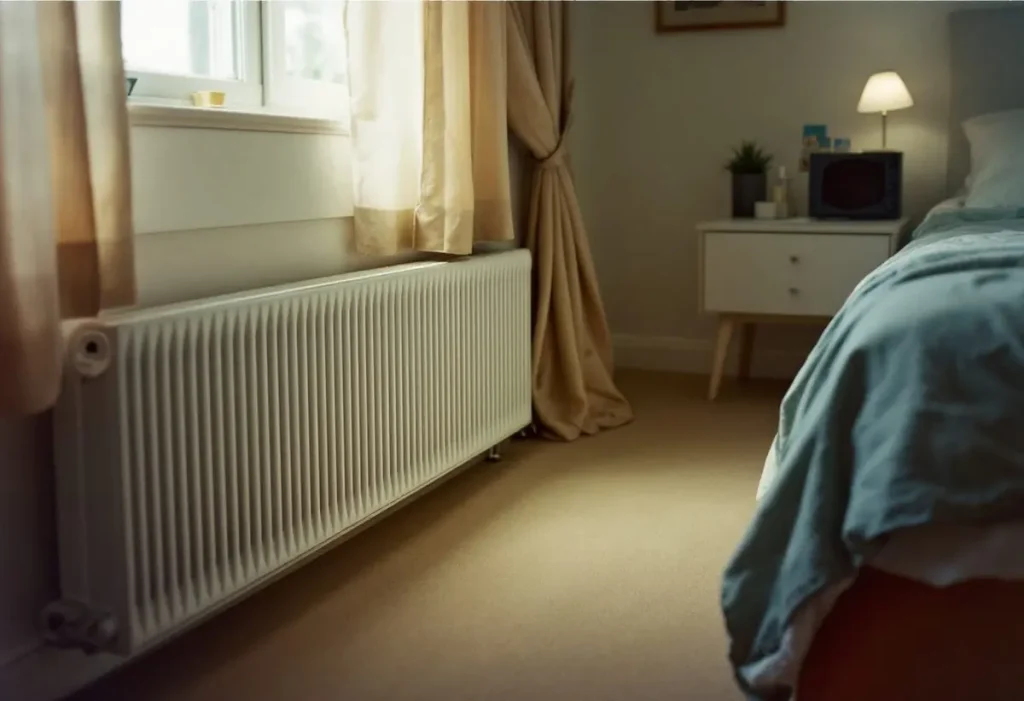
How much clearance does a baseboard heater need to run unattended?
Six inches in front of and above the heater, per Marley: “we recommend maintaining a minimum of 6 inches (152 mm) clearance above and in front of the heater at all times.” Furniture gets the same 6 inches. The 1 foot and 3 foot figures on top ranking pages are not in the Marley manuals we read.
The 2500 manual adds: “Do not install heater below an electrical convenience receptacle (outlet)”; no vinyl blinds or wall coverings above it; “Do not recess heater in wall or install heater inside any type enclosure”; no gasoline stored nearby. DOE advises 3/4 inch above floor or carpet; Marley allows floor mounting with up to 3/4 inch of carpet run up to the heater if airflow stays clear.
How dangerous is a baseboard heater compared with a portable space heater?
Nobody publishes a baseboard only number. NFPA’s heating fire tables file fixed and portable heaters in one row: 14,600 home fires a year in 2016 to 2020, 33% of heating fires but 420 deaths, 88% of all heating fire deaths. Central heat caused 1,860 fires and an estimated zero deaths.
Overnight is the risky window: fires between midnight and 6 a.m. were 13% of heating fires but about 43% of the deaths, summing NFPA’s hourly shares. A fixed heater cannot tip over, but bedding can still end up against it, which is what the 6 inch rule prevents. The full breakdown is in our home heating fire statistics report, and the portable side in what a space heater costs to run and the fire data.
Why does a baseboard heater keep shutting off, keep running or keep tripping the breaker?
Each symptom points at a different part: the safety limit, the thermostat, or a circuit loaded past its rating.
Keeps shutting off. Marley says the limit turns the heater off “if it is blocked or otherwise overheats” and that “During normal use, this safety control should not operate.” Clear the 6 inches; if it still cycles, Marley says disconnect power and have it checked by an electrician. Never bypass the limit.
Keeps running or keeps turning on. A thermostat directly above the heater reads the wrong air. Lux tells installers to avoid “positioning this thermostat in a location which is directly above any baseboard heating components,” and DOE notes built-in thermostats “often don’t sense the room temperature accurately.” Our guide to where a thermostat should go covers placement; a room that never reaches setpoint on the coldest nights has too little heater for its heat loss.
Keeps tripping the breaker. Marley’s Table 1 pairs total heater amps with a breaker size, and each limit works out to 80% of the breaker rating:
| Breaker and wire (Marley Table 1) | Max heater amps | Max watts at 240 V | Feet of 250 W/ft baseboard | 6 ft 1,500 W heaters |
|---|---|---|---|---|
| 15 A, #14 copper | 12 | 2,880 | 11.5 | 1 |
| 20 A, #12 copper | 16 | 3,840 | 15.4 | 2 |
| 30 A, #10 copper | 24 | 5,760 | 23.0 | 3 |
HVAC Brief calculation from Marley 2500 manual Table 1 and the 2500 series submittal (6.3 A per 6 ft heater at 240 V).
A trip with the load inside these limits points to a loose connection or failing breaker: 240 volt work for an electrician. Marley wants every connection tight “to prevent possible overheating.”
Which clicks, pops, smells and leaks mean a baseboard heater should be switched off?
Ticking and clicking are expected; Marley’s Model D leaves 1/8 inch at each end for expansion. Any liquid from an electric unit is not.
| Sign | Verdict | What the maker document says |
|---|---|---|
| Ticking or popping as it warms | Expected | Marley 2500: heater must “expand and contract during use”; mounting screws loosened 1/4 turn to allow it |
| Single click at the thermostat | Normal | Lux LV2: only Line 1 is switched “during normal temperature cycling” |
| Smoke or smell on first run | Normal, briefly | Marley 2500: run 1/2 hour “to remove oily residue from manufacturing”; Model D: a “new smell” is expected |
| Burning smell mid season | Clean it | Marley 2500: dust collects between the fins and the heater “should be cleaned regularly”; vacuum with power off |
| Heater cycling off by itself | Stop, call electrician | Marley Model D: if the over temperature device is cycling the heater, turn off power and have it serviced |
| Liquid under an electric unit | Power off at breaker | Marley Model D is a “liquid filled” electric baseboard; any servicing beyond cleaning goes to qualified service personnel |
Compiled by The HVAC Brief from Marley 2500/C2500 and Model D manuals and the Lux LV1/LV2/LV3 instructions.
Banging, gurgling or water dripping from a baseboard with copper pipes at each end is a hot water system, not an electric one. Diagnosis starts at the boiler’s pressure gauge reading; the loop is explained in our boiler and baseboard heating guide.
Frequently asked questions
Are baseboard heaters safe?
Installed to the maker’s clearances and wired through a thermostat, yes. Marley’s 2500 manual requires a thermostat, 6 inches to furniture, no outlet above and no enclosure, and each unit has a safety limit that shuts it off if it overheats. NFPA does not count baseboard fires separately.
Can you leave baseboard heaters on when not home?
Yes, at a lower setting. The City of Madison advises leaving the heat on at no lower than 55ºF while away, and DOE estimates a 7 to 10 F setback for 8 hours a day saves as much as 10% a year. Clear furniture and curtains to 6 inches first.
Does turning a baseboard thermostat all the way down turn the heater off?
Only a double pole thermostat turned to OFF breaks both supply lines. Lux says of its LV2: “Both LINE 1 and LINE 2 are broken when the dial is turned to the OFF position.” A single pole model switches one line only, and a dial at its lowest temperature, 50 F on Lux LV models, still calls for heat when the room falls that low.
Why is my baseboard heater leaking oil?
Some electric baseboards are liquid filled, such as Marley’s Model D. Any liquid from an electric unit means switching it off at the breaker; Marley limits owners to basic cleaning and assigns other servicing to qualified service personnel. A new 2500 unit can smoke briefly while a 1/2 hour run burns off factory oil.
How we researched this
On 9 November 2026 we read Marley’s 2500/C2500, Model D and D series baseboard manuals and 2500 submittal, the Lux LV thermostat instructions, NFPA’s Home Heating Fires supporting tables (December 2022), EIA Electric Power Monthly Table 5.6.A for August 2026, two archived DOE Energy Saver pages and a City of Madison notice. The three top ranking articles cited no sources, so their figures were excluded. We did not open the NEC or UL 1042, so no code clearances are stated. Costs are our calculation for a heater running every minute.
Sources
- Marley Engineered Products. “Electric Baseboard Heaters 2500 and C2500 Series: Installation, Operation and Maintenance Instructions.” https://marleymep.com/wp-content/uploads/5200-2194-010_2.pdf. Accessed November 2026.
- Marley Engineered Products. “Model D Electric / Hydronic Baseboard Heaters: Installation, Operation and Maintenance Instructions.” https://marleymep.com/wp-content/uploads/5200-2083-006.pdf. Accessed November 2026.
- Marley Engineered Products. “2500 Series Electric Baseboard Heater Submittal Sheet.” https://www.marleymep.com/wp-content/uploads/MEP_2500-Baseboard-Q_Submittal_2023-12-web.pdf. Accessed November 2026.
- LUX Products. “Mechanical Line Voltage Thermostats LV1, LV2, LV3: Installation and Operating Instructions” (archive.org copy). https://archive.org/download/manualsonline-id-a9967ac2-5b8c-40a4-8718-354cc0a81be2/a9967ac2-5b8c-40a4-8718-354cc0a81be2.pdf. Accessed November 2026.
- US Energy Information Administration. “Electric Power Monthly, Table 5.6.A, August 2026.” https://www.eia.gov/electricity/monthly/epm_table_grapher.php?t=epmt_5_6_a. Accessed November 2026.
- US Department of Energy. “Electric Resistance Heating” (archived copy). https://web.archive.org/web/2025id_/https://www.energy.gov/energysaver/electric-resistance-heating. Accessed November 2026.
- US Department of Energy. “Programmable Thermostats” (archived copy). https://web.archive.org/web/2025id_/https://www.energy.gov/energysaver/thermostats. Accessed November 2026.
- NFPA Research. “Home Heating Fires Supporting Tables.” https://content.nfpa.org/-/media/Project/Storefront/Catalog/Files/Research/NFPA-Research/US-Fire-Problem/Fire-causes/osHeatingTables.pdf. Accessed November 2026.
- City of Madison. “Temperatures Dropping; Keep Water Pipes Warm.” https://www.cityofmadison.com/node/12773. Accessed November 2026.
Leave a Reply