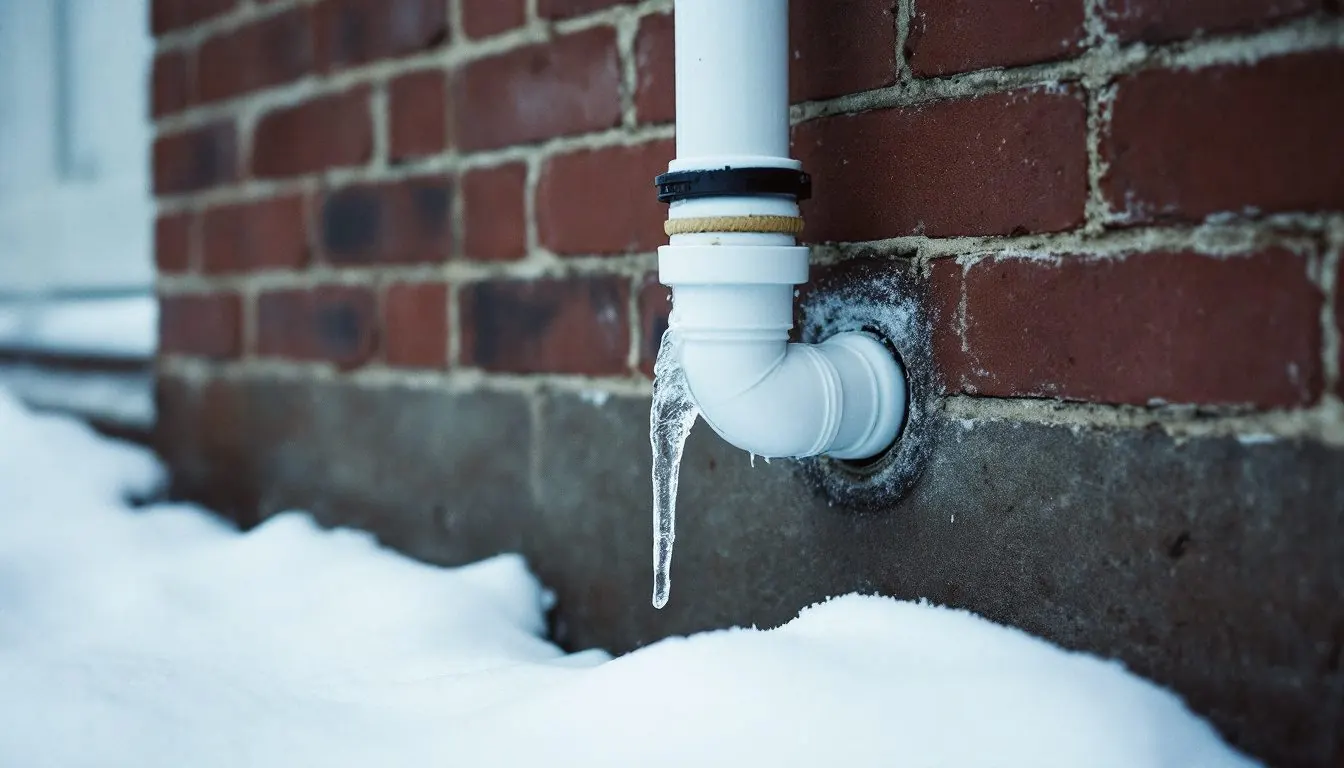
A furnace condensate line frozen solid stops a 90%+ furnace on purpose: water backs up toward the collector box, the pressure switch never closes, and the burners never light. Thaw the trap and drain with gentle heat, never a flame, re-prime the trap, then reroute, insulate or heat-trace the cold section so it cannot refreeze.
Where is the ice in a frozen furnace condensate line, and what does each spot do?
Follow the water out from the trap: ice can form at any of five points. Goodman says its pressure switches guard against “blocked condensate drain conditions” as well as poor combustion airflow, so a plug anywhere downstream looks the same to the control board (Goodman IOG-2015A).
| Ice point | What you see | What the furnace does | Permanent fix the maker names |
|---|---|---|---|
| 1. Trap, furnace in a space below freezing | Trap or hoses hard, cold or cracked | Inducer runs, burners never light, pressure switch code | Bryant 352MAV: “32°F minimum installed ambient or freeze protection required”; heat tape on the trap |
| 2. Drain run through an attic, garage or crawl space | Ice in the clear tubing or a cold, full PVC run | Same as 1, often after a few cold nights | Lennox ML296UHV: route “within the conditioned space”; if not possible, a heat cable kit |
| 3. Outdoor outlet | Ice plug or icicle at the end of the pipe | Same as 1 | Bosch BGH96: “Do not route the drain line outside where it may freeze.” |
| 4. Condensate pump discharge tubing | Pump tank full or overflowing | If the pump’s high water switch is wired in, the heat call simply stops, with no pressure switch code | Little Giant VCMA-20-PRO: clear blocked outlet tubing; keep the tubing out of the cold |
| 5. Exhaust vent outlet (not the drain) | Frost or ice closing the PVC vent outlet | Same code as 1, which is why the vent gets checked too | Goodman: insulate vent pipe exposed below 35°F with 1/2″ thick closed cell foam |
Compiled by The HVAC Brief from Goodman, Bryant, Lennox, Bosch and Little Giant instructions (Sources 1, 4, 5, 7, 8).
Row 5 matters because Lennox tells servicers that an “obstructed exhaust pipe will cause unit to shut off at pressure switch,” so a technician checks the PVC vent pipe and its termination before blaming the drain.
Which code does a frozen condensate drain line set on Carrier, Goodman and Lennox furnaces?
It sets the “pressure switch did not close” code, because the board cannot tell ice from any other blockage. No Carrier, Goodman or Lennox document we read has a separate frozen drain code; each row applies only to the board named.
| Maker and board or series | Code | Text in the maker document |
|---|---|---|
| Carrier, White-Rodgers 50M56D-751 replacement control | code 31 | “Pressure Switch Did Not Close” |
| Goodman GM9S92, GM9S96, GC9S96 single stage | E2 | “Pressure switch closed circuit is not closed” |
| Lennox ML296UHV | 3 flashes | “Pressure switch open with inducer energized” |
| Lennox ML296UHV | 6 flashes | “Pressure switch cycle lockout.” |
Compiled by The HVAC Brief from White-Rodgers 37-7757002, Goodman RS6612022r1 and Lennox 507869-04.
On that White-Rodgers board code 32 is “Ignitor Failure or Ignitor Relay Failure,” not a drain fault. Goodman’s flowchart for an open switch reads “Check venting, check drainage, check for condensate in inducer” and its 90% checklist adds “Drain trap prime and clear” (Goodman RS6612022r1). The brand pages for Carrier furnace error codes and Lennox furnace error codes list the other boards.
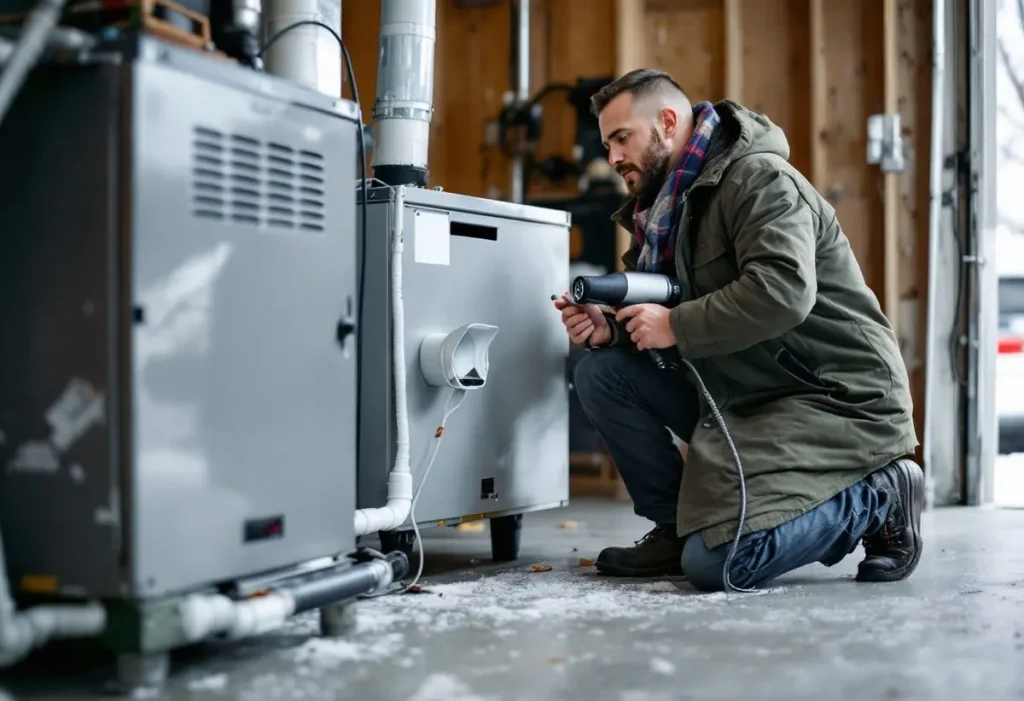
How do you thaw a frozen furnace condensate line without cracking the trap?
Warm the frozen section slowly with a hair dryer, a heating pad or towels soaked in hot water, working from the outlet end back toward the furnace so meltwater has somewhere to go. Those are the heat sources the American Red Cross lists for frozen pipes, along with its warning: “Do not use a blowtorch, kerosene or propane heater, charcoal stove, or other open flame device.”
- Set the thermostat to off and switch off furnace power at the service switch before handling the trap; Goodman marks its condensate drainage system “QUALIFIED SERVICER ONLY” in RS6612022r1.
- Find the ice using the five points above.
- Thaw it until water runs freely from the outlet.
- Re-prime the trap. Bosch says its BGH96 trap “can ONLY be primed by pouring water into the inducer drain side.”
- Restore power and call for heat. If the inducer runs but the burners still never light, stop there.
If the switch still stays open, a technician measures inducer suction with a manometer against the switch rating and checks the hose for water, as our furnace pressure switch guide shows. Goodman RS6612022r1 says never to bypass furnace controls, so no jumper.
How much water does a condensing furnace push into a frozen line?
At most about 1.13 gallons per hour on a 100,000 Btu/h furnace, which is why a plug stops the furnace within the first cycles. Burning one mole of methane makes two moles of water, and NIST lists methane’s heat of combustion at 890.7 kJ/mol.
| Furnace input | Water vapor, gallons per hour (maximum) | After 8 burner hours | After 16 burner hours |
|---|---|---|---|
| 40,000 Btu/h | 0.45 | 3.6 gal | 7.2 gal |
| 60,000 Btu/h | 0.68 | 5.4 gal | 10.8 gal |
| 80,000 Btu/h | 0.90 | 7.2 gal | 14.4 gal |
| 100,000 Btu/h | 1.13 | 9.0 gal | 18.0 gal |
HVAC Brief calculation: input (Btu/h) x 1.055056 kJ/Btu / 890.7 kJ/mol x 2 mol water x 18.015 g/mol, 1 kg = 1 liter, 3.785 liters per gallon; gas treated as pure methane. Upper bound: part of the vapor leaves through the vent.
Carrier’s own figure agrees: a 60,000 BTU/h furnace “can produce roughly 0.7 gallons of water vapor per hour.” Over a long cold night that is gallons, not drips, so a sagging or nearly flat outdoor run fills and freezes.
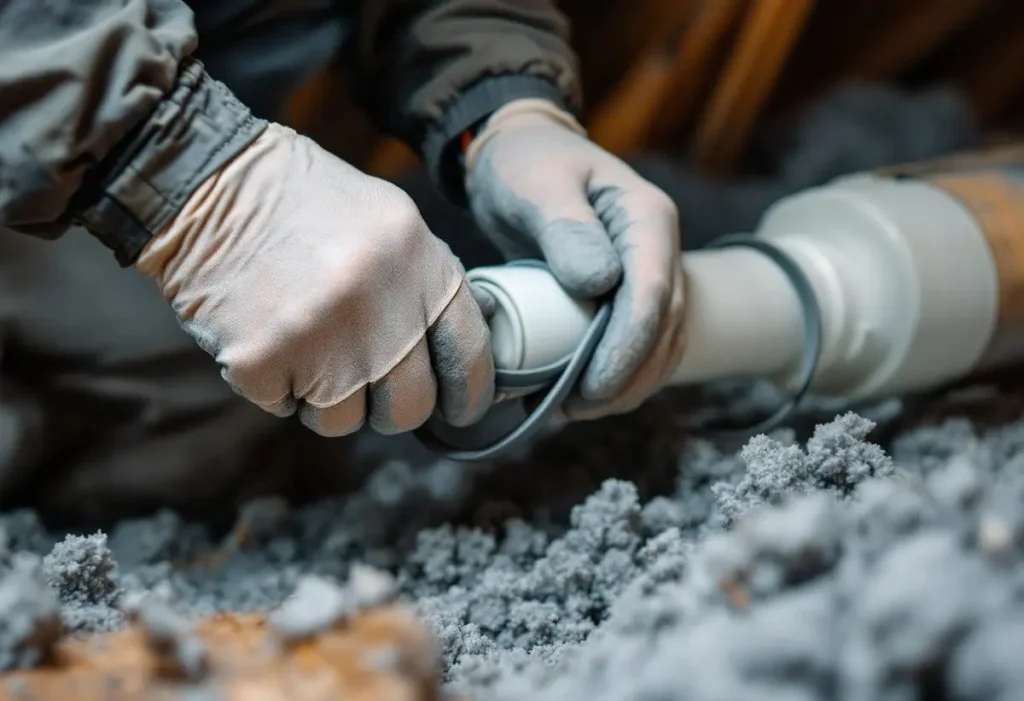
How do you stop a furnace condensate line from freezing again?
Move the cold section into heated space first; heat the trap and line only where moving it is not possible. Lennox, Carrier, Goodman and Bosch agree:
- Lennox (ML296UHV): the drain line “should be routed within the conditioned space,” and otherwise “a heat cable kit may be used on the condensate trap and line,” sold as 6 ft kit 26K68, 24 ft kit 26K69 and 50 ft kit 26K70 (Lennox 507869-04).
- Carrier and Bryant: use a freeze protection accessory or “3 to 6 watt per ft” self-regulating, shielded, waterproof heat tape, folded and wrapped on itself 3 times between the trap sides, then about 1 wrap per ft on the field drain (Bryant 352MAV).
- Goodman: where the furnace room can freeze, “the drain trap and drain line must be protected,” and it recommends accessory trap heaters, electric heat tape and/or RV antifreeze. The line keeps a 1/4 inch per foot downward slope.
- Bosch (BGH96): add foam insulation around the drain line, and “heat tracing may also be necessary,” but do not route it outside where it may freeze (Bosch BGH96).
At Bryant’s 3 to 6 W/ft, a 6 ft cable draws 18 to 36 W, or 13.0 to 25.9 kWh over 30 days at full output. GFCI and cable rules are in our heat tape for pipes guide. Whether the drain may end outdoors is a local code question, set out in can HVAC condensate drain outside; IRC M1411.3 asks for at least 1/8 inch per foot of fall to “an approved place of disposal.”
Is a frozen condensate pump line a different fault from a frozen drain?
Yes, because the furnace usually shuts down for a different reason. Little Giant says some VCMA-20-PRO pumps carry a high water switch that “opens a thermostat circuit when the pump reservoir is full, stopping production of condensate,” and lists “Outlet flow is blocked” as a cause of an overflowing tank (Little Giant VCMA-20-PRO manual).
So a frozen pump discharge line shows a full tank and a furnace that acts as if the thermostat stopped calling, with no pressure switch flash. Thaw the tubing and reroute it inside. With a gas furnace, Little Giant says to flush the tank so acidity does not fall below an average pH of 3.4; more on the condensate pump page.
What if the house will sit empty in freezing weather?
Do not just turn the furnace off and leave. Bryant and Carrier both state the unit “must not be installed, operated, and then turned off and left in an unoccupied structure during cold weather when temperature drops to 32°F and below” unless the trap and drain line have adequate freeze protection.
Goodman goes further for a vacant building that may freeze: drain all water-bearing pipes, winterize the building and close the water source. Bryant warns that “Freezing condensate left in condensate trap and drain line may cause cracks, and possible water damage may occur.” Water already on the floor? See furnace leaking water.
Frequently asked questions
Can a clogged condensate line cause freezing?
In winter it works the other way: a clogged or sagging line holds still water, and still water in a cold space freezes first. Bryant warns that condensate left standing in the trap and drain line can freeze and crack them. A clogged AC drain in summer causes leaks and float switch trips, while ice on the coil comes from airflow or refrigerant faults.
Can I pour RV antifreeze in my furnace condensate drain?
Goodman’s IOG-2015A lists RV antifreeze, alongside accessory drain trap heaters and electric heat tape, as recommended protection where the furnace environment may freeze. It is a stopgap for a cold room or a vacant house, not a fix for a line routed outdoors. Re-prime the trap with water before the furnace runs again.
Is it safe to run the furnace after thawing the condensate line?
Only once the trap is primed. Carrier’s KGAET0101ETK kit warns that an unprimed trap “may allow positive pressure vent gases to enter the structure through drain tube,” and vent gases contain carbon monoxide. If the inducer runs and the burners still do not light after priming, leave it off and have the pressure switch and vent tested.
How we researched this
We read the Goodman, Bryant, Carrier, Lennox, Bosch, White-Rodgers and Little Giant documents listed below, the NIST methane entry, the Red Cross frozen pipe page and IRC Chapter 14 (Seattle 2021 reprint). Codes cover only the boards named. Forums, videos and contractor blogs supplied questions, not figures. Researched November 14, 2026.
Sources
- Goodman Manufacturing. “*CVC96*BA Installation Instructions (IOG-2015A).” https://cdn.shopify.com/s/files/1/0748/4745/3475/files/GCVC96-Install_11e55e78-9b7a-49aa-bc24-d8f803e9a9af.pdf. Accessed November 2026.
- Goodman Manufacturing. “Service and Troubleshooting, GM9S92/GM9S96/GC9S96 (RS6612022r1).” https://mobile.goodmanmfg.com/mobileapp/stellent/pdf/infoPdf/Lit/RS6612022R1.pdf. Accessed November 2026.
- White-Rodgers (Copeland). “50M56D-751 Installation Instructions.” https://media.copeland.com/7b1c16cb-45cd-45fe-8e23-b16b0109fc57/0037-7757001%20%2D%2050M56D-751%20Instruction%20Sheet%20(EF).pdf. Accessed November 2026.
- Lennox Industries. “ML296UHV Installation Instructions (507869-04).” https://www.lennox.com/dA/05798283a5/507869-04.pdf. Accessed November 2026.
- Bryant. “352MAV Installation Instructions (352M-60-2).” https://www.shareddocs.com/hvac/docs/1009/Public/06/II352M.60.2.pdf. Accessed November 2026.
- Carrier. “KGAET0101ETK External Trap Kit Instructions.” https://www.shareddocs.com/hvac/docs/1009/Public/09/AG-GAET-02.pdf. Accessed November 2026.
- Bosch Home Comfort. “BGH96 IOM, RevC.” https://www.bosch-homecomfort.com/ca/media/country_pool/documents/installation-manuals/bgh96_furnace_revc_iom_09.2024.pdf. Accessed November 2026.
- Little Giant (Franklin Electric). “VCMA-20-PRO Condensate Pump Series Owner’s Manual.” https://www.industrialstores.com/media/industrialstores/product/attachments/Little-Giant-VCMA-20-PRO-Condensate-Pump-Series-Owners-Manual-%28English%29.pdf. Accessed November 2026.
- NIST Chemistry WebBook. “Methane.” https://webbook.nist.gov/cgi/cbook.cgi?ID=C74828&Mask=1. Accessed November 2026.
- American Red Cross. “Frozen Pipes.” https://www.redcross.org/get-help/how-to-prepare-for-emergencies/types-of-emergencies/winter-storm/frozen-pipes.html. Accessed November 2026.
- Carrier. “Furnace Leaking Water: Causes, Signs, and Solutions.” https://www.carrier.com/us/en/residential/hvac-resources/furnaces/furnace-leaking-water/. Accessed November 2026.
- Seattle Department of Construction and Inspections. “2021 Seattle Residential Code, Chapter 14 (IRC M1411.3).” https://seattle.gov/documents/Departments/SDCI/Codes/SeattleResidentialCode/2021SRCChapter14.pdf. Accessed November 2026.
Leave a Reply