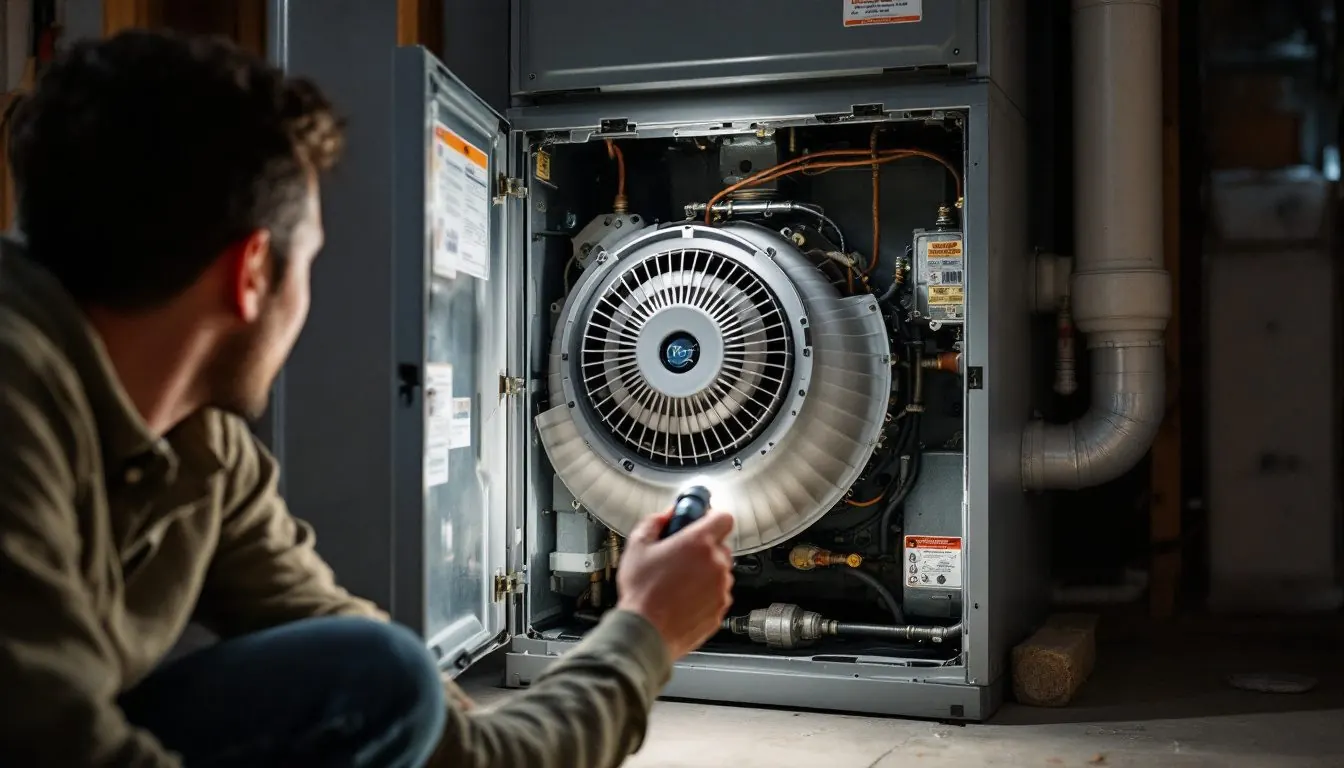
A furnace squealing noise almost always comes from something spinning. If it starts at the heat call, before the burners light, suspect the inducer motor. If it starts about 30 seconds after the flame and runs with the airflow, it is the blower: a slipping belt on older furnaces, worn bearings on direct-drive motors.
When does your furnace squeal: before the flame, 30 seconds after it, or after the burners go out?
The moment the squeal starts names the motor. A gas furnace runs its motors in a fixed order; Goodman’s RS6612022R1 service manual spells it out: the control energizes the induced draft blower first, waits for the pressure switch and pre-purge, lights the igniter, opens the gas valve, and only “after 30 seconds the indoor blower is energized on heating speed.” At shutdown the inducer runs a post purge of 15 seconds and the blower runs its off delay, 90 seconds by default and adjustable from 30 to 180 seconds.
Turn the thermostat up 3 degrees, start a stopwatch, and note when the squeal starts, whether it fades, and when it stops. Our guide to what HVAC noises mean covers bangs and rattles.
| When the squeal happens | Most likely source | Check with power off | What the technician measures |
|---|---|---|---|
| At the heat call, before the igniter glows; stops about 15 s after the burners go out | Inducer motor bearings (Goodman and Rheem: permanently lubricated) | Spin the inducer wheel by hand; rough, gritty or wobbly means bearings | Motor replacement, not oil; draft proven by the pressure switch afterward |
| Starts about 30 s after the flame, fades within a few seconds | Belt slip on a belt-drive blower (Gates: squeal or chirp = belt slip) | Glazed, cracked or oily belt; pulleys in line | Deflection force at mid span, 1 mm per 100 mm of span (Gates) |
| Starts about 30 s after the flame and stays as long as air blows | Blower motor bearings, wheel slipping on the shaft (Rheem), glazed belt or misaligned pulley | Shaft play and drag when the wheel is turned by hand | Running amps, no more than 10% over nameplate current (NORA) |
| Rises and falls with the filter or registers; a hiss or whistle more than a squeal | Air forced through a restriction (Genteq: check filter, then static) | Fresh filter, all registers open | Total external static pressure against the rating plate (Goodman) |
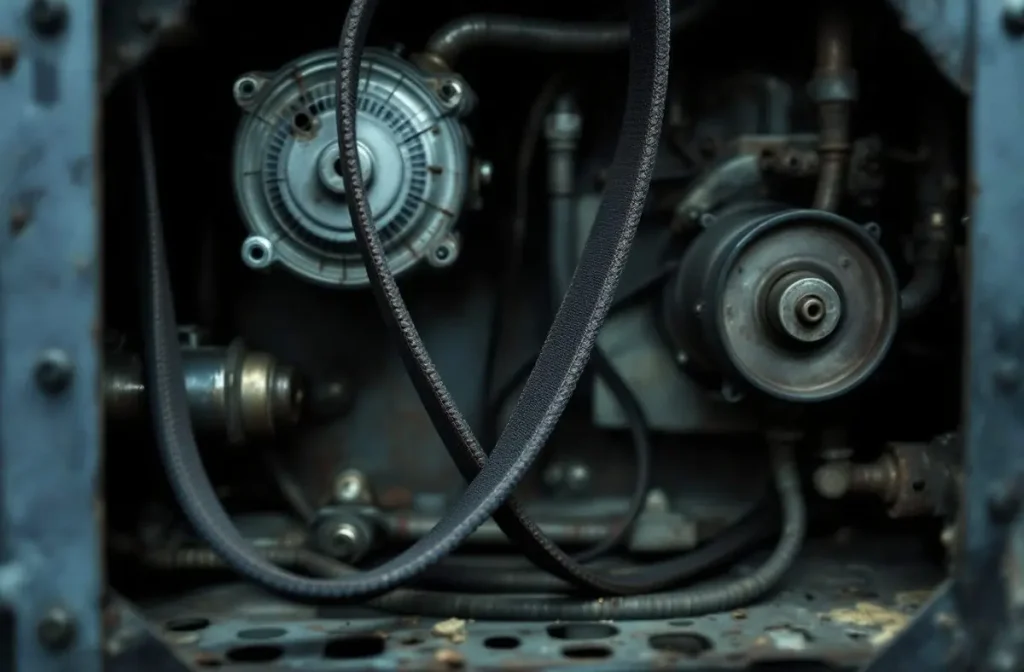
Does your furnace have a belt, a PSC motor or an ECM? How to tell in one look
Most furnaces built in the last few decades have no belt at all. NORA’s motor chapter calls belt-driven blowers “the most common type blowers on older furnaces”: the motor sits beside the blower housing and turns it through pulleys and a V belt. A direct-drive motor is mounted inside the wheel, with its shaft connected straight to the blower wheel. No belt and pulleys in sight means no belt squeal.
Direct-drive motors come in two families. A PSC motor has a run capacitor wired to it, often strapped to the blower housing, and NORA says PSC troubleshooting comes down to “the capacitor and the windings.” An ECM has an electronics module on the end of the motor and, on Genteq models, a 5-pin power connector plus a 16-pin control plug. Furnace fans made on or after July 3, 2019 must meet a fan energy rating under 10 CFR 430.32(y), which pushed newer furnaces toward ECM motors; our blower motor explainer compares the two.
Before looking: turn off the service switch at the furnace. Goodman’s *M9S80 instructions say the blower door interlock switch “interrupts unit voltage when the blower door is opened,” and add “Do not defeat this switch.” The door switch is a backup, not your lockout. Genteq tells technicians to wait at least 5 minutes after disconnecting power before opening an ECM control, “to allow the capacitors to dissipate.”
Why does the furnace squeal when starting, then stop after a few seconds?
On a belt-drive blower, a squeal that starts with the blower and fades is the belt slipping while the wheel comes up to speed. Gates’ Industrial Belt and Drive Preventive Maintenance manual (E2/20087) lists two causes for a squeal or chirp: belt slip, fixed by “Retension,” and contamination, fixed by cleaning the belts and pulleys. It warns that “If too little tension is applied, V-belts may slip.”
Gates also says “Do not use belt dressing,” the spray sold to quiet belts, because oil and chemical contamination leaves belts sticky or swollen. Its tension check deflects the span 1 mm per 100 mm of length under a rated force; we calculated about 0.12 inch on a 12 inch span. NORA adds that an adjustable pulley opened or closed too far causes poor seating of the V belt.
On a direct-drive ECM, a brief noise at start is often normal. Genteq’s ECM Service Guide (copy hosted on hackaday.io) says “It is normal for the motor to rock back and forth on start up” and warns not to replace the motor if that is the only symptom.
Why does the furnace squeal the whole time it is running?
A squeal that holds steady for as long as air blows points to the blower motor bearings or a drive part rubbing. Rheem’s 801T installation instructions list “Failing motor bearings” and a “Blower wheel slipping on the motor shaft” among the blower problems that trip the furnace’s limit switch, because both cut airflow. If the squeal comes with short heat cycles, read our limit switch guide next.
With power off, turn the wheel by hand: drag, grit or wobble means bearing wear. Gates checks belt drives with a straight edge across both pulley faces, and its noise table matches grinding to “Damaged bearings.”
The technician will clamp an ammeter on the motor lead. NORA says running current should not exceed 10% over the motor nameplate current. On a PSC blower they will also read the capacitor, covered in our capacitor explainer.
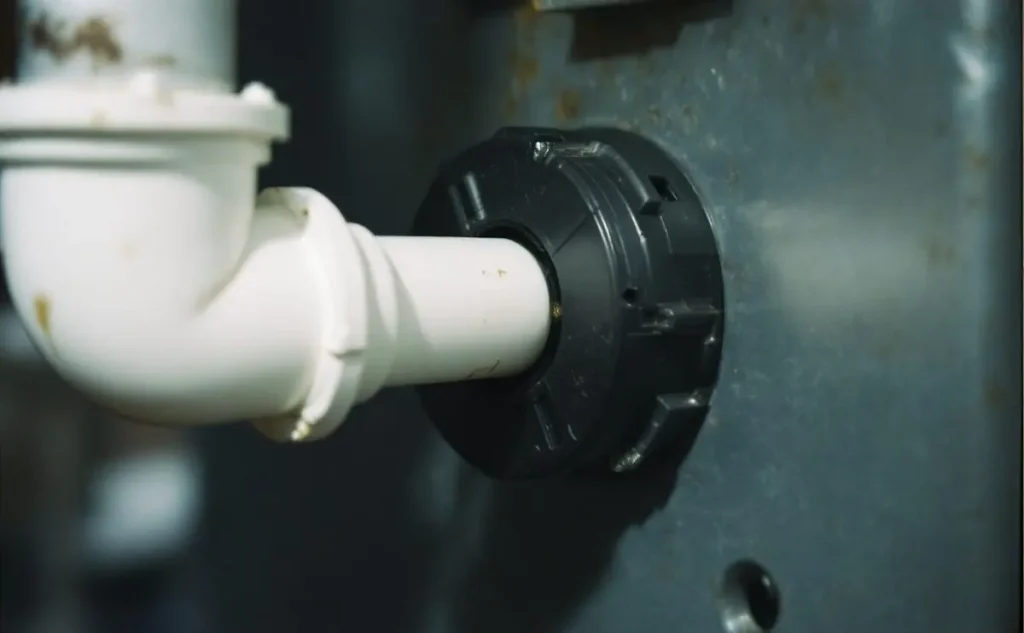
Is a high-pitched whine right at the heat call the inducer motor?
Usually, yes. The inducer starts first on every heat call in Goodman’s sequence, before anything glows, and stops about 15 seconds after the burners go out. A whine on that schedule is its bearings or wheel. Our inducer motor page covers testing and replacement.
Goodman’s RS6612022R1 says the bearings in the induced draft blower and circulator blower motors are “permanently lubricated by the manufacturer,” so a squealing inducer is replaced, not oiled. Fasco’s K674 kit instructions have installers spin a new inducer to confirm it moves freely. If the sound is steadier, a drone rather than a squeal, our furnace humming guide sorts the transformer and gas valve hums.
Can you oil a squealing furnace motor, or spray WD-40 on it?
On most furnaces made in recent decades, no. Goodman calls both motors permanently lubricated, and Rheem’s 801T is blunter: “DO NOT attempt to lubricate the bearings on the blower motor or the induced draft blower motor. Addition of lubricants can reduce the motor life and void the warranty.”
Older sleeve-bearing motors with visible oil ports are the exception. NORA’s chapter says motors that need it should be oiled on the maker’s schedule “using the manufacturers specified lubricant, typically non-detergent SAE 20 oil,” and that most motors are permanently lubricated. A penetrating spray such as WD-40 is not that oil; the only use Fasco’s K674 guide gives penetrating oil is freeing a rusted inducer wheel from its shaft for removal.
Is it a squeal or a whistle? When the noise is air, not a part
A whistle that changes when you swap the filter or close a register is air squeezing through a restriction, not a failing motor. Genteq’s guide says that if an ECM system is excessively noisy, remove the filter and check that dampers, registers and grilles are open; “If removing the filter corrects the problem, clean or replace with a less restrictive filter.” Then check the external static pressure against the maker’s figure. Our filter guide explains rating and sizing.
Goodman’s *M9S80 instructions say too much external static pressure can cause limit switch tripping and heat exchanger failure. A technician reads it with a manometer; Goodman’s worked example totals 0.4 inches of water column, compared against the rating plate.
When should you shut a squealing furnace off?
Shut it off at the thermostat and the service switch when the squeal turns to grinding, when you smell hot metal or burning insulation, or when the furnace starts shutting down mid-cycle. Gates ties grinding to damaged bearings, and Rheem ties failing bearings to limit trips. A steady squeal with normal heat can wait for a scheduled visit.
Genteq warns that “Working on the motor with power connected may result in electrical shock,” so leave motor work to a technician. A boom at ignition is a different, combustion problem: read our furnace bang guide before restarting.
Frequently asked questions
Why is my furnace making a high-pitched squeal?
A high-pitched squeal is usually a bearing or a belt. If it starts at the heat call before the burners light, it is the inducer motor, which Goodman says has permanently lubricated bearings, so the fix is replacement. If it starts about 30 seconds after the flame, it is the blower side.
Is a furnace squeaking noise the same problem as a squeal?
A short squeak or chirp on a belt-drive blower is belt slip in Gates’ troubleshooting table, fixed by retensioning or cleaning the belt and pulleys. On a direct-drive motor, a squeak that grows into grinding follows bearing wear, which Gates matches to damaged bearings.
What does a failing furnace blower motor sound like?
A steady squeal or screech for as long as air blows, later turning to grinding, is the bearing pattern. Rheem lists failing motor bearings among the causes of limit switch trips, so a squeal plus short heat cycles is the stronger signal. NORA says running current should stay within 10% of nameplate.
Is it okay to run a squealing furnace for a few days?
A steady squeal with normal heat can usually wait for a scheduled visit, as long as it does not turn to grinding, smell hot or trip the furnace off. Goodman’s *M9S80 instructions say too little airflow can cause limit switch tripping and heat exchanger failure, so a blower that slows down is not something to run on for weeks.
How we researched this
On November 17, 2026 we read the eight documents listed below, including Gates’ 2009 belt manual and Genteq’s 2014 ECM guide (third-party copy). Timings are Goodman defaults. We excluded repair prices (no federal source) and used no contractor blogs or roundups for figures.
Sources
- Goodman. “RS6612022R1 Service and Troubleshooting, Single Stage Gas Furnaces.” https://mobile.goodmanmfg.com/mobileapp/stellent/pdf/infoPdf/Lit/RS6612022R1.pdf. Accessed November 2026.
- Goodman. “Installation Instructions for *M9S80 and *C9S80 Gas Furnace.” https://documents.alpinehomeair.com/product/goodmangm9s8gc9s8installationmanual.pdf. Accessed November 2026.
- Rheem. “(-)801T Upflow Series Installation Instructions.” https://resource.gemaire.com/is/content/Watscocom/Gemaire/rheem_r801t_en_ii.pdf. Accessed November 2026.
- National Oilheat Research Alliance. “Chapter 11: Motors.” https://learning.noraweb.org/wp-content/uploads/2022/09/Chapter-11.pdf. Accessed November 2026.
- Gates Corporation. “Industrial Belt and Drive Preventive Maintenance (E2/20087).” https://help.bdsbearing.com/hubfs/Knowledge%20Base/Gates/Gates%20Industrial%20Belt%20and%20Drive%20Preventative%20Maintenance.pdf. Accessed November 2026.
- Genteq (Regal Beloit). “ECM Service Guide.” https://cdn.hackaday.io/files/1668027136456768/ECM%20Service%20Guide.pdf. Accessed November 2026.
- eCFR. “10 CFR 430.32 Energy and water conservation standards and their compliance dates.” https://www.ecfr.gov/current/title-10/chapter-II/subchapter-D/part-430/subpart-C/section-430.32. Accessed November 2026.
- Fasco. “K674 Installation and Operation Guide.” https://www.electricmotorwarehouse.com/content/PDF/K674_instructions.pdf. Accessed November 2026.
Leave a Reply