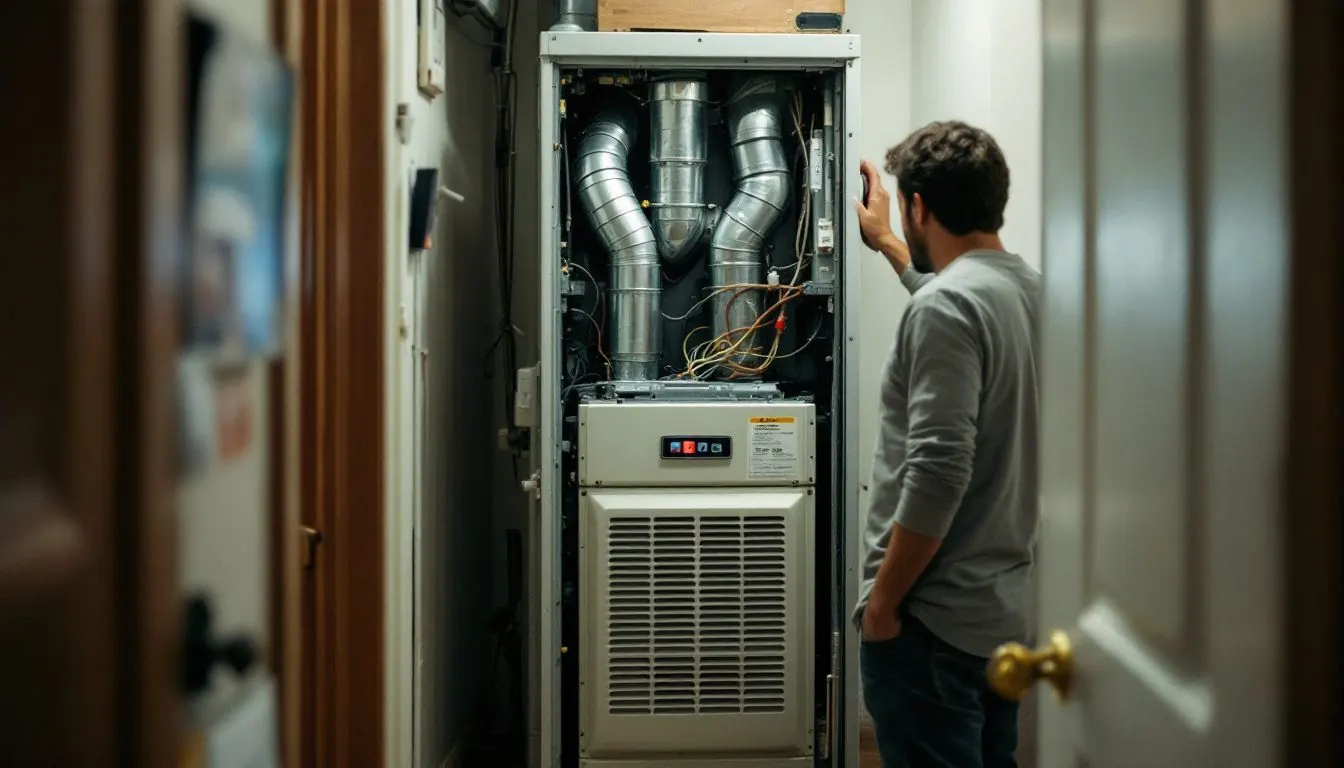
An electric furnace not heating has two branches. If the blower runs but the air is cool or lukewarm, some or all heating elements are not switching on: a second breaker off, a dead sequencer stage, an open limit or element. If nothing runs at all, line power or the 24 volt control circuit is missing.
Raise the setpoint, then stand at the furnace for 4 minutes before judging anything. Resideo’s R8330D sequencer instructions tell technicians to “allow at least 4 minutes per sequencer for elements to sequence on and off,” so cool air in the first minute is normal on a healthy unit (Resideo 60-0327).
Which of three symptoms does your electric furnace show after 4 minutes?
Nothing running, a blower moving cool air, or a blower moving lukewarm air. Each isolates a different part of the 240 V and 24 V circuits.
| What you see | Most likely cause | What you can check | What the technician measures |
|---|---|---|---|
| Nothing runs, thermostat reads HEAT | A breaker off, or door not latched | Furnace breakers in the panel and cabinet; door latched | 240 V at the unit; 24 V at R and C |
| Nothing runs, breakers all on | Transformer, its fuse, or the first sequencer | Thermostat mode and setpoint | Transformer secondary 22 to 28 V; control fuse; Rh to W1 jumper test |
| Blower runs, air at room temperature | No element energized: W1, first sequencer, limit or fuse link | Fan switch on AUTO; filter; return grilles clear | 24 V at W1; sequencer heater ohms; limit continuity |
| Blower runs, air lukewarm | Second circuit, later stage, W2 or one element | Second breaker; whether the thermostat is single stage | Current on each element circuit; element continuity |
| Heat in short bursts, then cool air | Limit opening on high temperature | Filter, closed registers, blocked return | Limit continuity after a 5 to 10 minute cool down |
Compiled by The HVAC Brief from the Nordyne E2 service manual, the Nordyne E3 owner’s manual, Resideo 60-0327 and the Johnson Controls EBE/EUE manual. Technician checks involve 240 V.
Why does an electric furnace blow lukewarm air when one of two breakers trips?
Because larger electric furnaces take two 240 V circuits and the blower sits on only one. Trip the other and the fan keeps running while part of the element bank goes cold.
Johnson Controls says its EBE/EUE 15, 17, 20 and 23 models “can be connected to a single or dual branch circuit” and ship “set up for dual power supply connections” (Johnson Controls 5396713-BIM-E-0720). The cabinets carry “either one or two 60 amp circuit breakers” of their own, so one furnace can have four breaker handles: two in the panel, two on the unit. Check all four.
| Unit (element rating) | Circuit 1 load | Circuit 2 load | Element heat left if circuit 2 is off |
|---|---|---|---|
| Johnson Controls EBE15A (14.4 kW) | 43.8 A | 20.0 A | 67% |
| Johnson Controls EBE17A (16.0 kW) | 47.1 A | 23.3 A | 65% |
| Johnson Controls EBE20A (19.2 kW) | 43.8 A | 40.0 A | 50% |
| Johnson Controls EBE23A (21.6 kW) | 47.1 A | 46.7 A | 48% |
| Goodman HKSC15XB heat kit, 240 V | 40 A | 20 A | 67% |
| Goodman HKSC19CB heat kit, 240 V | 40 A | 40 A | 50% |
HVAC Brief calculation from Johnson Controls 5396713-BIM-E-0720 Tables 2 and 4 and Goodman GARUF heat kit data: circuit 1 minus the 3.8 A maximum motor amps on the wiring label, divided by total element amps.
On the 20 kW model the 3.8 A gap between the circuits equals the blower’s maximum motor amps, so if circuit 1 trips instead, expect no airflow at all. Reset a tripped breaker once. OSHA’s workplace rule at 29 CFR 1910.334(b)(2) prohibits “the repetitive manual reclosing of circuit breakers”; a second trip belongs in our guide to why an HVAC breaker keeps tripping.
Stop line. Johnson Controls’ label warns that the furnace “may be connected to more than one power supply,” and its manual says homeowners “should never perform any maintenance which requires opening electric box door.” Breakers, door latch, filter and thermostat are yours; anything behind the control cover is 240 V technician work.
Can a single-stage thermostat leave half the elements off?
Yes. On a staged furnace the later elements wait for a second-stage signal, W2. Resideo’s R8330D procedure tells the technician that if an element is not energized, “check to see that second stage of thermostat is operating (or that R to W2 is jumpered for single stage thermostat).”
In Carrier’s KFFEH line the 3 to 10 kW heaters are single stage only, while the 18 to 30 kW heaters can run 3 stages (Carrier KFFEH). A single-stage thermostat on a furnace expecting W1 and W2, with no jumper, runs the first stage only: fine on a mild day, short on the coldest nights. If every element proves out, the question is capacity: see the furnace running but the house not warming up.
How does a failed sequencer stop an electric furnace from heating?
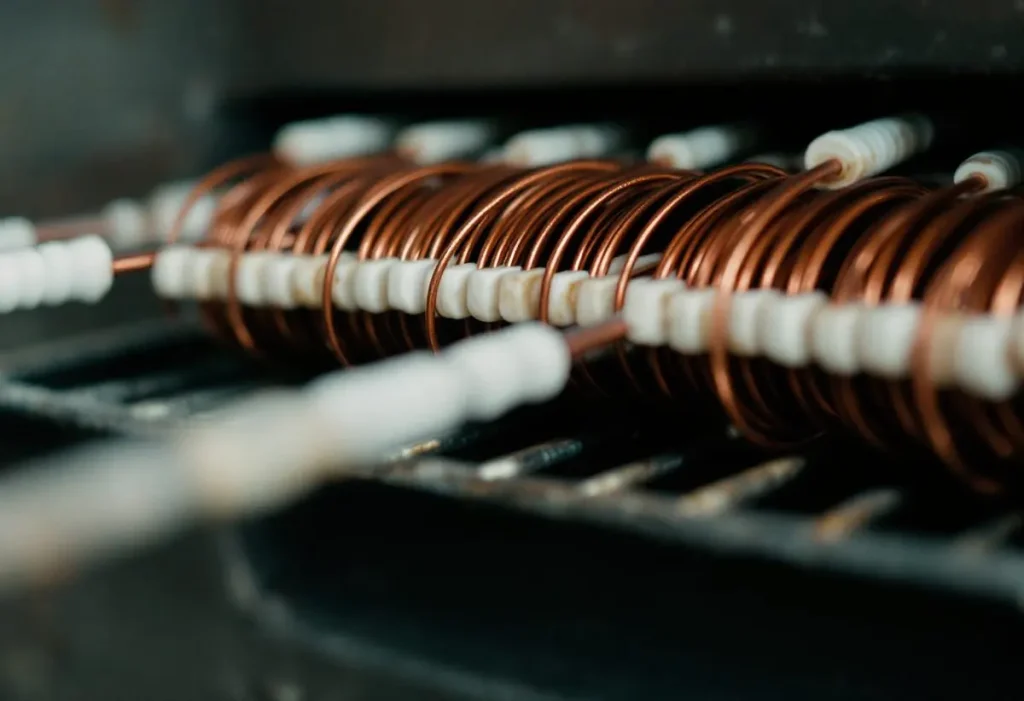
A sequencer is a heat-operated relay that closes its contacts one after another; when it fails, its elements never come on. Resideo’s R8330D “switches a fan and up to 3 heating elements”. Its timing is “10 seconds minimum between stages,” with all stages on “within 2 minutes” and off “within 4 minutes.”
Which stage dies decides the symptom. Resideo’s checkout says the fan “starts with first element on,” so a dead first sequencer looks like the nothing-runs branch; a dead second or third leaves the fan running and the air lukewarm. The R8330 “is not field repairable.”
Nordyne’s E2 service manual gives the test values: the bimetal heater should read “70 to 90 ohms,” the contacts get “a maximum time (110 seconds)” to close, and any contact still open “after three minutes” means it is defective (Nordyne E2, InspectApedia copy). Carrier’s KFFEH kits use a relay per element instead, bringing the second stage on about 5 seconds after the first.
What do the limit switch and fuse link do when airflow drops?
They cut the elements when the cabinet overheats, usually from poor airflow. Nordyne’s E2 manual says its limits open the element circuit on overheating “caused by air circulator failure, dirty filters, lack of return air, restricted ducts,” and that “all limit switches used are of the automatic reset type,” closing again as they cool.
The DOE agrees: the limit controller “may shut the furnace off if the blower fails or if a dirty filter is blocking the airflow” (DOE Energy Saver, archived copy). Goodman lists a “fuse link secondary high-temperature limit control” on its HKR, HKA, HKP and HKS heat kits (Goodman heat kit specifications). A melted fuse link does not close again; it is replaced, after the technician finds why the primary limit did not stop the overheating.
Is low voltage or a burned element why it is not heating well?
Either cuts output while the blower runs normally. An open element stops heating; 208 V instead of 240 V weakens every element, because resistance heat falls with the square of the voltage.
| One 5 kW element | At 240 V | At 208 V |
|---|---|---|
| Current | 20.8 A | 18.1 A |
| Resistance (fixed) | 11.52 ohms | 11.52 ohms |
| Heat output | 5,000 W | 3,756 W (75%) |
| Btu per hour | 17,060 | 12,814 |
HVAC Brief calculation: amps = watts ÷ volts; resistance = 240² ÷ 5,000; output at 208 V = 208² ÷ 11.52; 3,412 Btu per kWh. Johnson Controls rates its EBE15A at 15.0 kW on 240 V and 12.6 kW on 220 V, the same square law.
The DOE says electric furnace elements are “typically rated at five kilowatts,” three to seven per furnace. Goodman’s data puts its HKSX05XC kit at 20 A on 240 V. A technician clamps each element circuit; zero current with the sequencer contact closed points at the element or its limit, and Nordyne requires “an identical kW replacement.” Sizing belongs to our explainer on how an electric furnace stages its elements.
Why won’t my electric furnace turn on at all?
Either 240 volt power is not reaching the cabinet or the 24 volt control circuit is dead. Nordyne’s E3 owner’s manual lists the owner checks: thermostat set above room temperature on HEAT, the household panel disconnects on, the furnace breakers on, the door “closed and properly latched,” and the blower and relay plugs seated (Nordyne E3 owner’s manual).
Next the technician tests the transformer: Nordyne’s E2 secondary “should read 22 to 28 volts,” and Resideo accepts 24 V within 10 percent. On Carrier’s KFFEH heaters the secondary “is protected by a 5A fuse mounted on PCB.” Our HVAC transformer guide covers why they fail; if the heat call never arrives, see thermostat says heat on but no heat.
Frequently asked questions
How do I reset my electric furnace?
Most electric furnaces have no reset button. Nordyne says its element limits are the automatic reset type and close again as they cool. The practical reset is the breakers: switch the furnace breakers in the panel and on the cabinet off, then on, once. If one trips again, stop; OSHA prohibits repetitive manual reclosing of breakers in workplaces.
Why is my electric furnace not igniting?
An electric furnace has nothing to ignite. The DOE describes three to seven resistance elements, typically rated at five kilowatts each, switched on in stages. The step that replaces ignition is the first sequencer or relay closing; on a Resideo R8330D every stage is on within 2 minutes. If nothing happens after 4 minutes, follow the nothing-runs branch above.
Can a dirty filter stop an electric furnace from heating?
Yes. The DOE says the limit controller may shut the furnace off if a dirty filter is blocking the airflow, and Nordyne lists dirty filters, lack of return air and restricted ducts among the causes of a limit opening. Nordyne’s E3 manual puts filter replacement under regular maintenance and again before each heating season.
Electric furnace or heat pump: why does my electric HVAC blow cool air?
If an outdoor unit runs in winter, it is a heat pump air handler and the elements are backup. Johnson Controls ships its EBE/EUE furnaces “A/C or Heat Pump ready,” so the cabinets look alike. Cooler supply air is normal for a heat pump blowing cold air in heat mode; the strips run only on an AUX or EM call, explained in auxiliary heat vs emergency heat.
How we researched this
On November 19, 2026 we read the nine documents listed below; breaker shares and element figures are our arithmetic, shown under each table. Today’s top results (forum threads and a contractor blog) supplied no figures. The Nortek E7EB manual could not be retrieved and is excluded. No lifespan figure appears because no document we opened states one.
Sources
- Johnson Controls. “Installation Manual, Electric Furnace Models EBE*/EUE*, 5396713-BIM-E-0720.” https://www.yorknow.com/pub/media/documentation/EBE_EUE_Installation.pdf. Accessed November 2026.
- Resideo. “R8330D Electric Furnace Sequencer, 60-0327.” https://customer.resideo.com/resources/Techlit/TechLitDocuments/60-0000s/60-0327.pdf. Accessed November 2026.
- Nordyne. “E2 Series Electric Furnaces Service Manual” (copy hosted by InspectApedia). https://inspectapedia.com/heat/Nordyne-Electric-Furnace-Manual-E2.pdf. Accessed November 2026.
- Nordyne. “E3 Series Downflow, Upflow Electric Furnaces Owners Manual/Installation Instructions.” https://cdn.shopify.com/s/files/1/1071/8320/files/E3install.pdf. Accessed November 2026.
- Goodman. “HKR/HKA/HKP/HKS Electric Heat Kits for Air Handlers and Packaged Electric Units.” https://gotductless.com/cdn/shop/files/HKSX_Heat_Kit_Specs.pdf. Accessed November 2026.
- Goodman. “GARUF Specification Sheet, Heat Kit Data.” https://apps.goodmanmfg.com/brochures/files/60d0ca194e60dSS-GARUF.pdf. Accessed November 2026.
- Carrier. “KFFEH Electric Heater Packages Installation Instructions.” https://s3.amazonaws.com/s3.supplyhouse.com/product_files/Carrier-KFFEH0401N03-Install-Instructions.pdf. Accessed November 2026.
- US Department of Energy, Energy Saver. “Electric Resistance Heating” (archived copy). https://web.archive.org/web/2025id_/https://www.energy.gov/energysaver/electric-resistance-heating. Accessed November 2026.
- eCFR. “29 CFR 1910.334, Use of equipment.” https://www.ecfr.gov/current/title-29/section-1910.334. Accessed November 2026.
Leave a Reply