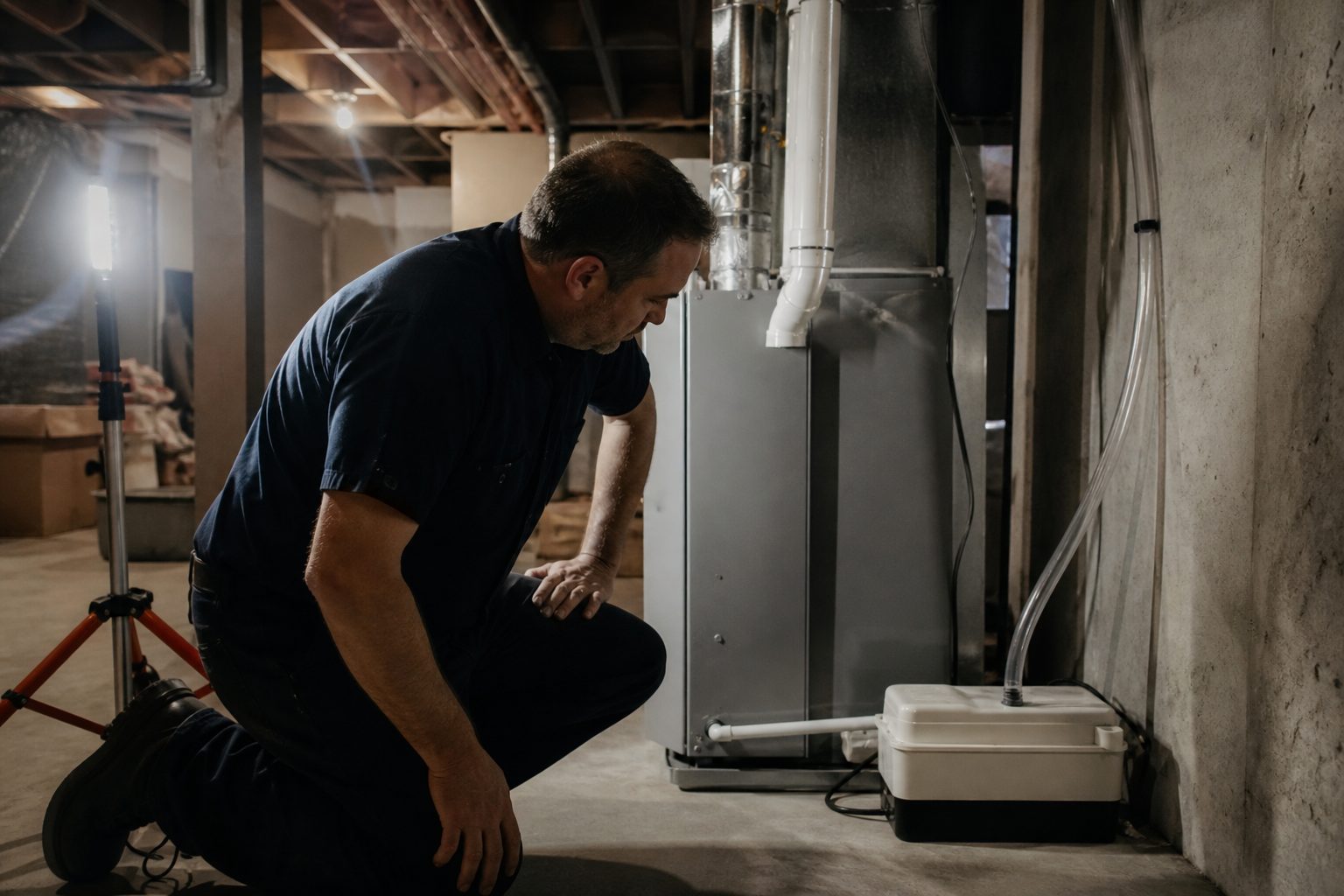
What is a condensate pump? A condensate pump is a small reservoir, float switch and impeller that lifts the water your cooling or condensing heating equipment produces up to a drain when gravity cannot carry it there.
Key Takeaways
- A condensate pump is used “when a gravity drain is impractical or impossible to install,” per the DOE Building America Solution Center.
- Condensing boiler condensate is “highly acidic (pH of 2),” and condensing furnace condensate is pH 3 or below, per two Building America guides.
- The International Residential Code, as restated by Building America, says condensate “shall not discharge into a street, alley, or other area where it would cause a nuisance.”
- 88% of US households used air conditioning in 2020, from 18,496 responding homes in the EIA RECS.
- Gas furnaces must reach 95% AFUE from December 18, 2028, a DOE rule putting more homes on acidic condensate.
- DOE Energy Saver tells owners to “clear the unit’s drain channels periodically with a stiff wire to prevent clogs.”
Why does cooling equipment make water at all?
Because cold metal pulls moisture out of indoor air. As air passes over the evaporator coil, Building America says, “its temperature is lowered below the saturation point,” and “the moisture condenses out and falls as liquid into a collector under the coil.”
That collector is the primary drain pan. Dehumidification is half of what an air conditioner does, which is why an oversized system leaves a house cool and clammy.
A second source appears in winter. A condensing furnace or boiler cools its flue gases enough that exhaust water vapor turns liquid inside the heat exchanger and vent. That water is acidic, and it arrives when the cooling drain sits dry. If water is showing up around the furnace itself, our furnace leaking water guide sorts the causes by season and furnace type.
When do you need a condensate pump instead of a gravity drain?
When the water has nowhere to fall. Building America states that a condensate pump “is used when a gravity drain is impractical or impossible to install,” and names the common cases: “some basement-installed systems or where cooling has been added to an existing heating system located within the interior walls of a slab-foundation home.”
Three cases cover most homes. Equipment sits below the nearest drain, as with a basement air handler on a slab floor. No drain is within reach, as in many attics. Or the unit is a head on an interior wall, which is why ductless head placement often decides it.
| Drain route | When it applies | What it needs |
|---|---|---|
| Gravity drain | Pan above an approved drain, continuous fall | Trap, cleanout, 3/4 inch pipe, 1/8 inch per foot fall (IRC, via Building America) |
| Condensate pump, cooling duty | Basement or attic equipment, mini split heads | Reservoir, float switch, check valve, safety switch wired to the equipment |
| Condensate pump, acid duty | Condensing furnace or boiler, no gravity path | Pump the maker lists for acidic condensate, sited downstream of a neutraliser |
How does a condensate pump work?
Water drains from the pan into a reservoir. A float rises with it, closes a switch, and an impeller pushes the water out through small tubing to a drain. A check valve holds the column of water in the discharge line so it does not run back when the motor stops.
The safety switch is the part most owners never think about. Building America: “should the pump fail or should the discharge line become blocked, a second switch will open a low-voltage circuit that shuts down the air conditioner.” A dead condensate pump often shows up as cooling that stops.
Why does a condensing furnace or boiler need a different condensate pump?
Because that water is acid. The Building America guide to condensing boilers states that “this condensate water is highly acidic (pH of 2),” and its combustion furnaces guide puts furnace condensate at pH 3 or below. Cooling condensate is far closer to neutral, so the two duties are not interchangeable.
The treatment is a neutraliser: a cartridge of calcium carbonate media the condensate passes through first. Building America says jurisdictions may require “a neutralizer containing calcium carbonate or a similar material to raise its pH before disposal,” adding that “such pretreatment is recommended whether required by code or not.”
So the pump on this duty should be a model the maker lists for acidic condensate, and the neutraliser normally sits upstream of it. That matters to anyone planning a condensing boiler swap or a furnace replacement before the 95% AFUE standard that DOE finalised in 2023.
The myth worth correcting
A condensate pump is not a filter and not a neutraliser. It moves water. On a condensing appliance the acid is still acid after the pump, and the neutralising media is a separate device that is spent after a time. Untreated condensate in a steel drain shows up years later as a corroded pipe.
Where is condensate allowed to discharge?
To an approved point of disposal, never where it creates a nuisance. Building America quotes the International Residential Code: “condensate shall not discharge into a street, alley, or other area where it would cause a nuisance.” Many homes discharge outside near the foundation, with a splash pan.
The same guide covers the line. The drain pipe “should not be less than 3/4 inches in diameter,” must not narrow downstream, and should be pitched toward the discharge point, with the code allowing 1/8 inch per foot. Permitted IRC materials include PVC, CPVC, ABS, copper and galvanized steel.
Tying the line into household plumbing is a local question. Building America says to “follow local codes to determine the acceptability of directing the condensate drains into the domestic plumbing system.” A shared connection should include a backflow prevention valve.
What goes wrong with a condensate pump?
Five faults account for most calls. A pump is a wet, warm plastic box with a motor in it, so biological growth and wear both apply.
| Failure | What the owner sees | What is happening |
|---|---|---|
| Biofilm in reservoir and line | Cooling stops on a humid day, or water appears under the unit | Slime restricts the outlet or jams the float; DOE warns clogged drains can stop equipment or overflow |
| Stuck float switch | Pump never runs, or runs constantly | Float hangs on scale or debris and never signals the motor |
| Failed check valve | Pump short cycles, clicking on and off | Discharge water runs back into the tank after each cycle |
| Frozen discharge line | Heating stops in a cold snap | Outdoor run freezes; Building America says to protect it with insulation or heat tape |
| Wrong lift or wrong duty | Pump runs but water still backs up | Required lift exceeds the model rating, or a cooling pump is on acidic condensate |
Water at the indoor unit has other causes, and the symptom map for a leaking or warm blowing air conditioner separates a pump fault from a frozen coil. On ductless equipment, deep cleaning a mini split often fixes drainage complaints.
What does condensate pump maintenance actually involve?
Keeping the water path clear. DOE Energy Saver, in an archived copy of its air conditioner maintenance page, tells owners to “clear the unit’s drain channels periodically with a stiff wire to prevent clogs,” and warns that clogged drains can shut the equipment off or cause water damage.
The vinegar question deserves a careful answer. No federal source we found endorses pouring vinegar, bleach or tablets into a condensate pump reservoir, and none forbids it. What is documented is that the reservoir, float and line must stay clear. Bleach attacks metal parts, and some makers void warranty coverage over it. Slow release tablets are a trade convention, not a tested standard.
The defensible position is mechanical. Clear the line, flush the reservoir with clean water, and treat any chemical as a question for the maker. A seasonal visit should include the drain, which is why the contents of a real tune up matter, as does the autumn furnace checklist.
What should you check before calling about a condensate pump?
Four checks, all outside the cabinet. None involve opening an electrical enclosure, touching refrigerant lines or working on a combustion appliance.
- Look at the reservoir. A full tank while the equipment is off points at the pump, float or discharge line, not the coil.
- Follow the discharge tube to its end point. A kink, a loose fitting or a winter ice plug at an outdoor termination is visible without tools.
- Check whether the equipment shut itself off rather than failed. A system that will not start on a humid day, with water in the pan, is doing what the safety switch is meant to make it do.
- Note the season. Water only in winter points at a condensing furnace or boiler, not the cooling side of a central system.
Beyond that, stop. Wiring a safety switch, sizing a pump for the lift required, and anything touching a combustion appliance belongs to a licensed contractor working to local code. A standalone dehumidifier with its own pump follows the same rule.
How we researched this
Research date September 2026. Cited: DOE Building America guides on condensate drain pans, combustion furnaces and condensing boilers, which restate International Residential Code language because codes.iccsafe.org blocks automated fetches; EIA 2020 RECS; the DOE furnace standards final rule; and an archived DOE Energy Saver maintenance page. Excluded: contractor blogs, which carried no traceable figures, and all installed prices, because no federal or national lab source publishes one here. One manufacturer specification supplies pump lift and tank size, labelled as such. Reddit was not mined, because the topic touches combustion appliances.
Frequently asked questions
How long does a condensate pump last?
No federal source publishes a service life. What is documented is the wear path: Building America notes dirty, poorly draining pans “can be breeding grounds for bacteria,” and reservoir biofilm fouls floats and outlets.
Why did my air conditioner stop instead of leaking?
That is the safety switch. Building America says that if the pump fails or the discharge blocks, “a second switch will open a low-voltage circuit that shuts down the air conditioner.” Lost cooling is the designed outcome.
Can I pour vinegar into a condensate pump?
No federal guidance endorses or forbids it. DOE Energy Saver only says to clear drain channels “periodically with a stiff wire to prevent clogs.” Bleach is riskier around metal parts, and some makers exclude chemical damage from warranty.
Does a condensing furnace need a special pump?
It needs one rated for the duty. Building America puts condensing boiler condensate at “pH of 2” and furnace condensate at pH 3 or below, and recommends neutralising “whether required by code or not.”
Where can condensate legally discharge?
To an approved point of disposal. The International Residential Code, as restated by Building America, says condensate “shall not discharge into a street, alley, or other area where it would cause a nuisance.” Sewer rules are local.
How high can a condensate pump lift water?
It depends on the model. Little Giant lists its VCMA-20 series at 80 gallons per hour at 1 foot of head and a 20 foot maximum lift on 115 volts, a manufacturer claim.
Why does the discharge line freeze in winter?
Because condensing appliances make condensate in the heating season, and an outdoor run of small tubing holds little water. Building America: “if condensate is drained to outdoors then protect the drain from freezing by either insulation or heat tape.”
Sources
- DOE Building America. “HVAC has Corrosion-Resistant Condensate Drain Pan.” https://basc.pnnl.gov/resource-guides/hvac-has-corrosion-resistant-condensate-drain-pan. Accessed September 2026.
- DOE Building America. “Combustion Furnaces.” https://basc.pnnl.gov/resource-guides/combustion-furnaces. Accessed September 2026.
- DOE Building America. “Condensing Boilers.” https://basc.pnnl.gov/resource-guides/condensing-boilers. Accessed September 2026.
- EIA. “Nearly 90% of U.S. households used air conditioning in 2020.” https://www.eia.gov/todayinenergy/detail.php?id=52558. Accessed September 2026.
- US Department of Energy. “DOE Finalizes Efficiency Standards for Residential Furnaces.” https://www.energy.gov/articles/doe-finalizes-energy-efficiency-standards-residential-furnaces-save-americans-15-billion. Accessed September 2026.
- DOE Energy Saver. “Air Conditioner Maintenance.” Archived copy, https://web.archive.org/web/2025id_/https://www.energy.gov/energysaver/air-conditioner-maintenance. Accessed September 2026.
- Little Giant. “VCMA-20 Series Condensate Pump,” product page on littlegiant.com, VCMA and VCMX series. Manufacturer claim. Accessed September 2026.
Leave a Reply