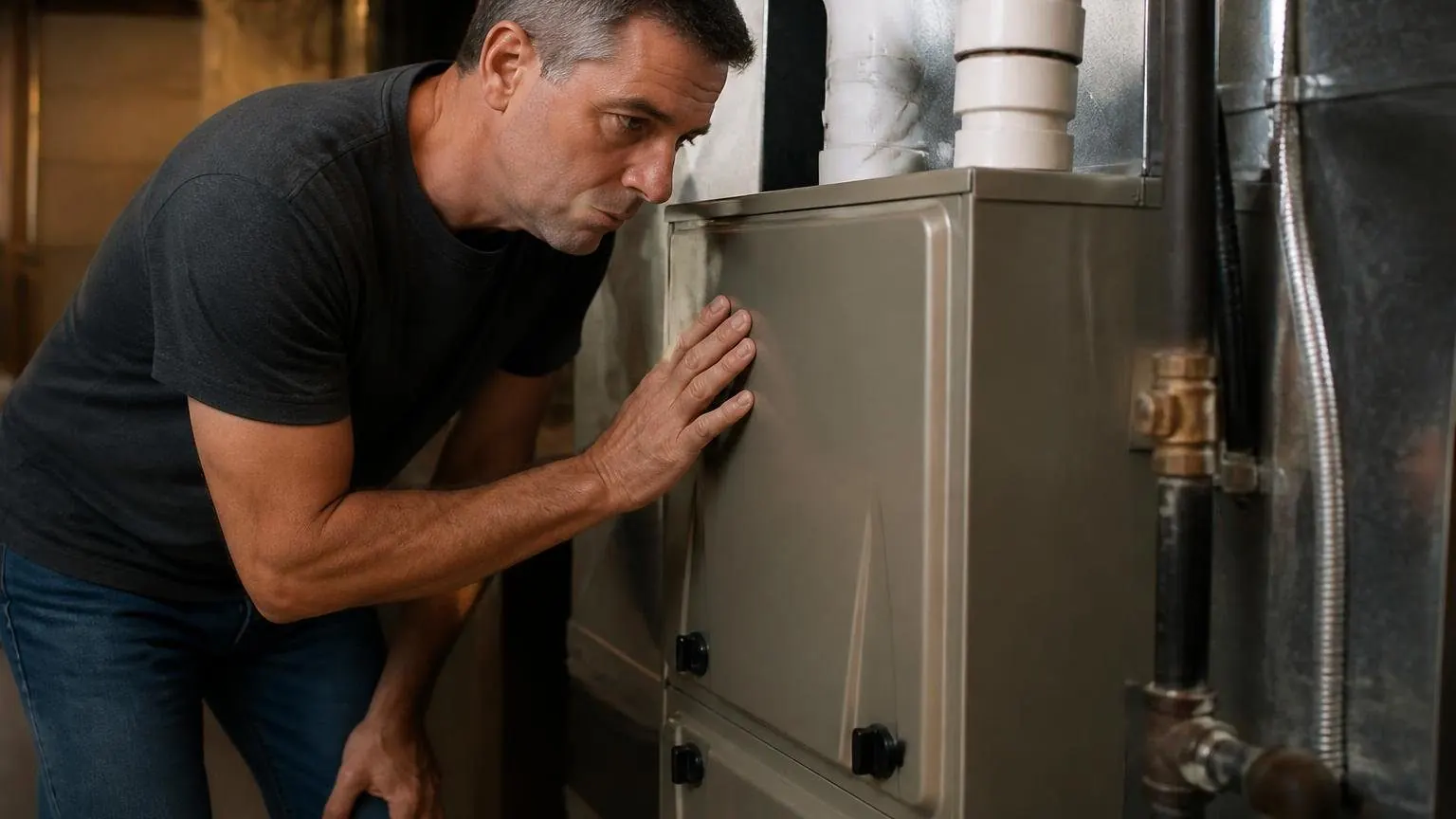
A furnace whooshing noise is normal when you hear one soft whoosh as the burners light, a few seconds after the small inducer fan starts, and a rush of air from the vents about 30 seconds later when the blower comes on. A loud whoomp at lighting, or a hiss with the burners off, is not normal.
Time the sound against the furnace’s own sequence. Goodman’s service manual RS6610004 prints the order for its White-Rodgers 50A55 and 50M56 controls, and every whoosh a gas furnace makes belongs to one step of it.
| Seconds from gas valve opening | What the furnace is doing | What you hear | Normal? |
|---|---|---|---|
| Before 0 (15 s prepurge on 50M56) | Inducer clears the heat exchanger; igniter heats for 5 to 17 s on 50A55 | Steady whir or air rush at the flue pipe, no flame | Yes |
| 0 to 4 s | Gas valve opens; flame must be sensed within 4 s | One soft whoosh, then a steady burner rumble | Yes, if soft |
| 0 to 4 s, loud | Gas lit late after collecting in the burner box | A whoomp, boom or bang | No: shut down |
| 30 s | Circulator blower starts on heat speed | Air rushing out of every register | Yes, unless it roars or puffs |
| 300 or 600 s | Two-stage furnace on a single-stage thermostat steps up to high fire | A second, bigger burner and air sound | Yes |
| 4, 58 and 112 s, then quiet | No flame proven: 30 s purge, 20 s preheat, retry, three trials, lockout | Inducer whoosh repeating with no heat | No: ignition fault |
| Call ends | Gas off; inducer runs a 15 s post purge; blower runs 90 to 180 s | Burner sound stops, air keeps flowing | Yes |
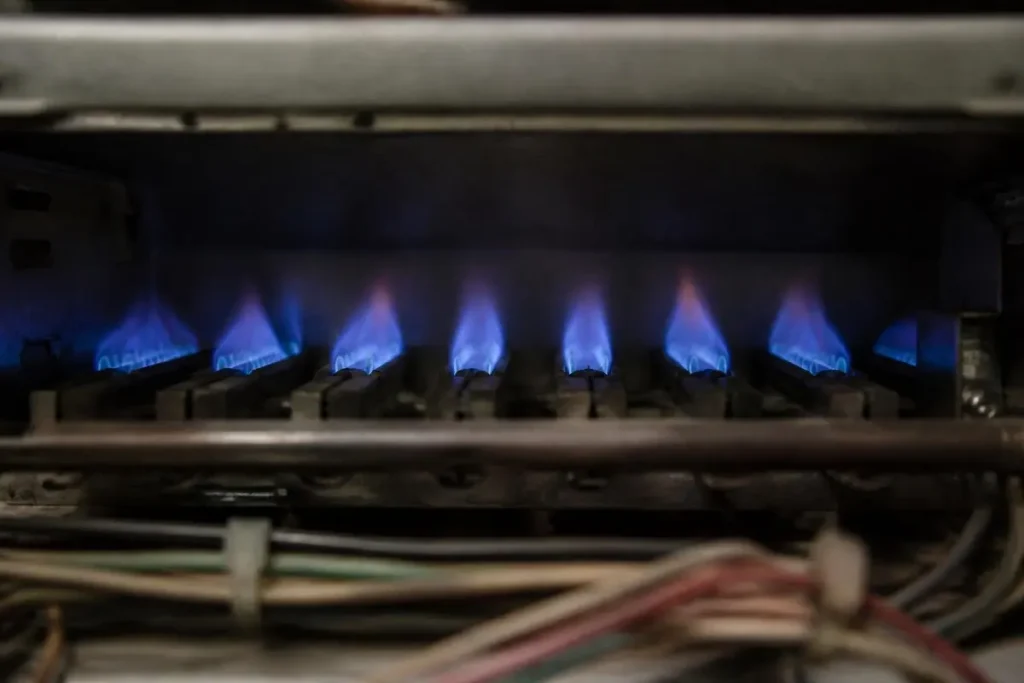
Is the whoosh when the burners light normal, or is it delayed ignition?
A single soft whoosh at lighting is normal; a loud one is the fault Carrier’s owner’s manual names. Carrier’s OM58-131 manual for its induced combustion furnaces says buildups on the main burners “can cause faulty firing” and that this “delayed ignition” is “characterized by an alarmingly loud sound.” If the furnace makes a loud noise when the main burners light, the manual says to “shut down the furnace and call your servicing dealer” (Carrier OM58-131).
The difference is how much gas is waiting. On the Goodman 50A55 sequence the control expects a flame signal within 4 seconds of opening the gas valve, so gas that lights on time makes a short whoosh across the burner ports. Gas that lights late has filled the burner box first. Our page on a furnace bang at start-up works through dirty burners, a weak igniter and low gas pressure.
Two-stage furnaces light louder by design. On Goodman’s 50M56 two-stage control, both the low and high stage gas valves open at ignition and the high stage valve “closes after five seconds,” so a two-stage unit lights with a full-fire whoosh that settles within 5 seconds.
Why does the furnace whoosh before any flame, then again and again with no heat?
The first whoosh of every heat call is the inducer, not gas. On the 50M56 control the induced draft blower runs a “15 second prepurge period causing pressure switch contacts to close,” and only then does the igniter start; on the 50A55 the igniter warms for between 5 and 17 seconds before gas flows. So 15 seconds or more of fan noise with no flame is the furnace working as designed. The start-up order for a gas furnace shows what you should see at each step.
Repeating whooshes with no heat mean the flame is not being proven. For the White-Rodgers 50A65 control in Amana single-stage furnaces, Goodman’s manual describes a 30 second inducer purge and a 20 second igniter preheat after each failed trial, three trials in all, then lockout with one short flash. We calculated the timing: each 4 second trial fails at 4, 58 and 112 seconds after the first gas valve opening, then the furnace goes quiet. The board “will automatically reset one hour after lockout occurs.” If you hear clicks but never the whoosh, the clicking but not lighting checklist starts at the igniter.
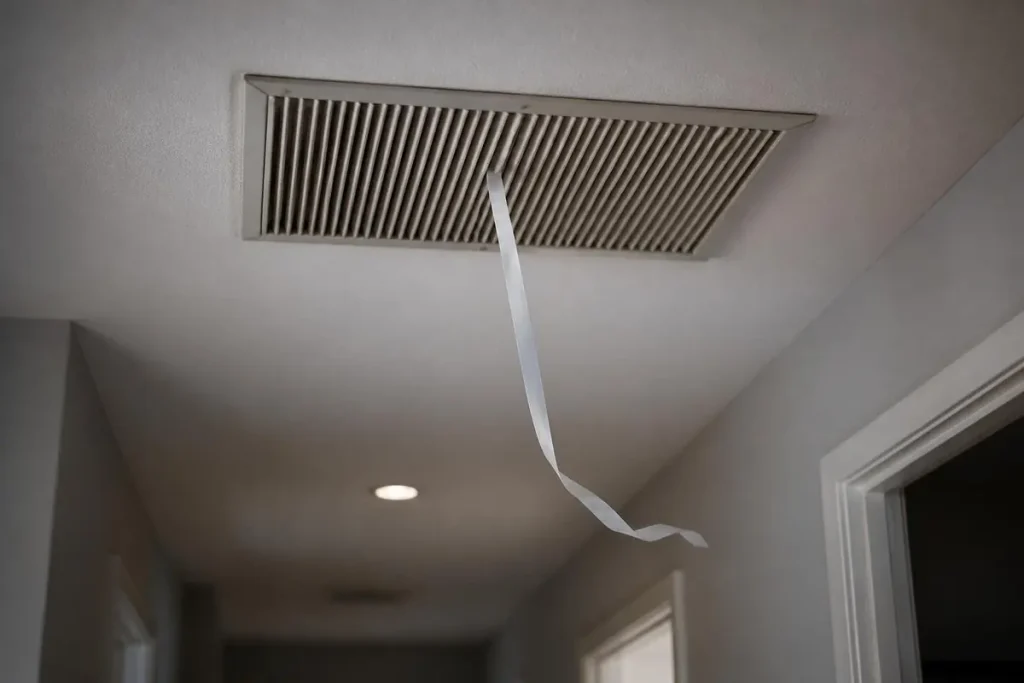
Why is there a loud whoosh of air from the vents 30 seconds after the flame?
That rush is the circulator blower, and on the 50A55 sequence it starts after a “fixed thirty (30) second blower on delay.” Some air noise at every register is normal. Goodman’s own variable-speed blowers “ramp up and down at the beginning or end of a cycle to reduce air rush noise,” which is why an older single-speed blower that jumps straight to full speed sounds more abrupt.
A whoosh that roars, or that grew louder after a new furnace went in, points at static pressure. Goodman’s troubleshooting chart in RS6610004 lists four causes of “Air noise”: “High static creating high blower speed,” “Incorrect supply or return ductwork,” “Incorrect or dirty filter(s)” and “Incorrect blower speed setting.” A new furnace can sound worse on old ducts: Goodman’s constant-airflow motor raises RPM “as the static increases,” and “in some undersized duct installations this may cause noise or high airflow complaints.” For a blower that “puffs” at high speed, Goodman’s test is: “Does removing panel or filter reduce ‘puffing’?”
In John Proctor’s ASHRAE Journal column on 34 California split systems with furnaces, the common residential furnace rating point is 0.50 in. w.c., and “None of the systems had an external static pressure of 0.50 in. w.c. (125 Pa) or less.” Proctor found the most common airflow problem was on the return side. Our guide to static pressure covers the fixes in cost order.
Why does a two-stage furnace whoosh again 5 or 10 minutes into the cycle?
Because it is stepping up from low fire to high fire on a timer. Goodman’s manual says a single-stage thermostat on a two-stage furnace gives “a timed transition from low to high fire,” and the furnace runs on low “for a fixed period of time before stepping up,” set to 5 or 10 minutes by DIP switch 3. When it shifts, the 50M56 control energizes the high stage gas valve and the blower’s high heat speed together, so both the burner and the vent airflow get louder at once, 300 or 600 seconds into the low-fire run.
Is a hiss or whoosh with the burners off a gas leak?
It can be, and it is the one whoosh with no safe waiting period. The South Dakota Public Utilities Commission lists “hissing, whistling or roaring noise” as a gas meter red flag and says to “get out of the house, go somewhere safe and call for help” (SD PUC). Peoples Gas also names “an unusual hissing noise” as a leak sign alongside the added rotten egg odor.
Stop line. If the furnace is between cycles (no inducer, no flame, no blower) and you hear a hiss at the gas pipe, valve or meter, do not reset or relight anything. Carrier’s OM58-131 label reads: do not try to light any appliance, do not touch any electrical switch, leave the building immediately and call your gas supplier from a nearby phone.
A hiss that comes with a smell has its own order of steps in our page on a furnace that smells like gas. A hiss that is really a high whistle at a filter slot or register belongs to the furnace whistling noise decoder, which sizes return grilles against blower airflow.
Is the whoosh coming from an outdoor heat pump instead of the furnace?
On a dual-fuel or heat pump system, a whoosh outdoors with the outdoor fan stopped and steam rising is the defrost cycle. The reversing valve shifts into defrost and back out, which our page on a heat pump making loud noise in cold weather times against Copeland, Carrier and Rheem documents.
What will a technician measure on a furnace that whooshes too loudly?
Gas pressure, static pressure and the ignition timing. For the Goodman R9T96 and D9T96 furnaces, installation manual IOG-2038E sets natural gas supply pressure between 4.5″ w.c. minimum and 10.0″ w.c. maximum and a high stage manifold pressure of 3.5″ w.c., read with the burners firing.
For air noise, the same manual has the technician read return static (its example: -.1″ w.c.) and supply static (.3″ w.c.) and add them for total external static (.4″ w.c. in the example). If the total exceeds the maximum on the rating plate, it says to “check for closed dampers, registers, undersized and/or oversized poorly laid out duct work.” It also warns against “highly restrictive 1″ filters which produce static pressure loss greater than .25″ W.C.” For the burner side, the technician inspects the burners for the dirt, rust or scale that Carrier’s OM58-131 tells owners to look for before each heating season. A broader map of rattles, squeals and hums is in our HVAC noises chart.
Frequently asked questions
Should a furnace make noise?
Yes, some. A gas furnace normally makes an inducer whir, one soft whoosh at lighting and an air rush when the blower starts, which Goodman’s 50A55 sequence delays a fixed 30 seconds after the gas valve opens. Goodman even ramps its variable-speed blowers up and down to reduce air rush noise. Loud bangs, grinding or a hiss with the burners off are not part of a normal cycle.
Why is my HVAC making a whooshing noise?
With the heat on, it is usually the burners lighting or the blower pushing air. If the air whoosh is loud, Goodman’s RS6610004 troubleshooting chart lists high static, wrong supply or return ductwork, a dirty or wrong filter and the blower speed setting. Its IOG-2038E manual warns against 1 inch filters with a static loss greater than .25″ W.C.
What does a furnace sound like when it’s going out?
The noise signs that point to a failing part are a lighting sound that turns into a bang, which Carrier calls an alarmingly loud sound, and an inducer that keeps cycling with no flame. On Amana’s White-Rodgers 50A65 control that retry pattern ends in lockout after three trials, with one short LED flash, and the board resets itself one hour later.
When should you worry about a furnace whooshing sound?
Worry about three versions: a loud whoomp when the burners light, a hiss or roar near the gas pipe or meter with the furnace off, and air noise with puffing that started after new equipment. The South Dakota PUC lists hissing, whistling or roaring noise as a gas red flag and tells people to get out and call for help.
How we researched this
We read Goodman service manual RS6610004 Rev. 9 (November 2009) for the White-Rodgers 50A55, 50M56 and 50A65 sequences and air-noise chart, Goodman IOG-2038E, Carrier OM58-131, Proctor’s October 2012 ASHRAE Journal column and leak guidance from the South Dakota PUC and Peoples Gas. Timings in the table are arithmetic on those published delays (fwh-calc.py). We excluded the contractor blogs and Q&A threads ranking today: none cite a maker document. Research date: November 26, 2026.
Sources
- Goodman Manufacturing. “Service Instructions, 80%, 90%, 95% Gas Furnaces and Accessories, RS6610004 Rev. 9.” https://s3.amazonaws.com/s3.supplyhouse.com/product_files/Goodman-GMS951155DXA-Install-Instructions.pdf. Accessed November 2026.
- Goodman Manufacturing. “*R9T96 and *D9T96 Installation Instructions, IOG-2038E.” https://mobile.goodmanmfg.com/mobileapp/stellent/pdf/infoPdf/Lit/IOG-2038E.pdf. Accessed November 2026.
- Carrier Corporation. “Induced Combustion Gas Furnace Owner’s Manual, OM58-131.” https://www.shareddocs.com/hvac/docs/1009/Public/01/OM58-131.pdf. Accessed November 2026.
- Proctor, John. “Residential AC Filters.” ASHRAE Journal, October 2012. https://mail.proctoreng.com/dnld/ASHRAE2012.pdf. Accessed November 2026.
- South Dakota Public Utilities Commission. “Natural Gas Meter Safety.” https://puc.sd.gov/consumer/ngmetersafety.aspx. Accessed November 2026.
- Peoples Gas. “If You Smell Gas.” https://peoplesgas.com/safety/if-you-smell-gas. Accessed November 2026.
Leave a Reply