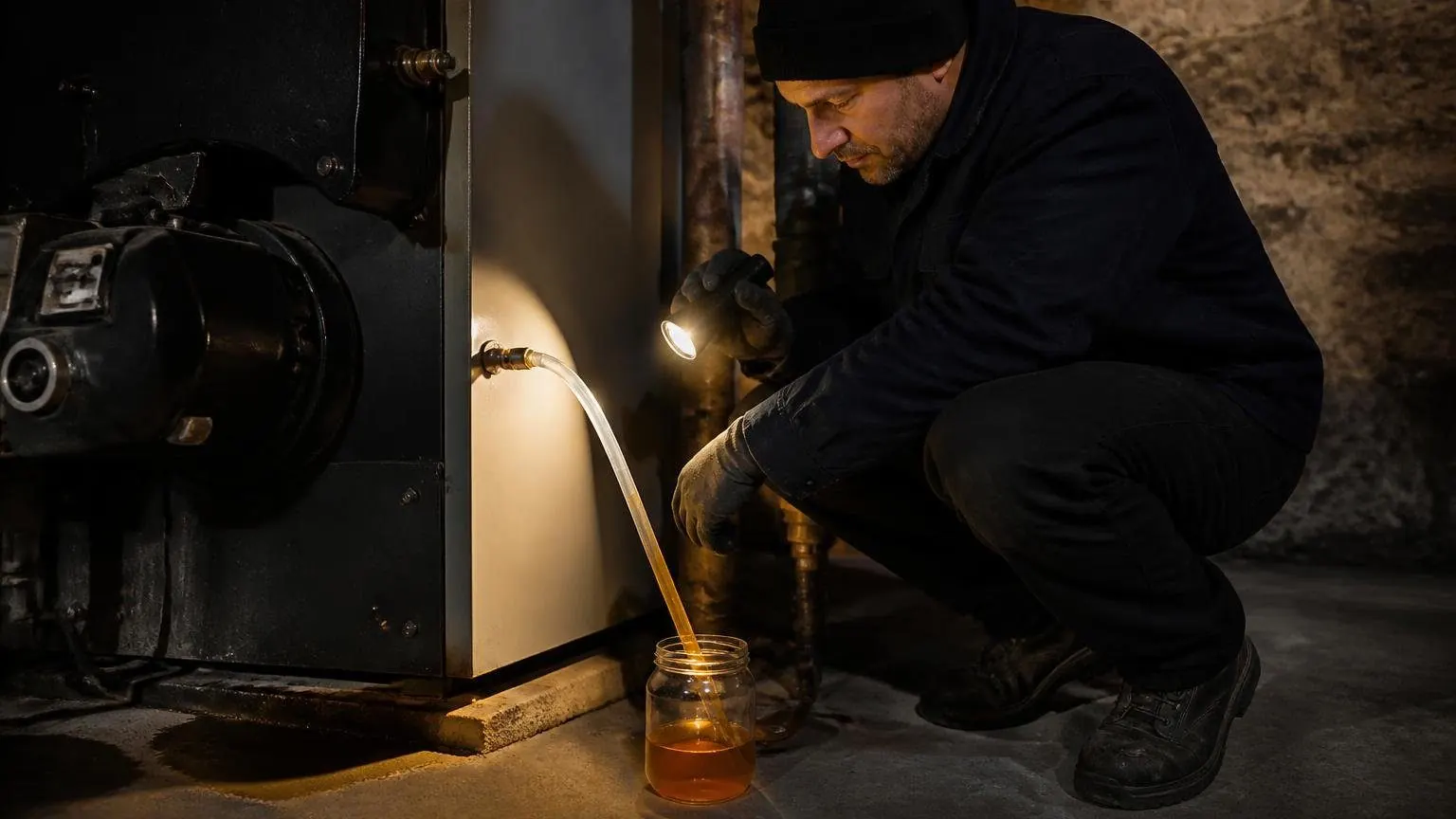
To bleed an oil furnace, refill the tank, push a clear hose onto the fuel pump’s bleeder port into a container, open the bleeder, start the burner and let oil run until it flows with no froth or bubbles, then close the bleeder. A Beckett GeniSys 7505 gives you a 4 minute prime mode for this.
Every step below comes from the makers’ own instructions, written for technicians; Suntec’s pump sheet says its pump “must be installed by a qualified technician.” Here is what those manuals say about bleeding after a run out, and where they say to stop.
How much oil goes in, and what do you need before you open the bleeder?
Enough oil to cover the pickup again, a clean filter, a clear hose and a container. None of the maker documents we read sets a minimum number of gallons for a restart; read the heating oil tank gauge after the delivery. Beckett’s AFG manual tells owners to “Always keep your oil tank full, especially during the summer” to limit condensation. If the burner pulled the last inches of the tank, check for water and sludge with our guide to water in a heating oil tank.
The kit, per the GeniSys 7505 manual: “a clear plastic hose over the bleed port fitting” and “a suitable container to collect purged oil.” Add a wrench for the bleeder, gloves and eye protection (Suntec’s list) and, per the Beckett AFG manual, “Keep a fire extinguisher nearby and ready for use.” If the filter has been clogged by the dregs of the tank, change it first, using the steps in how to change an oil furnace filter.
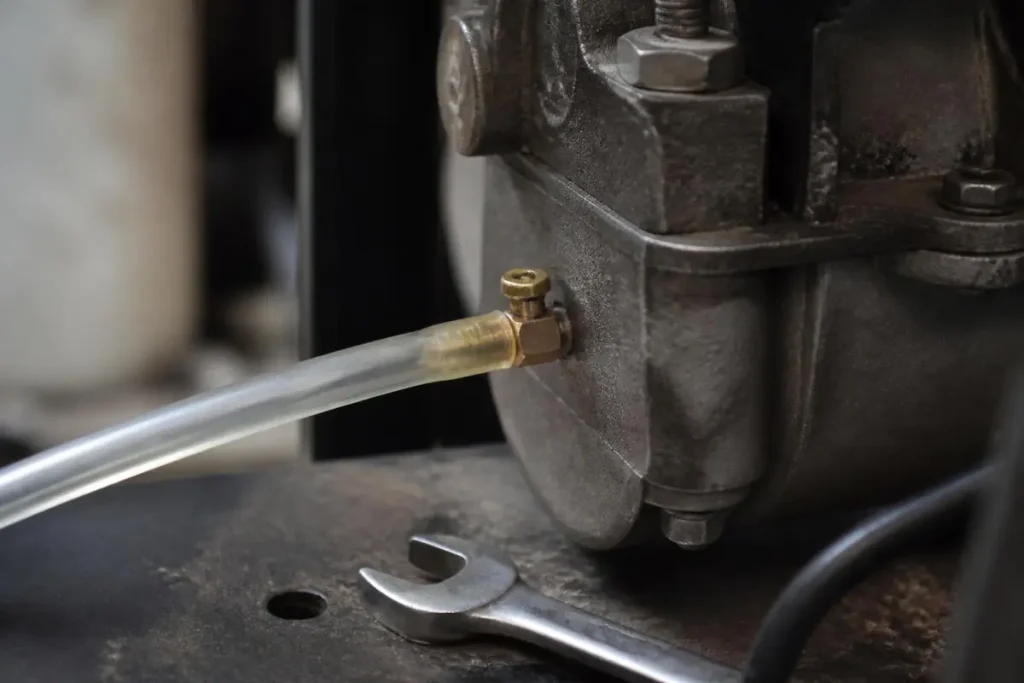
Where is the bleeder valve on an oil furnace fuel pump?
It is a small hex fitting on the fuel pump, the block on the burner where the copper oil line ends. Suntec, Webster and Riello put it in different places, and on a Riello 40 it shares a port with the pressure gauge.
| Pump | Where the bleeder is | How the maker says to bleed | Stop when |
|---|---|---|---|
| Suntec A (single stage) and B (two stage) | Air bleeder on the pump body, shown in Suntec Figures 1 and 2 | Start the burner, open the bleeder CCW, catch the oil in a container | “air free oil flows from the air bleeder”; close it, stop burner |
| Webster M34DK-3 | Bleed valve on the side of the pump, beside the bypass plug | The sheet gives no bleed steps; follow the burner maker’s procedure | Not stated on the Webster sheet |
| Riello 40 F3/F5 pump | Pressure port and bleeder port are one fitting (item 7) | Gravity line: loosen until oil flows, tighten, start. Lift line: technician false light method | “purged of air”; tighten and “immediately shut down” |
| Any pump on a Beckett AFG with GeniSys 7505 | Clear hose on the pump bleed port, bleed port fully open | Use the 4 minute Pump Prime mode | “all froth and bubbles are purged” |
Compiled by The HVAC Brief from the Suntec Model A, B fuel unit sheet (Sid Harvey), the Webster fuel units sheet M34DM-3, the Riello 40 F3/F5 manual C6501000 and the Beckett GeniSys 7505 manual.
How do you bleed the pump with the burner running, step by step?
You run the burner with the bleeder wide open so the pump pushes oil and trapped air out of the hose instead of the nozzle. Beckett says to “fully open the pump bleed valve to prevent oil spray from accumulating in the combustion chamber during the air bleed procedure.” The rows are for a Beckett burner with a GeniSys 7505 control.
| Step | What you do | What you should see | If you do not |
|---|---|---|---|
| 1 | Open the oil valves at the tank and at the filter | No drip at the filter or fittings | Close the valve and fix the leak first |
| 2 | Hose on the bleed port, other end in the container; open the bleeder fully | Nothing yet; the pump is stopped | Find the right fitting before power goes on |
| 3 | Set the thermostat above room temperature to call for heat | Motor and igniter start | Check the switch, the fuse and the red reset light |
| 4 | Once the burner starts, hold reset 15 seconds until the yellow light comes on, then release | Burner restarts | Check the light: red means lockout; reset once only |
| 5 | While the igniter is still on, click reset | Yellow light stays on: Pump Prime, 4 minutes | Repeat steps 4 and 5 |
| 6 | Watch the hose | Foam and air gaps, then solid oil with no bubbles | When the yellow light goes off, start Pump Prime again |
| 7 | Close the bleeder snug while oil is still flowing | Flame holds and the burner keeps running | Stop; see the stop rules below |
| 8 | End the call for heat, wipe up, call for heat again | Normal start, no smoke | Turn the burner off and book service |
Compiled by The HVAC Brief from the Beckett AFG manual “Start Up Burner” steps 1 to 12 and the GeniSys 7505 “Priming the Pump” section.
On a Honeywell R7184, the older primary that Beckett’s 7505 replaced, the R7184 guide 69-1384 uses one short press: while the ignition is on, press and release reset (“hold 1/2 second or less”), and the lockout time stretches to 4 minutes, or 45 seconds on earlier units. If the pump has not primed by then, reset and repeat.
Why does each reset give you only 15 seconds, and how many tries are safe?
Because the control is built to stop spraying oil into a chamber with no flame. The AFG manual’s R7184P sequence opens the oil valve after a 15 second valve on delay and expects flame “within the 15 second lockout time.” Every failed try leaves that oil in the chamber, so the Beckett 7505 moves to a hard lockout after repeat failures and the R7184 enters restricted lockout after three lockouts in a row, “to prevent repetitious resetting by the homeowner.”
So never press reset again and again with the bleeder closed; use the prime mode with the bleeder open. The light colors and lockout states are decoded on our oil burner reset button page, and what unburned oil does when it finally lights is on the oil furnace puffback page.
Does a two-pipe oil system need bleeding after running out of oil?
Usually not by hand. Suntec’s A/B sheet says that on two-pipe systems “Air bleeding is automatic”: the return line carries the air back to the tank, and opening the bleeder only hastens it. One-pipe systems need the manual bleed above.
Count the copper lines at the pump: one means one-pipe; two, supply and return, means two-pipe with a bypass plug fitted. Suntec says one-pipe is for pumps below, or no more than 8 feet above, the bottom of the tank; the AFG manual says a tank more than eight feet below the burner requires a two-pipe system. On Webster R series pumps the model code tells you: a final digit that is even means factory set for two-pipe, odd means one-pipe. A Riello 40 on a two-line lift system is purged by covering its photocell with false light so the burner runs in prepurge only, which is a technician job, per the Riello 40 F3/F5 manual.
Why does the burner lose prime again an hour after you bleed it?
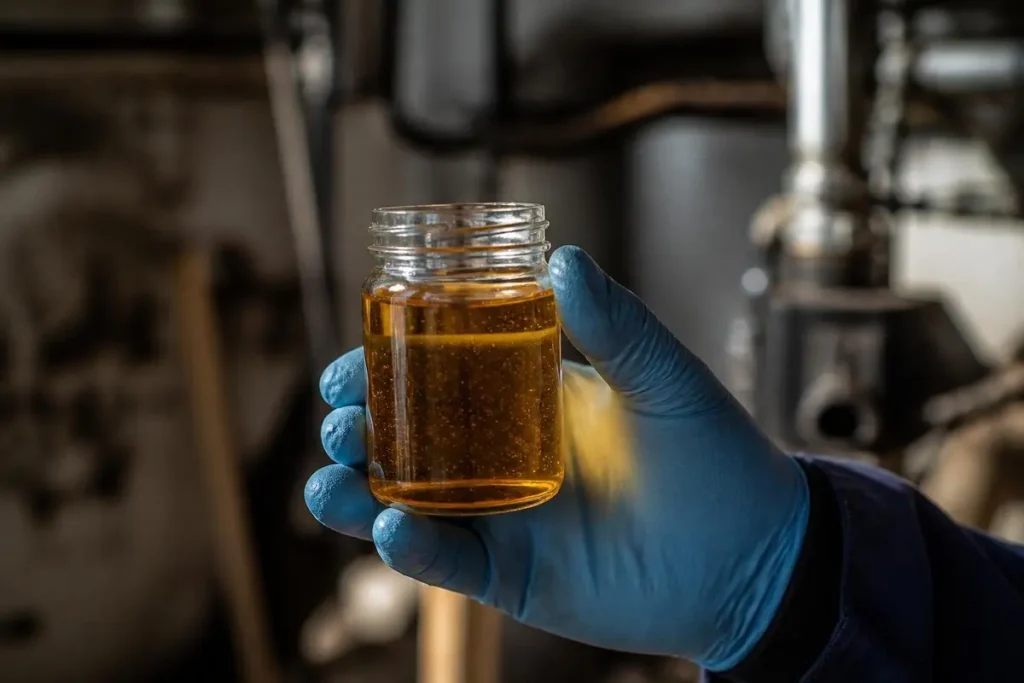
Air is still leaking in on the suction side, or a restriction is starving the pump. Beckett’s troubleshooting page (archived copy) lists “Air in oil supply” behind afterdrip and smoky starts and says to use “a clear hose on the pump bleeder port to see if there is air present,”.
Suntec says to use flare fittings and “do not use compression fittings!” because lines must be “absolutely air tight” to avoid “air binding, after drip, rough burner starts and stops, loss of prime.” A restriction shows up as high vacuum at the pump inlet: Webster rates its R series single stage units for a maximum of 10 in. Hg and two stage units for 15 in. Hg, and Riello caps its lift systems at 11.44 inches of mercury. A nozzle that keeps dripping after shutdown is covered in our oil burner nozzle guide.
When should you stop bleeding and call for service?
Stop when there is oil or vapor in the chamber, when the chamber is very hot, or when the control has gone to a hard or restricted lockout. The AFG manual says “Do not attempt to start the burner when excess oil has accumulated in the appliance, the appliance is full of vapor, or when the combustion chamber is very hot,” and for an oil flooded appliance to shut off the power and the oil and “clear all accumulated oil before continuing.”
A hard lockout on the 7505 “must be reset only by a qualified service technician.” Stop too if you smell raw oil at the pump or filter after the bleed; our heating oil smell guide separates leaks from combustion smells. A technician will put gauges on the pump. Suntec’s checks are inlet pressure no more than 3 psi, return line pressure no more than 10 psi on two-pipe systems, and a nozzle cutoff that holds at no lower than about 80% of operating pressure. They also clean the pump strainer, a once a year job in Suntec’s sheet.
Frequently asked questions
How to bleed oil furnace Beckett?
On a Beckett burner with a GeniSys 7505 control, put a clear hose on the pump bleed port and open it fully, call for heat, hold reset 15 seconds until the yellow light comes on, release, then click reset while the igniter is on. That starts a 4 minute Pump Prime mode. Bleed until the oil has no froth or bubbles, then close the bleeder.
What happens if you don’t bleed a furnace?
On a one-pipe oil system the pump stays air bound, so the burner runs its 15 second trial with little or no oil, fails to prove flame and locks out. Beckett warns that failing to prime the pump properly “could result in unstable combustion, hot gas puff-back and heavy smoke,” and repeated failed starts push the control into a hard lockout.
How to bleed an oil burner line?
The line is bled through the pump’s bleeder, not at the tank: the running pump pulls oil up the line and pushes the air out of the hose. If it never clears, look for a suction leak. Suntec specifies 3/8 inch OD one-pipe lines under 50 feet, 1/2 inch from 50 to 100 feet, all with flare fittings.
How to bleed an old oil furnace?
Older burners often have a Honeywell R7184 primary instead of a Beckett 7505. Press and release its reset in under half a second while the ignition is on, and the lockout time extends to 4 minutes, or 45 seconds on earlier units. Three lockouts in a row put it into restricted lockout, which needs a 30 second hold to clear.
How we researched this
In November 2026 we read the seven maker documents listed under Sources and the top ranking pages for this query. We left out those pages’ advice to restart up to ten times or leave a bleeder loose, since no maker document supports either. No maker or agency document we found sets a minimum delivery in gallons for a restart, so this page gives none. Carlin controls were not checked.
Sources
- R.W. Beckett Corporation and Weil-McLain. “Ultra Oil AF/AFG Burner Manual.” https://www.weil-mclain.com/wp-content/uploads/RW-Beckett-AFG-Burner-Manual-for-Ultra-Oil-VBL-0321.pdf. Accessed November 2026.
- R.W. Beckett Corporation. “GeniSys 7505 Control Manual.” https://zoro.com/static/cms/enhanced_pdf/Metropac%20Industries%20Inc_61649xxGeniSysxx7505xxControlxxManualxx144726.pdf. Accessed November 2026.
- Honeywell. “R7184 Series Primary Controls, technician guide 69-1384.” https://inspectapedia.com/heat/Honeywell-R7184-Guide-69-1384.pdf. Accessed November 2026.
- Sid Harvey. “Suntec Model A, B Fuel Units.” https://www.sidharvey.com/documents/SuntecA,BFUELUNITS.pdf. Accessed November 2026.
- Webster (via Sid Harvey). “Webster R and M Series Fuel Units, M34DM-3.” https://www.sidharvey.com/documents/M34DM-3.pdf. Accessed November 2026.
- Riello. “Riello 40 F3 and F5 Manual, C6501000.” https://www.weil-mclain.com/wp-content/uploads/wgo-riello-oil-burner-manual_1.pdf. Accessed November 2026.
- R.W. Beckett Corporation. “Troubleshoot” (archived copy). https://web.archive.org/web/2025id_/https://www.beckettcorp.com/support/troubleshoot/. Accessed November 2026.
Leave a Reply