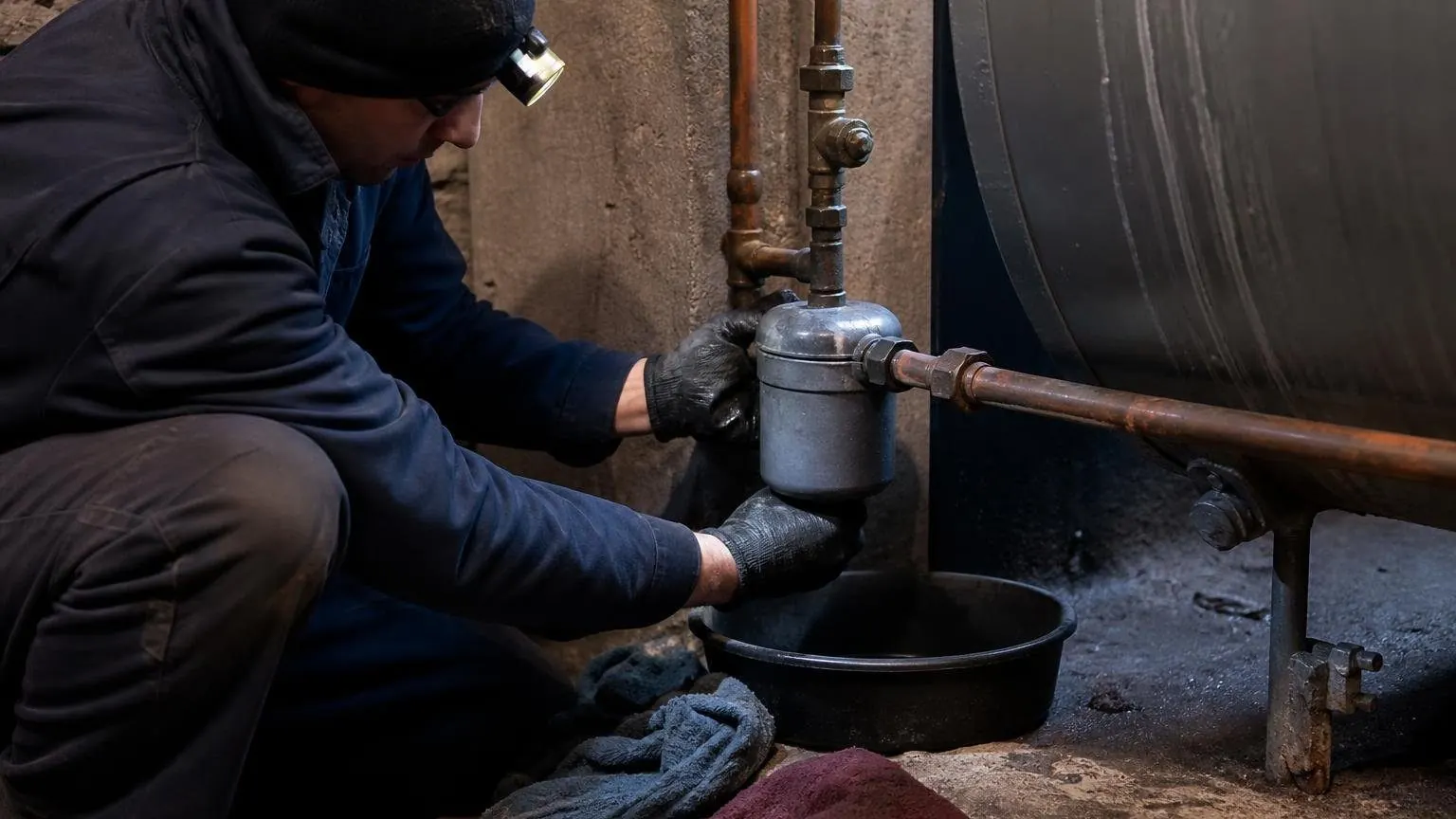
To change an oil furnace filter, switch off the burner and close the tank valve, set a pan under the canister, loosen the center bolt, swap the felt cartridge and every gasket, reassemble, then open the valve and bleed the air out at the pump. General Filters and Beckett both call for a new cartridge once a year.
This page covers the fuel filter: the metal canister on the copper oil line between tank and burner, the same part on an oil boiler. The pleated air filter in a forced-air oil furnace is a separate part, sized in our furnace filter size by model number guide.
Which oil furnace filter do you have, and which cartridge fits it?
The General Filters catalog shows two designs: a bowl canister with a center bolt and a felt or microfiber cartridge (General 1A-25A, 1A-25B, Unifilter 77B), or a disposable spin-on can on an aluminum head (Gar-Ber R2000, General G). Read the model stamped on the head.
| Housing on your oil line | Replacement element | Rated removal | Max firing rate | Working pressure | Seal to replace |
|---|---|---|---|---|---|
| General 1A-25A, 1A-25B, 77B (bowl) | 1A-30, 1A-30BG, 88CR or RF-1 | 10 micron | 10 GPH | 40 psi | BG5-1A bowl gasket |
| General 2A-700A, 2A-700B, 99B (bowl) | 2A-710, 2A-710BG, 101 or RF-2 | 10 micron | 25 GPH | 40 psi | BG5-2A bowl gasket |
| Gar-Ber 11V-R2000 (spin-on) | R2000 can | 10 microns | 10 gph | 15 psi | BG5-R/G seal |
| Gar-Ber 11V-R, General 1A-10G (spin-on) | R or G can | 10 microns | 10 gph | 15 psi | BG5-R/G seal |
| Strainer in a Suntec A or B pump | Clean; replace if corroded | Mesh screen | Pump decal | Inlet 3 psi max | New cover gasket |
Compiled by The HVAC Brief from the General Filters General 2000 catalog, Sid Harvey’s Suntec A and B sheet and Suntec Form 2100.
The plain 1A-30 is listed for oil “up to B5,” while General rates its FKM BioGasket to B100, so where heating oil now carries biodiesel (our oil heating system page lists the state rules) ask for the BG version. The catalog prints “25 GPH” beside the 1A-30BG, but the 1A-25B spec table says 10 GPH; treat 10 GPH as the limit.
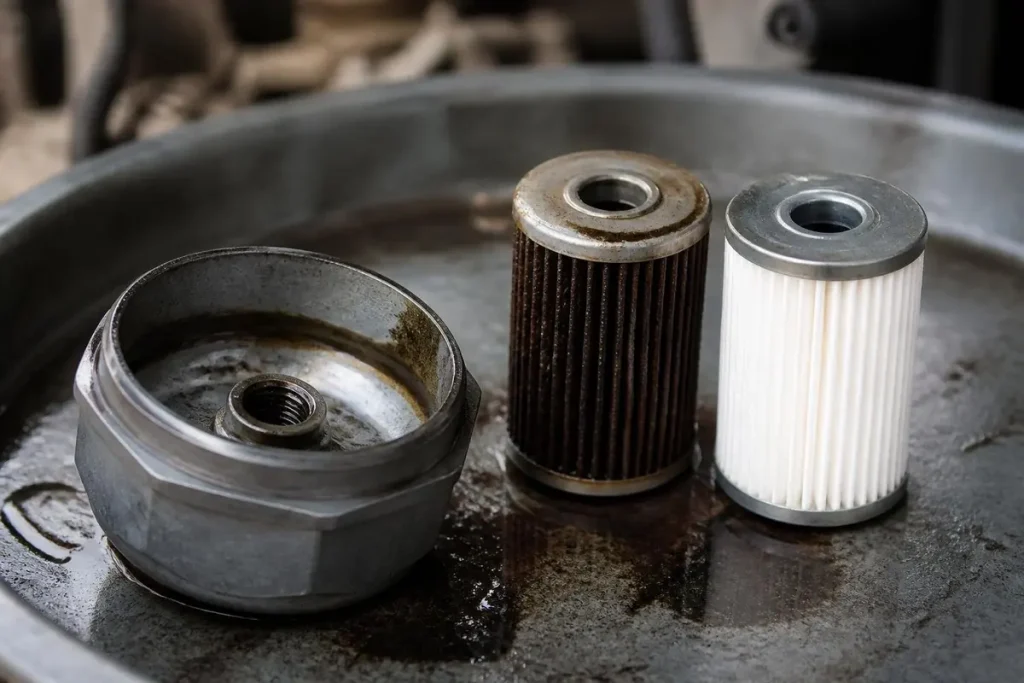
How do you change a canister oil furnace filter like the General 1A-25A, step by step?
You need a new cartridge with its gasket kit, two wrenches, a drip pan and rags. The order follows the fuel path in the diagram, from step 1 at the valve to step 4 at the pump.
- Kill power. Beckett warns “There could be more than one disconnect switch.”
- Close the oil valve. Beckett specifies two fusible-handle valves, one near the tank and one near the burner “upstream of the filter.” Close the one feeding the filter.
- Stage for spills. Sid Harvey’s Suntec sheet lists oil-resistant gloves, eye protection, absorbent pads and a large oil-resistant container.
- Open the bowl. Hold the head with one wrench so the copper line cannot twist, loosen the center bolt with the other and lower the full bowl straight down.
- Read the old cartridge. Bag it. Rusty sludge or water in the bowl points at the tank; our water in heating oil tank guide shows the paste test.
- Clean and refit. Wipe the bowl, scrape off the old gasket, seat the new cartridge and every gasket in the kit (bowl, center bolt, bleed screw), and tighten the bolt snug.
- Open the valve and check. Watch the bowl joint and bolt for a minute before restoring power.
- Bleed the air at the pump (next sections), run a full cycle and check again for drips.
A weep at the bowl joint usually means a reused or twisted gasket, and it gives off the raw-oil smell our heating oil smell in house guide traces fitting by fitting.
How is a spin-on filter such as the Gar-Ber R2000 different?
Close the valve, unscrew the whole can and fit a new one with a fresh seal; there is no bowl to clean. General rates the R2000 at 10 microns with 500 sq in of media and a Water Block polymer that “removes water from fuel oil,” so a can full of water is working but still says the tank needs attention.
Most Gar-Ber and General G heads list a 1/8″ vacuum/bleed port, where a technician can read filter loading on a vacuum gauge. General rates Gar-Ber cans for biodiesel up to 20%, below its B100 bowls, and gives no tightening torque, so follow the instructions packed with the can.
Does the oil burner need bleeding after a filter change, and where is the bleeder?
Yes, on a one-pipe system: the open bowl let air in, and Sid Harvey’s Suntec sheet blames air for “air binding, after drip, rough burner starts and stops, loss of prime.” The bleeder is on the pump, not the filter. Start the burner, open the bleeder counterclockwise into a container and “Continue bleeding until air free oil flows,” then close it. Suntec Form 2100 warns that “hurried bleeding may impair operation.”
On two-pipe systems Form 2100 says “Priming is automatic”; the bleed valve only speeds it up. Beckett’s GeniSys 7505 has a Pump Prime mode that runs for four minutes. Tubing, container and safe reset counts are on our how to bleed an oil furnace page. Beckett’s rule applies: “Do not allow oil to spray into a hot combustion chamber while bleeding air from the pump,” because that is how an oil furnace puffback starts.
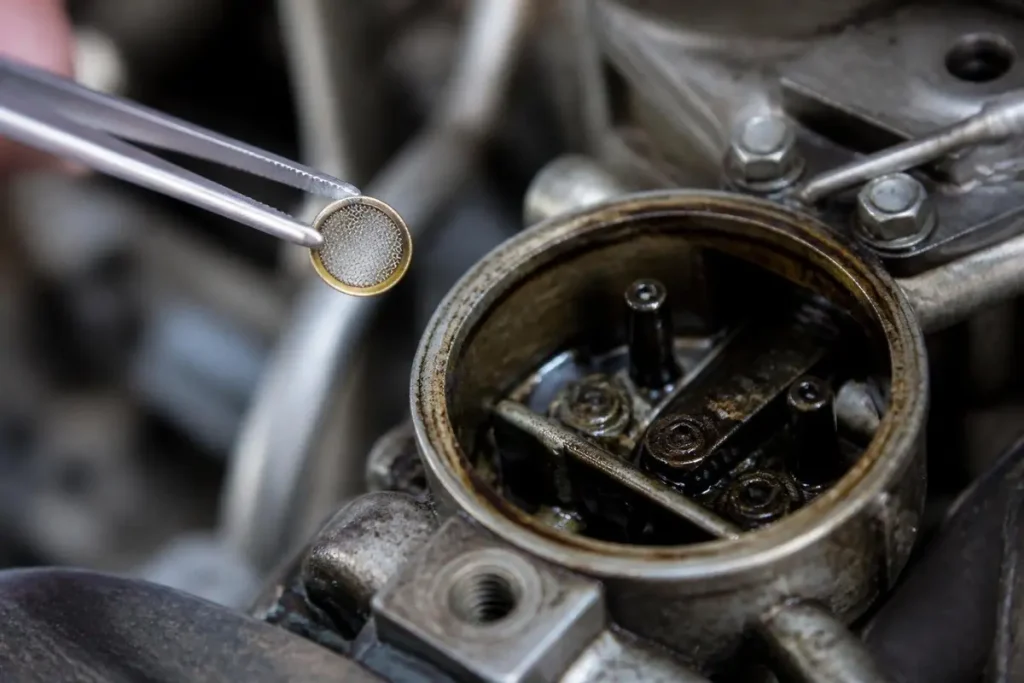
Should the pump strainer be cleaned when the oil filter is changed?
Yes, at the same annual visit. Beckett’s AF/AFG maintenance checklist lists “Replace the oil supply line filter” and, next, “Remove and clean the pump strainer if applicable.” Sid Harvey’s Suntec sheet says to clean the strainer “once a year, or more often if necessary,” reached by removing a cover “held by the four machine screws.”
Beckett’s bulletin says to brush the screen in clean fuel oil or kerosene and “tighten the four cover screws evenly”; Sid Harvey says to “Always install a new cover gasket.” NORA Chapter 4 notes most technicians just replace the strainer, and lists “Air leaking around cover” as a pump fault.
How often should the oil filter be changed, and what does a clog between services mean?
Once a year. General Filters lists the 1A-25B’s maintenance as “Annual Filter replacement,” and Beckett says the cartridge “must be replaced to avoid contamination of the fuel unit and nozzle.” A filter that plugs within months is a symptom: water or sludge from the tank is feeding it.
A loading filter shows up as vacuum at the pump inlet. NORA’s rule of thumb is 1 in Hg per foot of lift, 1 in Hg per 10 ft of line, 2 to 4 in Hg for an oil safety valve (OSV) and ½ in Hg for a clean filter. Suntec’s limits are 6″ Hg single pipe and 12″ Hg two-pipe for a Model A pump, and 17″ Hg for a Model B. The gap is all the clogging a filter can absorb.
| Install | Lift (ft) | Line (ft) | OSV (in Hg) | Vacuum, clean filter | Pump limit | Margin left for filter loading |
|---|---|---|---|---|---|---|
| Basement tank, one-pipe | 0 | 15 | 0 | 2.0 | 6 (Model A) | 4.0 |
| Same, with an OSV | 0 | 15 | 3 | 5.0 | 6 (Model A) | 1.0 |
| Outdoor tank, one-pipe, lifting | 4 | 30 | 0 | 7.5 | 6 (Model A) | None |
| Buried tank, two-pipe, Model A | 6 | 40 | 0 | 10.5 | 12 (Model A) | 1.5 |
| Buried tank, two-pipe, Model B | 10 | 60 | 0 | 16.5 | 17 (Model B) | 0.5 |
HVAC Brief calculation: vacuum = lift x 1 + line / 10 + OSV (3, midpoint of NORA’s 2 to 4) + 0.5, NORA Chapter 4’s simplified rule. Limits from Suntec Form 2100. Example installs are illustrative. Script: change-oil-furnace-filter-calc.py.
The burner with the least margin starves first as its filter loads. The outdoor one-pipe row fails even with a new filter, a line design fault; Form 2100 caps one-pipe lift at 8 feet.
When does an oil furnace need a second filter near the burner?
When the nozzle is small. Beckett’s AF/AFG manual wants a primary filter “rated for 50 microns or less,” and for “firing rates below 0.75 gph” suggests dual filtration: a 50 micron primary near the tank and a secondary “rated for at least 10 microns” near the burner. With two canisters, change both and bleed once. Our oil burner nozzle guide explains why small nozzles plug.
Which parts of the job belong to the oil technician, and what will they measure?
Beckett says “a qualified service technician must service this burner annually,” with the filter on the same checklist as the nozzle and a combustion test. If the burner will not relight after your change, press reset once, then stop; our oil burner reset button guide explains why.
The readings that matter: inlet vacuum against the calculated figure (NORA lists “Plugged fuel filter” when high); inlet pressure, capped at 3 psi under NFPA 31 per Suntec; nozzle pressure on a 0 to 300 psi gauge; and cutoff, which on the Sid Harvey test should drop no lower than about 80% of operating pressure.
Frequently asked questions
How often should you change an oil furnace air filter?
The air filter is a different part from the oil filter and is checked far more often. ENERGY STAR’s maintenance checklist tells owners to “Inspect, clean, or change air filters once a month” on a furnace, central air conditioner or heat pump. The oil line filter is changed once a year at the burner service.
What size cartridge does a 1A-25A oil filter take?
General Filters lists the 1A-30 wool felt cartridge for the 77B, 1A-25B and 1A-25A, with the 1A-30BG, 88CR and RF-1 as alternatives, all rated at 10 microns. The larger 2A-700A takes the 2A-710 family, so read the stamp on the filter head before buying.
Are oil filters easy to change?
The swap is a bolt, a cartridge and gaskets. The hard part is the air: Suntec Form 2100 warns that “hurried bleeding may impair operation,” and Beckett bans spraying oil into a hot chamber while bleeding. If the burner will not hold prime after two attempts, suspect a suction leak at the new gasket or the pump cover.
How do you change an oil burner filter on a two-pipe system?
The cartridge change is the same; the bleeding is easier. Suntec Form 2100 says “Priming is automatic” on two-pipe systems, and opening the bleed valve only speeds it up. Form 2100 caps inlet and return pressure at 10 psi, and Beckett’s manual says “Do NOT install valves in the return line,” citing NFPA 31.
How we researched this
On 26 November 2026 we read the 8 maker, trade-association and federal documents in Sources. Today’s ranking pages (social video, a forum thread, a strainer how-to, a car oil filter article) supplied no figures. Westwood’s and Suntec’s own sites did not respond, so no Westwood specification appears. No prices are given: no federal source publishes one.
Sources
- General Filters, Inc. “General 2000 Catalog.” https://res.cloudinary.com/wholesale-plumbing/image/upload/Documents1/General_2000_Catalog.pdf. Accessed November 2026.
- General Filters, Inc. “Model 1A-25B.” https://www.generalfilters.com/products/general-fuel-oil-filters/model-1a-25b/. Accessed November 2026.
- R.W. Beckett Corporation. “Beckett Model AF/AFG Burners Instruction Manual” (Weil-McLain Ultra Oil edition). https://www.weil-mclain.com/wp-content/uploads/RW-Beckett-AFG-Burner-Manual-for-Ultra-Oil-VBL-0321.pdf. Accessed November 2026.
- R.W. Beckett Corporation. “Successfully Locating Suction Line Leaks” (CleanCut fuel unit servicing). https://www.beckettcorp.com/bulletins/successfully-locating-suction-line-leaks/. Accessed November 2026.
- Sid Harvey Industries. “Suntec Model A, B Fuel Units” (remanufactured unit instructions). https://www.sidharvey.com/documents/SuntecA,BFUELUNITS.pdf. Accessed November 2026.
- Suntec Industries, Inc. “Models A-7000 and B-8000 Single and Two-Stage Fuel Units, Installation Information” (Form 2100). https://www.hvacdiscounters.com/customer/docs/skudocs/a7000-b7000-iom.pdf. Accessed November 2026.
- National Oilheat Research Alliance. “Chapter 4: Fuel Units and Valves.” https://learning.noraweb.org/wp-content/uploads/2022/09/Chapter-4.pdf. Accessed November 2026.
- ENERGY STAR (EPA and DOE). “Maintenance Checklist.” https://www.energystar.gov/saveathome/heating-cooling/maintenance-checklist. Accessed November 2026.
Leave a Reply