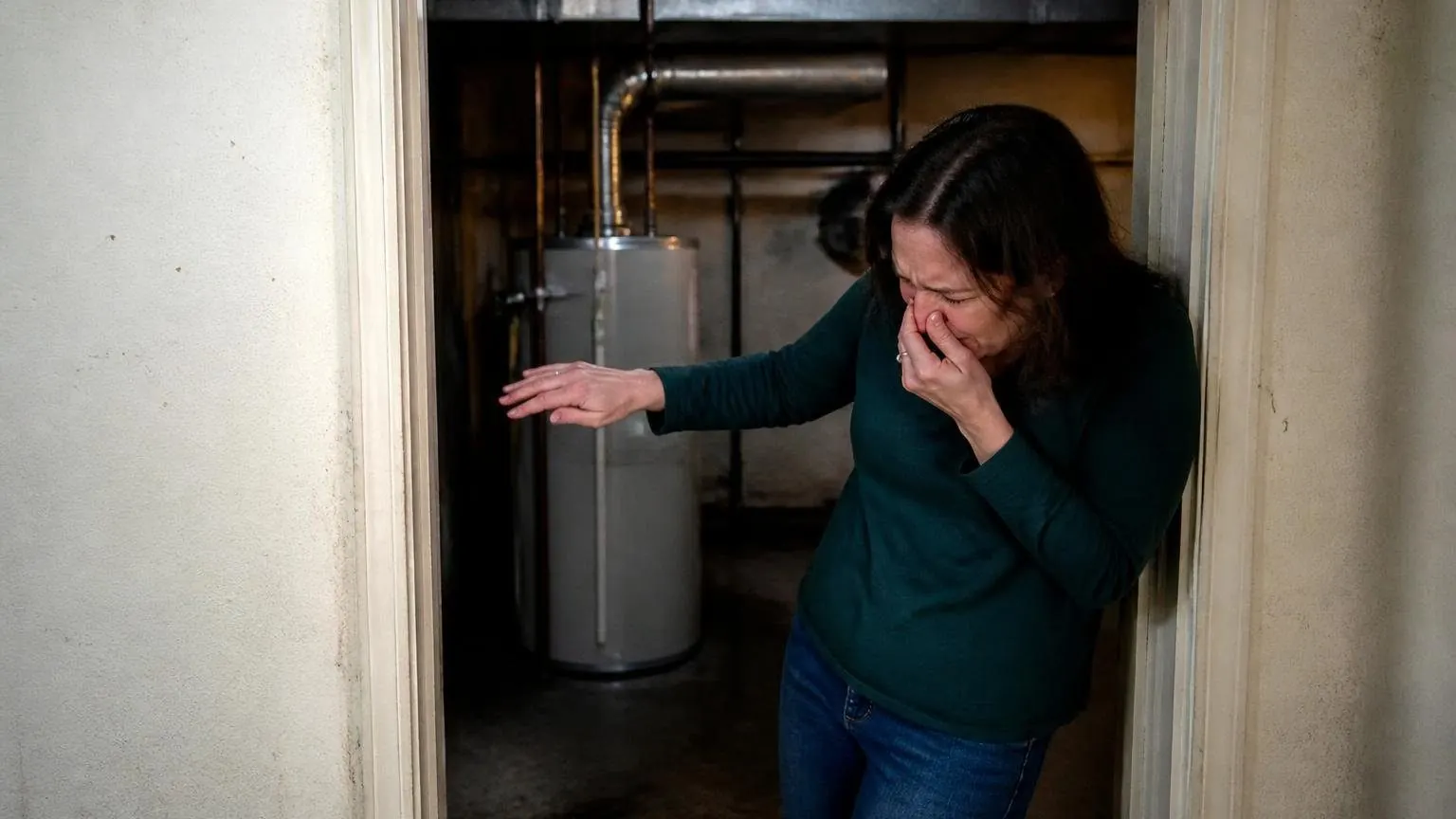
If your water heater smells like gas in the air around the tank, the gas line or near the floor, treat it as a leak: leave, touch no switches, and call the gas supplier from outside. If the rotten egg odor comes only out of the hot water itself, it is hydrogen sulfide from the tank, not fuel gas.
Is the smell in the room air or in the hot water coming out of the tap?
That one question splits a gas emergency from a water chemistry nuisance. Utility gas carries mercaptan, which PHMSA describes as skunk like and the Indiana Utility Regulatory Commission as rotten egg or sulfur. Hydrogen sulfide made inside a tank smells much the same.
Where your nose finds it decides. NDSU Extension says odor only from the hot water tap means sulfates reacting with the magnesium anode. Fuel gas shows up in the air at the gas cock, union, flex connector or control valve; Rheem says LP “will collect first in lower areas,” so sniff near the floor too. A furnace or boiler with the same odor follows the same stop rule, covered on our furnace smells like gas page.
| What you smell | Where and when | Likely source | First move |
|---|---|---|---|
| Rotten egg or skunk | Room air near tank, piping or floor | Fuel gas leak (mercaptan odorant) | Leave, no switches, call from outside |
| Rotten egg | Hot tap water only | Hydrogen sulfide: sulfate, bacteria, magnesium anode | Anode swap, chlorinate; no evacuation |
| Rotten egg | Hot and cold taps | Sulfur in the well or supply | Treat and test the water supply |
| Stale exhaust | Draft hood, burner firing | Spillage up the vent fails | Burner off, spillage test |
| Faint gas whiff | After a failed pilot attempt | Unburned gas from the attempt | Knob OFF, wait 10 minutes, recheck |
| Gasoline or solvent | Room with stored cans | Flammable vapors near the burner | Ventilate, shut off burners and pilots |
| Light smoke, oily | First firing of a new heater | Oil burning off metal parts | Normal per A.O. Smith; fades |

What do you do first when the gas smell is at the water heater?
Get out, then call. Rheem’s PROClassic manual (AP23059) says: do not try to find the cause, light any appliance, touch any electrical switch or use any phone in the building; leave with family and pets; contact the gas supplier, a service agency or the fire department; stay away until the area is declared safe. A.O. Smith’s label in manual 326940 adds “call your gas supplier from a neighbor’s phone.”
The official instructions split on one step. Rheem says “Leave the doors open for ventilation.” The Indiana commission says “Do not open windows” to air out the house, because opening one can make a spark and gas is explosive at only 5 to 15 percent in air. All agree you leave first; if your utility gives a rule, follow it.
| Source | Who to call, from where | Windows and doors |
|---|---|---|
| Rheem manual AP23059 | Gas supplier, service agency or fire department | Leave doors open for ventilation |
| A.O. Smith manual 326940 | Gas supplier from a neighbor’s phone; fire department if unreachable | Not addressed |
| PHMSA (archived copy) | 911 from a safe location, then the pipeline company | Not addressed |
| Indiana Utility Regulatory Commission | Gas provider and 911, away from the building | Do not open windows |
| Peoples Gas | 911, then the utility’s 24/7 hotline | Not addressed |
How strong does a real gas leak smell before it is dangerous?
49 CFR 192.625 says the gas must be odorized so that at one-fifth of the lower explosive limit it is readily detectable by a person with a normal sense of smell. We calculated it: one-fifth of the 5 percent lower limit is 1 percent gas in air, a fifth of the mix that can ignite.
So a faint odor is the warning working: the Indiana commission says leave for “even a faint natural gas odor.” Rheem warns of “odorant fade” and recommends gas detectors; Peoples Gas warns of nasal fatigue.
Where does a gas water heater actually leak, and what will the technician check?
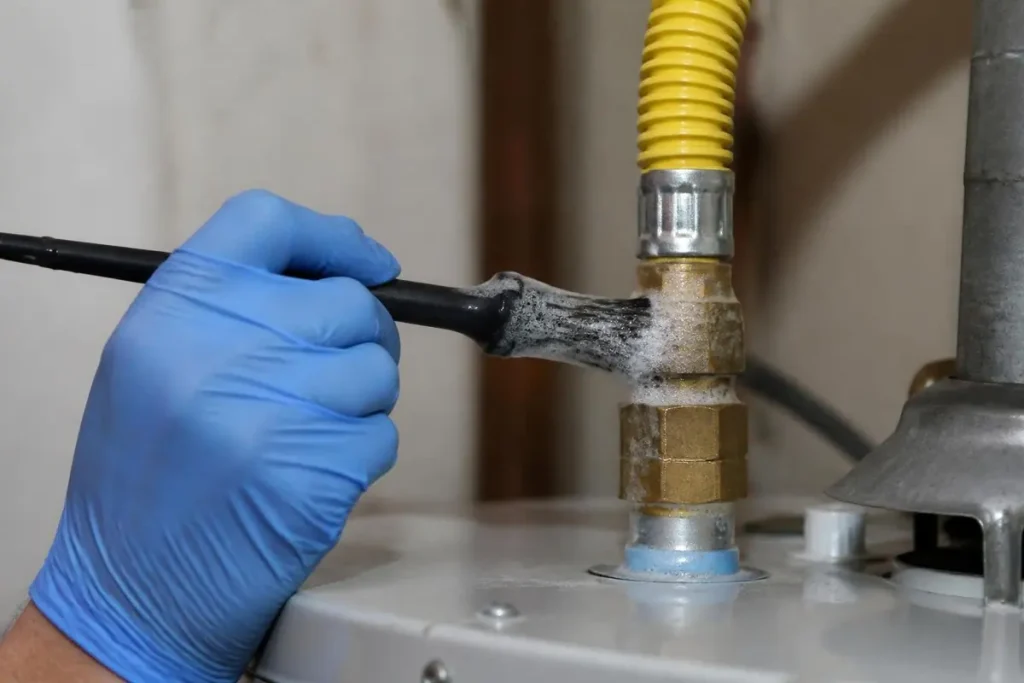
At the joints between the shutoff valve and the burner. Rheem’s checklist calls for a shutoff valve and union with every connection soap tested, including the gas control’s factory connections. A.O. Smith’s service steps add the manifold tube and pilot tube connections at the burner.
The technician brushes leak solution on each joint; A.O. Smith’s recipe is one part hand dish soap to 15 parts water, and bubbles mean a leak. Rheem says never use an open flame. On A.O. Smith tanks like those in manual 326940 the gas control also carries the status light that the A.O. Smith blinking light codes decode.
One normal exception: raw gas can linger after a failed pilot attempt. A.O. Smith’s label says turn the knob OFF and “Wait ten (10) minutes to clear out any gas,” then smell again near the floor; still there means stop. The relight itself is in our water heater pilot light guide.
Why does it smell like exhaust or gas only when the burner is running?
That pattern points at venting, not the gas line. Rheem calls its draft hood tank a Category I natural draft appliance: warm flue gas must rise up the vent, and when it does not, combustion products spill from the draft hood’s relief opening. Rheem’s test: after 5 minutes of main burner operation, hold a match, candle or smoke at that opening; it should be pulled in.
Rheem flags a vent connector smaller than the draft hood outlet, a shared vent left mis-sized after another Category I appliance is removed, and in cold climates a terminal blocked by snow. A room short of air stalls the draft too, as our combustion air rules explain. Sealed direct vent models, like those in A.O. Smith manual 326940, have no draft hood to test.
The smell is the clue, not the danger. The EPA calls carbon monoxide “an odorless, colorless and toxic gas,” so a CO alarm or a headache means leave and call 911. Check alarms against the CO detector placement rules; for a furnace, see furnace exhaust smell in the house.
Why does the hot water smell like rotten eggs when there is no gas leak?
Because the tank is making hydrogen sulfide. A.O. Smith’s manual 326940 says four things must all be present: sulfate in the water, little or no dissolved oxygen, sulfate reducing bacteria in the tank, and excess active hydrogen from the anode. The Minnesota Department of Health says a magnesium anode can supply electrons that aid the conversion, and to confirm it by smelling hot and cold taps after a few hours away.
Fixes: A.O. Smith says 140°F can reduce the smell (with a mixing valve) and a less active anode plus chlorination may end it; Minnesota suggests 160°F for several hours. Our water heater anode rod page covers rod metals and the bleach dose.
Why does the heater room smell like gasoline, and why is that worse?
Because the burner can ignite it. Rheem warns that flammable vapors “can be drawn by air currents from surrounding areas to the water heater,” and when flammables must be used nearby, says to open doors and windows and shut off every gas appliance in the area, pilots included.
FVIR (flammable vapor ignition resistant) tanks are built to contain it. Bradford White’s FVIR service manual says a flame arrestor plate stops flames traveling back out of the combustion chamber and a thermal switch shuts down pilot and burner. Its fix after a “flammable vapor incident” is one line: “Replace water heater.”
Is a smell from a brand new or long unused water heater normal?
A little, at first firing. A.O. Smith’s manual 326940 says “a small amount of smoke and odor during the initial start-up” is not uncommon, from oil burning off metal parts, and it “will disappear in a short while.” A rotten egg odor in the air is never part of that.
A heater idle for two weeks or more is a different risk: Rheem and A.O. Smith warn that flammable hydrogen gas can build up. Open a hot faucet for several minutes before running a dishwasher or washer, with no flame nearby. Both describe it by sound, like air escaping from the pipe, not by smell.
Frequently asked questions
Can you smell gas from a hot water heater?
Yes, if fuel gas leaks at its shutoff valve, union, flex connector or control. Under 49 CFR 192.625, utility gas must be readily detectable at one-fifth of the lower explosive limit, about 1 percent natural gas in air. Rheem warns that odorant fade can weaken the smell, so it recommends gas detectors as well.
Why does my water heater smell like gas but there is no leak?
If the odor is only in the hot water, NDSU Extension says sulfate is reacting with the magnesium anode to make hydrogen sulfide. If it comes from the draft hood while the burner runs, that is spillage, checked with Rheem’s match test after 5 minutes of firing.
Why does my water heater smell like gas after a shower?
A long shower keeps the burner firing, so a smell that appears then points at the vent: flue gas spilling at the draft hood instead of rising. Rheem’s spillage test runs after 5 minutes of main burner operation. If the odor is in the hot shower water itself, it is hydrogen sulfide from the tank, per NDSU Extension.
Why does my water heater smell like sewage?
Usually it is the same hydrogen sulfide reaction A.O. Smith manual 326940 describes. The Minnesota Department of Health adds that in rare instances well water odor comes from sewage or other pollution, and says to test a private well for coliform bacteria and nitrate to be safe. A water boiler smelling of gas in the room follows the gas stop rule.
How we researched this
We read Rheem’s PROClassic manual (AP23059), A.O. Smith manual 326940, Bradford White’s FVIR service manual, 49 CFR 192.625, PHMSA’s leak page (archived copy; the live page blocks fetches), Indiana Utility Regulatory Commission and Peoples Gas leak instructions, NDSU Extension and Minnesota Department of Health hydrogen sulfide guidance, and the EPA’s carbon monoxide page. Contractor blogs and forum threads in the current search results were excluded as sources; a CPSC page that refused the request is not cited. The 1 percent figure is our calculation. Researched November 26, 2026.
Sources
- Rheem Manufacturing. “PROClassic Gas Water Heaters Use and Care Manual, AP23059.” https://res.cloudinary.com/dzhpkjoqj/RheemNew/PROClassicGas_UseInstall. Accessed November 2026.
- A.O. Smith. “Residential Gas Water Heaters Installation and Operating Manual, 326940.” https://assets.aosmith.com/damroot/Original/10001/326940.pdf. Accessed November 2026.
- Bradford White. “Flammable Vapor Ignition Resistant Water Heaters Service Manual.” https://www.gtsanders.com/userfiles/documents/Bradford_White_LG155H803N-475_Manual.pdf. Accessed November 2026.
- eCFR. “49 CFR 192.625 Odorization of gas.” https://www.ecfr.gov/current/title-49/subtitle-B/chapter-I/subchapter-D/part-192/subpart-L/section-192.625. Accessed November 2026.
- PHMSA. “Pipeline Leak Recognition and What to Do” (archived copy). https://web.archive.org/web/2025id_/https://www.phmsa.dot.gov/safety-awareness/pipeline/pipeline-leak-recognition-and-what-do. Accessed November 2026.
- Indiana Utility Regulatory Commission. “Safe Gas.” https://www.in.gov/iurc/pipeline-safety-division/safegas/. Accessed November 2026.
- Peoples Gas. “If You Smell Gas.” https://peoplesgas.com/safety/if-you-smell-gas. Accessed November 2026.
- NDSU Extension. “Rotten egg odor only from the hot water tap.” https://www.ag.ndsu.edu/waterquality/documents/rotten-egg-odor-only-from-the-hot-water-tap. Accessed November 2026.
- Minnesota Department of Health. “Hydrogen Sulfide in Well Water.” https://www.health.mn.gov/communities/environment/water/wells/waterquality/hydrosulfide.html. Accessed November 2026.
- U.S. EPA. “Carbon Monoxide’s Impact on Indoor Air Quality.” https://www.epa.gov/indoor-air-quality-iaq/carbon-monoxides-impact-indoor-air-quality. Accessed November 2026.
Leave a Reply