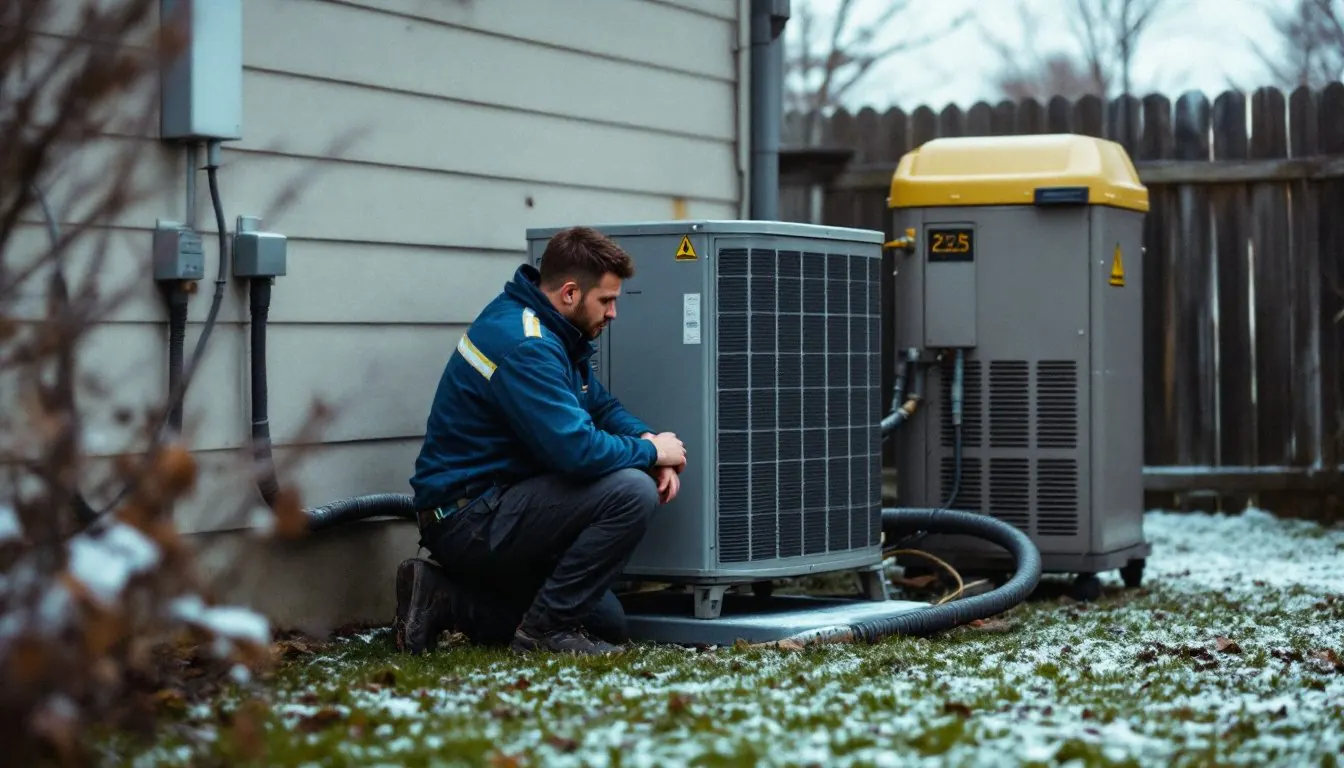
Yes. It is illegal to release freon on purpose while servicing, repairing or disposing of an air conditioner, heat pump, refrigerator or car AC. Clean Air Act section 608 and 40 CFR 82.154 ban knowing venting of R-22, R-410A, R-454B and R-134a alike, with civil penalties up to $124,426 per day per violation.
EPA notes that “Freon” is a trademark name used for several different refrigerants, from CFC-12 to HCFC-22, so the useful question is which gas, which equipment and what was going on when it escaped. The chemistry is in our explainer on what refrigerant actually is; the law follows here.
Which freon releases are illegal under 40 CFR 82.154, and which are not?
A release is illegal when a person knowingly vents a regulated refrigerant while maintaining, servicing, repairing or disposing of an appliance. The ban has applied to CFCs and HCFCs since July 1, 1992, and the same section of the Act extended it to substitutes such as HFCs five years after November 15, 1990. EPA’s definition of “appliance” in 40 CFR 82.152 names air conditioners, motor vehicle air conditioners, refrigerators, chillers and freezers, so a car, a window unit and a central heat pump are all inside it.
| What someone does | Legal? | Rule that decides it | Penalty basis |
|---|---|---|---|
| Opens a valve or cuts the lines to let R-22, R-410A or R-454B out of a home AC or heat pump | No | CAA 608(c)(1) and (2); 40 CFR 82.154(a)(1) | CAA 113 civil or criminal |
| Recovers the gas into a cylinder, then empties the cylinder into the air | No | 40 CFR 82.154(a)(3) | Treated as venting |
| Loses a puff when hoses come off during proper recovery with certified equipment | Yes | De minimis release, 40 CFR 82.154(a)(2) | None |
| Vents CO2, nitrogen or water from any system | Yes | Exempt, 82.154(a)(1)(i) to (iii) | None under part 82 |
| Vents R-290 (propane) from a household refrigerator or self-contained room AC, or R-600a from a household refrigerator | Not prohibited by 82.154 | Exempt end uses, 82.154(a)(1)(viii) and (ix) | None under part 82; fire risk remains |
| Sells R-22, R-410A or R-454B in a cylinder to an uncertified buyer | No | Sales restriction, 82.154(c)(1) | CAA 113; seller keeps invoices for three years |
| Sells a can of car AC refrigerant holding two pounds or less, with a self-sealing valve | Yes | 82.154(c)(1)(ix) and (c)(2) | None |
| Sells R-12 in a container under 20 pounds to someone without Section 609 certification | No | 40 CFR 82.34(b) | CAA 113 |
| Hauls a refrigerator or window AC to the scrapyard with the gas still inside | Yes, if not tampered with | Final processor recovers or gets a signed statement, 82.155(b) | Falls on the scrapyard or landfill |
Compiled by The HVAC Brief from 40 CFR 82.152, 82.154, 82.155 and 82.34 (eCFR text current to October 2026), 42 U.S.C. 7671g and EPA’s homeowner FAQ.
EPA has carved out propane (R-290) and isobutane (R-600a) in the small factory-sealed uses listed in 82.154(a)(1), which is why our R-290 refrigerant guide treats flammability, not the venting ban, as the real limit on those units. Split systems running R-410A, R-454B or R-32 are not exempt.
Is it a felony to release freon into the air?
It can be. Clean Air Act section 113(c)(1) makes a knowing violation of any requirement of subchapter VI, the stratospheric ozone title that holds section 608, punishable by a fine under title 18 or imprisonment “not to exceed 5 years, or both”, and the maximum doubles for a second conviction. A 5-year maximum sits in the “five or more years” band that 18 U.S.C. 3559 classifies as a Class D felony, and 18 U.S.C. 3571 sets the fine for an individual felony at not more than $250,000 ($500,000 for an organization).
The criminal cases on record involve deliberate cutting by thieves. EPA’s Title VI enforcement list records that Byron Stuckey cut the lines of an air conditioner he was stealing in Wichita, Kansas, and received 12 months of probation on the federal charges. Shannon Wayne Harrold of Glenford, Ohio, who dismantled stolen units on site for copper, got 54 months in prison and $29,045 in restitution in a case EPA describes as a Clean Air Act violation for cutting the tubing.
How much is the fine for releasing freon in 2026?
The statute says $25,000 per day for each violation, adjusted yearly for inflation. The table in 40 CFR 19.4 for penalties assessed on or after January 8, 2025 sets the court (judicial) maximum at $124,426 per day per violation, the administrative maximum at $59,114 per day per violation with an order cap of $472,901, and field citations at $11,823 per day.
| Days a venting violation ran | Court case maximum ($124,426 per day) | Administrative order maximum ($59,114 per day, capped) |
|---|---|---|
| 1 | $124,426 | $59,114 |
| 2 | $248,852 | $118,228 |
| 5 | $622,130 | $295,570 |
| 8 | $995,408 | $472,901 (cap reached) |
| 10 | $1,244,260 | $472,901 |
HVAC Brief calculation: days times the per-day maximum in 40 CFR 19.4 Table 1 for 42 U.S.C. 7413(b) and 7413(d)(1), one violation per day. Script kept with our working files.
Real settlements land far below these ceilings. EPA’s list shows JTR Heating and Cooling paying a $28,919 civil penalty in April 2022 after EPA alleged it knowingly vented R-22 and R-410a on at least two occasions, while scrap recycler Schnitzer Steel paid $1,550,000 in 2022 to resolve alleged Clean Air Act refrigerant violations at 40 recycling facilities. One vendor blog ranking for this query still quotes $44,539 per day, which is not the current 19.4 figure.
Is it illegal to buy or sell freon without an EPA license?
For home AC and heat pump refrigerant, yes on the selling side: 40 CFR 82.154(c)(1) bars anyone from selling R-22, R-410A, R-454B or any other non-exempt refrigerant unless the buyer holds Type I, II, III or Universal certification, employs a certified technician and shows proof, or is buying for resale. EPA’s FAQ: refrigerant for stationary appliances “is only sold to certified technicians or the companies that employ them.” What that card covers is laid out in our page on EPA 608 certification types.
The rule reaches installs too. EPA’s FAQ answers “No” to a homeowner installing an R-410A mini split, because connecting or disconnecting pre-charged lines or hoses “requires a Section 608 technician certification.” Refrigerant sealed inside an appliance with a fully assembled circuit is exempt under 82.154(c)(1)(vii), which is why stores sell window units. As for using freon, nothing bans running an existing system: EPA says owners can keep using R-22 equipment, though no new R-22 has been made or imported since January 1, 2020, a supply story told in whether you can still get R-22.
Is it illegal to put freon in your car yourself?
No, for today’s cars. Section 82.154(c)(1)(ix) lets stores sell MVAC refrigerant such as R-134a to anyone in a container holding two pounds or less, with a unique fitting and, for cans made or imported since January 1, 2018, a self-sealing valve that leaks no more than 3.00 grams per year when closed. The Section 609 certification rule in 40 CFR 82.34(a) applies to people servicing MVACs “for consideration”, meaning for pay.
Two limits remain. R-12 cannot be sold in a container under 20 pounds to anyone who is not 609 certified (82.34(b)). And because 40 CFR 82.152 counts a motor vehicle air conditioner as an appliance, letting a car’s charge out before a repair is venting, for an owner as much as for a shop.
Is it illegal to dump freon with an old fridge, freezer or window AC?
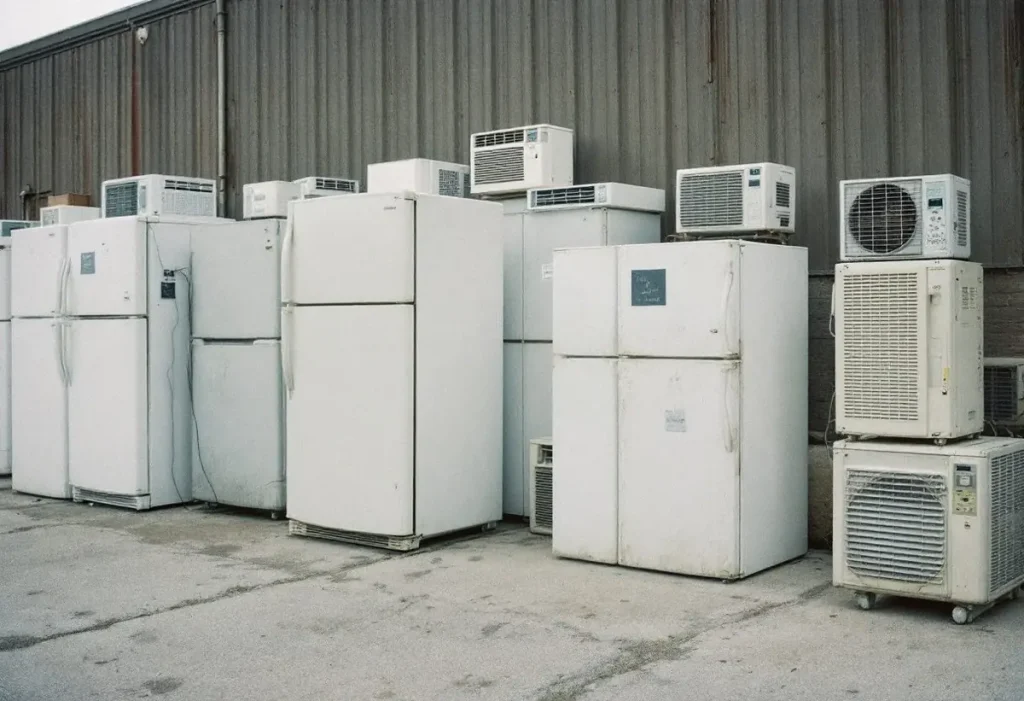
Hauling it away intact is legal; cutting lines or pulling the compressor first is not. EPA’s FAQ tells owners not to tamper with an appliance before disposal and says the Clean Air Act “prohibits the knowing release of most types of refrigerant during appliance disposal.” Under 40 CFR 82.155(b), the final processor, such as a scrap recycler or landfill, must either recover what is left or obtain a signed statement naming who recovered it and when, and keep those statements for three years.
That matters in November, when window units come out and old ones get scrapped. Section 82.155 defines “leaked out” to exclude “deliberate acts such as cutting refrigerant lines”, so a cut line does not turn a full unit into an empty one in the eyes of the rule. The machines and evacuation levels a technician uses are covered in our refrigerant recovery guide.
What can you do if a contractor or neighbor is venting freon?
Report it to EPA through the ECHO violation report form, which EPA’s homeowner FAQ links for exactly this case. Note the date, address and what you saw: a hose discharging to open air with no recovery machine or cylinder on site, or lines being cut. Section 113(f) of the Act lets EPA pay an award of up to $10,000 to a person whose information leads to a criminal conviction or a civil penalty, subject to appropriations.
If the gas is escaping indoors, ventilate first and read our page on what a freon leak in the house means for the people inside. A slow leak from a worn coil is not a crime, and the 2026 HFC leak-repair duties do not reach home systems, as our explainer on the 2026 refrigerant leak repair rules shows.
Frequently asked questions
Why is releasing freon illegal?
Congress wrote the ban into Clean Air Act section 608 because CFCs and HCFCs such as R-22 deplete the stratospheric ozone layer. EPA’s homeowner FAQ says the global phaseout is expected to avoid more than 280 million cases of skin cancer in the United States among people born between 1890 and 2100. HFCs such as R-410A are covered too; EPA calls most of them potent greenhouse gases.
Is it illegal to leak freon?
A leak that happens on its own is not knowing venting under 40 CFR 82.154(a)(1). The violation is the deliberate release during service, repair or disposal. EPA asks homeowners to have technicians locate and repair leaks instead of topping off, and 40 CFR 82.155 says refrigerant has not “leaked out” if it escaped through deliberate acts such as cutting refrigerant lines.
Is it illegal to use freon?
No. EPA’s homeowner FAQ says people can keep using air conditioners that run on HCFC-22, and EPA does not require owners to replace or convert them. No new HCFC-22 has been made or imported into the United States since January 1, 2020, so repairs rely on reclaimed or stockpiled gas handled by a Section 608 certified technician.
How we researched this
In November 2026 we read the current eCFR text of 40 CFR 82.152, 82.154, 82.155, 82.34 and the part 19.4 inflation table (versions in force on October 1, 2026), the statute text of 42 U.S.C. 7671g and 7413 and 18 U.S.C. 3559 and 3571 on Cornell LII, EPA’s homeowner FAQ (last updated April 1, 2026) and EPA’s Title VI enforcement list. We checked 40 CFR part 84 subpart C and found no separate HVAC venting ban there; its new knowing-release ban (84.110) covers fire suppression equipment. We excluded penalty figures from vendor blogs, which quote superseded amounts, and did not cover state rules, which can add requirements. This is not legal advice.
Sources
- eCFR. “40 CFR 82.154, Prohibitions.” https://www.ecfr.gov/current/title-40/chapter-I/subchapter-C/part-82/subpart-F/section-82.154. Accessed November 2026.
- eCFR. “40 CFR 82.152, Definitions.” https://www.ecfr.gov/current/title-40/chapter-I/subchapter-C/part-82/subpart-F/section-82.152. Accessed November 2026.
- eCFR. “40 CFR 82.155, Safe disposal of appliances.” https://www.ecfr.gov/current/title-40/chapter-I/subchapter-C/part-82/subpart-F/section-82.155. Accessed November 2026.
- eCFR. “40 CFR 82.34, Prohibitions and required practices.” https://www.ecfr.gov/current/title-40/chapter-I/subchapter-C/part-82/subpart-B/section-82.34. Accessed November 2026.
- eCFR. “40 CFR 19.4, Statutory civil monetary penalties, as adjusted for inflation, and tables.” https://www.ecfr.gov/current/title-40/chapter-I/subchapter-A/part-19/section-19.4. Accessed November 2026.
- Cornell LII. “42 U.S.C. 7671g, National recycling and emission reduction program.” https://www.law.cornell.edu/uscode/text/42/7671g. Accessed November 2026.
- Cornell LII. “42 U.S.C. 7413, Federal enforcement.” https://www.law.cornell.edu/uscode/text/42/7413. Accessed November 2026.
- Cornell LII. “18 U.S.C. 3559, Sentencing classification of offenses.” https://www.law.cornell.edu/uscode/text/18/3559. Accessed November 2026.
- Cornell LII. “18 U.S.C. 3571, Sentence of fine.” https://www.law.cornell.edu/uscode/text/18/3571. Accessed November 2026.
- US EPA. “Homeowners and Consumers: Frequently Asked Questions.” https://www.epa.gov/ods-phaseout/homeowners-and-consumers-frequently-asked-questions. Accessed November 2026.
- US EPA. “Enforcement Actions under Title VI of the Clean Air Act.” https://www.epa.gov/ozone-layer-protection/enforcement-actions-under-title-vi-clean-air-act. Accessed November 2026.
- US EPA ECHO. “Report Environmental Violations.” https://echo.epa.gov/report-environmental-violations. Accessed November 2026.
Leave a Reply