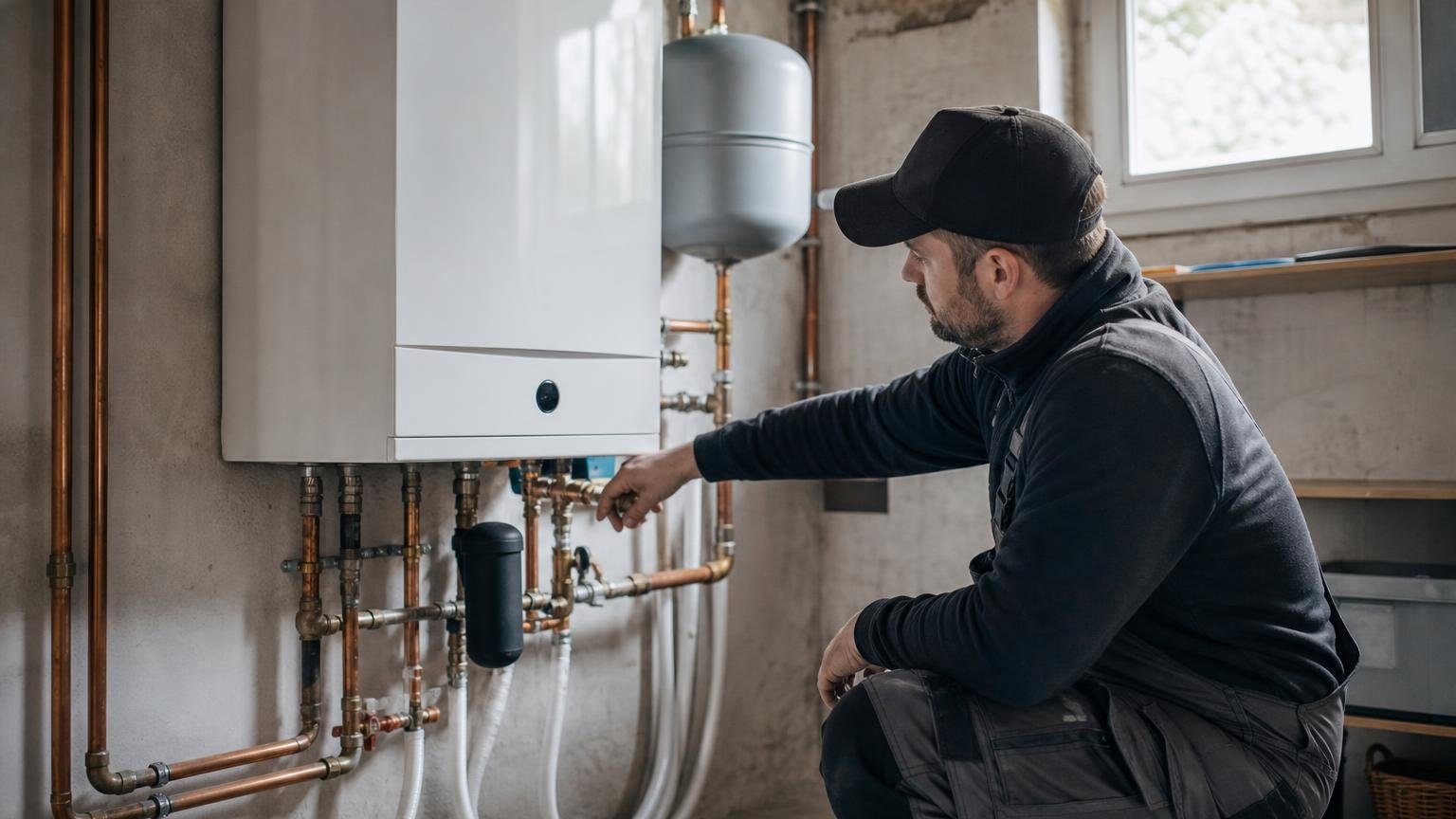
What is a combi boiler? A combi boiler is one wall-hung gas or propane boiler that heats your hydronic loop and also heats tap water on demand, with no storage tank. US models we checked deliver about 4.7 to 4.8 gallons per minute at a 77°F rise, roughly one shower and a sink in the northern US.
Key Takeaways
- DOE’s 2023 test procedure rule treats a combi as a boiler, so a gas combi needs 84% AFUE.
- Navien lists 4.7 gpm at a 77°F rise for its NCB-240/130H, and Lochinvar lists 4.8 gpm for its Noble NKC199N (maker claims).
- The same Navien unit is rated 7.2 gpm at a 50°F rise, 53% more than at a 77°F rise.
- EPA’s groundwater map runs from about 5°C (41°F) on the northern border to 25°C (77°F) in south Florida.
- At the federal 2.5 gpm showerhead limit, a 4.7 gpm combi runs one shower plus a faucet; two 2.0 gpm WaterSense heads need 4.0 gpm.
- DOE says a high-efficiency boiler with an indirect tank “can be the least expensive means of providing hot water” (DOE Energy Saver, archived copy).
What is a combi boiler?
A combi boiler, short for combination boiler, heats a closed hydronic loop of baseboard, radiators or radiant floor, and heats tap water through a separate heat exchanger the moment a hot tap opens. There is no storage tank.
Federal rules have no “combi” product class. 10 CFR 430.2 defines a hot water boiler as one that supplies hot water “for space heating application,” with heat input under 300,000 Btu per hour. DOE’s 2023 test procedure rule says a combination unit meeting that definition is tested under appendix EE and held to the boiler standards.
The heating side works like any other hot water heating system. Two other US designs share the name: oil boilers with a built-in “tankless coil”, and Building America’s condensing water heater feeding a hydronic air coil (NREL, 2014).
How does a combi boiler make hot water on demand?
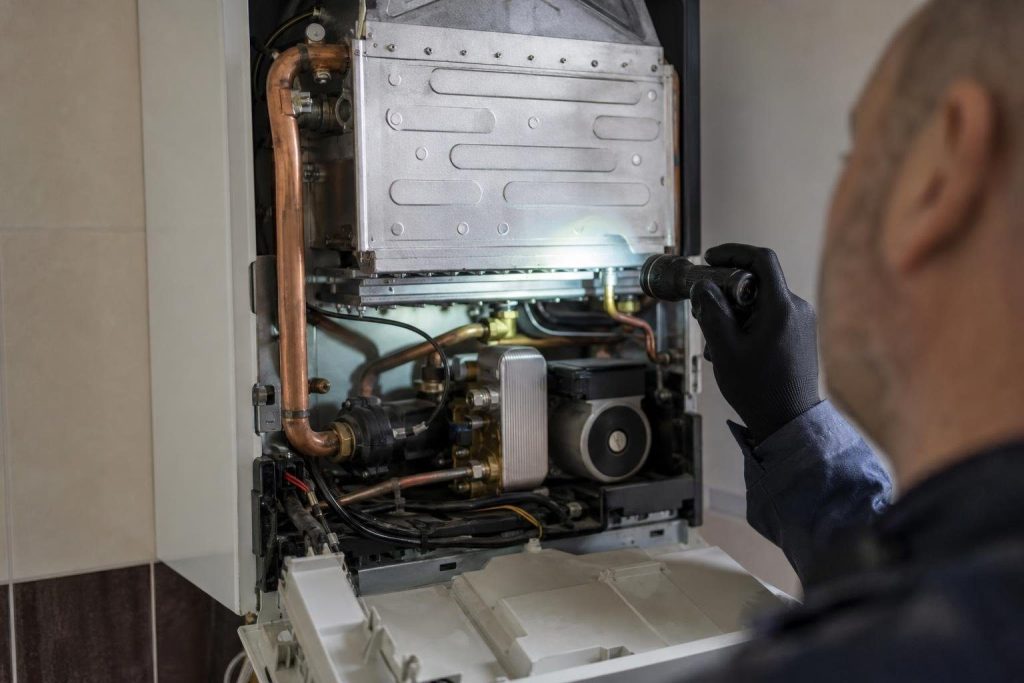
When a hot tap opens, the combi senses flow, swings a 3-way valve to send boiler water through a flat plate heat exchanger, and fires the burner to match the draw. Space heating pauses until the tap closes (Navien NCB-H brochure).
- The flow sensor in the hot water module detects a draw.
- The 3-way valve diverts boiler water from the heating zones to the plate heat exchanger.
- The modulating burner ramps to match flow; Navien lists 15:1 turndown on hot water and 11:1 on heating.
- Cold supply water picks up heat across the plate and leaves at setpoint, adjustable from 86 to 140°F on the NCB-H.
- The tap closes and the valve swings back to heating.
Because the burner is sized for showers, Navien’s NCB-240/130H fires up to 199,900 Btu/h for tap water but only 130,000 Btu/h for heat (Navien QuickFacts).
Condensing efficiency depends on cool return water. DOE’s Building America guideline says to design so return water does not exceed 130°F, which a low-temperature radiant floor does easily.
How many showers can a combi boiler run at once?
Divide the combi’s rated flow at your temperature rise by your shower flow. A Navien NCB-240 rated 4.7 gpm at a 77°F rise runs one 2.5 gpm shower plus a 2.2 gpm faucet with 43°F northern inlet water; with 70°F inlet water it is rated 7.2 gpm, enough for two showers and a faucet.
That is DOE’s method: add the flows used at once (its 0.75 gpm faucet plus 2.5 gpm shower example needs 3.25 gpm) and assume 50°F inlet and 120°F output, a 70°F rise, unless you measure (DOE Energy Saver, archived copy).
EPA’s map puts shallow groundwater near 5°C (41°F) along the northern border, 20°C (68°F) on the Gulf Coast and 25°C (77°F) in south Florida. DOE suggests checking with a thermometer under a cold tap.
| Inlet water (where) | Rise to 120°F | Navien NCB-190 | Navien NCB-240 | 2.5 gpm showers (NCB-240) | 2.0 gpm showers (NCB-240) |
|---|---|---|---|---|---|
| 43°F (northern tier) | 77°F | 3.7 gpm | 4.7 gpm | 1.9 | 2.3 |
| 50°F (DOE default) | 70°F | 4.1 gpm | 5.1 gpm | 2.0 | 2.6 |
| 65°F (mid South) | 55°F | 5.2 gpm | 6.6 gpm | 2.6 | 3.3 |
| 70°F (Gulf Coast, Florida) | 50°F | 5.8 gpm | 7.2 gpm | 2.9 | 3.6 |
Federal law caps showerheads at 2.5 gpm and faucets at 2.2 gpm (10 CFR 430.32(o) and (p)); WaterSense heads use no more than 2.0 gpm. Counting full flow is conservative, since showers blend in cold water.
Read the fine print on “3 showers”. Navien says the NCB-H can run “up to 3 showers and a dishwasher at the same time” but names no inlet temperature. Three 2.5 gpm showers need 7.5 gpm, more than any NCB-H model is rated for at a 55°F rise or higher. Ask for the gpm at your own rise.
To compare with a tankless water heater, use a 67°F rise, the federal test’s 58°F supply and 125°F delivery (10 CFR 430 appendix E). At that rise Navien rates the NCB-240 at 5.4 gpm.
What federal efficiency rules apply to a combi boiler?
Only the boiler rules. Under 10 CFR 430.32(e)(2), a gas-fired hot water boiler made since January 15, 2021 needs at least 84% AFUE and an oil-fired one 86%. AFUE is a space heating rating, so it says nothing about how efficiently the combi heats tap water.
The rule also bans a constant-burning pilot on gas models and requires automatic water temperature adjustment that holds boiler water at no more than 140°F with no heat load. Boilers equipped with tankless domestic water heating coils are exempt from that adjustment requirement.
Neither Navien’s nor Lochinvar’s sheet lists a water heater Uniform Energy Factor. DOE’s consumer page mentions a combined appliance efficiency (CAE) figure, 0.59 to 0.90 across combination systems, but CAE is not the federal compliance metric. When you replace an old boiler, compare AFUE first and hot water gpm second.
Combi boiler vs indirect tank vs tankless water heater: how do they compare?
A combi is one appliance with no tank; an indirect tank stores boiler-heated water so several fixtures can draw at once; a separate tankless water heater gives each job its own burner. DOE calls indirect water heaters “a more efficient choice for most homes.”
| Setup | Hot water limit | Federal rating | Heat during showers | Appliances |
|---|---|---|---|---|
| Combi boiler (Navien NCB-H, Lochinvar Noble) | Burner rating at your rise: 4.7 to 4.8 gpm at 77°F on the largest models | AFUE only | Pauses while tap water runs | One appliance, one vent |
| Boiler plus indirect tank | Stored volume plus boiler recovery | AFUE for the boiler | Depends on the zone controls | Boiler and tank, one vent |
| Boiler plus tankless water heater | DOE: typically 2 to 5 gpm per tankless unit | AFUE plus UEF tested at 58°F in, 125°F out | Unaffected | Two burners, two vents |
| Oil boiler with tankless coil | Boiler water temperature and coil size | AFUE; coil boilers exempt from temperature adjustment | Shares boiler heat | One boiler |
The indirect tank wins on simultaneous draws, because a bathtub or two showers come from storage rather than the burner’s instantaneous rating, and DOE notes the stored energy lets the boiler cycle less often.
A separate tankless water heater keeps heat and hot water independent but adds a second vent. DOE says demand heaters run 24% to 34% more efficient than storage tanks in homes using 41 gallons or less a day (archived copy).
When does a combi boiler fit a US home?
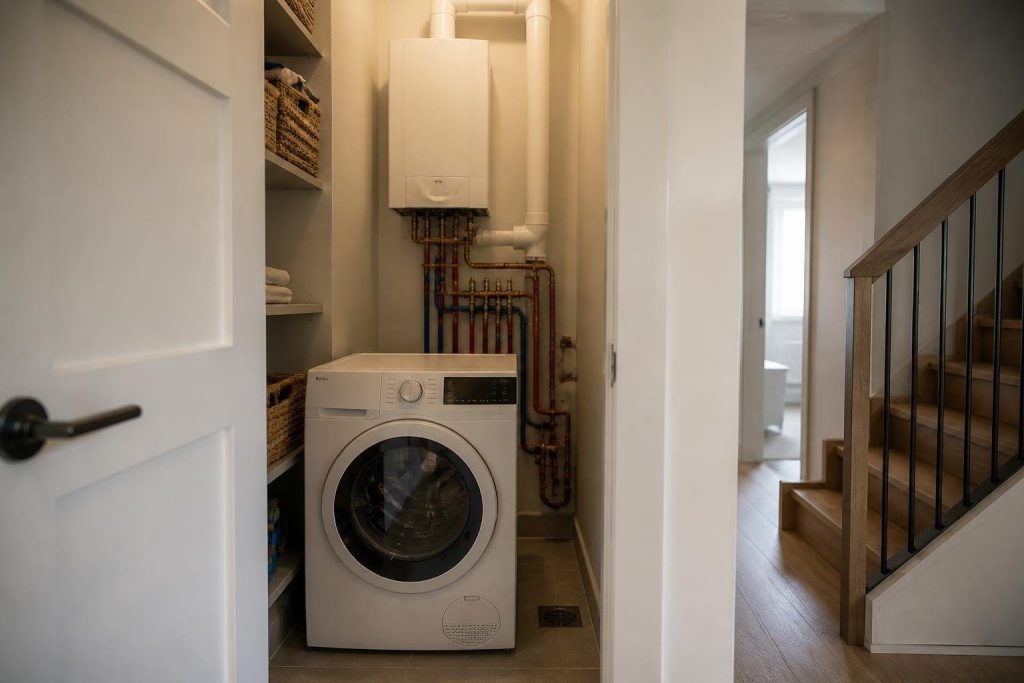
A combi fits when your hot water demand, in gpm at your real temperature rise, stays within its rated flow and your heat load fits its modulation range, usually in homes with one or two bathrooms. DOE says combination systems are best sized by a qualified contractor.
- Measure winter inlet water at a cold tap; subtract it from 120°F.
- Add the flows used at once: 2.5 gpm per shower, 2.2 per faucet.
- Read the maker’s gpm at that rise; Lochinvar lists 5.2 gpm at a 70°F rise for the NKC199N.
- Size the heating side from a heat load calculation, since an oversized boiler short cycles.
- Pick emitters that keep return water under 130°F so the boiler condenses.
Navien says ratings are unchanged when a natural gas NCB-H is converted for propane heat. Homes without gas can consider an electric boiler with a tank.
A big tub or three bathrooms point to an indirect tank, an option our boiler installation explainer also covers. Weigh the scald tradeoffs in our water heater temperature guide in mind; DOE warns that 140°F increases scald risk.
A gas combi still burns fuel indoors, so keep the yearly boiler service visit and a CO alarm placed to code.
How we researched this
Research date: October 9, 2026. We read 10 CFR 430 as in force October 1, 2026, DOE’s 2023 boiler test procedure rule, three archived DOE Energy Saver pages, and Navien and Lochinvar spec sheets. Shower counts are our arithmetic.
Excluded: vendor installed-price surveys (no federal series), UK guides in kW and litres, and a distributor-hosted Viessmann sheet. Reddit was skipped because gas combustion is a safety topic.
Frequently asked questions
Is a combi boiler the same as a tankless water heater?
No. A tankless water heater only heats tap water and is rated by Uniform Energy Factor, tested from 58°F to 125°F. A combi also heats your hydronic loop, so DOE tests it as a boiler under AFUE. DOE puts typical tankless output at 2 to 5 gpm.
How many showers can a combi boiler run at once?
At a 77°F rise, the largest US models we checked are rated 4.7 to 4.8 gpm: one 2.5 gpm shower plus a faucet, or two 2.0 gpm WaterSense showers. With 70°F inlet water, Navien’s NCB-240 is rated 7.2 gpm, enough for two full-flow showers and a faucet.
Why does a combi boiler give less hot water in winter?
Colder inlet water means a bigger rise for the same burner. Navien rates its NCB-240 at 7.2 gpm for a 50°F rise but 4.7 gpm for a 77°F rise. EPA’s map shows shallow groundwater as cold as about 41°F along the northern border.
Can a combi boiler run on propane?
Yes. Navien states that NCB-H ratings are the same for natural gas models converted to propane, and lists a propane supply pressure of 8.0 to 13.5 inches of water column. Lochinvar sells LP versions of the Noble by changing the N in the model number to L.
Does the house still heat while someone showers?
Not while the combi makes tap water: its 3-way valve sends boiler water to the plate heat exchanger instead of the heating zones. Lochinvar’s Noble adds an air handler interlock so hydro-air systems do not blow cool air while the boiler makes domestic hot water.
What AFUE does a combi boiler need?
A gas-fired combi made since January 15, 2021 needs at least 84% AFUE and an oil-fired one 86%, under 10 CFR 430.32. Navien’s NCB-H and Lochinvar’s Noble both list 95.0% AFUE. AFUE measures space heating only, not hot water efficiency.
Sources
- eCFR. “10 CFR 430.32, Energy and water conservation standards.” https://www.ecfr.gov/current/title-10/chapter-II/subchapter-D/part-430/subpart-C/section-430.32. Accessed October 2026.
- eCFR. “10 CFR 430.2, Definitions.” https://www.ecfr.gov/current/title-10/chapter-II/subchapter-D/part-430/subpart-A/section-430.2. Accessed October 2026.
- eCFR. “10 CFR 430, appendix E to subpart B.” https://www.ecfr.gov/current/title-10/chapter-II/subchapter-D/part-430/subpart-B/appendix-Appendix%20E%20to%20Subpart%20B%20of%20Part%20430. Accessed October 2026.
- DOE. “Test Procedure for Consumer Boilers, final rule, 2023.” https://www.energy.gov/sites/default/files/2023-02/consumer-boilers-tp-fr.pdf. Accessed October 2026.
- DOE Energy Saver. “Sizing a New Water Heater (archived copy).” https://web.archive.org/web/2025id_/https://www.energy.gov/energysaver/sizing-new-water-heater. Accessed October 2026.
- DOE Energy Saver. “Tankless or Demand-Type Water Heaters (archived copy).” https://web.archive.org/web/2025id_/https://www.energy.gov/energysaver/tankless-or-demand-type-water-heaters. Accessed October 2026.
- DOE Energy Saver. “Tankless Coil and Indirect Water Heaters (archived copy).” https://web.archive.org/web/2025id_/https://www.energy.gov/energysaver/tankless-coil-and-indirect-water-heaters. Accessed October 2026.
- DOE Building America. “Measure Guideline: Condensing Boilers.” https://www1.eere.energy.gov/buildings/publications/pdfs/building_america/measure_guide_condensing_boilers.pdf. Accessed October 2026.
- EPA. “Shallow ground water temperature map.” https://www3.epa.gov/ceampubl/learn2model/part-two/onsite/tempmap.html. Accessed October 2026.
- EPA WaterSense. “Showerheads.” https://www.epa.gov/watersense/showerheads. Accessed October 2026.
- NREL. “Retrofit Integrated Space and Water Heating: Field Assessment.” https://www.osti.gov/biblio/1132127. Accessed October 2026.
- Navien. “NCB-H brochure and QuickFacts.” https://www.navieninc.com/downloads/ncb-h-brochure-en/download. Accessed October 2026.
- Lochinvar. “Noble combi boiler brochure NKC-07.” https://www.lochinvar.com/lit/NKC_07.pdf. Accessed October 2026.
Leave a Reply