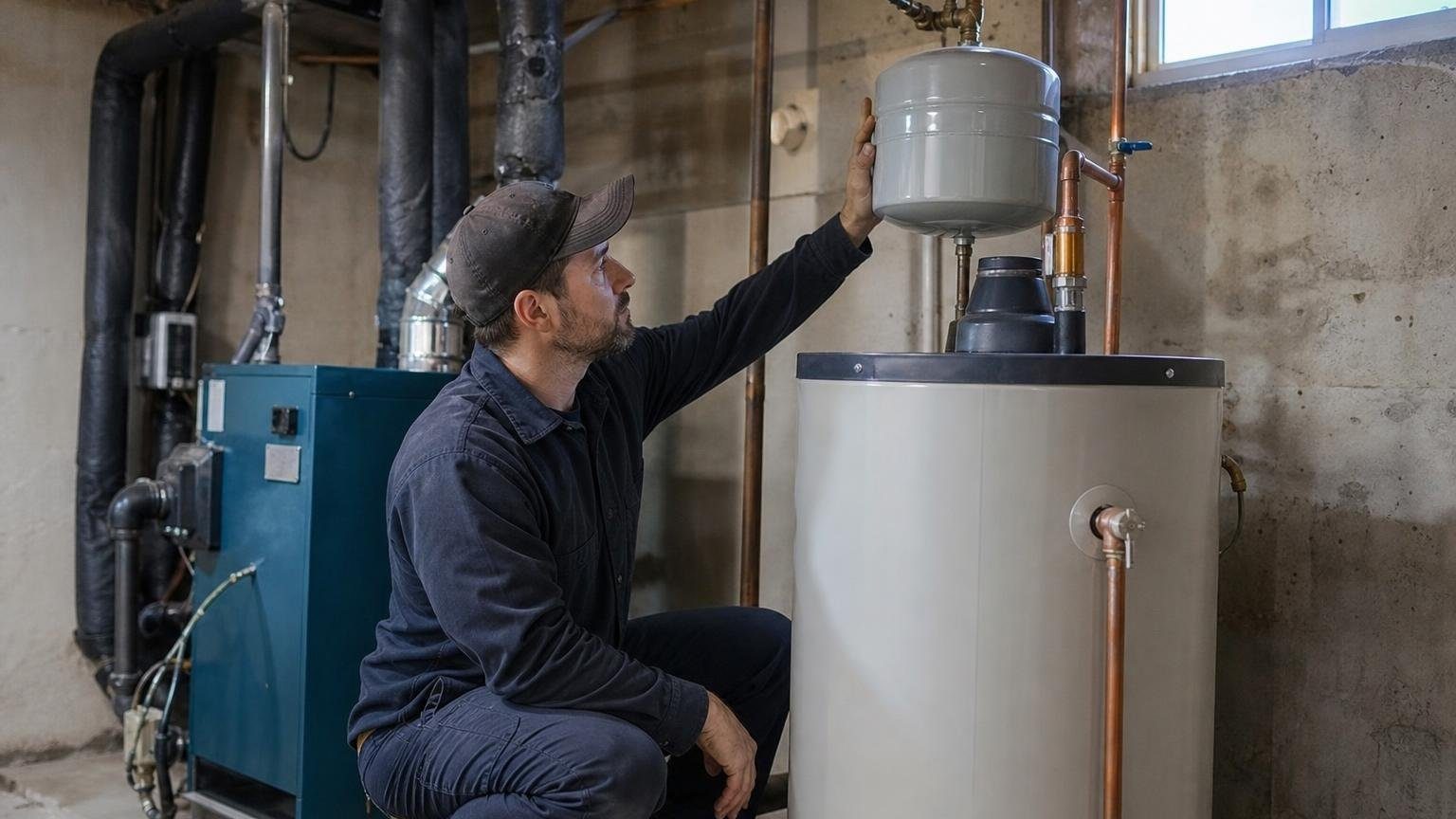
What is an expansion tank? An expansion tank is a small steel tank with an air cushion behind a diaphragm that soaks up water as it heats and expands. Boiler tanks ship near 12 psig; water heater tanks hold drinking water and are set to street pressure.
Key Takeaways
- Water heated from 50°F to 140°F grows 1.7%, about 0.83 gallon in a 50 gallon heater, by our arithmetic on the USGS water density table.
- Amtrol ships Extrol boiler tanks at 12 psig and says to match the boiler fill valve setting (Amtrol Extrol manual, maker claim).
- Amtrol’s Therm-X-Trol charts assume a pre-charge equal to static supply pressure and a 150 psi T&P valve (Therm-X-Trol brochure).
- North Carolina’s plumbing code section 607.3 requires a thermal expansion tank when a storage heater is fed through a check valve, PRV or backflow preventer, per the North Carolina State Fire Marshal.
- Amtrol picks an EX-30 for a 100,000 Btu/h boiler on finned baseboard and an EX-60 on cast iron radiators (Extrol brochure).
- For high boiler pressure, Watts’ ET tank sheet says to check the gauge and the tank’s air charge first, then the fill valve.
What is an expansion tank, and why are there two kinds?
An expansion tank is a steel vessel split by a diaphragm, with water on one side and pressurized air on the other. As heated water grows, the air compresses to make room, holding pressure below the relief valve setting.
Two products share the name. A boiler expansion tank sits on the sealed loop of a hot water heating system. A water heater expansion tank, or thermal expansion tank, sits on the cold supply of a storage heater and holds drinking water.
They are not interchangeable. Amtrol says its Extrol boiler tanks must not go on “domestic water systems,” and Taco’s CX sheet reads “NOT FOR USE WITH POTABLE WATER.” Our inspector’s checklist for tank water heaters covers the rest.
| Item | Boiler expansion tank | Water heater expansion tank |
|---|---|---|
| Water it holds | Closed heating loop water | Drinking water |
| Factory pre-charge (Amtrol) | 12 psig (Extrol EX) | 50 psig (Therm-X-Trol in-line models) |
| Set pre-charge to | Boiler fill pressure | Static supply pressure |
| Relief valve in maker sizing | 30 psig boiler relief | 150 psi T&P valve |
| Where it goes | Boiler supply side, suction side of the circulator | Cold supply, downstream of check valves, PRVs and backflow preventers |
How does an expansion tank work?
An expansion tank works like an air spring. Heated water grows but barely compresses, so the tank stores the growth and returns it as the system cools.
Per the USGS density table, water weighs 0.99975 g/cm³ at 50°F and 0.98338 at 140°F, so hot water takes 1.7% more room. A 50 gallon heater warmed from 50°F to 140°F adds about 0.83 gallon; a boiler loop heated from 50°F to 180°F grows about 3.0%.
Without a working tank, pressure climbs until the relief valve opens. Compare a boiler gauge with our normal boiler pressure readings.
What should expansion tank pressure be?
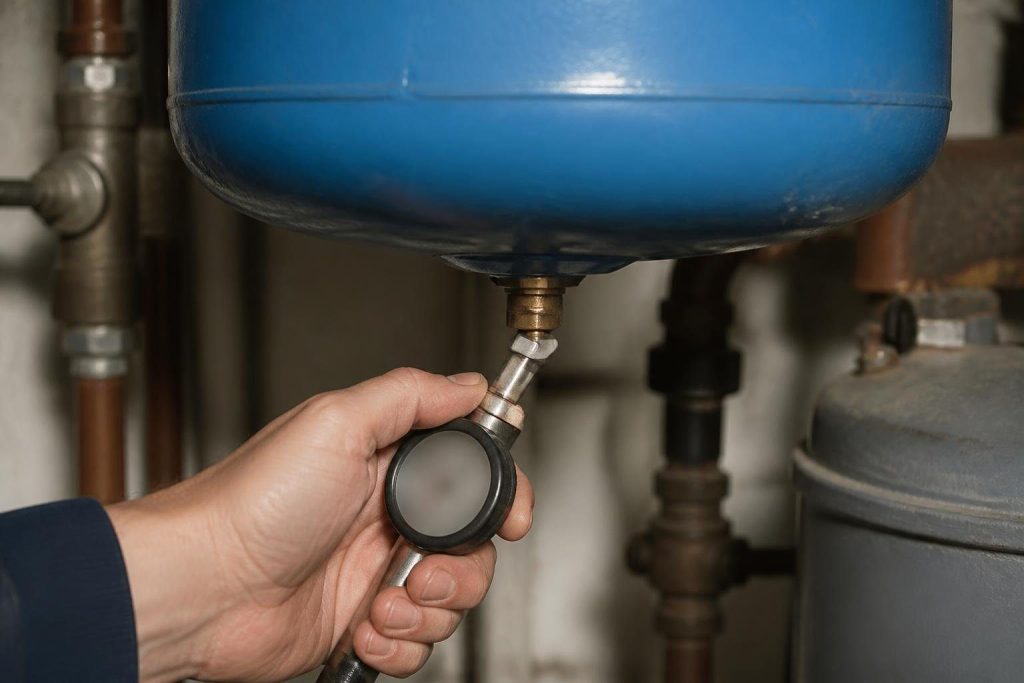
Set a boiler expansion tank to the boiler’s cold fill pressure, usually its 12 psig factory charge, and a water heater expansion tank to the home’s static water pressure. Read both with a tire gauge while the tank is isolated and empty.
The 12 psig default follows from height. Using the USGS figure of 62.424 lb/ft³, a foot of water exerts 0.433 psi, so 12 psi lifts water about 28 feet; taller systems need a higher fill and matching charge. Taco’s CX sheet says its charge should read 11 to 14 psi new and equal fill pressure at the tank.
Temperature moves the gauge. Taco’s chart shows a 12 psi charge set at 68°F reading 10.4 psi at 36°F and 13.6 psi at 100°F, and says to correct it only when off by more than 1 psi.
For potable tanks, Watts says to read system pressure at a gauge with a faucet opened, set the pre-charge to match and never exceed an 80 psi air charge. Amtrol’s in-line Therm-X-Trol ships at 50 psig, so a 60 psi house needs air added.
Checking a boiler tank, per Amtrol and Watts:
- Turn off the boiler and let the water cool; Amtrol sets pre-charge at ambient temperature only.
- Close the tank’s isolation valve, or drop system pressure to zero, and drain the tank.
- Read the air valve with an accurate tire gauge.
- Add or bleed air to match the boiler fill valve setting.
- Reopen, refill, fire the boiler and watch the relief valve.
Amtrol mounts the Extrol on the boiler supply, on the suction side of the circulator pump.
Safety point. Amtrol says its tanks must be installed by a licensed professional, and a corroded or damaged tank replaced with no pre-charge adjustment. A tank check belongs in every annual boiler service visit.
Do you need a thermal expansion tank on a water heater?
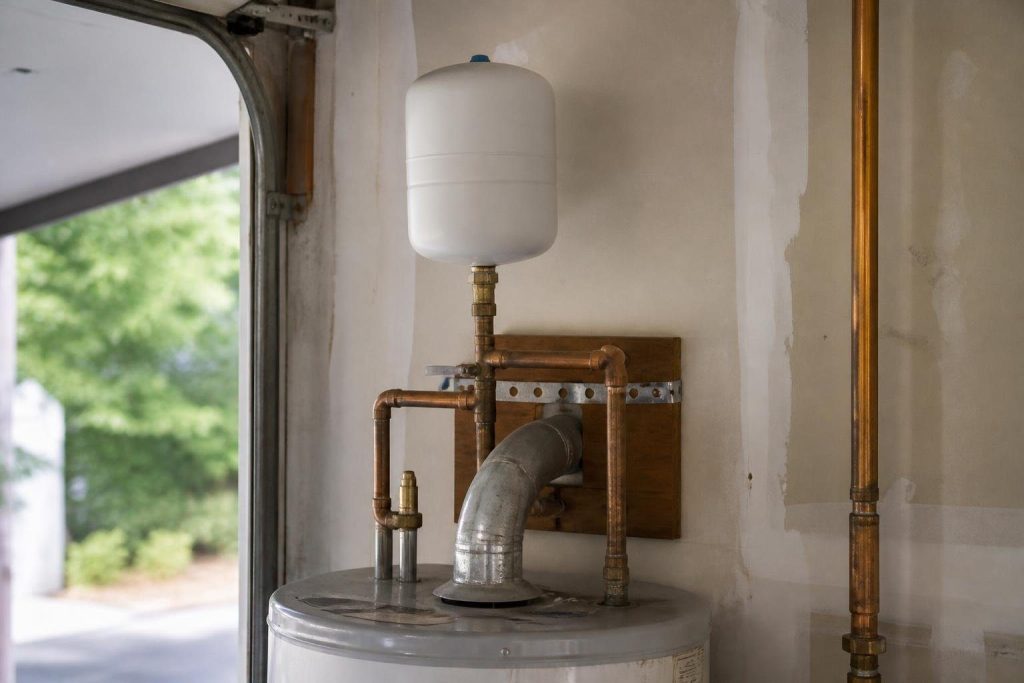
Yes, in most US jurisdictions, if the heater stores water and its supply passes a check valve, pressure reducing valve or backflow preventer. Those devices block expanded water from returning to the street main, which closes the system.
Plumbing codes based on the International Plumbing Code put the rule in section 607.3. In North Carolina’s version, quoted by the North Carolina State Fire Marshal, a thermal expansion tank “shall be connected to the water heater cold water supply pipe at a point that is downstream of all check valves, pressure reducing valves and backflow preventers,” sized to the maker’s instructions.
The residential code says the same in IRC section P2903.4: where a check valve or backflow device sits on a system “using storage water heating equipment” and heat raises pressure, “a device for controlling pressure shall be installed.” The DOE Building America checklist repeats the rule.
North Carolina’s interpretation applies it to water heater replacements too, and says a tankless water heater outside a closed recirculation loop does not need one. Local amendments vary, so confirm with your building department.
How do you size an expansion tank?
Size a boiler expansion tank from boiler output and emitter type, and a water heater expansion tank from heater gallons, temperature and supply pressure, using the maker’s chart, so the tank absorbs expansion before pressure reaches the relief setting.
Amtrol’s Extrol chart assumes a 12 psig fill, a 30 psig relief valve and 180°F average water. It picks larger tanks for cast iron than for finned baseboard, tracking cast iron’s larger water content. Radiant floor systems without barrier tubing or air elimination get Amtrol’s Radiant Extrol.
| Amtrol model | Tank volume (gal) | Max acceptance (gal) | Example chart pick |
|---|---|---|---|
| EX-15 | 2.0 | 1.0 | 50,000 Btu/h, finned baseboard |
| EX-30 | 4.4 | 2.5 | 100,000 Btu/h, finned baseboard |
| EX-60 | 6.7 | 2.7 | 100,000 Btu/h, cast iron radiators |
| EX-90 | 14.0 | 11.3 | 250,000 Btu/h, finned baseboard |
For potable tanks, the Therm-X-Trol chart at 140°F picks the 2.0 gallon ST-5 for a 40 or 50 gallon heater at 40 to 80 psig, and the 4.4 gallon ST-12 for 80 gallons. A 120 gallon heater at 80 psig gets the ST-25V.
Boyle’s law shows why. A 50 gallon heater at 60 psig adds 0.83 gallon; an ST-5 charged to 60 psig squeezes its 2.0 gallons of air to 1.17 and ends near 113 psig, under the 150 psi T&P. An ST-12 ends near 77 psig. A higher water heater temperature setting adds expansion, and Amtrol’s 160°F and 180°F charts step up sooner.
How to tell if an expansion tank is bad
A bad expansion tank shows up as pressure swings: a boiler gauge climbing toward 30 psi when hot, a dripping relief valve, or water at the tank’s air valve. Confirm it on a cold, isolated, drained tank.
Check in this order, from the Watts and Amtrol sheets:
- Rule out the gauge; Watts lists calibration first.
- Read the air charge on the cold, drained tank. Far below fill pressure means the charge is lost.
- Press the air valve briefly. The air side should hold only air, so water there means a failed diaphragm and a new tank.
- On Amtrol tanks with an InSight cap, a discolored tip means replacement, though Amtrol says not to rely on the cap alone.
- Test the fill valve. Watts says to close the shutoff ahead of it, draw down to 12 psi and watch for buildup several hours later. A leaking tankless coil can do the same.
Knocking is a common field check: a waterlogged tank sounds solid, though that is only a hint. If the relief valve still drips, Amtrol says the tank may be “improperly charged or undersized,” and wants the valve inspected at least every 3 years. Our owner checks for a boiler that will not heat cover the rest.
How we researched this
Researched October 2026. We read 20 documents and cite 10 from Amtrol, Watts and Taco (maker claims), USGS, the North Carolina State Fire Marshal, UpCodes and DOE Building America. Expansion percentages, psi per foot and the Boyle’s law example are our arithmetic.
Excluded: Reddit and forums, because pressure and relief valves are a safety topic; vendor prices, because no federal series exists; and codes.iccsafe.org, which blocks automated reading. We read the Taco and Watts ET sheets from InspectAPedia copies.
Frequently asked questions
What is the purpose of an expansion tank?
It absorbs the volume water gains as it heats in a closed system, keeping pressure below the relief setting. Water grows about 1.7% from 50°F to 140°F on USGS data, and Amtrol says its Therm-X-Trol keeps that growth from opening the heater’s relief valve.
Do I really need an expansion tank on my water heater?
Yes, when a storage water heater is fed through a check valve, pressure reducing valve or backflow preventer, under section 607.3 of North Carolina’s IPC based code. Without those devices, expanded water can flow back to the main. Local codes differ.
How much does it cost to replace a water heater expansion tank?
No federal or national lab price series covers expansion tanks, so we do not quote vendor prices. The part is small; Amtrol’s ST-5 holds 2.0 gallons. North Carolina says a replacement heater on a closed system needs an expansion device too, so plan for it.
What can I use instead of an expansion tank?
Codes ask for a means of control. IRC section P2903.4 calls for “a device for controlling pressure,” and North Carolina names a “tank, valve, etc.” North Carolina’s section 607.3 names a tank, so check what your jurisdiction accepts before choosing another device.
What happens if a boiler expansion tank is full of water?
With no air left to compress, loop pressure climbs as the boiler heats and the relief valve may drip. Amtrol says a dripping relief valve can mean the tank is improperly charged or undersized; Watts says to check the air charge when pressure runs high.
Can I use a boiler expansion tank on a water heater?
No. Amtrol says Extrol hydronic tanks must not go on domestic water systems and points to its Therm-X-Trol line. Taco’s CX sheet reads “NOT FOR USE WITH POTABLE WATER.” Amtrol’s in-line potable tanks also ship at 50 psig, not 12.
How often should an expansion tank be checked?
Amtrol says a professional should check the system, including the expansion tank, yearly and more often as it ages, and inspect the relief valve at least every 3 years or after any discharge. Check the charge only with the tank isolated and empty.
Sources
- Amtrol. “EXTROL Installation and Operation Instructions, Part 9015-941.” https://www.amtrol.com/wp-content/uploads/2025/08/9015-941-07_25-Extrol-IO-w_InSight-Cap.pdf. Accessed October 2026.
- Amtrol. “EXTROL brochure MC2680.” https://www.amtrol.com/wp-content/uploads/2025/09/MC2680-09_25-EXTROL-Brochure.pdf. Accessed October 2026.
- Amtrol. “Therm-X-Trol brochure MC4090.” https://www.amtrol.com/wp-content/uploads/2025/10/MC4090-09_25-ThermXtrol-Brochure.pdf. Accessed October 2026.
- Watts. “IS-PLT-35 Installation Instructions.” https://www.watts.com/dfsmedia/0533dbba17714b1ab581ab07a4cbb521/12108-source. Accessed October 2026.
- Watts. “IS-ET Series ET Expansion Tanks” (InspectAPedia copy). https://InspectAPedia.com/heat/Watts-ET-15-90-Expansion-Tank-Manual.pdf. Accessed October 2026.
- Taco. “CX Expansion Tanks Instruction Sheet” (InspectAPedia copy). https://InspectAPedia.com/heat/Taco-CX-Expansion-Tank-Manual.pdf. Accessed October 2026.
- U.S. Geological Survey. “Water Density.” https://www.usgs.gov/special-topics/water-science-school/science/water-density. Accessed October 2026.
- North Carolina Office of the State Fire Marshal. “Thermal Expansion Control, Section 607.3.” https://www.ncosfm.gov/plumbing/06073-thermal-expansion-control-0/open. Accessed October 2026.
- UpCodes. “P2903.4 Thermal Expansion Control, 2024 IRC.” https://up.codes/s/thermal-expansion-control. Accessed October 2026.
- U.S. Department of Energy, Building America Solution Center. “Gas Tank Water Heater checklist.” https://basc.pnnl.gov/home-improvement-expert/checklists/gas-tank-water-heater. Accessed October 2026.
Leave a Reply