
Water heater pilot light out? Smell for gas near the floor first. If there is none, turn the knob to OFF, wait the time on your label, set it to PILOT, hold it down, press the igniter until the pilot lights, keep holding about one minute, then turn to ON.
Key Takeaways
- Rheem’s FVIR label: wait five (5) minutes, then hold the knob about one (1) minute after the pilot lights (Rheem).
- 30, 40 and 50 gallon gas tanks made after July 1, 2003 were expected to meet the FVIR standard, ANSI Z21.10.1 (CPSC).
- Bradford White lists seven causes of a pilot that dies when the button is released; three sit in the valve or thermal switch (Bradford White).
- A pilot lost once a day or once a week points to combustion air, venting or a dirty flame arrestor (same manual).
- DOE modeled a 450 Btu/hr water heater pilot (65 FR 25042); at EIA’s 2025 price that is about $58.37 a year.
- Smell gas? Leave on foot and call 911 from a safe location (PHMSA).
How do I know if my water heater pilot light is out?
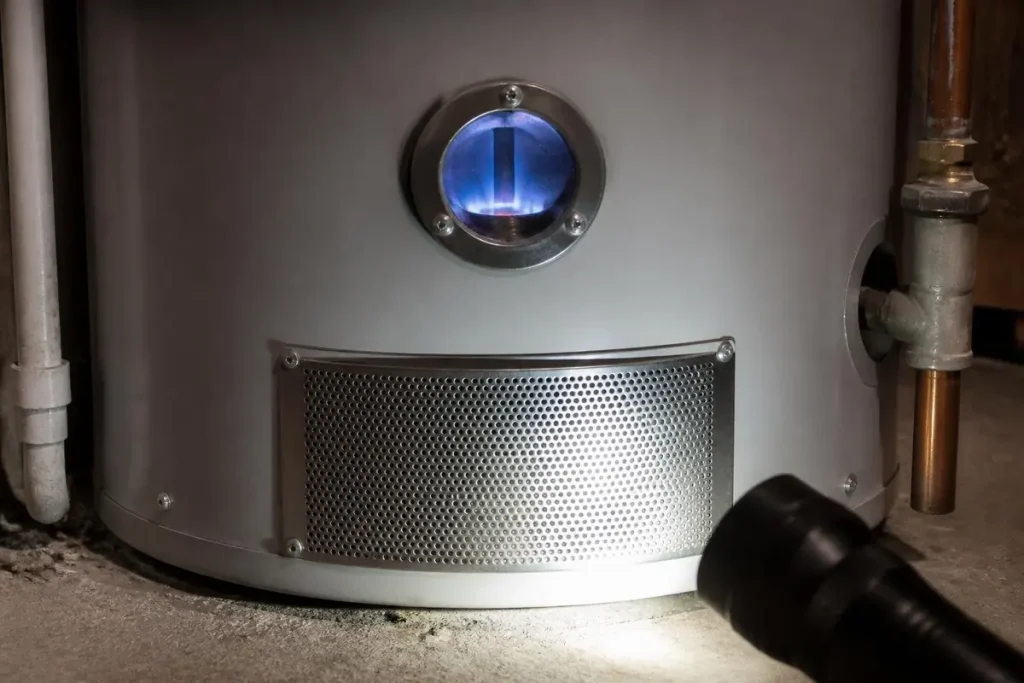
Look through the sight glass on the inner door at the base of the tank. No small flame there, plus cold taps, means the pilot is out. On an FVIR tank, Rheem’s label says the flame “can only be seen through the sight glass window.”
Electronic gas controls also use a status light. In Bradford White’s Honeywell table, no light means the pilot may be out. No hot water with a healthy pilot is a different fault; see our water heater not heating guide
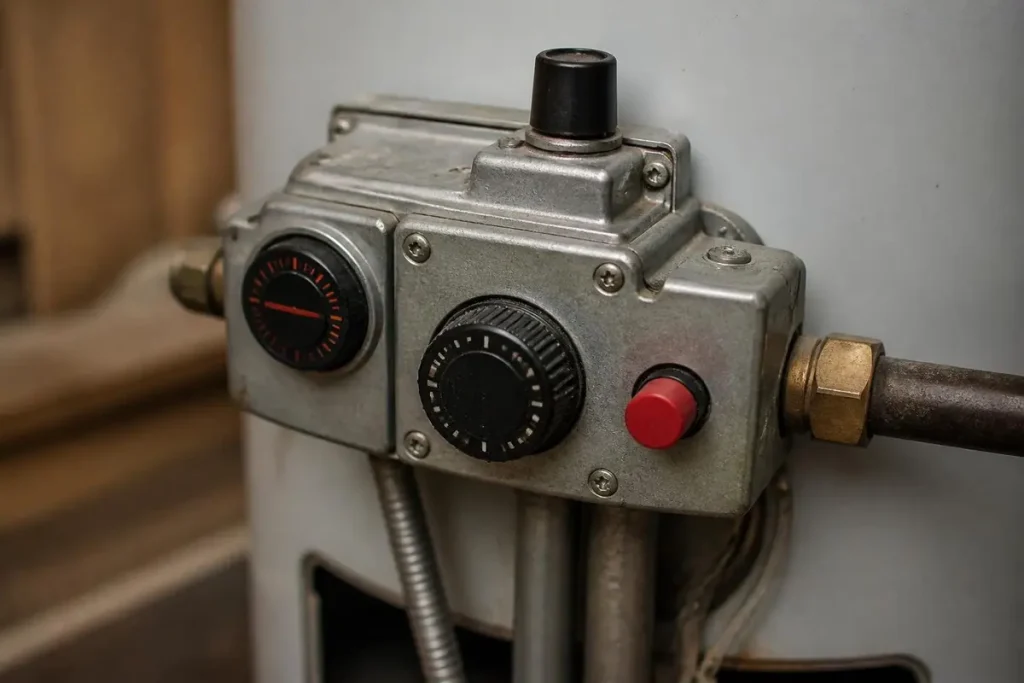
Which kind of ignition does your gas water heater have?
Most gas tanks have a standing pilot lit by a push-button piezo spark. What differs is the sensor in the pilot flame: a thermocouple on a mechanical valve, or a thermopile powering an electronic valve with a status light.
| Setup | Named example | Flame sensor | How you light it |
|---|---|---|---|
| FVIR standing pilot, mechanical valve | Rheem PROClassic gas | Thermocouple | Hold knob at PILOT, press piezo, hold about 1 minute |
| FVIR standing pilot, electronic valve | A.O. Smith ProMax; Bradford White (Honeywell) | Thermopile | Piezo; status light confirms flame |
| Electronic or direct spark lighting | A.O. Smith info center | Varies by model | Hold knob, click igniter about once a second, up to 90 seconds |
A.O. Smith’s ProMax spec sheet says its valve “uses a thermopile to generate the power” it needs (A.O. Smith AOSRG45551, maker claim), which is why such tanks blink codes. Furnaces are a different appliance; see our furnace pilot guide.
How to light a water heater pilot light, step by step
Turn the gas off, wait, check for gas, light at PILOT with the piezo button and hold the knob about a minute before turning to ON. These steps follow Rheem’s FVIR label (Rheem Use & Care, page 17). Your own label wins.
- Set the dial to its lowest setting. Push the knob down slightly and turn it to OFF, by hand only, never with tools or force.
- Wait. Rheem’s label says five (5) minutes; A.O. Smith’s guidance says at least 10 minutes (A.O. Smith info center). Then smell around the tank and near the floor.
- Remove the outer door only; never open the sealed inner door.
- Turn the knob to PILOT, press it fully down and hold. Press the piezo button several times until flame shows in the sight glass.
- Keep holding about one (1) minute, then release. If the pilot goes out, start again.
- Refit the door, turn the knob to ON and set the dial; our temperature setting guide covers the 120 versus 140 degree choice.
The label’s stop rules: if the knob does not pop up, stop and call; if the pilot will not stay lit after several tries, turn to OFF and call a technician or the gas supplier.
What is FVIR, and why does it change the job?
FVIR means flammable vapor ignition resistant: a sealed combustion chamber that keeps a water heater pilot light from igniting gasoline fumes in the room. CPSC said 30, 40 and 50 gallon gas storage heaters made after July 1, 2003 were expected to comply (CPSC, July 8, 2003).
CPSC estimated that vapor ignition by gas water heaters was involved in nearly 800 residential fires a year, with an average of five deaths and 130 injuries. The voluntary standard, ANSI Z21.10.1, added vapor resistance in February 2000 and lint, dust and oil resistance in November 2002.
Each design adds a way for the pilot to go out:
- A.O. Smith: intake filter, flame arrestor and a thermal cutoff (TCO) that shuts gas “if poor combustion is detected” (maker claim).
- Bradford White DEFENDER Safety System: an arrestor plate and a thermal switch that also trips on “lint, dust or oil accumulation on the arrestor plate” (Bradford White 238-51542-00A).
- Rheem: a combustion shutoff device that trips on vapors or blocked air inlets.
A tank that keeps losing its pilot may be protecting itself, which is why air openings at water heater installation matter for years.
Why does the water heater pilot light keep going out?
Timing tells you why. One that dies when you release the knob is a flame sensing or safety shutoff problem. One that runs for hours or days, then goes out, points to air supply, venting or a clogged flame arrestor.
| Symptom | Causes the maker lists | Source |
|---|---|---|
| Pilot will not light at all | Air in gas line, clogged orifice, pinched pilot tube, piezo not sparking | Rheem; Bradford White |
| Goes out when knob is released | Loose or weak thermocouple, open ECO, bad valve magnet, tripped thermal switch | Bradford White; Rheem |
| Goes out after cycles, daily or weekly | Too little combustion air, clogged or wrong vent, dirty flame arrestor | Bradford White |
| Two flashes, three second pause | Weak pilot signal: thermopile, unstable pilot, blocked pilot tube, thermal switch | Bradford White (Honeywell) |
| Pilot on, burner never fires | Dial set low, low gas pressure, valve out of calibration | Bradford White |
Correction: a new thermocouple does not fix every pilot that drops out. Rheem lists an opened “single use gas shut-off device” in the valve (the ECO) and a tripped “combustion shutoff device”, both technician jobs. Bradford White’s thermal switch resets by button, but only after you “determine cause of switch activation.”
Bradford White calls 20 to 30 millivolts good thermocouple output on an open circuit test, with connections finger tight plus 1/4 turn. Thermopile tanks run 350 to 850 mV; below 350mV, replace the pilot assembly. Rheem adds that excessive condensation “can cause pilot burner outage.”
Our guide to combustion and make up air covers air openings; venting faults are also a carbon monoxide risk, so see our CO alarm placement rules.
When should you not relight the water heater pilot?
Not if you smell gas, if any part of the heater has been under water, or after several failed tries. Rheem’s label says a flooded water heater “must be replaced.” Utility gas carries mercaptan, an odorant with a skunk like smell, per PHMSA.
If you smell gas, PHMSA’s guidance is:
- Leave the area by foot immediately; do not try to find the leak.
- Do not create any ignition source, such as an electrical switch or a match.
- Call 911 from a safe location, then notify the gas company (PHMSA).
Rheem adds: use no phone in the building; call the gas supplier from a neighbor’s phone. A discharging T&P valve is a separate fault; our relief valve guide explains what it signals.
How much gas does a water heater pilot light burn?
About 450 Btu an hour, roughly $58 of gas a year at the 2025 national price. DOE used a 450 Btu/hr pilot after the makers’ trade group, GAMA, said that is the size they use (65 FR 25042).
The arithmetic: 450 Btu/h times 8,760 hours is 3,942,000 Btu a year. At 1,036 Btu per cubic foot (EIA), that is about 3,805 cubic feet. At EIA’s 2025 US residential average of $15.34 per thousand cubic feet (EIA), the pilot burns about $58.37 a year, or $4.86 a month.
That is gross gas, not pure waste: part of the pilot’s heat reaches the water, and we found no federal figure for that share. Prices vary; see natural gas prices by state. Replacing an old tank? Our water heater replacement guide covers fuels and federal rules.
How we researched this
Researched October 14, 2026. We read the Rheem and Bradford White FVIR manuals, A.O. Smith’s spec sheet and info center, CPSC’s 2003 release, a DOE Federal Register notice, EIA data and PHMSA guidance: about 15 sources opened, 9 cited.
Maker figures are maker claims for named models. Reddit was skipped (gas safety topic). Contractor blogs and their unsourced hold times were excluded; we give no repair prices because no federal series covers them. The pilot cost is our arithmetic.
Frequently asked questions
Can I relight the pilot light on my water heater myself?
Usually, yes. The lighting label on the tank is written for the owner; Rheem’s has 12 numbered steps. Stop and call a technician or the gas supplier if you smell gas, the knob does not pop up, the heater has been under water, or the pilot will not stay lit after several tries.
How do I reset the pilot light on my water heater?
Most tanks have no pilot reset; you relight from OFF. Bradford White tanks have a resettable thermal switch on the inner door, to be reset only once the cause is found. Rheem says an opened single use shut-off in the gas valve means a technician should replace the control.
Why is my water heater pilot light blinking?
The blink is a status light on an electronic gas valve. In Bradford White’s Honeywell table, one flash with a three second pause means flame is detected, a solid light means the knob was just turned OFF, and two flashes mean a weak pilot signal.
Why won’t my pilot stay lit with a new thermocouple?
Because the thermocouple is only one of seven causes Bradford White lists. An open ECO, a weak gas valve magnet or a tripped thermal switch also drop the pilot. If it lights and later goes out, check combustion air, the vent and the flame arrestor.
How long do you hold the pilot button on a water heater?
Rheem’s label says about one (1) minute after the pilot lights, so the thermocouple can heat. On electronic lighting models, A.O. Smith says click the igniter about once a second for up to 90 seconds. Follow your own tank’s label.
Can you light an FVIR water heater with a match?
No. Rheem’s label says the pilot is lit by a piezo spark system and warns, in capitals, not to open the inner door and light it by hand. The sealed inner door is part of the flame arrestor design CPSC described in 2003.
Should I turn off the water heater pilot light to save gas?
Only if the tank will sit unused, as in a vacation home. A 450 Btu/hr pilot burns about $58.37 of gas a year at the 2025 price, and part of that heat reaches the water. Tankless units are a different design; see our tankless water heater guide.
Sources
- Rheem. “Use & Care Manual, Residential Gas FVIR Certified Water Heaters.” https://res.cloudinary.com/dzhpkjoqj/RheemNew/PROClassicGas_UseInstall. Accessed October 2026.
- Bradford White. “FVIR Water Heaters Service Manual,” 238-51542-00A REV 4/15 (distributor copy). https://www.gtsanders.com/userfiles/documents/Bradford_White_LG155H803N-475_Manual.pdf. Accessed October 2026.
- A.O. Smith. “ProMax Residential Gas Water Heaters, AOSRG45551.” https://assets.hotwater.com/damroot/Original/10005/aosrg45551.pdf. Accessed October 2026.
- A.O. Smith. “How to Light a Pilot Light.” https://www.hotwater.com/info-center/how-to-light-a-pilot-light.html. Accessed October 2026.
- CPSC. “New Technology In Gas Water Heaters Can Save Lives,” July 8, 2003. https://www.cpsc.gov/Newsroom/News-Releases/2003/New-Technology-In-Gas-Water-Heaters-Can-Save-LivesCPSC-GAMA-Say-New-Heaters-Will-Prevent-Fires-from-Flammable-Vapors. Accessed October 2026.
- DOE. 65 FR 25042, water heater standards proposal, April 28, 2000. https://www.federalregister.gov/documents/2000/04/28/00-9847/energy-conservation-program-for-consumer-products-energy-conservation-standards-for-water-heaters. Accessed October 2026.
- EIA. “U.S. Price of Natural Gas Delivered to Residential Consumers,” annual. https://www.eia.gov/dnav/ng/hist/n3010us3a.htm. Accessed October 2026.
- EIA. “Units and calculators explained.” https://www.eia.gov/energyexplained/units-and-calculators/. Accessed October 2026.
- PHMSA. “Pipeline Leak Recognition and What to Do” (archived copy). https://web.archive.org/web/2025id_/https://www.phmsa.dot.gov/safety-awareness/pipeline/pipeline-leak-recognition-and-what-do. Accessed October 2026.
Leave a Reply