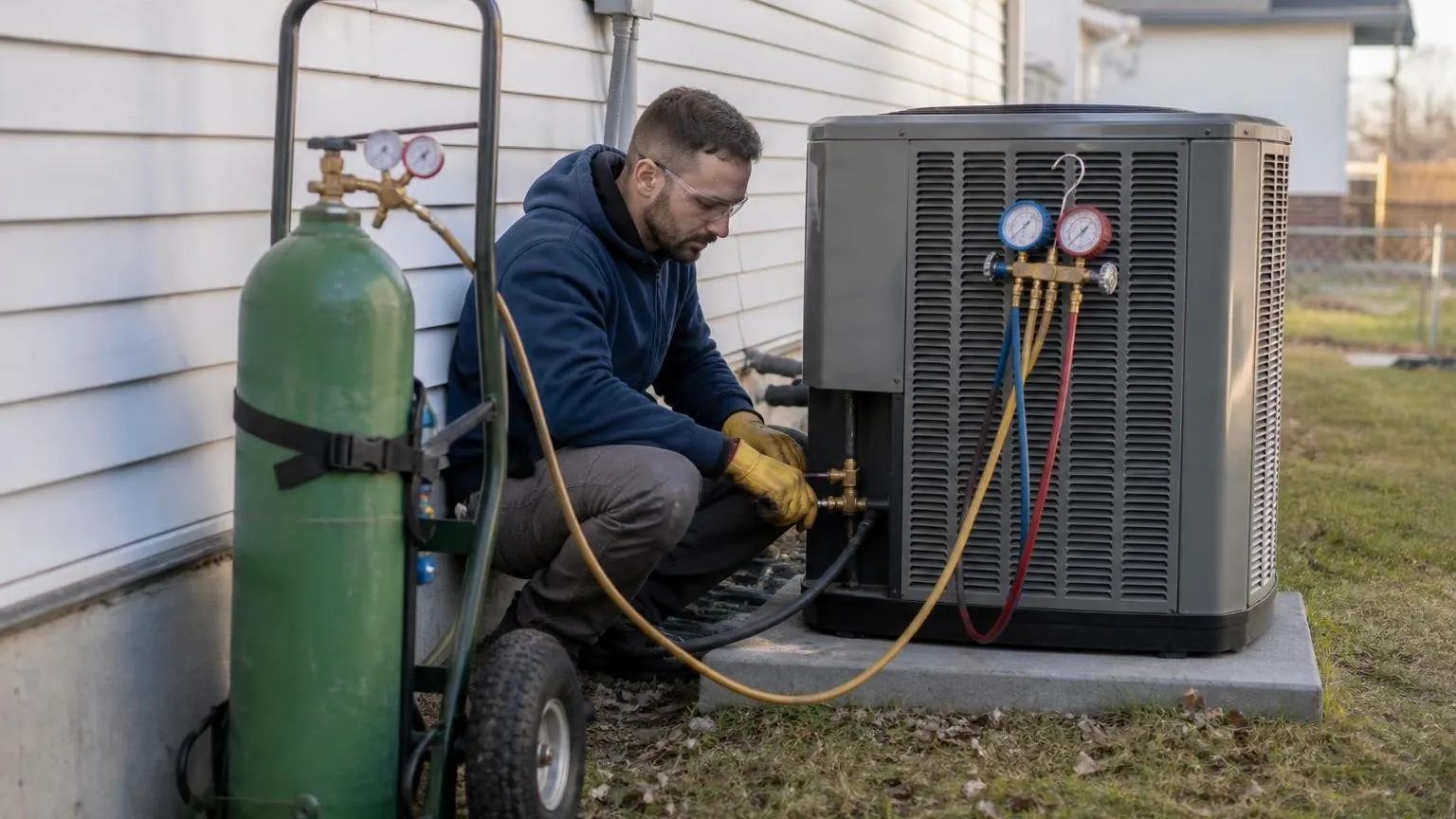
What is a nitrogen pressure test? A nitrogen pressure test fills a brazed refrigerant circuit with dry nitrogen to the test pressure in the equipment manual, then watches the gauge for a drop. Goodman and Daikin specify 450 PSIG for 15 minutes; Mitsubishi steps up to 601 PSIG and waits about a day.
Key Takeaways
- Goodman’s GSX manual calls for 450 PSIG of dry nitrogen held at least 15 minutes, with a regulator and a relief valve set no higher than 450 psig (Goodman IO-258W).
- Mitsubishi’s MXZ-SM manual pressurizes in steps of 73, 218 and 601 PSIG and passes the pipe if it holds for about one day (Mitsubishi Electric).
- Rheem’s R-454B instructions use nameplate design pressure and a 60 minute hold (Rheem).
- Never oxygen or air: Bryant warns oxygen mixtures “can lead to an explosion” (Bryant).
- Venting test nitrogen is legal: 40 CFR 82.154 exempts “Nitrogen in any application” from the venting ban (eCFR).
- By our gas law arithmetic (NIST SP 811 constants), a 20°F overnight cooldown takes a tight 450 psig test to about 433 psig.
What is a nitrogen pressure test, and why dry nitrogen?
A nitrogen pressure test, also called a standing pressure test, proves a new or repaired refrigerant circuit is tight before it is evacuated and charged. Dry nitrogen is used because it is inert, carries no moisture and is exempt from the federal venting ban, so it can be released when the test ends.
It sits between brazing and evacuation: a new line set run between the coil and condenser gets brazed, pressurized with nitrogen, held, then released and pumped down with an HVAC vacuum pump and micron gauge. Daikin’s DAQ instructions also allow dry helium and add: “No refrigerant shall be used for pressure testing to detect leaks.”
The test shows whether the circuit holds; finding the leak takes bubbles or a detector, covered in our guide to refrigerant leak detection methods.
What do you need before a nitrogen pressure test?
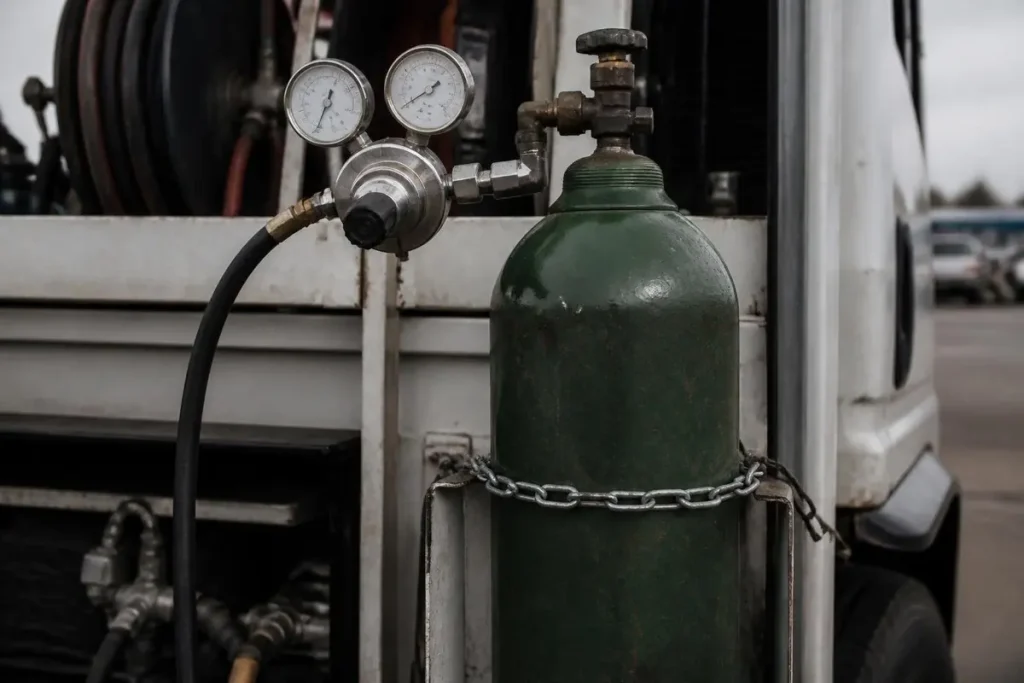
You need dry nitrogen, a regulator with a relief valve, hoses and gauges rated above the test pressure, a thermometer and bubble solution. Goodman’s manual makes the regulator and relief valve mandatory, with the relief “set to open at no more than 450 psig.”
Gauge. An analog or digital manifold gauge set, or a single test gauge. Bryant specifies hoses with a 700 psig service rating for Puron work; Rheem specifies 800 psig hoses for R-454B.
Core tool. Rheem removes the Schrader cores before brazing “to protect seals from heat damage.” Our Schrader valve explainer covers cores and caps.
Thermometer. Mitsubishi tells installers to “measure the surrounding temperature” at full pressure, because the reading moves with it.
Safety: no oxygen, no shop air
Goodman: “never use oxygen, high pressure air or flammable gases for leak testing.” Rheem warns that oxygen “reacts violently with oil.” OSHA’s welding rule, 29 CFR 1910.253, says a jet of oxygen “must never be permitted to strike an oily surface,” and every compressor circuit holds oil.
What nitrogen pressure test psi do equipment makers specify?
The manual for the unit on the job sets the number, and the documents we read range from 300 to 601 PSIG. There is no single “R-410A test pressure.”
| Document | Equipment | Test pressure | Hold | Pass rule |
|---|---|---|---|---|
| Goodman IO-258W (July 2021) | GSX condensing unit, R-410A | 450 PSIG | 15 minutes minimum | Does not drop below 450 PSIG |
| Daikin IOD-1063A (August 2024) | DAQ air handler, R-32 | 450 PSIG, nitrogen or helium | 15 minutes minimum | Does not drop below 450 PSIG |
| Mitsubishi MXZ-SM manual (2021) | Multi-zone outdoor unit, R-410A | 73, then 218, then 601 PSIG | 5 minutes per step, then about one day | Pressure does not decrease, after temperature correction |
| Rheem RP14AY/RP15AY | Heat pump, R-454B | Nameplate design pressure | 60 minutes | No drop; soap the braze joints if it falls |
| EPA GreenChill guideline | Commercial refrigeration | 300 psig minimum | 24 hours | No more than 1 pound change, same gauge |
One caution: Rheem’s R-454B manifold spec reads the low side only to 250 psig with a 550 psig retard, so read a 450 or 601 PSIG test on a gauge rated for it.
How do you pressure test AC lines with nitrogen, step by step?
Pressurize the line set and indoor coil through the service ports with the outdoor unit’s valves shut, raise pressure in stages, then isolate the cylinder and hold. Rheem says to “be certain both refrigerant shutoff valves at the outdoor unit are closed.”
- Finish brazing with nitrogen flowing, let joints cool, and reinstall the Schrader cores.
- Connect the regulator, relief valve and hose; Mitsubishi uses both the liquid and gas service ports.
- Raise pressure in steps. Mitsubishi’s sequence is 73 PSIG and 218 PSIG with a five minute wait at each, then full pressure.
- Bubble every braze joint and flare nut at each step, while the pressure is still low.
- At full pressure, close the cylinder valve, as Rheem specifies, and record pressure, time and pipe temperature.
- Hold for the manual’s time and compare temperature corrected readings.
- Pass: release the nitrogen and evacuate. Fail: find the leak, repair, repeat.
That staged sequence comes from a multi-zone mini split manual, which also says to “use a leak detector or soapy water to check for gas leaks at the pipe connection sections.” On any mini split installation, that means every flare nut.
Why flow nitrogen while brazing?
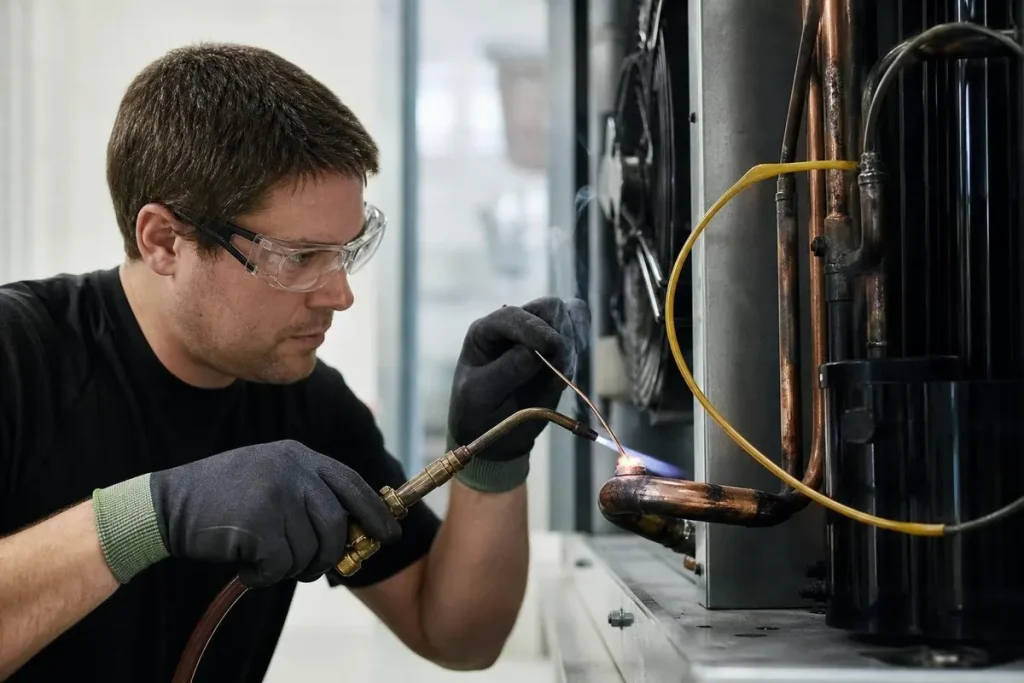
Flowing nitrogen during brazing keeps copper oxide scale from forming inside the joint. Goodman explains that the POE oil in R-410A systems “will clean any copper-oxide present from the inside of the refrigerant lines and spread it throughout the system,” which “may cause a blockage or failure of the metering device.”
A brazing purge is a flow, not a pressure test. Rheem says to flow dry nitrogen “while brazing, but do not allow pressure inside tubing which can result in leaks,” and to turn the regulator off once the system is full. Rheem states it flatly: “nitrogen must be flowed while brazing.”
A liquid line filter drier traps debris ahead of the metering device,, a backstop rather than a substitute for the purge. Our refrigerant oil explainer covers why POE behaves differently from mineral oil.
How long should a nitrogen pressure test hold, and how do you correct for temperature?
Hold it for the manual’s time: 15 minutes for Goodman and Daikin, 60 minutes for Rheem, about one day for Mitsubishi and 24 hours in EPA’s GreenChill guideline for commercial refrigeration. On long holds, correct for temperature before calling it a leak.
Nitrogen in a sealed circuit follows the gas law: P1 / T1 = P2 / T2, with both values absolute. Add 14.7 to gauge psi (one standard atmosphere is 14.696 psi in NIST SP 811) and add 459.67 to °F to get degrees Rankine.
Worked example: a line set reaches 450 psig at 85°F in the afternoon and is read at 65°F the next morning.
- Absolute start pressure: 450 + 14.7 = 464.7 psia.
- Temperatures: 85 + 459.67 = 544.67°R and 65 + 459.67 = 524.67°R.
- Expected pressure: 464.7 × 524.67 ÷ 544.67 = 447.6 psia, which is 432.9 psig.
A reading near 433 psig passes, though it sits 17 psi below the start. Mitsubishi’s rule of thumb is about 1.5 PSIG per 1°C (1.8°F). Our arithmetic at 601 PSIG and 77°F gives about 1.15 psi per °F, or 2.1 psi per °C, so use the formula rather than the shortcut on a long hold.
GreenChill also says to read start and finish “using the same gauge.”
Can you add refrigerant to the nitrogen to find a leak?
Some manuals allow a small trace charge, others forbid it, and federal guidance on venting the mixture is narrow. Goodman’s method charges “to 10 PSIG with the appropriate system refrigerant” and finishes to 450 PSIG with nitrogen so an electronic detector can sniff it. Daikin’s DAQ manual says no refrigerant shall be used.
The federal baseline is 40 CFR 82.154(a)(1): no one servicing an appliance may knowingly vent refrigerant, while “Nitrogen in any application” is exempt. EPA’s older Section 608 fact sheet said “mixtures of nitrogen and R-22 that are used as holding charges or as leak test gases may be released” (archived copy).
That page addressed ozone-depleting refrigerants such as R-22. Current 82.154 text has no trace gas clause, and we found no EPA statement extending the allowance to R-410A, R-454B or R-32. EPA’s GreenChill guideline “does not condone the use of fluorinated refrigerants” as tracers. The cautious course is to recover a traced charge with the equipment described in our refrigerant recovery guide; 82.154(c) already limits refrigerant sales to buyers with EPA 608 certification or their employers.
How we researched this
Researched October 18, 2026. We read 15 primary documents and cite 10: manuals from Goodman, Daikin, Mitsubishi Electric, Rheem and Bryant, 40 CFR 82.154 and 29 CFR 1910.253 via the eCFR API, two EPA documents and NIST SP 811. The temperature correction is our own arithmetic. Maker figures apply to named models.
Excluded: blog and tool-seller test pressures that traced to no manual, and prices, which no federal series covers. Reddit was not used because this is a safety topic.
Frequently asked questions
What psi should a nitrogen pressure test be for R-410A?
Use the figure in the installation manual for the unit. Goodman’s GSX manual specifies 450 PSIG with a relief valve set no higher than 450 psig, while Mitsubishi’s MXZ-SM manual steps up to 601 PSIG. Test pressure is not the operating pressure shown on a refrigerant pressure chart.
Why did my nitrogen pressure test drop overnight?
Usually temperature, not a leak. By our gas law arithmetic, a sealed 450 psig test that cools from 85°F to 65°F should read about 433 psig. Mitsubishi tells installers that a 1°C change moves pressure about 1.5 PSIG and to “make the necessary corrections.” A drop beyond the corrected figure means a leak.
Can you pressure test an AC with compressed air instead of nitrogen?
No. Bryant’s installation instructions say “never use air or gases containing oxygen for leak testing,” because pressurized mixtures containing oxygen “can lead to an explosion.” Goodman’s manual likewise bans oxygen, high pressure air and flammable gases for leak testing, and requires a pressure regulator and relief valve on the nitrogen line.
Is it legal to vent the nitrogen after the test?
Yes, for straight nitrogen. 40 CFR 82.154(a)(1) exempts “Nitrogen in any application” from the federal venting ban, and EPA’s GreenChill guideline says to release the nitrogen charge to the atmosphere with adequate ventilation. A charge traced with refrigerant is a different question, covered above.
Does a vacuum test replace a nitrogen pressure test?
No. A vacuum can only load joints by one atmosphere, about 14.7 psi, while Goodman’s test pushes 450 PSIG against them. Goodman and Daikin both run the standing pressure test first, then the deep vacuum. The vacuum decay test checks moisture and tightness at low pressure.
How much does an AC nitrogen pressure test cost?
We found no federal or national lab price series for it, so we do not publish a figure. Goodman, Rheem and Mitsubishi all list the test as an installation step. Hold time drives labor, from 15 minutes in Goodman’s manual to about a day in Mitsubishi’s.
Sources
- Goodman Manufacturing. “Condensing Unit Air Conditioning Installation & Service Reference, IO-258W.” July 2021. https://www.budgetheating.com/content/files/downloadables/gsx%20-%20installation%20manual.pdf. Accessed October 2026.
- Daikin Comfort Technologies. “DAQ Series Installation Instructions, IOD-1063A.” August 2024. https://daikincomfort.com/docs/default-source/daq-series-r-32/im-iod-1063a.pdf. Accessed October 2026.
- Mitsubishi Electric. “MXZ-SM36/48/60NAM, MXZ-SM36/42/48NAMHZ Installation Manual.” 2021. https://s1.img-b.com/build.com/mediabase/specifications/mitsubishi/1972912/mitsubishi-mxz-sm36namhz-2-msz-fs12na-msz-fs15na-installation-sheet.pdf. Accessed October 2026.
- Rheem Manufacturing. “RP14AY, WP14AY, RP15AY R-454B Heat Pump Installation Instructions.” 2023. https://www.budgetheating.com/content/files/downloadables/rp14ay%20wp14ay%20rp15ay%20installation%20instructions.pdf. Accessed October 2026.
- Bryant. “113A/114C Split System Air Conditioner Installation Instructions.” https://resource.carrierenterprise.com/is/content/Watscocom/bryant_114cnc018000_article_1457429453457_en_ii1. Accessed October 2026.
- eCFR. “40 CFR 82.154, Prohibitions.” https://www.ecfr.gov/current/title-40/chapter-I/subchapter-C/part-82/subpart-F/section-82.154. Accessed October 2026.
- U.S. EPA. “Complying With The Section 608 Refrigerant Recycling Rule” (archived copy). https://web.archive.org/web/20101221074352/http://www.epa.gov/ozone/title6/608/608fact.html. Accessed October 2026.
- U.S. EPA. “GreenChill Best Practices Guideline: Ensuring Leak-Tight Installations of Commercial Refrigeration Equipment.” https://www.epa.gov/sites/default/files/documents/LeakGuidelines.pdf. Accessed October 2026.
- eCFR. “29 CFR 1910.253, Oxygen-fuel gas welding and cutting.” https://www.ecfr.gov/current/title-29/subtitle-B/chapter-XVII/part-1910/subpart-Q/section-1910.253. Accessed October 2026.
- NIST. “Special Publication 811, Guide for the Use of the International System of Units.” 2008. https://nvlpubs.nist.gov/nistpubs/Legacy/SP/nistspecialpublication811e2008.pdf. Accessed October 2026.
Leave a Reply