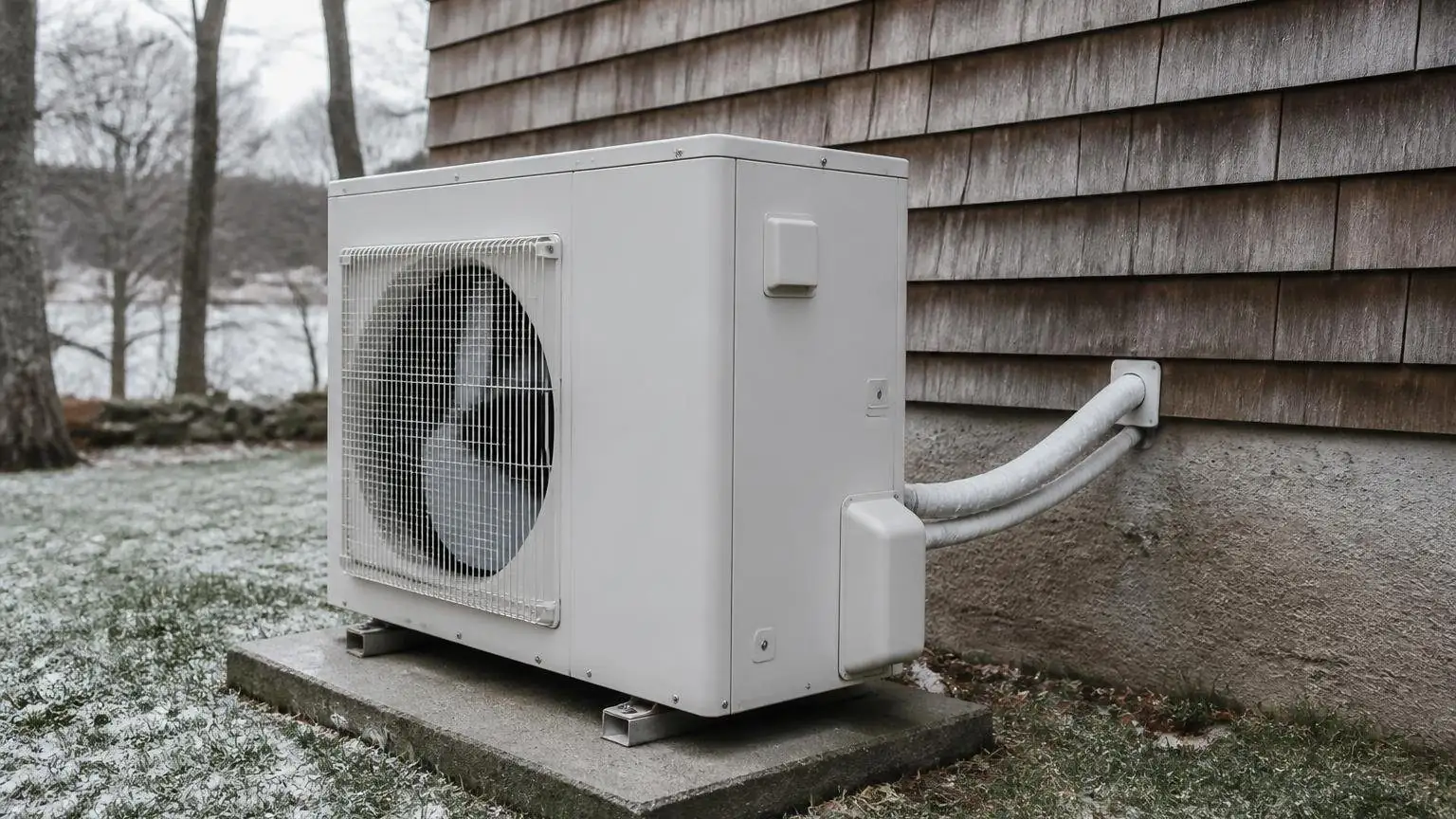
What is an air to water heat pump? An air to water heat pump is an electric heat pump that pulls heat from outdoor air and puts it into water for radiant floors, radiators and fan coils. It can replace or back up a boiler, and it runs most efficiently at low water temperatures.
Key Takeaways
- Arctic’s 035ZA falls from COP 3.63 to 2.54 at 35.6°F outdoors as water rises from 95°F to 140°F, per its maker’s performance table.
- DOE classes these units as consumer boilers with “no AFUE requirements,” per the May 2024 Federal Register.
- ENERGY STAR’s 2019 to 2020 award required COP 1.7 or better at 5°F air and 110°F water, per the award criteria.
- Two NREL test homes measured seasonal heating COPs of 3.26 and 4.18, per a 2013 field report (archived copy).
- SpacePak rates its Solstice CC32 to -22°F outdoors and 140°F water, per its CC32 submittal sheet.
What is an air to water heat pump?
An air to water heat pump (AWHP) is an outdoor heat pump whose indoor side is a refrigerant-to-water heat exchanger instead of an air coil. NREL’s Building America report describes AWHPs as units that “substitute a refrigerant-to-water heat exchanger for the customary refrigerant-to-air indoor air coil.” That water then feeds a hydronic heating system.
They come in two layouts. A monobloc keeps all refrigerant in the outdoor unit and sends water through the wall; SpacePak calls its CC32 an “eco-conscious and future-proof monobloc design.” A split runs a refrigerant line set to an indoor hydronic module; SpacePak’s Solstice SIS ships with a 35-foot line set and says the split design can reduce the use of glycol in the water loop.
How does an air-to-water heat pump work?
An air-to-water heat pump runs the same refrigeration cycle as any heat pump, but it hands the heat to water:
- The outdoor fan pulls air across the coil, and cold refrigerant absorbs heat from it.
- The compressor raises the refrigerant’s pressure and temperature.
- The refrigerant gives up its heat to the water in a refrigerant-to-water heat exchanger.
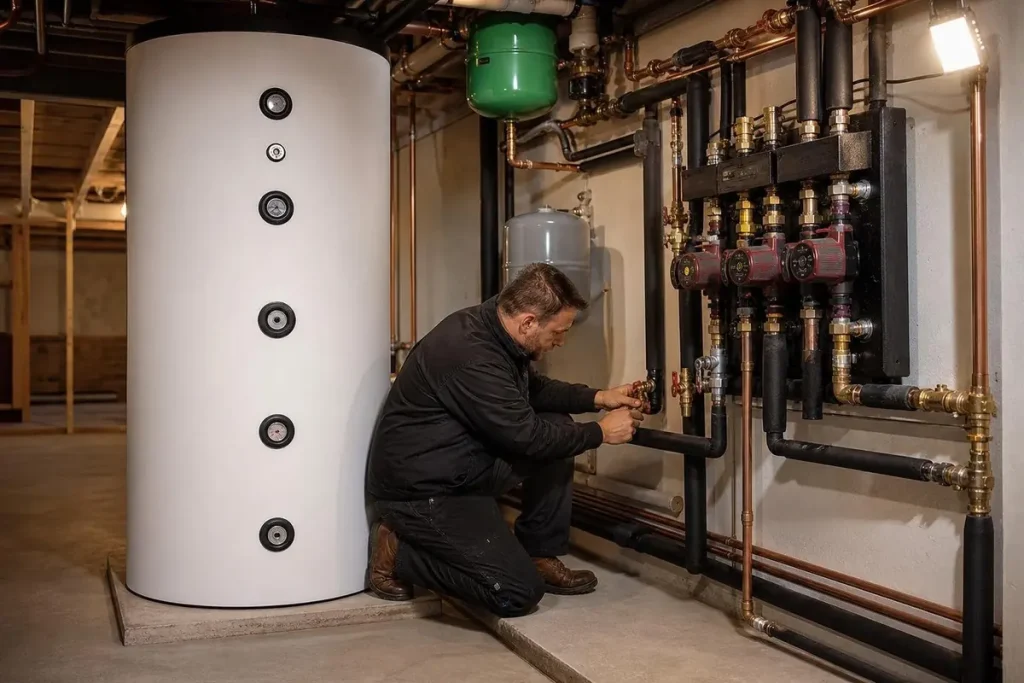
- A circulator moves the water to a buffer tank or straight to the emitters, and zone thermostats draw heat as rooms call.
Arctic’s installation manual says the heat pump only holds the buffer tank at a set temperature. In defrost the unit reverses to cooling and removes “some heat from the buffer tank” to clear the coil, which is one reason makers specify a tank. Air-to-air units run a similar defrost cycle.
Why does water temperature decide air to water heat pump efficiency?
Hotter water means lower COP, because it widens what NREL calls the “thermal lift,” the gap between condenser and evaporator temperatures. In the maker tables below, COP at a fixed outdoor temperature falls by 30% to 59% between 95°F and 140°F water.
| Model (source) | Outdoor air | COP, 95°F water | COP, 120 to 122°F water | COP, 140°F water |
|---|---|---|---|---|
| Arctic 035ZA | 35.6°F | 3.63 | 2.84 | 2.54 |
| Arctic 035ZA | 5°F | 2.60 | 2.01 | 1.74 |
| SpacePak CC32-40 | 32°F | 3.36 to 4.43 | 2.18 to 2.82 | 1.49 to 1.86 |
| SpacePak CC32-40 | 5°F | 2.60 to 3.34 | 1.76 to 2.25 | 1.08 to 1.36 |
| Daikin Altherma (via NREL) | 45°F | 4.37 | not reported | not reported |
Arctic’s values come from its 035ZA performance table, whose middle column is 122°F. SpacePak prints a COP range per cell in its CC32-40 heating table. NREL reports the Altherma rating at 45°F outdoors and 95°F supply water.
One caveat: NREL found performance “most dependent on outdoor air conditions with less than expected sensitivity” to load-side water temperature in its two hot-dry test homes, so treat the table as a design guide.

Which emitters work with an air-to-water heat pump?
Emitters sized for low water temperatures work best: slab radiant floor heating, low-temperature panel radiators and hydronic fan coils. Fin-tube baseboard sized for boiler water is the hard case.
Myth check: “It plugs into any boiler system.” Not reliably. In DOE’s 2023 boiler rulemaking, boiler makers Crown and U.S. Boiler told DOE that traditional boilers deliver water “at a temperature of 180 °F or higher,” while hydronic heat pumps are “mostly incapable of reaching above 150 °F on a design day.” Those are industry comments, but maker sheets show the ceiling: 140°F for the CC32, 131°F for SpacePak’s SIM monobloc.
Older boiler and baseboard heating loops sized for hotter water can leave rooms short on design days. DOE’s Energy Saver guide (archived copy) says that because “dry” radiant floors heat an air space under the subfloor, the system “needs to operate at a higher temperature.” In a ducted house, the hydro air system route puts a water coil in the air stream instead.
Can an air-to-water heat pump cool and make hot water?
Yes. Most can cool by sending chilled water to fan coil units, and many can heat a domestic hot water tank. Radiant floors can cool only where the floor stays above the indoor dew point.
NREL’s field study found radiant-only cooling caused no floor condensation or comfort problems in California’s dry Central Valley. Its model found radiant cooling “not appropriate in humid climates,” and advised some form of dehumidification “in all but the driest climates,” which a fan coil upstream of the floor can supply.
Hot water is weaker. The same study found water heating performance “much lower than expected,” blaming poor heat transfer to the storage tank and regular use of the electric backup. A well-sized indirect water heater coil matters more with heat pump water than with boiler water.
How do air-to-water heat pumps handle cold weather?
Capacity and COP fall as the air gets colder, so most systems keep a backup heater or boiler. SpacePak lists the CC32 down to -22°F; for air-to-air units, see our cold climate heat pump guide. At 5°F, the table above shows COPs of about 1.1 to 3.3, depending on model and water temperature.
Arctic’s backup contact closes when outdoor air is below 18°C (64°F), the tank is more than 5°C below setpoint, and the compressor has run 30 minutes with a temperature rise under 2°C. Arctic also warns that a 35% glycol mix raises system pressure drop by 25%, which changes pump sizing.
Is there a federal efficiency rating for an air to water heat pump?
No. DOE treats residential air-to-water heat pumps as consumer boilers but has not adopted a test procedure for them, so no federal minimum efficiency applies. Makers such as SpacePak publish data tested to AHRI Standard 550/590, the rating standard for “Water-chilling and Heat Pump Water-heating Packages.”
DOE’s March 2023 boiler test procedure rule concluded that hydronic air-to-water heat pumps “meet the definitional criteria to be classified as a consumer boiler,” but that the boiler test “would not provide test results that are representative.” The May 2024 water heater rule confirmed there is “no Federal test procedure” and “no AFUE requirements for these heat pumps.” The boiler test method, appendix EE, still contained no heat pump procedure when we read the October 1, 2026 edition.
ENERGY STAR had no label for them either, as of its December 2025 program planning document, which says “EPA intended to work on adding heat pump boilers starting with an ENERGY STAR test method.” The nearest independent numbers are the 2019 to 2020 award winners, tested under AHRI 550/590:
| Award model | COP at 5°F air, 110°F water | COP at 17°F air, 105°F water | COP at 47°F air, 105°F water |
|---|---|---|---|
| Chiltrix CX34 | 1.98 | 2.43 | 3.48 |
| SpacePak LAHP48 | 1.99 | 2.35 | 3.18 |
| Arctic 035ZA/BE | 2.31 | 2.74 | 4.02 |
| Arctic 050ZA/BE | 2.29 | 2.74 | 3.91 |
| Arctic 060ZA/BE | 2.15 | 2.70 | 3.89 |
Source: ENERGY STAR’s award winner list; all five used R-410A.
What are the downsides of an air-to-water heat pump?
The main downsides are a water-temperature ceiling, extra hardware and no federal rating to compare models.
- Temperature ceiling. SpacePak sheets top out at 130°F to 140°F, and COP is lowest there.
- Extra hardware. Buffer tanks, glycol or a split line set, and a backup heat source are common. NREL’s Tucson house used a 30-gallon buffer tank to limit short cycling.
The upside is distribution. NREL measured 96% distribution efficiency for its radiant floors, versus an estimated 76% for typical tight ducts in an attic, and modeled up to 31% annual HVAC energy savings against an air-to-air heat pump with attic ducts. When pricing, compare a like-for-like boiler replacement and check current heat pump rebates, since program rules change.
How we researched this
Researched October 28, 2026: 19 primary sources opened, 13 listed below. COPs were read from maker PDFs, with outdoor and water temperature on every row. Federal status comes from the Federal Register and the October 1, 2026 eCFR text. Nordic’s ATW brochure was excluded because its rating header gives 104°F and 50°C for the same water temperature. Installed prices were excluded except NREL’s labelled estimate. Reddit was not used.
Frequently asked questions
How well do air-to-water heat pumps work?
They work well when water temperatures stay low. NREL’s two Building America test homes in California and Arizona measured seasonal heating COPs of 3.26 and 4.18, or three to four units of heat per unit of electricity. Performance falls with colder air and hotter water.
Can an air to air heat pump heat water?
Not on its own. An air-to-air heat pump has a refrigerant-to-air indoor coil, and NREL describes an AWHP as the version that swaps that coil for a refrigerant-to-water heat exchanger. For domestic hot water, a heat pump water heater is the usual product; an AWHP can also heat a tank.
How much does it cost to install an air-to-water heat pump system?
No federal price series exists. The only national-lab figure we found is NREL’s mature-market estimate for a dry-climate slab home: $6,300 total incremental cost, combining $4,000 of slab insulation, $6,400 of radiant floor with buffer tank and a $4,100 credit for dropping ducts. The 2013 report gives no dollar year.
What water temperature does an air-to-water heat pump need?
As low as the emitters allow. In Arctic’s 035ZA table at 35.6°F outdoors, COP is 3.63 at 95°F water and 2.54 at 140°F. Slab radiant floors and generously sized fan coils usually allow the lower end; DOE notes dry radiant floors need hotter water.
Do air-to-water heat pumps need a buffer tank?
Often, but not always. NREL’s Arizona house used a 30-gallon buffer tank to limit short cycling, while its California house skipped one because the slab’s mass and the inverter compressor prevented short cycling. Arctic’s manual draws defrost heat from the buffer tank.
Is an air-to-water heat pump a boiler under federal rules?
Yes, by definition. DOE’s March 2023 rule found hydronic air-to-water heat pumps meet the consumer boiler definition. DOE has not adopted a test procedure for them, so its May 2024 rule says there are no AFUE requirements for these heat pumps.
Sources
- Arctic Heat Pumps. “ARCTIC 035ZA/BE performance data”. https://cdn.shopify.com/s/files/1/2380/1317/files/ARCTIC-035ZA_BE_performance_data_TUV-C_degree_F.pdf. Accessed October 2026.
- Arctic Heat Pumps. “Installation and Instruction Manual” (distributor copy). https://www.hvacquick.com/catalog_files/Arctic_HP_IOM.pdf. Accessed October 2026.
- SpacePak (Mestek). “SD-CC32-0624 submittal”. https://www.literature.mestek.com/dms/SpacePak/SD-CC32-0624.pdf. Accessed October 2026.
- SpacePak (Mestek). “SD-SIM-1023 submittal”. https://www.literature.mestek.com/dms/SpacePak/SD-SIM-1023.pdf. Accessed October 2026.
- SpacePak (Mestek). “SD-SIS-0923 submittal”. https://www.literature.mestek.com/dms/SpacePak/SD-SIS-0923.pdf. Accessed October 2026.
- NREL Building America. “Air-to-Water Heat Pumps With Radiant Delivery in Low-Load Homes,” December 2013 (archived copy). https://web.archive.org/web/2025id_/https://www.nrel.gov/docs/fy14osti/60057.pdf. Accessed October 2026.
- US Department of Energy. “Test Procedure for Consumer Boilers,” 88 FR 15510, 2023. https://www.govinfo.gov/content/pkg/FR-2023-03-13/pdf/2023-03982.pdf. Accessed October 2026.
- US Department of Energy. “Energy Conservation Standards for Consumer Water Heaters,” May 6, 2024. https://www.govinfo.gov/content/pkg/FR-2024-05-06/pdf/2024-09209.pdf. Accessed October 2026.
- eCFR. “10 CFR 430, Subpart B, Appendix EE.” https://www.ecfr.gov/current/title-10/chapter-II/subchapter-D/part-430/subpart-B/appendix-Appendix%20EE%20to%20Subpart%20B%20of%20Part%20430. Accessed October 2026.
- ENERGY STAR. “Emerging Technology Award Requirements: Air-to-Water Heat Pumps.” https://www.energystar.gov/sites/default/files/asset/document/ENERGY%20STAR%202020%20Emerging%20Technology%20Award%20Final%20Criteria%20Requirements%20-%20Air-to-Water%20Heat%20Pumps.pdf. Accessed October 2026.
- ENERGY STAR. “Award Winning Air-to-Water Heat Pumps.” https://www.energystar.gov/sites/default/files/asset/document/2019%20ETA%20QPL_Air%20to%20Water%20Heat%20Pumps_0.pdf. Accessed October 2026.
- ENERGY STAR. “Information to Assist EE Program Planning,” December 2025. https://www.energystar.gov/sites/default/files/2025-12/ENERGYSTARInformationtoAssistEEProgramPlanningDec2025.pdf. Accessed October 2026.
- US Department of Energy, Energy Saver. “Radiant Heating” (archived copy). https://web.archive.org/web/2025id_/https://www.energy.gov/energysaver/radiant-heating. Accessed October 2026.
Leave a Reply