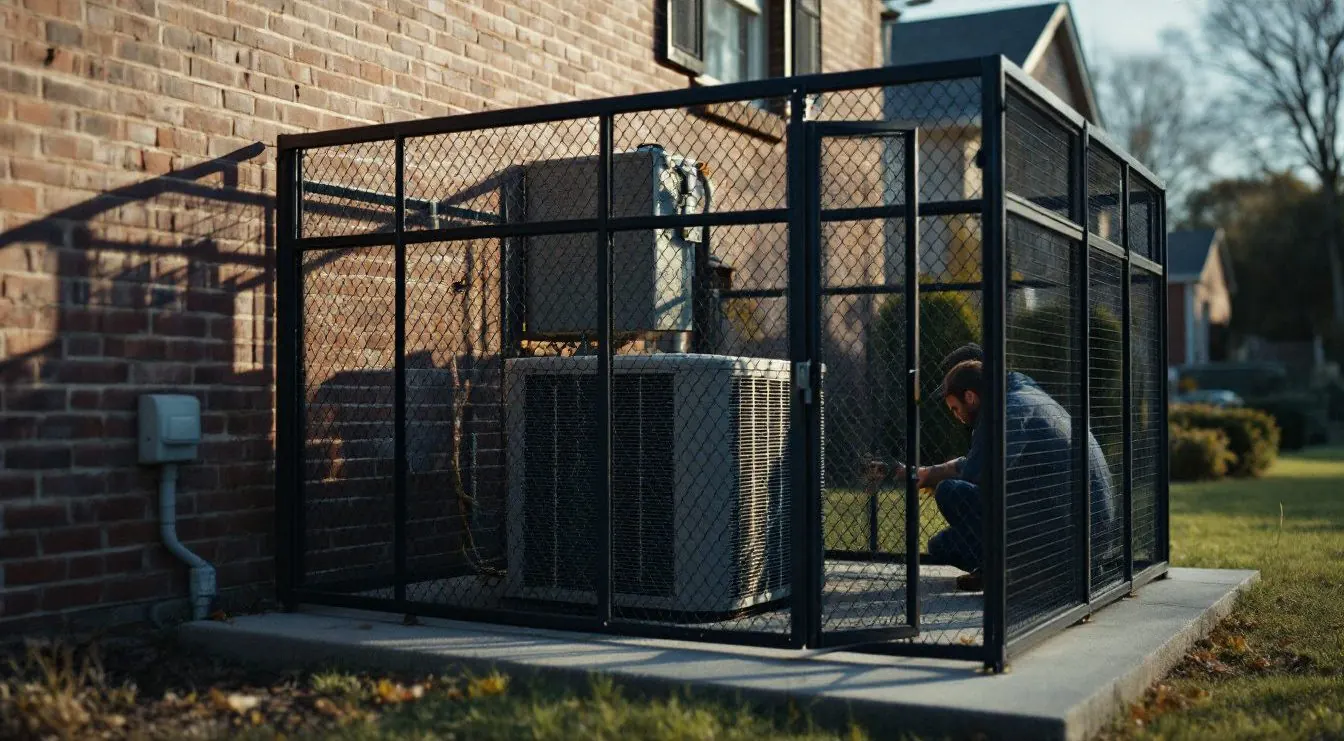
What is an AC cage? An AC cage is a locked steel enclosure anchored around an outdoor condenser to slow copper thieves. It works only if it keeps the clearances in your unit’s installation manual: 6 to 36 inches on the sides, 48 to 60 inches clear above, and open service access.
Key Takeaways
- 725 of 5,904 US metal theft insurance claims in 2017 and 2018, about 12%, mentioned AC or HVAC (NICB report, archived copy).
- Insured US metal theft claims fell from 12,630 in 2014 to 2,887 in 2018 (NICB 2017 release, archived copy).
- Goodman tells owners: “Do not construct a fence near the unit” without first asking the dealer (Goodman IOG-4002A).
- Carrier’s 38EYA instructions require 30 inches at the service end and 48 inches above the unit (Carrier 38EYA, archived copy).
- The 2024 IRC, section M1411.15, requires locking tamper-resistant caps on outdoor refrigerant access ports (IRC 2024 via UpCodes).
- Arizona scrap dealers must mail payment for air conditioner cooling coils, not pay on site (Arizona Senate brief, 2022).
What is an AC cage, and what does it protect?
An AC cage is a bolted or anchored steel frame, usually with a locking lid or top bar, that surrounds the outdoor condensing unit. It protects the copper inside the coil, the refrigerant piping and the compressor from being cut out and sold as scrap.
The outdoor unit rejects heat through copper tubing; our explainer on what the condenser actually does shows the parts. RectorSeal’s AC Guard line, one widely stocked brand, uses 16 gauge steel and adjusts from 34 inches high by 30 by 30 inches up to 59 by 48 by 48 inches, according to its product page.
A cage is not a cover: it must stay open to airflow all year. Our review of what makers say about AC unit covers explains why full wraps cause trouble.
How common is AC copper theft?
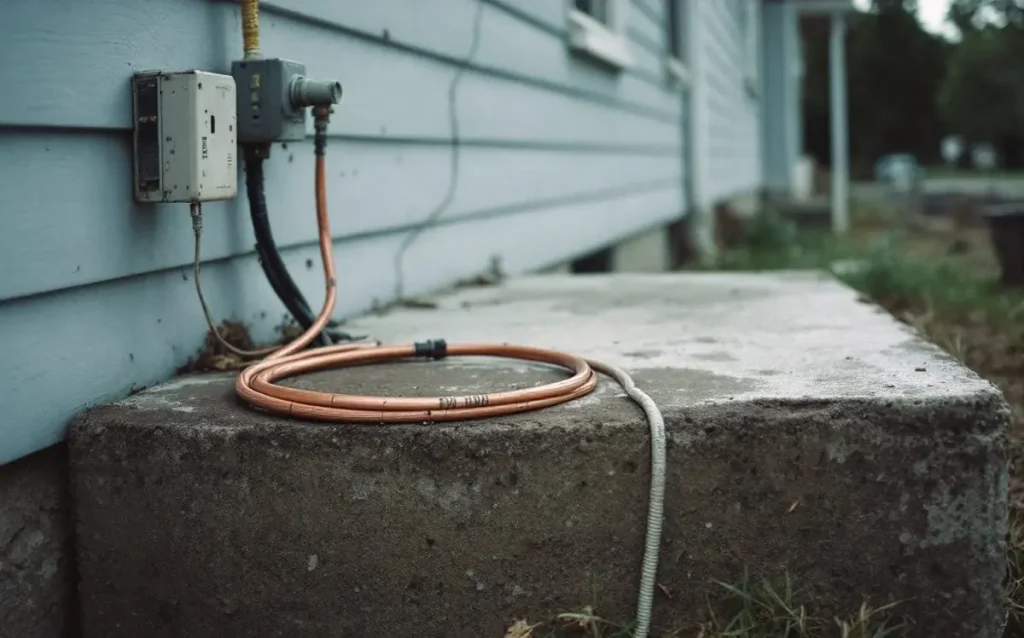
Less common than in 2014, per the latest NICB trend data, but still a steady insurance loss. The National Insurance Crime Bureau counted 5,904 US metal theft claims with a date of loss in 2017 or 2018, and 725 of them used “a/c”, “ac”, “air cond” or “hvac” in the loss description. That is about 12.3% (725 divided by 5,904).
The trend is down. NICB counted 12,630 metal theft claims in 2014, 9,699 in 2015 and 5,103 in 2016. Its next report counted 3,017 in 2017 and 2,887 in 2018. Across both reports that is a drop of about 77%, with a caveat: NICB warns that its ISO ClaimSearch dataset is dynamic, so counts can shift between editions.
Claims undercount theft, since unfiled losses never appear. NICB found 3,497 of the claims were against personal policies; whether yours pays is a wording question covered in our guide to homeowners insurance and HVAC losses.

How much clearance does an AC cage need?
As much as your condenser’s manual requires from any obstruction, measured to the cage’s bars and lid. The manuals we read ask for 6 to 36 inches on the sides, 30 inches at the service side and 48 to 60 inches above the fan.
No manual we read names security cages, so treat bars, posts and a lid as obstructions. Goodman says as much for fences: “Do not construct a fence near the unit” without first asking your dealer, because restricted airflow “could lead to poor operation and/or severe equipment damage.” A starved coil runs hot and works the condenser fan motor harder.
| Maker and document | Side clearance | Service side | Above the unit |
|---|---|---|---|
| Goodman, IOG-4002A installation reference (2017) | Residential table: 10, 10, 18 and 20 inches by position | Side away from the structure must keep service clearance | Top unobstructed; if under an obstruction, at least 60 inches |
| Carrier, 38EYA installation instructions | 6 inches on 1 side, 12 inches on all remaining sides | 30 inches at the service end | 48 inches |
| Lennox, XP25 installation instructions (2018) | One side 36 inches, one 12 inches, the last 6 inches | 30 inches to the access panel | 48 inches |
| Trane, TTR condensing units installer’s guide 18-AC41D16-5 | At least 12 inches from any wall or shrubbery | 30 inches in front of the control box, to meet the National Electrical Code | Unrestricted for at least five (5) feet |
Each figure applies to the named product line, so check your own model, as in the Lennox XP25 manual or the Trane 18-AC41D16-5 guide.
Myth check: “several inches” is enough
Two ranking cage roundups advise “several inches” or “12 to 24 inches” around the unit, unsourced. The manuals are stricter overhead: 48 inches (Carrier, Lennox), five feet (Trane) and 60 inches under any obstruction (Goodman).
Will an AC cage fit a 3-ton condenser? A worked check
Often not with a solid lid. A Goodman GLXS3BN3610, a 36,000 BTU/h condenser, measures 26 inches wide, 26 inches deep and 32.5 inches high on its spec sheet. Compare two RectorSeal sizes.
- Fixed 30 by 30 by 30 inch cage: the unit is 32.5 inches tall, so it does not fit at all, and the side gap would be only 2 inches.
- Largest adjustable cage, 48 by 48 inches: centered, the gap is (48 minus 26) divided by 2, or 11 inches per side. That is 1 inch short of Carrier’s and Trane’s 12 inch figure.
- Height: a lid at 59 inches sits 26.5 inches above the 32.5 inch unit, short of 48 inches (Carrier, Lennox) and 60 inches (Goodman).
- Service side: Carrier and Lennox want 30 inches at the access panel, so that cage wall needs a gate or removable panel.
Meeting Carrier’s numbers with walls as obstructions takes about 50 by 62 inches: 26 plus 12 plus 12 across, 26 plus 30 plus 6 deep. The practical fix is an open top bar, not a solid lid, plus a locked service gate. The GLXS3B spec sheet lists dimensions for every size from 1.5 to 5 tons.
What do building codes say about AC cages and service access?
No model code we read names cages, but three rules limit them. The 2024 IRC section M1305.1 requires “a level working space not less than 30 inches deep and 30 inches wide” in front of the control side, and M1401.2 requires clearances that “permit maintenance, servicing and replacement.”
The same chapter adds a theft measure. Section M1411.15 says outdoor refrigerant access ports “shall be fitted with locking-type tamper-resistant caps or shall be otherwise secured to prevent unauthorized access.” The 2021 IMC carries the same rule as section 1101.9, with an exception for equipment in controlled areas “such as on roofs with locked access hatches or doors.” Our guide to Schrader valves and locking caps covers the hardware; the working space rule is in IRC 2024 Chapter 13.
Electrical access matters too. EC&M’s NEC 110.26 restatement says working space must be at least 30 inches wide and 6½ ft high where equipment may need servicing while energized. A cage that boxes in the AC disconnect can block that space, and many jurisdictions treat a large added structure as permit work, so check locally.
Do scrap metal laws make AC theft harder?
They make stolen coils harder to sell, and rules vary by state. NICB’s 2019 report notes that states and cities have required scrap yards to check ID, record license plates, pay by check and hold metal for police.
Arizona’s Senate research staff brief says dealers must mail payment, not pay on site, for copper and for “air conditioner cooling coils,” and must keep transaction records for two years. Indiana, per a ReMA summary, lets dealers buy AC evaporator coils or condensers only from HVAC businesses or sellers with a bill of sale.
What are the alternatives to an AC cage?
Anchoring, locking caps and placement protect a condenser without boxing it in or blocking its airflow.
- Anchor the unit. Carrier’s 38EYA manual calls for tie-down bolts through base pan knockouts where conditions or code require, Lennox says some installations need strapping to the pad, and Goodman’s GLXS3B spec lists four anchor brackets per unit.
- Fit locking caps. They do not stop a cut line set, but they are a code requirement wherever the IRC or IMC section applies.
- Consider the roof. The IMC exempts equipment behind locked roof hatches or doors from the locking cap rule, treating controlled access as security in itself.
- Protect the line set. Our refrigerant line set guide covers the copper thieves cut first.
Damage from a poorly fitted cage may fall outside what an HVAC warranty covers. For the other big outdoor unit risk in numbers, see our air conditioner fire statistics.
How we researched this
Researched October 31, 2026. We read 24 documents and cite 15: NICB theft data, four makers’ installation literature, a Goodman spec sheet, IRC and IMC text, an NEC restatement, an Arizona Senate brief, a ReMA statute summary and a RectorSeal product page. Maker and trade documents are Tier 2, quoted only about their own products.
Excluded: cage retail roundups, contractor blogs, an installer’s FAQ (unsourced cost and clearance claims) and Reddit. We tested no cages. Prices are omitted because no federal series tracks them. We found no NICB metal theft report newer than 2019.
Frequently asked questions
Does an AC cage void the warranty?
No manual we read mentions cages. Goodman’s IOG-4002A says not to build a fence near the unit without first discussing it with the dealer, because restricted airflow could cause severe equipment damage. Ask your dealer first and keep every manual clearance.
Does homeowners insurance cover a stolen AC unit?
Often, depending on policy wording and the deductible. NICB found 3,497 of 5,904 metal theft claims in 2017 and 2018 were filed against personal policies, so homeowners do claim these losses. File a police report quickly and check the theft wording in your policy.
Can an AC cage reduce efficiency?
Yes, if it crowds the coil or caps the fan. Goodman warns that restricted airflow “could lead to poor operation and/or severe equipment damage.” Keep the side clearances in your manual, which run from 6 to 36 inches in the manuals we read, and avoid solid lids.
How tall should an AC cage be?
Tall enough, or open enough on top, to keep the discharge clear. Carrier’s 38EYA and Lennox’s XP25 call for 48 inches above the unit, Trane’s 18-AC41D16-5 for five feet, and Goodman for 60 inches beneath any overhead obstruction. An open top bar avoids the problem.
What are locking refrigerant caps?
Keyed caps for the service ports on the outdoor unit. The 2024 IRC section M1411.15 requires outdoor access ports to have locking tamper-resistant caps or to be otherwise secured. The same rule was M1411.8 in the 2015 and 2018 IRC and is 1101.9 in the 2021 IMC.
Which states restrict selling AC coils as scrap?
Rules vary by state. Arizona requires dealers to mail payment for air conditioner cooling coils instead of paying on site. Indiana limits dealer purchases of air conditioner condensers and evaporator coils to HVAC businesses or sellers with written proof of ownership, per a ReMA summary.
Sources
- National Insurance Crime Bureau. “2017 to 2018 Metal Theft Claims (Public Dissemination),” ForeCAST report, Oct. 4, 2019. Archived copy. https://web.archive.org/web/2025/https://www.nicb.org/media/1657/download Accessed October 2026.
- National Insurance Crime Bureau. “NICB Sees Decline in Metal Thefts,” Oct. 29, 2019. Archived copy. https://web.archive.org/web/2025/https://www.nicb.org/news/news-releases/nicb-sees-decline-metal-thefts Accessed October 2026.
- National Insurance Crime Bureau. “NICB Reports Steep Drop in Metal Theft Claims,” Nov. 21, 2017. Archived copy. https://web.archive.org/web/2025/https://www.nicb.org/news/news-releases/nicb-reports-steep-drop-metal-theft-claims Accessed October 2026.
- Goodman Manufacturing. “Condensing Unit / Heat Pump Installation and Service Reference, IOG-4002A,” Jan. 2017. https://cdn.shopify.com/s/files/1/0253/0852/8730/files/Goodman_GSZ16_Installation_Manual__1.pdf Accessed October 2026.
- Goodman Manufacturing. “GLXS3B Specification Sheet, SS-GLXS3B-R32.” https://cdn.shopify.com/s/files/1/0748/4745/3475/files/Goodman-GLXS3B-specsheet_fc59d0b3-c33b-4712-828e-42b0b39d4e89.pdf Accessed October 2026.
- Carrier. “38EYA Split-System Heat Pump Installation and Start-Up Instructions.” Archived copy. https://archive.org/download/manualsonline-id-6371e5dc-7d07-46bd-9e20-9d37c2b8b668/6371e5dc-7d07-46bd-9e20-9d37c2b8b668.pdf Accessed October 2026.
- Lennox Industries. “XP25 Installation Instructions, 507005-01F,” 2018. https://www.lennox.com/dA/3afe37cae1/507005-01f.pdf Accessed October 2026.
- Trane. “Installer’s Guide, TTR Condensing Units, 18-AC41D16-5.” Distributor-hosted copy (Young Supply). https://wizard.youngsupply.com/files/51-10747.pdf Accessed October 2026.
- UpCodes. “2024 International Residential Code (Texas), Chapter 14.” https://up.codes/viewer/texas/irc-2024/chapter/14/heating-and-cooling-equipment-and-appliances Accessed October 2026.
- UpCodes. “2024 International Residential Code (Texas), Chapter 13.” https://up.codes/viewer/texas/irc-2024/chapter/13/general-mechanical-system-requirements Accessed October 2026.
- UpCodes. “2021 International Mechanical Code (Texas), Chapter 11.” https://up.codes/viewer/texas/imc-2021/chapter/11/refrigeration Accessed October 2026.
- EC&M (Mike Holt). “NEC Requirements for Working Clearances,” Feb. 9, 2023. https://www.ecmweb.com/national-electrical-code/code-basics/article/21259374/nec-requirements-for-working-clearances Accessed October 2026.
- Arizona State Senate. “Scrap Metal,” Issue Brief, Nov. 10, 2022. https://azleg.gov/Briefs/Senate/SCRAP%20METAL%202022.PDF Accessed October 2026.
- ReMA. “Indiana Metals Theft Statute” summary. https://www.recycledmaterials.org/wp-content/uploads/in-metallawd6460a1f8fb866e3af13ff0000e99eee-1.pdf Accessed October 2026.
- RectorSeal. “AC Guard” product page. https://rectorseal.com/ac-guard-cage/ Accessed October 2026.
Leave a Reply