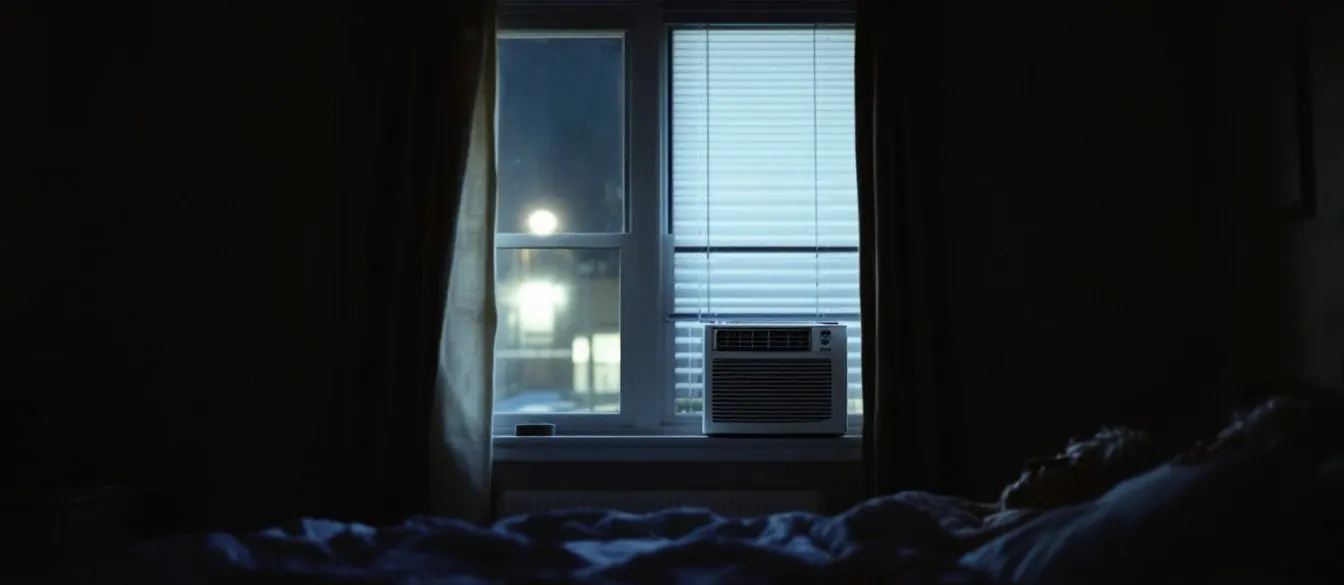
Should I run AC all night? Yes on hot or humid nights, and on every hot night when an adult over 65 sleeps in the house: CDC tells older adults to stay in air conditioning. Keep the bedroom at 77°F or cooler, where sleep losses begin. On cool, dry nights, switch it off and open windows.
| Your night | Do this overnight | Source |
|---|---|---|
| Heat wave, HeatRisk orange or red | Run all night, no setback above 77°F | NWS HeatRisk level 2 and up |
| Adult over 65 in the house | Run all night on any hot night | CDC older adults guidance |
| Humid night, room near 72°F | Run on AUTO fan at a modest setting | EPA: below 60%, ideally 30 to 50% |
| Cool, dry night | Off; windows plus ceiling fan | DOE Fans for Cooling |
| Ordinary warm night, tight budget | Run with sleep mode, room no warmer than 77°F | Baniassadi et al., 2023 |
| House empty all day | Run at night; set back 7 to 10°F while out | DOE Energy Saver thermostats |
Compiled by The HVAC Brief from the CDC, NWS, EPA and DOE pages and the 2023 sleep study listed under Sources.
What does it cost to run the AC all night at August 2026 power prices?
About $1.83 a night for a 3 ton central system whose compressor runs half of an 8 hour night, and $0.53 for an 8,000 Btu window unit doing the same. We calculated each unit’s draw from its federal minimum efficiency and priced it at 18.16 cents per kWh, the US residential average for August 2026 in EIA Electric Power Monthly Table 5.6.A.
| Compressor hours in an 8 hour night | 3 ton central (2.52 kW) | Cost per night | 8,000 Btu window (0.73 kW) | Cost per night |
|---|---|---|---|---|
| 2 hours (mild night) | 5.03 kWh | $0.91 | 1.47 kWh | $0.27 |
| 4 hours (warm night) | 10.07 kWh | $1.83 | 2.94 kWh | $0.53 |
| 6 hours (hot, humid night) | 15.10 kWh | $2.74 | 4.40 kWh | $0.80 |
| 8 hours (nonstop) | 20.14 kWh | $3.66 | 5.87 kWh | $1.07 |
HVAC Brief calculation: draw = capacity divided by efficiency. 36,000 Btu/h at SEER2 14.3 (split AC minimum, Southeast and Southwest, 10 CFR 430.32(c)(6)) and 8,000 Btu/h at CEER 10.9 (room AC standard until May 26, 2026, 430.32(b)(1)). SEER2 is a seasonal average: round figures, not a bill forecast.
Time the outdoor unit for one night to find your row. At the nonstop extreme, 30 nights cost about $110 for the central system at the US price, $96 at Texas’s 15.91 cents and $180 at California’s 29.75 cents. For a full year, see the annual cost to run air conditioning by state.
Is it cheaper to turn the AC off at night and cool the house back down in the morning?
No. Turning it up saves energy, and the house does not pay it back in the morning. DOE’s Energy Saver thermostat page (archived copy, 2017) calls the payback idea “a common misconception”: “a higher interior temperature will slow the flow of heat into your house.”
The question is where to take the setback. DOE’s savings claim is “as much as 10% a year on heating and cooling by simply turning your thermostat back 7°-10°F for 8 hours a day,” and its summer advice is “keeping your house warmer than normal when you are away.” Taken overnight, a 7 to 10°F rise puts a 72°F bedroom at 79 to 82°F, where sleep studies record losses, so the empty daytime hours are the better place. The same page set 78°F “only when you are at home and need cooling”; our page on what DOE’s thermostat settings actually say has the rest.
What overnight setting keeps sleep intact: 74°F, 77°F or 78°F?
77°F is the warm edge. In a Harvard Medical School study of older adults in their own homes, sleep “was most efficient and restful when nighttime ambient temperature ranged between 20 and 25 °C” (68 to 77°F), with “a clinically relevant 5-10 % drop in sleep efficiency when the temperature increased from 25 °C to 30 °C” (77 to 86°F), per Baniassadi et al., Science of the Total Environment, 2023.
Watch the sleep button. Midea’s MAW08S1VWWT manual says sleep mode raises the cooling setting 2°F after 30 minutes and 2°F more after another 30, then holds it for “6 or 7 hours.” Set 74°F, press sleep, and the room settles near 78°F. The study covered adults 65 and older; other ages are in our guide to the best temperature for sleeping.
When is running the AC all night a health decision, not a comfort one?
When the night stays hot and someone in the house is over 65. The CDC tells older adults to “Stay in air-conditioned buildings as much as possible” and “Do not rely on a fan as your main cooling source when it’s really hot outside,” because they “do not adjust as well as young people to sudden changes in temperature.”
The National Weather Service HeatRisk map scores “both daytime and nighttime temperatures,” and its top level, magenta 4, is defined by “no overnight relief.” If your county shows orange or higher tonight, leave the AC running. Our heat-related deaths data shows why.
Does a humid night change the answer even when it is only 72°F outside?
Yes. An AC removes moisture only while the compressor chills the coil, so a house left off on a muggy night can climb past EPA’s mold guidance to keep indoor humidity “below 60 percent (ideally between 30 and 50 percent)” (EPA).
A $10 to $50 hygrometer, EPA’s price range, answers this better than a thermometer. Above 60% at bedtime, run the AC with the fan on AUTO, not ON: on ON the blower re-wets the air from the coil between cycles, as our fan ON vs AUTO humidity test summary shows.
When should you turn the AC off and open the windows instead?
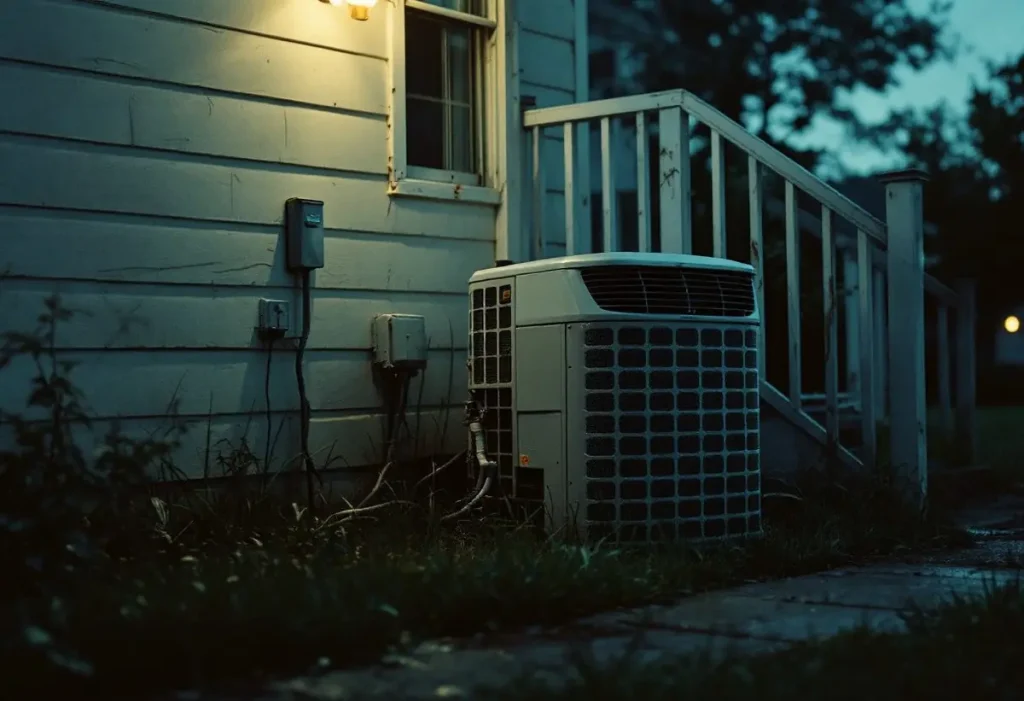
When the outdoor air is cooler than the bedroom, dry and clean. DOE’s Fans for Cooling page (archived copy, 2017) says a ceiling fan lets you raise the setting “about 4°F with no reduction in comfort” and in moderate heat “may allow you to avoid using your air conditioner altogether.”
Midea’s window AC troubleshooting table lists “Outdoor temperature below 64°F (18°C)” and “Thermostat set too cold for night-time cooling” as causes of ice on the coil, fixed with FAN ONLY mode. A low in the low 60s means the compressor is not needed.
Is it safe to leave a window or portable AC running while you sleep?
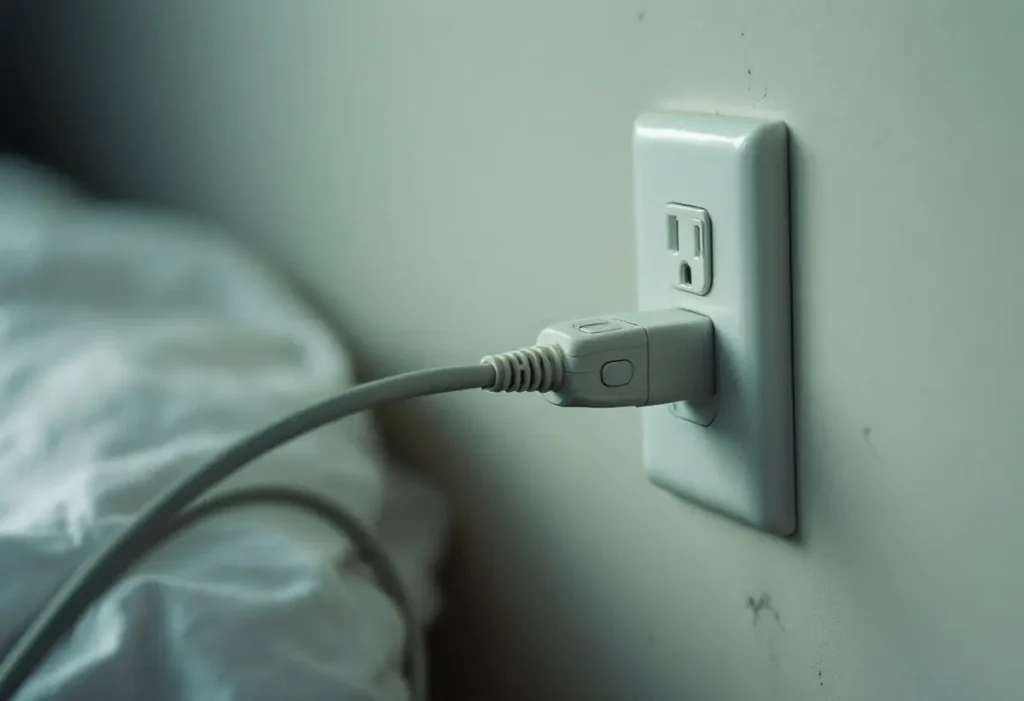
Yes, when it is plugged straight into a wall outlet. The Midea manual says “Do not use an extension cord or an adapter plug,” and its plug has a current detection device “designed to reduce the risk of fire,” with TEST and RESET buttons to check each season. We did not open a portable AC manual; the CPSC cord rules below apply to both.
CPSC counts “about 2,000 residential fires each year associated with electric cords or plugs, killing 60 people,” and says extension cords overheat feeding “appliances that consume more watts than the cord can handle” (CPSC). A plug that is hot in the morning means stop until the cord and outlet are checked. Causes by unit type are in our air conditioner fire statistics.
Does running the AC all night wear out the compressor faster?
No maker document we read says so. Makers guard against the opposite, rapid off and on: Midea’s manual describes “an automatic 3 minutes time delayed start if the unit is turned off and on quickly,” which “prevents overheating of the compressor.”
An AC that runs nonstop all night is normal near your area’s design temperature and a warning sign on a mild night; compare the cut-off temperatures in why a house won’t cool below 75.
Frequently asked questions
Can a furnace run all night?
Yes, but DOE’s winter advice is to set the thermostat “to 68°F while you’re awake and setting it lower while you’re asleep or away from home.” The exception is a heat pump in heating mode, where a setback “can cause the unit to operate inefficiently” unless the thermostat is built to limit backup electric heat.
Can I leave space heater on all night?
No. The US Fire Administration says “Turn space heaters off when leaving the room or going to bed” and keep anything that can burn at least 3 feet away. Running costs and federal fire figures are in our space heater cost and safety page.
Can you run dehumidifier all night?
Yes, if its bucket or drain hose can take a full night’s water and you set it inside EPA’s ideal indoor range of 30 to 50 percent relative humidity, with 60 percent as the ceiling. Sizing and running costs are in our dehumidifier guide.
Why is my AC running all night but not cooling?
On a window unit, check the coil behind the front grille for ice. Midea lists an outdoor temperature below 64°F, a dirty filter and a “thermostat set too cold for night-time cooling” as causes, fixed by FAN ONLY mode and a higher setting. On central air, work through our three step AC running but not cooling diagnosis.
How we researched this
Research date: November 6, 2026. We read the CDC, NWS, EPA, CPSC and USFA pages listed below, DOE Energy Saver thermostat and fan pages (2017 copies in the University of North Texas web archive; the live pages return 404), the Baniassadi 2023 abstract, 10 CFR 430.32 as of October 1, 2026, EIA Table 5.6.A for August 2026 and the Midea MAW08S1VWWT manual. Costs are our calculation. We excluded the top ranking pages’ numbers, including a “3 to 5 kWh per hour” central AC figure, because none named a source.
Sources
- Centers for Disease Control and Prevention. “Heat and Older Adults (Aged 65+).” https://www.cdc.gov/heat-health/risk-factors/heat-and-older-adults-aged-65.html. Accessed November 2026.
- National Weather Service, Weather Prediction Center. “NWS HeatRisk.” https://www.wpc.ncep.noaa.gov/heatrisk/. Accessed November 2026.
- US Environmental Protection Agency. “A Brief Guide to Mold, Moisture and Your Home.” https://www.epa.gov/mold/brief-guide-mold-moisture-and-your-home. Accessed November 2026.
- US Department of Energy, Energy Saver. “Thermostats” (archived copy, February 1, 2017). https://webarchive.library.unt.edu/web/20170201184843/https://energy.gov/energysaver/thermostats. Accessed November 2026.
- US Department of Energy, Energy Saver. “Fans for Cooling” (archived copy, January 27, 2017). https://webarchive.library.unt.edu/web/20170127020006/https://energy.gov/energysaver/fans-cooling. Accessed November 2026.
- Baniassadi A, Manor B, Yu W, Travison T, Lipsitz L. “Nighttime ambient temperature and sleep in community-dwelling older adults.” Science of the Total Environment 899:165623, 2023. https://pubmed.ncbi.nlm.nih.gov/37474050/. Accessed November 2026.
- US Energy Information Administration. “Electric Power Monthly, Table 5.6.A, August 2026.” https://www.eia.gov/electricity/monthly/epm_table_grapher.php?t=epmt_5_6_a. Accessed November 2026.
- Electronic Code of Federal Regulations. “10 CFR 430.32, Energy and water conservation standards.” https://www.ecfr.gov/current/title-10/chapter-II/subchapter-D/part-430/subpart-C/section-430.32. Accessed November 2026.
- US Consumer Product Safety Commission. “Household Extension Cords Can Cause Fires” (Publication 5032). https://www.cpsc.gov/s3fs-public/5032.pdf. Accessed November 2026.
- US Consumer Product Safety Commission. “Extension Cords and Power Strips.” https://www.cpsc.gov/s3fs-public/ExtensionCordsPowerStrips.pdf. Accessed November 2026.
- US Fire Administration. “Heating Fire Safety.” https://www.usfa.fema.gov/prevention/home-fires/prevent-fires/heating/. Accessed November 2026.
- Midea. “MAW08S1VWWT-T Window Air Conditioner Owner’s Manual.” https://www.midea.com/content/dam/midea-aem/us/air-conditioners/window-a-c/maw08s1vwwt-t/MAW08S1VWWT-T-Manual.pdf. Accessed November 2026.
Leave a Reply