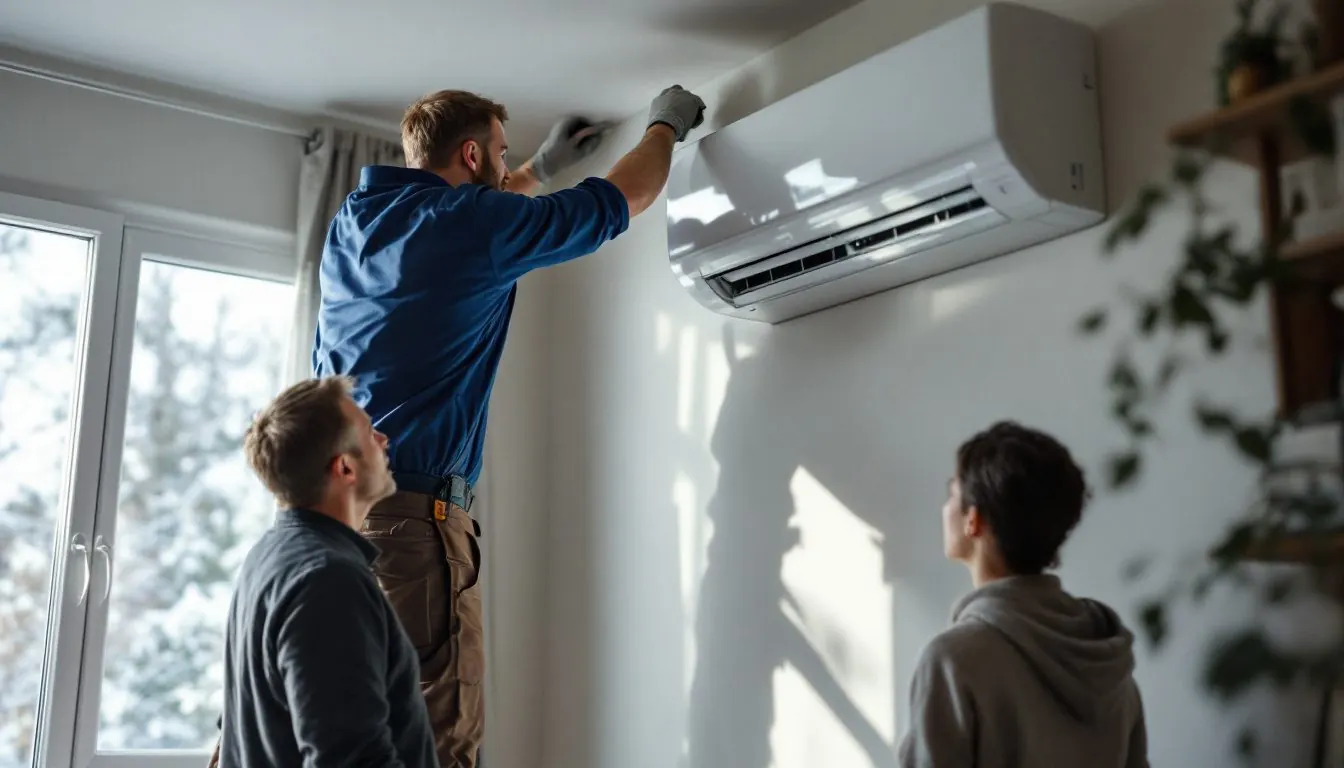
Fujitsu mini split error codes are read by counting two lamps: OPERATION blinks give the first character and TIMER blinks the second, so 1 and 1 is code 11, a serial communication error, and 10 Operation blinks mean an A code. Older Fujitsu lines reuse numbers like 11 and 22 for different faults, so match your series first.
| Blinks (Operation, Timer) | Code | Fujitsu’s wording | Owner check (power off) | Technician job |
|---|---|---|---|---|
| 1, 1 | 11 | Serial communication error | Breaker off 5 minutes, restart once | 187 to 253 VAC supply; wire 3 fluctuating 60 to 130 VDC |
| 1, 2 | 12 | Wired remote controller communication error | Wired controllers: look for a cut cable | Terminals, cable continuity |
| 1, 5 | 15 | RGLX: automatic air flow adjustment error. RLF: check run unfinished | RGLX: filter and return clear | Fan motor, or a new check run |
| 2, 2 | 22 | Indoor unit capacity error (RLF multi-zone) | Note which other heads are dark or show 11 | Fix those heads; total capacity |
| 3, 5 | 35 | Manual auto switch error | Look for a stuck or pressed button | Meter the switch |
| 4, 1 / 4, 2 | 41 / 42 | Indoor room / heat ex. (pipe) thermistor error | None | Resistance chart |
| 5, 1 | 51 | Indoor unit fan motor error (below 1/3 speed for 56+ seconds) | Spin the blower by hand | Ohm windings, board |
| 5, 3 | 53 | Drain pump error (RGLX, RLF) | Drain outlet blocked or crushed | Float switch, CN9, PCB |
| 5, 8 | 58 | Intake grille error (wall, RLF) | Front grille fully closed | Limit switch, CN11 |
| 6, 3 to 6, 5 | 63 to 65 | Inverter, PFC circuit / active filter, IPM errors | Clear the outdoor coil; nothing inside | Boards, 415 V DC limits, IPM |
| 7, 1 to 7, 7 | 71 to 77 | Outdoor thermistor errors (discharge, compressor, pipe, outdoor, heat sink) | None | Resistance chart, Main PCB |
| 8, 6 | 86 | High pressure switch error / pressure sensor error | None | Switch open over 10 seconds |
| 9, 4 | 94 | Over current error | Outdoor coil and airflow clear | Fan motor, coil |
| 9, 7 | 97 | Outdoor unit fan motor error | Ice or debris on the blade | Under 100 RPM: motor, DC voltage |
| 10, 1 | A1 | Discharge temperature error | None: refrigerant side | 230°F (110°C) twice in 24 hours |
| 10, 3 | A3 | Compressor temperature error | None: refrigerant side | 226°F (107.8°C) twice in 24 hours |
| 10, 5 | A5 | Low pressure error | None: refrigerant side | Gauges, leak check |
| 13, 2 | J2 | Branch box error (RLF multi-zone) | None | Plugs, field wiring |
Compiled by The HVAC Brief from Fujitsu General America’s 410A Mini-Split Troubleshooting Guide (6-26-FG2020, Rev. 5/2019): RGLX ducted, RL2/RLS3/RLB/RLXB wall and RLF multi-zone tables, plus Fujitsu help-center articles. Rows appear in all three tables unless a series is named.
How do you turn Operation and Timer blinks into a Fujitsu code number?
OPERATION blinks give the first character, TIMER blinks the second. In Fujitsu General America’s troubleshooting guide, 3 and 5 is 35, a count of 10 is written A (10 and 5 is A5), and 13 and 2 is the multi-zone branch box code J2. The Economy lamp reads “Continuous” on every fault row.
Wired controllers show the number, which can differ by controller: the indoor fan motor fault shows as 51 or 12.
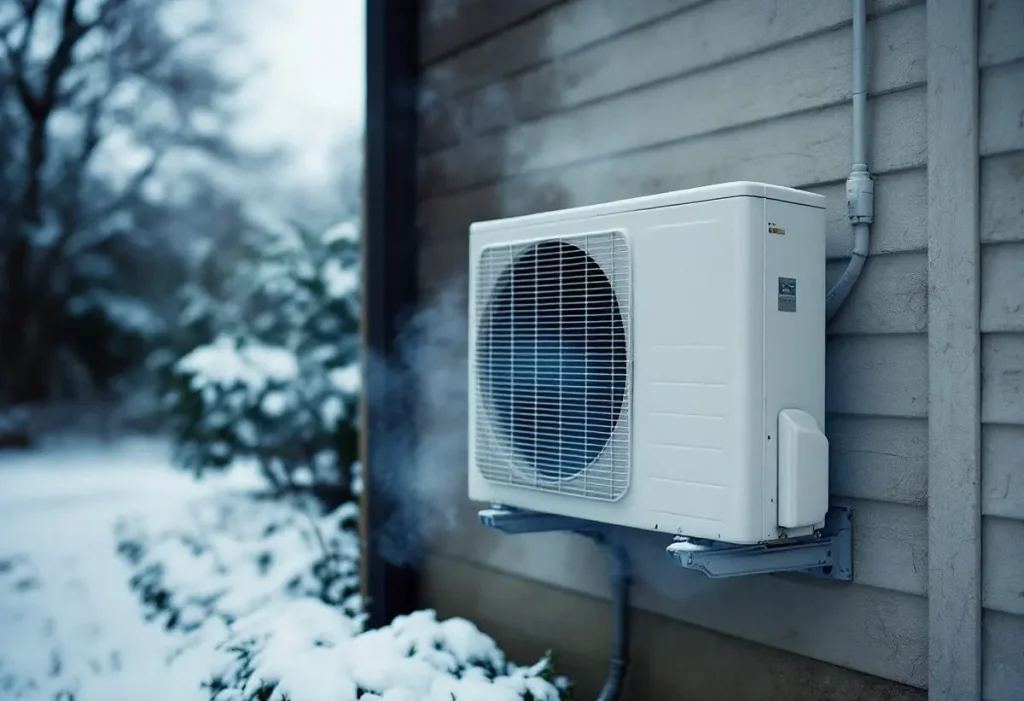
Is your Fujitsu blinking a fault, or a defrost, test run or power-loss status?
Not every blink is a code. Per Fujitsu General’s lamp FAQ, Operation and Timer blinking alternately means power was interrupted; blinking simultaneously means a test run, ended with START/STOP.
A Fujitsu AST-series operating manual adds two heating patterns: a slow OPERATION flash is automatic defrost, pausing heat for between 7 and 15 minutes, and a quick flash of 1 second on, 1 second off means the selected mode cannot run, as when a multi-zone head is started in Heat while another runs in Cool. Defrost is normal; see how heat pumps cope with cold weather. Lamp names and colors vary by model, Fujitsu’s FAQ warns.
Why does code 11, 12, 15 or 22 mean something else on an older Fujitsu?
Because Fujitsu changed its numbering between generations. Per Fujitsu’s communication error article, RL2, RLS3, RLF, LMAS, LZAS, LPAS and RGLX units flash 1 Operation and 1 Timer for a communication fault, while legacy RL, RLS, RLQ, RML and RMLQ units use Timer counts alone. Check the rating label.
| Number or fault | Current RL2, RLS3, RLF, RGLX | Legacy RMLQ multi-zone |
|---|---|---|
| 11 | Serial communication error (1, 1) | Indoor unit EEPROM abnormal (all lamps blinking) |
| 12 | Wired remote communication (1, 2) | Indoor fan motor lock or speed (6, 2 or 6, 3) |
| 15 | RGLX air flow adjustment; RLF check run unfinished (1, 5) | Compressor temperature thermistor (3, 8) |
| 22 | Indoor unit capacity error (2, 2) | Electronic air cleaner power PCB circuit error (4, 8) |
| Manual auto button | Code 35 (3, 5) | Code 20 (4, 2) |
| Drain pump or float | Code 53 (5, 3) | Code 09 (2, 6) |
| Communication | 1 Operation, 1 Timer | Operation off; Timer 2, 3 or 4 blinks |
Compiled by The HVAC Brief from Fujitsu’s 6-26-FG2020 guide: current tables versus the ASU9/12/18RMLQ table.
So 22 on an ASU12RLF1 and 22 on an ASU12RMLQ point to different parts, and 15 on an RGLX ducted mini split is a fan fault while 15 on an RLF head is unfinished commissioning. Daikin’s remote codes are no guide to a Fujitsu either.
What do Fujitsu codes 11, 22 and 35 mean?
11 is a serial communication error: the indoor and outdoor units are not talking. After a 5 minute power-off, if 11 returns, the technician confirms 187 to 253 VAC at the outdoor unit (115 VAC on the 9RL2 and 12RL2) and at indoor terminals 1 and 2, then reads the number 3 wire, which should fluctuate between 60 and 130 VDC; a steady reading marks the faulty side. Fujitsu does not recommend wire nuts or splices there.
22, the multi-zone indoor unit capacity error (ASU RLF, ASUH LPAS), misleads owners. Fujitsu’s capacity error article says the head flashing 22 is the normal working unit; another head cannot reach the outdoor unit, usually flashing a communication code or dark. Fix that head and 22 clears.
35 is a manual auto switch error: the MANUAL AUTO button read as pressed for 60 or more consecutive seconds. Look for a stuck button or a cover pressing it; the technician meters the switch.
What does a Fujitsu blinking 10 times mean?
Ten Operation blinks start every A code, all refrigerant-side protection stops. A1 trips at a discharge temperature of 230°F (110°C) or higher twice within 24 hours; A3 is the compressor version at 226°F (107.8°C); A5 is low suction pressure held for 5 minutes, 5 times within 2 hours. The first check for each: is the 3-way service valve open?
Ten Timer blinks give 3A (wired-remote communication circuit) or 6A (RLF display PCB communication). Fujitsu’s Service Bulletin 044 says A5 only occurs on a 1 to 1 indoor and outdoor matchup, and only when outdoor air falls below 32°F.
Why would a wall-mounted Fujitsu flash the drain pump code 53?
It should not. Fujitsu’s drain pump error article says wall-mounted units should never flash a float switch error, and if one does, the indoor controller PCB should be changed. Code 53 is listed for RLF, RGLX and LUAS1 series and trips when the float switch stays on for 3+ minutes.
On a ducted or cassette unit, check the condensate outlet is not blocked or crushed. The technician meters the float, inspects the CN9 connector and blows the hose clear with nitrogen; if all pass, Fujitsu says replace the controller PCB. Leaks without a code are in our mini split repair and cleaning guide.
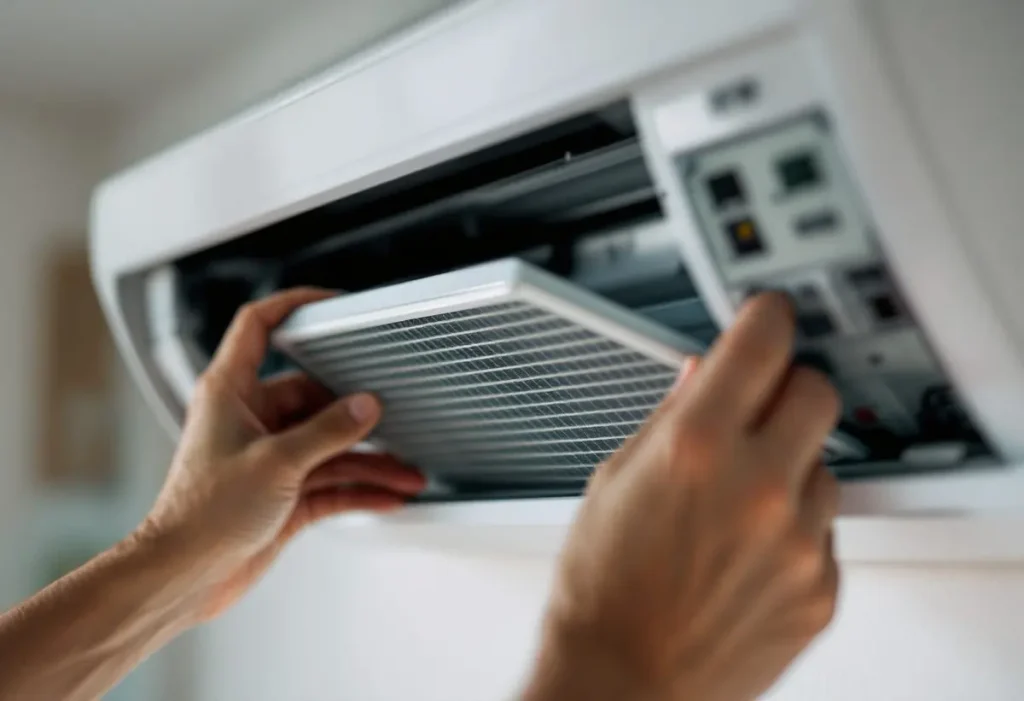
What can you check before the technician comes, and where do you stop?
Owner checks are power-off checks: the disconnect off for 5 minutes, then one restart. For fan codes 51 and 97, spin the fan by hand with power off; Fujitsu says it should turn without resistance and slow to a stop, not stop abruptly. For 65 and 94, clear leaves and snow: Fujitsu lists blocked heat radiation as a cause.
Stop at anything live or pressurized. Fujitsu General Australia’s technical reference says to let capacitors discharge before resistance checks and leaves live-voltage testing to qualified personnel. Every A code needs gauges, and under 40 CFR 82.161 anyone who could open the refrigerant circuit must hold EPA Section 608 certification.
A breaker that trips on restart is a separate symptom: see why an HVAC breaker keeps tripping. Give the technician the model number, both blink counts and whether the code returned after the 5 minute reset.
Frequently asked questions
Why is my Fujitsu mini split blinking red and green?
Read the lamp labels, not the colors. Fujitsu’s AST manual describes a red OPERATION and green TIMER lamp, while Service Bulletin 0041 calls Operation green and Timer red on ARU and AUU units. Alternate blinking means power was interrupted; counted groups are a code.
Why is my Fujitsu mini split blinking green in heat mode?
If that lamp is OPERATION, Fujitsu’s AST manual gives two meanings: a slow flash is automatic defrost, pausing heat for 7 to 15 minutes, and a quick 1 second on, 1 second off flash means the mode cannot run because another head was started first in Cool, Dry or Fan.
How do I reset a Fujitsu mini split error code?
Fujitsu’s help-center checklists start the same way: pull the disconnect for 5 minutes, restore power and see whether the code returns. A code that comes back is a fault to trace. For A5, Service Bulletin 044 tells technicians to enter function setting F3-40 before powering down.
Does a blinking orange light on a Fujitsu mean a fault?
Not by color alone. The Fujitsu documents we opened define lamps by name, and the AST manual uses orange for its SWING lamp. A TIMER lamp flashing during timer operation is, per that manual, a timer setting fault after a power interruption; a counted pair with OPERATION is a code.
How we researched this
We read Fujitsu General America’s 6-26-FG2020 troubleshooting guide (posted on a distributor help center), six Fujitsu help-center fault articles and bulletins, Fujitsu General FAQ 0084, an archived AST operating manual, Fujitsu Australia’s legacy reference index and 40 CFR 82.161. Excluded: the “E:EE” remote display and remote check-mode sequences on ranking pages, which no Fujitsu document we opened describes; outdoor-board LED tables owners cannot see; and newer LMAS, LZAS and LPAS rows Fujitsu has not confirmed. Researched 7 November 2026.
Sources
- Fujitsu General America. “410A Mini-Split Troubleshooting Guide, Part 6-26-FG2020 Rev. 5/2019.” https://jswallacegroup.zendesk.com/hc/en-us/article_attachments/24487052372503. Accessed November 2026.
- Fujitsu General America Help Center. “Communication Error.” https://fujitsugeneral.zendesk.com/hc/en-us/articles/115015666167-Communication-Error. Accessed November 2026.
- Fujitsu General America Help Center. “Indoor Capacity Error.” https://fujitsugeneral.zendesk.com/hc/en-us/articles/115015839148-Indoor-Capacity-Error. Accessed November 2026.
- Fujitsu General America Help Center. “Drain Pump Error.” https://fujitsugeneral.zendesk.com/hc/en-us/articles/115015779527-Drain-Pump-Error. Accessed November 2026.
- Fujitsu General America Help Center. “Indoor Fan Motor Error.” https://fujitsugeneral.zendesk.com/hc/en-us/articles/115015751127-Indoor-Fan-Motor-Error. Accessed November 2026.
- Fujitsu General America Help Center. “S Bulletin 044: A5 Error Code.” https://fujitsugeneral.zendesk.com/hc/en-us/articles/360018819474-S-Bulletin-044-A5-Error-Code. Accessed November 2026.
- Fujitsu General America Help Center. “Service Bulletin 0041: ARU/AUU E11 Communication Error.” https://fujitsugeneral.zendesk.com/hc/en-us/articles/115016042708-0041-ARU-AUU-E11-Communication-Error. Accessed November 2026.
- Fujitsu General (Thailand). “FAQ 0084: What should I do when the indicator lamps on the indoor unit blink?” https://www.fujitsu-general.com/th/en/support/faq/split/0084.html. Accessed November 2026.
- Fujitsu General Limited. “Operating Manual, Wall Mounted Type AST7, AST9, AST12 Series, P/N9373538035” (archived copy). https://archive.org/download/manualsonline-id-f6bd4c27-1e12-41a3-9b5a-99ef4dd4babf/f6bd4c27-1e12-41a3-9b5a-99ef4dd4babf.pdf. Accessed November 2026.
- Fujitsu General Australia. “Legacy Error Codes and Diagnostic Reference.” https://assist.fujitsugeneral.com.au/support/solutions/articles/6000094256-legacy-error-codes-and-diagnostic-reference. Accessed November 2026.
- U.S. Government Publishing Office, eCFR. “40 CFR 82.161 Technician certification.” https://www.ecfr.gov/current/title-40/chapter-I/subchapter-C/part-82/subpart-F/section-82.161. Accessed November 2026.
Leave a Reply