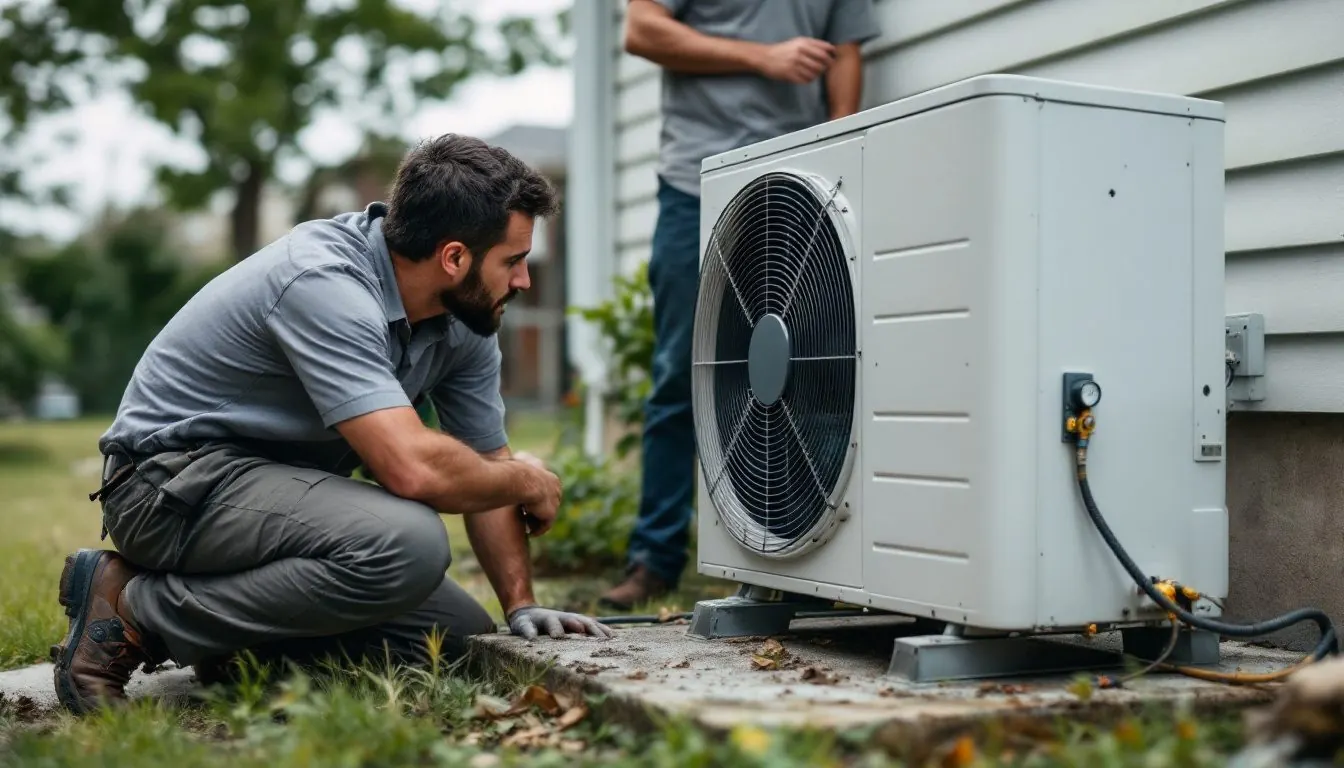
Gree mini split error codes are two characters on the indoor display. Gree’s Livo R32 owner’s manual says U8, H6, H3, E1, E5, E6 and E8 may clear after a restart, while C5, F0, F1, F2 and EA need a technician. F0 is low refrigerant; Fo is pump-down mode. E2, E9 and defrost are not faults.
Which Gree codes clear with a restart, and which need a technician?
Gree sorts them itself: page 14 of the Livo R32 owner’s manual splits codes into “It can be eliminated after restarting the unit” and “Please contact qualified professionals for service.” The table keeps that split and adds wording and tests from the Livo R32 service manual (LIV09HP to LIV36HP). The Sapphire R32 manual prints the same codes, except EA.
| Code | Gree’s wording | Circuit or part | Safe owner check | Technician job |
|---|---|---|---|---|
| Owner’s manual: may clear after a restart | ||||
| U8 | Zero-crossing signal of indoor unit | Supply, indoor board | One breaker restart | Supply voltage |
| H6 | No feedback from indoor unit’s motor | Indoor blower motor | Power off; flashlight on the wheel | 280 to 310 VDC, plug pins 1 and 2 |
| H3 | Overload protection of compressor | Compressor overload | Clean filter and outdoor coil | Overload under 1 ohm |
| E1 | High pressure protection of system | High pressure switch | Clear outdoor coil; off 15 minutes | Trips at about 600 PSI |
| E5 | AC overcurrent protection | Supply, fans, compressor | Clean filter | Voltage under load |
| E6 | Communication malfunction between indoor unit and outdoor unit | Wire 2, cable, boards | Note when E6 appears | 54 to 56 VDC, wire 2 lifted |
| E8 | High temperature prevention protection | Indoor coil sensor | Clean filter | 20K sensor ohm test |
| Owner’s manual: contact qualified professionals | ||||
| C5 | Malfunction of jumper cap | Jumper cap | None | Move cap to new board |
| F0 | Refrigerant insufficient protection | Charge, valves, sensors | Note mode | PT chart, leak search |
| F1, F2 | Indoor ambient / evaporator sensor open or short | 15K air, 20K coil sensors | None | Ohm test vs chart |
| EA | Refrigerant leak alarm | R32 circuit | Ventilate, no flames, unit off | Flammable gas detector |
| Service manual only | ||||
| H5 | IPM protection | Inverter module | Off about 10 minutes | Windings 0.6 to 2.0 ohms |
| PL | DC bus voltage is too low | Supply, outdoor board | None | L to N under 150 VAC |
| Status displays, not faults | ||||
| E2 | Evaporator anti-freezing protection | Cold indoor coil | Clean filter; wait | Only if it repeats |
| E9 | Anti cold air protection | Fan held in heat | Wait | None |
| Fo | Refrigerant-recovery mode | Pump-down mode | Restart normally | Sensors if stuck |
| Heat lamp | Defrosting: Heat indicator Flash once/10s | Defrost | Wait | None |
Compiled by The HVAC Brief from the Livo R32 service manual error code list (pages 84 to 89), Livo R32 owner’s manual page 14, and the step data behind Gree Comfort’s online error code tool, the source of the technician values.
Owner checks stop at filters, airflow, the breaker and a flashlight; Gree’s safety list opens with “Cut off the power supply of air conditioner before checking and maintenance.” Gauges on R-410A or R-32 open the refrigerant circuit, work 40 CFR 82.161 reserves for certified technicians, as our EPA 608 certification explainer describes.
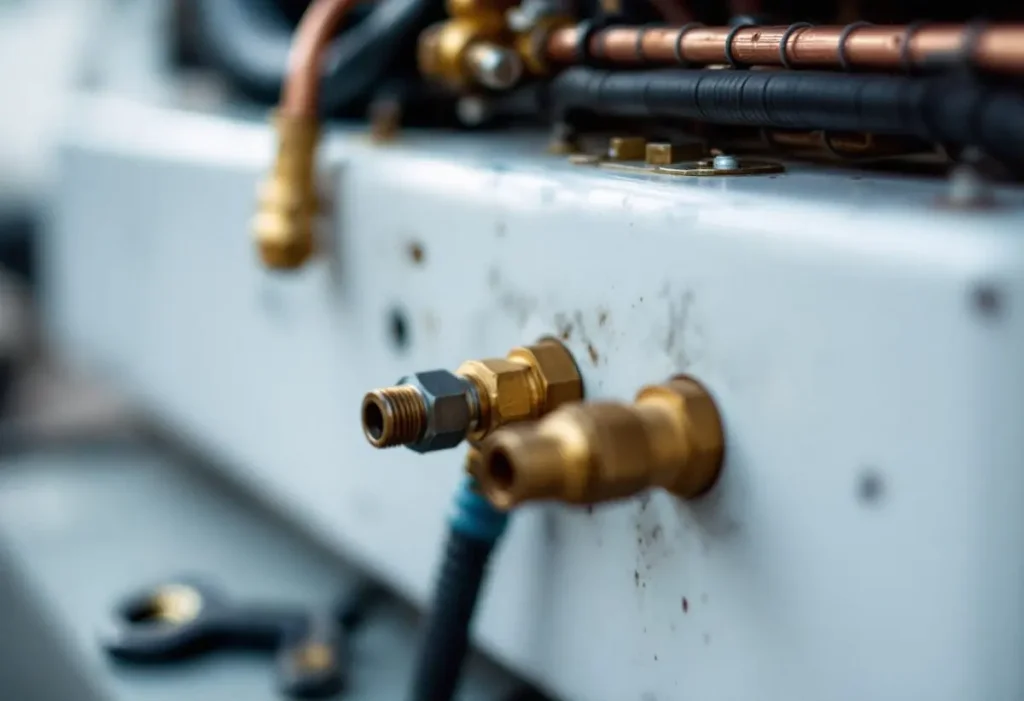
Is F0 on a Gree low refrigerant, or is it Fo pump-down mode?
F0 with a zero is a refrigerant fault; Fo with a lowercase o is a service mode. Gree’s own online tool rewrites a typed “f0” as “fo,” then returns two entries: “FO: Refrigerant Leak Protection Lock Out” and “Fo: Refrigerant Recovery Mode (Pump down status).”
Per the Livo R32 manual, F0 trips in cooling or dry with the compressor at 30 Hz or more when both coil temperatures change by 2°C or less. After 3 consecutive stops the unit locks out and “needs to be restored by re-energization.” Humid weather, half-open valves and loose coil sensors are also listed, so F0 is not proof of a leak. Gree starts the technician at standing pressure; our refrigerant pressure chart explains that comparison.
Fo pumps refrigerant into the outdoor unit. The manual’s method: within 5 minutes of power-up, COOL at 16°C (60.8°F), press LIGHT 3 times within 3 seconds; Gree’s tool then closes the small valve, and the large one at 0 psi. Our refrigerant recovery page covers the rest.

What does Gree E6 mean if it appears at power-up instead of 3 to 4 minutes later?
E6 is lost indoor to outdoor communication, and timing points to the side. Gree’s tool: “If the E6 is displayed at power up then it is most likely an INDOOR unit issue”; after 3 to 4 minutes, most likely outdoor. E6 “will not reset until the problem is resolved,” so breaker cycling does not help.
Gree checks wiring first: matching colors on terminals 1, 2, 3 and ground, 14/4 600V stranded copper cable, no splices, then add-ons such as a condensate pump float on terminal 3. Below 50 VDC on wire 2 at the outdoor terminal, a shorted compressor, fan motor or thermistor may be dragging the signal down.
Is Gree EA a refrigerant leak alarm on R32 units?
Yes, on the Livo R32: “Refrigerant leak alarm,” cause “The air conditioner may have refrigerant leakage,” in the owner’s call-a-professional list. The Sapphire R32 table and Gree’s online tool have no EA, so on other lines treat it as undefined until your manual says otherwise.
The owner’s manual labels the unit “Appliance filled with flammable gas R32,” and the service manual says to “minimize the density of refrigerant” and keep it from fire: air the room, no flames, unit off. Our R32 refrigerant page covers flammability, and refrigerant leak detection how leaks are found.
Why does Gree H5 keep coming back after a reset?
H5 is IPM protection, which Gree’s tool list calls “IPM module synchronization and over-current protection.” The Livo R32 manual says to re-energize “after about 10 min,” and to replace the module if H5 survives several tries. Dirty coils, closed valves, overcharge and a poor vacuum can all trip it first.
Gree’s compressor test: windings equal, “generally between .6 and 2.0 Ohms,” open to ground. Current on every lead with no start means a stuck compressor; no current on a lead means a failed main board. For L3 and H6, Gree says “a surge or brown out” can set the code and recommends surge protection on inverter units, the subject of our AC surge protector guide.
Is E1 on a Gree high pressure, and how long should power stay off?
E1 is “High pressure protection of system.” Gree’s tool says remove power for 15 minutes; the switch trips at about 600 PSI and the board “will only allow the switch to open 1 time” before locking out. Listed causes: a dirty outdoor coil, closed valves on a new install, air in the lines and overcharge.
Where do Gree’s own code lists disagree?
Gree prints these codes in three documents (Livo R32, its online tool and the older Sapphire manual), and 4 rows do not match.
| Code | Livo R32 service manual | Gree Comfort online tool | Older Sapphire manual (SAP09HP/12HP230V1) |
|---|---|---|---|
| E2 | Anti-freezing, “Not error code” | “Indoor coil freeze protection,” undercharge checked first | Anti-freezing, “Not the error code” |
| E9 | Anti cold air protection, not a fault | Two rows: fan delay in heating (status) and “Condensate overflow protection” on units with a factory pump | Cold air prevention, not a fault |
| H4 | “System is abnormal” | High temperature overload; normal protection at 127°F outdoor or above | “System is abnormal” (row 34) |
| Defrost | Heat lamp flashes once every 10 seconds | H1: “Status code: defrosting or oil return in heating mode” | “H1 or heating indicator is off 0.5s and blinks 10s” |
Compiled by The HVAC Brief from the three Gree documents named in the headers. Both R32 manuals call defrost a “status code in cooling process,” a template error.
The tool’s F3 step also says “coil 15K sensor, ambient 20K sensor,” reversing its own rule (15K air, 20K coil, 50K discharge). Defrost itself is on our heat pump defrost cycle page.
What does a Gree mini split flashing 8 times mean?
No Gree document we opened defines an 8 flash code. The Livo R32 owner’s manual says the “temperature indicator on indoor unit will blink to display corresponding error code,” so characters flash rather than a lamp counting. The older Sapphire manual gives one count: on E5 the outdoor yellow light will blink 5 times. The “LED1 Flashes 8 Times” pattern online is from a GE manual, not Gree.
Blinking green searches belong to other brands: Daikin’s operation lamp is on our Daikin mini split error codes page, Fujitsu’s lamp counts on the Fujitsu mini split error codes page.
Frequently asked questions
Is FO the same as F0 on a Gree mini split?
In practice, yes. Gree’s tool rewrites “f0” as “fo,” and its capital FO entry, “Refrigerant Leak Protection Lock Out,” matches the manuals’ F0 low refrigerant fault. Lowercase Fo is “Refrigerant Recovery Mode (Pump down status),” a pump-down started by pressing LIGHT 3 times within 3 seconds in cooling.
What does H1 mean on a Gree mini split?
H1 means defrost, not a failure: Gree’s tool lists “Status code: defrosting or oil return in heating mode.” On the older Sapphire, H1 on the remote is a defrost setting; cancel it with the remote off by holding MODE for 5 seconds. The Livo R32 flashes the heat lamp once every 10 seconds instead.
What does E7 mean on a Gree multi zone?
E7 is a mode conflict between indoor heads, not between indoor and outdoor. The Livo R32 manual describes two indoor units where “one is cooling and the other is heating.” Gree’s tool says every head must be in HEAT for heating, while cool and dry can run on different heads.
Which sensor do Gree codes F1 to F5 point to?
Per Gree’s tool: F1 indoor air (15K), F2 indoor coil (20K), F3 outdoor air (15K), F4 outdoor coil (20K), F5 compressor discharge (50K). These codes mean an open or shorted sensor; one that reads wrong but in range will not set a code.
How we researched this
On 7 November 2026 we read Gree’s Livo R32 service manual (file dated September 2025) and owner’s manual, the Sapphire R32 and older Sapphire service manuals, Gree Comfort’s code article, and the two data files behind its online tool (83 and 259 rows). Code glyphs are drawn, so we read them from page images. We excluded blog and parts-store code lists (one shifts F1 to F4 by one sensor), a GE manual’s blink codes, and rebadged brands, for which we found no Gree document.
Sources
- Gree Electric Appliances. “Livo R32 Service Manual (LIV09HP to LIV36HP).” https://www.greecomfort.com/assets/our-products/livo-r32/documents/livo-r32-service-manual-a.pdf. Accessed November 2026.
- Gree Electric Appliances. “Livo R32 Installation and Owner’s Manual, Indoor.” https://www.greecomfort.com/assets/our-products/livo-r32/documents/livo-r32-installation-owner-s-manual-indoor-a.pdf. Accessed November 2026.
- Gree Electric Appliances. “Sapphire R32 Service Manual (SAP09HP to SAP24HP).” https://www.greecomfort.com/assets/our-products/sapphire-r32/documents/sapphire-r32-service-manual-a.pdf. Accessed November 2026.
- Gree Electric Appliances. “Sapphire Service Manual, 9 and 12 MBH Models.” https://www.greecomfort.com/assets/our-products/sapphire/documents/sapphire-service-manual-9mbh-and-12mbh-models-a.pdf. Accessed November 2026.
- Gree Comfort. “Troubleshoot Error Codes” (tool data: /scripts/error-codes.json and /scripts/error-codes-v2.json). https://www.greecomfort.com/troubleshoot-error-codes/. Accessed November 2026.
- Gree Comfort. “GREE Mini-Split Error Codes: Understanding What They Mean and How to Resolve Them.” https://www.greecomfort.com/news-and-events/understanding-gree-mini-split-error-codes/. Accessed November 2026.
- Electronic Code of Federal Regulations. “40 CFR 82.161 Technician certification.” https://www.ecfr.gov/current/title-40/chapter-I/subchapter-C/part-82/subpart-F/section-82.161. Accessed November 2026.
Leave a Reply