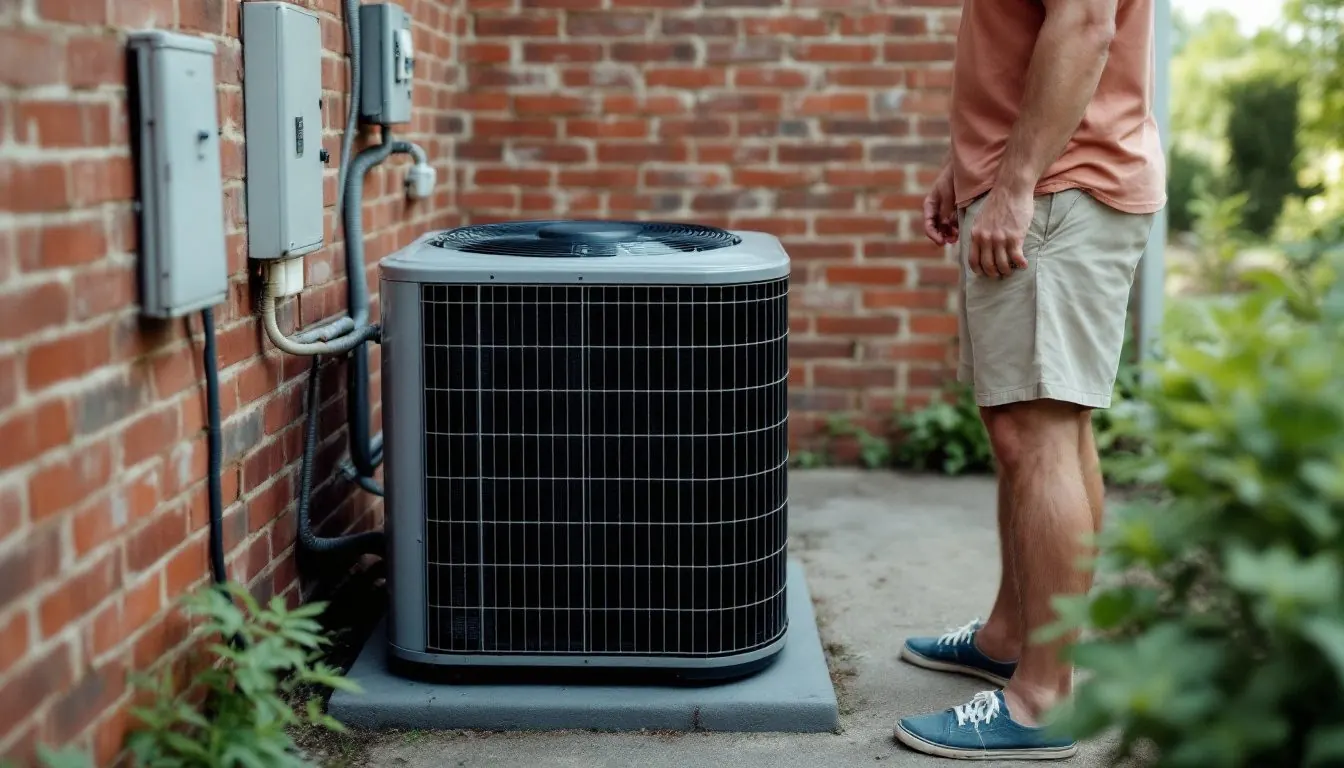
An outside AC unit making a humming noise is normal only while the fan spins and warm air rises off the top. A hum with the fan blade still, or with nothing turning, means a motor has power but cannot start: usually a failed run capacitor, a stalled fan motor or a locked compressor. Switch the thermostat to OFF.
What is turning while your outside AC unit hums?
What moves tells you more than the pitch. Hold a hand above the top grille: warm air off a spinning blade means the AC’s compressor and fan are both working. Then match what you see to one of six patterns from Rheem, Tecumseh, Copeland and ABB tables.
| What you hear and see | Causes the maker documents list | Reading that settles it |
|---|---|---|
| Steady hum, fan turning, warm air off the top | Normal operation (Goodman GSXN4: 71.0 to 75.0 dBA) | House cooling; amps near nameplate RLA |
| Hum, fan blade still, compressor running | Fan section of the shared capacitor, or the fan motor (Rheem Flash Code 2) | Microfarads at the FAN terminal; motor windings |
| Hum, nothing turning, lights may dim | Rheem Flash Code 4 Locked Rotor: failed run capacitor, low line voltage, liquid refrigerant, seized bearings | Amps near nameplate LRA; voltage during the start attempt |
| Hum, silence, retry every few minutes | Compressor internal overload opening and resetting (Copeland; Tecumseh rows B and D) | Contactor closed but no compressor current |
| Buzz or chatter at the contactor | Coil short of pull-in: ABB 24 V coils need up to 18 V; Rheem flags under 17 VAC | Coil volts during the start attempt |
| Hum with the thermostat at OFF | Rheem Flash Code 8 Welded Contactor: “Compressor always runs” | Contacts closed with the coil dead |
Compiled by The HVAC Brief from Goodman SS-GSXN4, Rheem 7083500, Tecumseh’s service chart, Copeland AE4-1331 R9 and ABB coil data.
Is a steady hum from the outside unit normal when the fan is spinning?
Yes. Goodman’s GSXN4 specification sheet rates its 1.5 to 5 ton condensers at 71.0 to 75.0 dBA: a compressor plus a 1/8 to 1/4 hp PSC fan motor at work. The sheet gives no measuring distance, so a phone app reading is not comparable; our guide to air conditioner decibel levels explains why.
The signal is change: a hum that is new, louder, or arrives with warm air indoors. Carrier’s R-410A owner’s manual says built-in start delays are normal: “Don’t be alarmed.” Rattles and clanks belong to our guide on which HVAC noises mean stop.
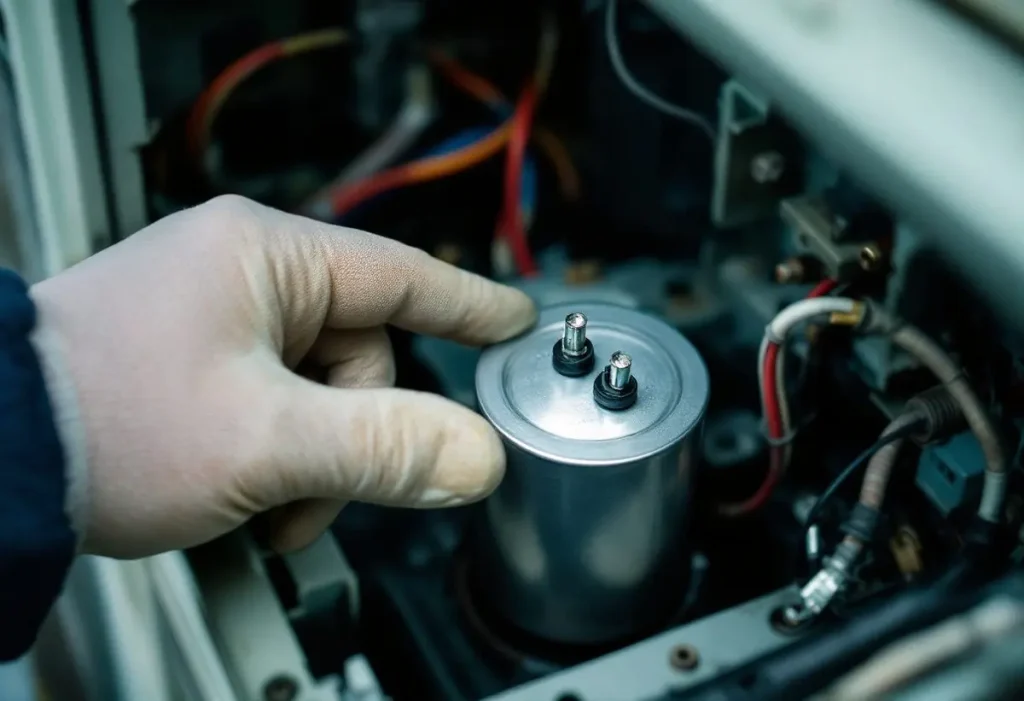
Why does the AC unit hum while the fan blade sits still?
The fan motor has power but no starting push, or its bearings have tightened. Goodman’s GSXN4 legend names the part “RCCF” (run capacitor for compressor and fan), so a weak FAN section can stall the blade while the compressor hums on below it. Ratings and failure modes are in our HVAC capacitor explainer.
Without the fan, heat stays in the coil: Rheem lists “Condenser fan is not running” under Flash Code 2, and its high pressure switch opens above 575 psig, reclosing at 460 psig. Nidec’s RESCUE condenser motors carry an “Automatic Reset Thermal Overload Protector”, so a stalled fan hums, trips, cools and retries. Replacement matching is on our condenser fan motor page.
How long should an AC compressor hum before it starts?
Well under a second. Copeland’s AE4-1331 bulletin says starting current is “normally six or more times higher than the rated running amperage” and “lasts from 100 to 300 milliseconds until the rotor starts turning.” A hum you can count in whole seconds is a compressor held in locked rotor.
We took the RLA and LRA Goodman prints for each GSXN4 size and worked out what a stall pulls:
| Goodman model (size, compressor) | Rated sound | RLA | LRA | LRA ÷ RLA | Locked rotor load at 230 V |
|---|---|---|---|---|---|
| GSXN401810 (1.5 ton, rotary) | 71.0 dBA | 6.1 A | 35.1 A | 5.8x | 8.1 kVA |
| GSXN402410 (2 ton, rotary) | 72.0 dBA | 8.4 A | 41.2 A | 4.9x | 9.5 kVA |
| GSXN403010 (2.5 ton, rotary) | 72.0 dBA | 11.6 A | 59 A | 5.1x | 13.6 kVA |
| GSXN403610 (3 ton, scroll) | 72.0 dBA | 16 A | 91.9 A | 5.7x | 21.1 kVA |
| GSXN404210 (3.5 ton, scroll) | 71.0 dBA | 17.7 A | 110.2 A | 6.2x | 25.3 kVA |
| GSXN404810 (4 ton, scroll) | 73.0 dBA | 19.9 A | 110 A | 5.5x | 25.3 kVA |
| GSXN406010 (5 ton, scroll) | 75.0 dBA | 25.6 A | 150 A | 5.9x | 34.5 kVA |
HVAC Brief calculation: amps and dBA from Goodman SS-GSXN4; ratio = LRA ÷ RLA; load = LRA × 230 V.
A humming 3 ton GSXN4 holds 91.9 A, about 21.1 kVA, against 16 A running: hence the harsher sound and dimming lights. Tecumseh’s “hums but trips on overload protector” row lists low voltage, a bad starting capacitor or relay, an open or shorted winding, mechanical trouble and liquid refrigerant. A hard start kit answers only some of those.
Why does the outside unit hum, go quiet, then hum again every few minutes?
That rhythm is the compressor’s internal overload. Copeland’s protector “opens the common connection of a single-phase motor” and reacts to “current and motor winding temperature”; once open, “the compressor must be allowed to cool sufficiently to allow it to reset.” Rheem lists “Unusually long compressor protector reset time due to extreme ambient temperature” under Flash Code 5.
So the top-ranked claim that windings burn out “within a few hours” is not what makers write. Repetition is the risk: Copeland warns that if a compressor cycles after a fault, “there is a high probability that the compressor will be damaged.” Set the thermostat to OFF; if the breaker trips instead, read why an AC keeps tripping the breaker.
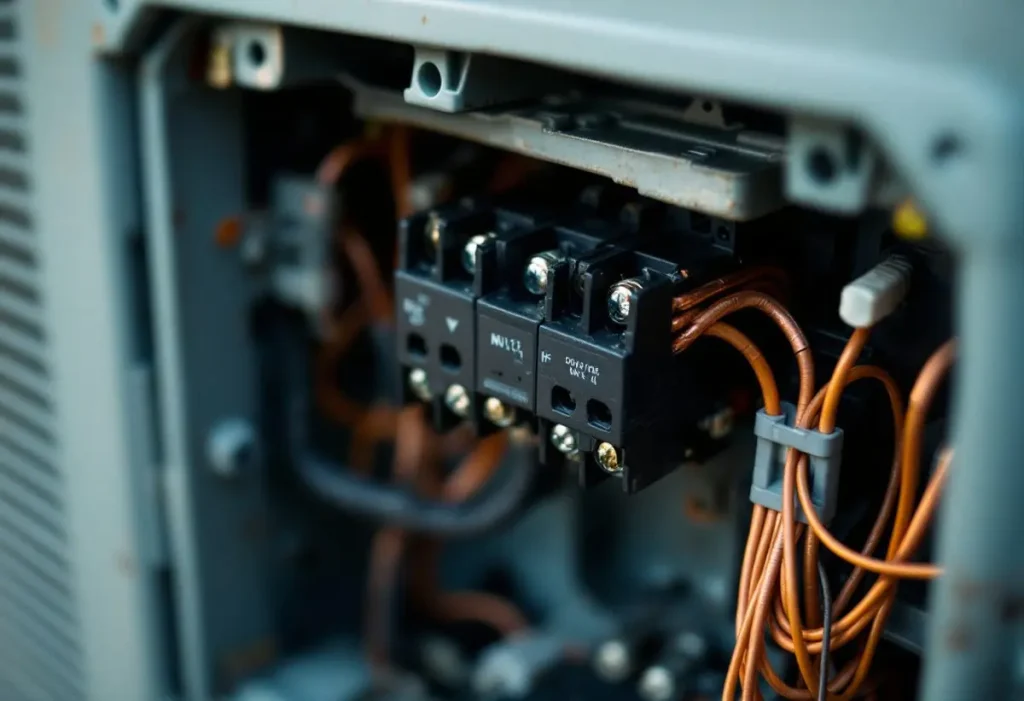
Is the AC contactor buzzing, and what voltage makes it chatter?
Often, yes: the contactor is the 24 V relay that switches the compressor and fan. ABB’s DP20 to DP40 two-pole contactors with a 24 V AC coil list a maximum pick-up voltage of 18 V and a minimum drop-out voltage of 6 to 15 V. So a coil fed under 18 V may not close, and one sagging toward the drop-out band can let go and pull in again: chatter. See our HVAC contactor guide.
Rheem’s Comfort Alert flags “Control circuit < 17VAC” as Flash Code 9: an overloaded control transformer or low line voltage. Goodman allows 197 V minimum on the 208/230 V GSXN4, and Copeland says a sagging supply at start “could cause light dimming or a buzzing noise where wire is pulled through conduit.”
Why is the outside AC unit humming after a power outage or a flicker?
A blip under 0.5 second can spin a single-phase scroll backward. Copeland says such interruptions “may result in powered reverse rotation” until the internal overload trips, that “This will not cause any damage to the compressor,” and that it then restarts normally. An odd hum, silence, then normal cooling after a storm flicker fits.
Silence after power returns is often a timer: Rheem’s units wait 5 minutes after a safety switch resets. Still silent an hour later? Work through AC not working after a power outage.
What does humming from the outside unit with the thermostat at OFF mean?
A motor is still being fed. Rheem’s Comfort Alert Flash Code 8, “Welded Contactor,” reads “Compressor always runs”, and Rheem expects the coil to “fall below 0.5VAC when off.” If the fed motor is locked, it hums instead of running.
A live cabinet at idle is normal (Rheem’s factory crankcase heater wants 24 hours of power before checkout); a humming motor is not. Open the outdoor AC disconnect and the breaker until a technician checks the contactor.
What can you check yourself, and what will the technician measure?
Note which pattern you see, time the hum in seconds, check the breaker, and clear debris only with the disconnect open. Leave the control panel shut: OSHA 1910.333 says “Capacitors shall be discharged” before work. A hum from the indoor furnace cabinet is covered in our furnace humming noise guide.
Copeland’s troubleshooting guide sets the technician’s order: voltage at the compressor terminals during a start attempt (Goodman’s floor is 197 V), amp draw against RLA and LRA, then winding resistance and resistance to ground. Add capacitor microfarads against the printed rating and coil voltage against the 18 V pick-up.
Frequently asked questions
Is it safe to leave an outside AC unit humming if the fan is not spinning?
No. With the condenser fan stopped, discharge pressure climbs; Rheem lists a stopped fan under its Flash Code 2 pressure trip, with a high pressure switch that opens above 575 psig. Copeland warns that a compressor left cycling after a fault faces a high probability of damage. Set the thermostat to OFF and have the capacitor and fan motor tested.
Can low voltage make an air conditioner hum?
Yes. Copeland says low starting voltage cuts torque and lengthens locked rotor time, and the sag can cause light dimming or a buzzing noise in conduit. Goodman sets 197 V as the minimum for its 208/230 V GSXN4 units, and on the control side Rheem flags anything under 17 VAC as a low voltage fault.
Will a hard start kit stop a humming AC compressor?
Only when weak starting torque is the cause. Copeland says start assist is usually not required on its residential scrolls because they start unloaded, and Goodman fits it at the factory on GSXN4 units when required. A kit cannot fix an open winding, seized bearings or a failed run capacitor, all on Rheem’s Flash Code 4 list.
How we researched this
We read Copeland bulletin AE4-1331 R9 (September 2024) and its troubleshooting guide, the Tecumseh service chart, Rheem 7083500, Goodman’s SS-GSXN4 sheet and wiring legend, Carrier’s owner’s manual, ABB’s contactor catalog, a Nidec motor submittal and OSHA 1910.333, plus the three top-listed articles, whose unsourced prices and burn-out timings we excluded. Ratios and kVA are our arithmetic. No maker publishes how long a locked compressor hums before its protector trips, so we give no figure. Researched November 7, 2026.
Sources
- Copeland. “Application Engineering Bulletin AE4-1331 R9: R-410A 1.5 to 5 Ton Copeland Scroll Compressors.” https://apps.copeland.com/Publications/AEB/AE4_1331_R9.pdf. Accessed November 2026.
- Copeland (Emerson). “Troubleshooting Guide: Not Starting/Running and Starts/Runs”. https://cdn.shopify.com/s/files/1/0605/9560/1544/files/copeland-scroll-compressor-troubleshooting-guide-en-7683780.pdf. Accessed November 2026.
- Tecumseh. “Trouble Shooting and Service Chart”. https://www.industrialstores.com/media/industrialstores/product/attachments/Tecumseh-Electrical-Service-Parts-Troubleshooting-Guide.pdf. Accessed November 2026.
- Rheem. “Outdoor Air Conditioner User’s Information and Installation Instructions, 2-Stage R-410A Split System” (7083500). https://files.rheem.com/LiteratureArchive/7083500.pdf. Accessed November 2026.
- Goodman. “GSXN4 Split System Air Conditioner Product Specifications” (SS-GSXN4). https://cdn.shopify.com/s/files/1/0766/1171/5363/files/GSXN402410.pdf. Accessed November 2026.
- Carrier. “Owner’s Manual: Split-System Air Conditioner Using R-410A Refrigerant”. https://res.cloudinary.com/ddi66icj4/image/upload/v1658097162/NH_Manual_Air_Conditioner_Carrier_R_Split_System_AC_410_A_Refrigerant_6ef95ef748.pdf. Accessed November 2026.
- ABB. “Definite Purpose Contactors: The complete range” (1SXU100114C0201). https://library.e.abb.com/public/790af83132a143be97b838939fa15958/1SXU100114C0201_Definite%20Purpose%20Contactors_DGT.pdf. Accessed November 2026.
- Nidec U.S. Motors. “RESCUE Motors Permanent Split Capacitor Condenser Fan” submittal sheet. https://s3.amazonaws.com/s3.supplyhouse.com/product_files/USMotors-5481H-Submital-Sheet.pdf. Accessed November 2026.
- OSHA. “29 CFR 1910.333, Selection and use of work practices.” https://www.osha.gov/laws-regs/regulations/standardnumber/1910/1910.333. Accessed November 2026.
Leave a Reply