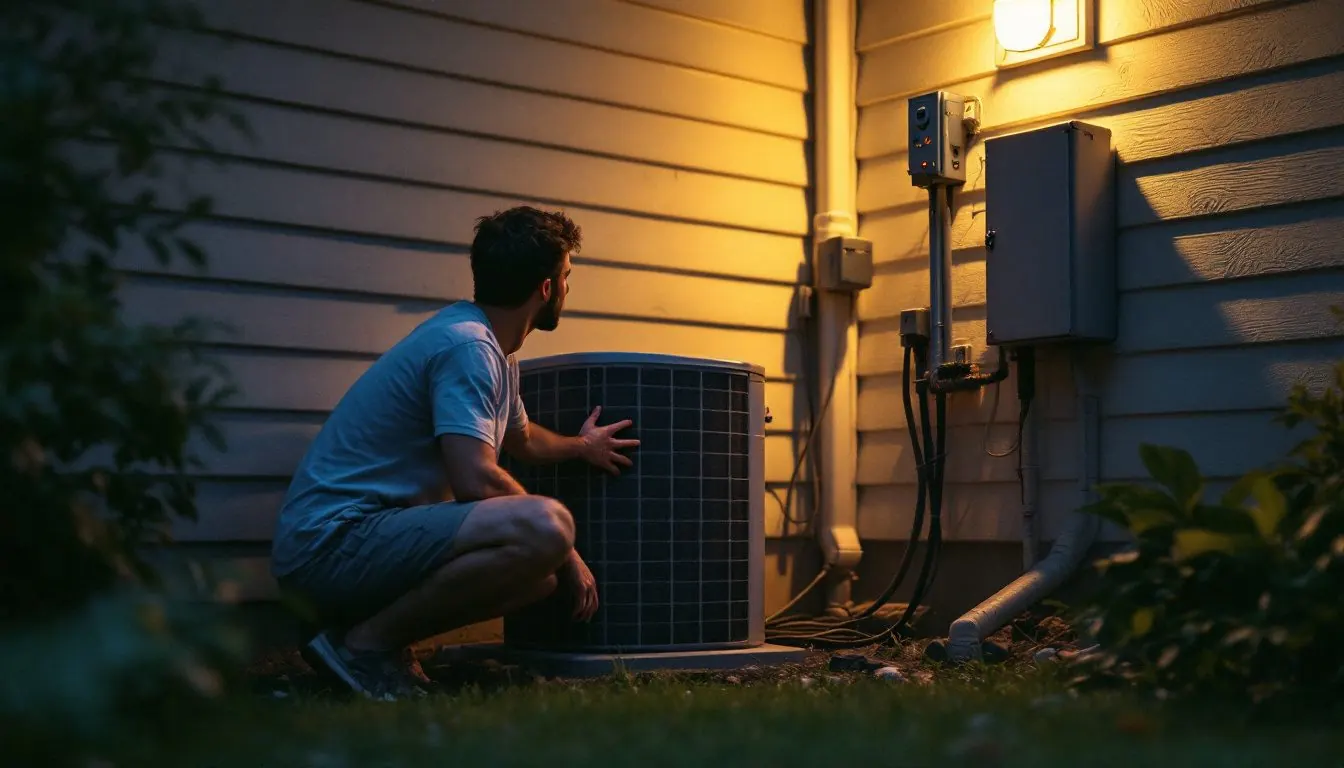
AC not working after a power outage? Wait 5 minutes first: Honeywell and Carrier thermostats hold the compressor off for 3 to 5 minutes after power returns. If it is still off, check the thermostat display, then the 120 V furnace breaker, the 240 V outdoor breaker and the outdoor disconnect, resetting a tripped breaker once only.
Start with what is running 10 minutes after the lights came back; each row names the reading that settles it.
| What you see or hear | Check | Reading that decides it | What it means | Who |
|---|---|---|---|---|
| Cool On flashing, nothing running | Leave it alone | Stops flashing, outdoor unit starts within 5 minutes | Compressor protection delay (Honeywell, Carrier) | Owner |
| Thermostat blank | Batteries, then indoor breaker and furnace switch | Goodman board LED off: no power or open fuse | Lost battery power or 24 V from the furnace | Owner, then tech |
| Blower runs, outdoor unit silent | 240 V breaker, then outdoor disconnect | Handle in the middle or OFF | Outdoor circuit open (Tecumseh: “Line disconnect open”) | Owner, one reset |
| Outdoor unit hums, fan still | Thermostat to Off | Volts at the contactor; capacitor against its label | Low voltage, capacitor, relay or windings (Tecumseh) | Technician |
| Mini split stays dark | Remote ON, wait 3 minutes | Runs after the 3-minute standby | Auto-restart off (Daikin JC jumper cut) | Owner |
| Mini split shows U2 | Wait, count repeats | Restarts after 3-minute standby | Daikin low voltage, below 180 ~ 196 V | Owner, then utility |
How long should the AC take to restart once the power comes back?
Allow 5 minutes. The Honeywell RTH6360 guide says that when Heat On or Cool On flashes, the “Compressor protection feature is engaged. Wait 5 minutes for the system to restart safely, without damage to the compressor.” Carrier’s thermostat page gives 3 to 5 minutes and names a power outage, a tripped breaker or a brief surge as triggers for the delay mode. After an outage a Sensi may also flash its whole screen once as it reboots, and the Sensi thermostat flashing guide separates that from the compressor delay.
Ductless systems carry their own timer. Daikin’s FTXR-T service manual says “It takes 3 minutes to restart the operation because 3-minute standby function is activated.” The timeline below treats 5 minutes, the longest printed figure, as the line where a delay becomes a fault.
Do not switch the thermostat off and on to hurry it: Carrier says the timer restarts and warns “Avoid repeatedly power-cycling the system, as this can stress the compressor over time.” A ranking contractor blog says to wait 30 minutes; no maker document we read asks for that. On several White-Rodgers models the setpoint flashes while that lockout runs, which the Emerson thermostat flashing guide sorts model by model. The delay logic in depth is on our page about a thermostat that says Cool On but the AC is not running. How long outages typically last where you live is in our power outage statistics by state; the average US customer was without power for 11 hours in 2024.
Did the outage blank the thermostat or change its settings?
Usually not the settings. The RTH6360 guide says the time and day survive if batteries go back in within two minutes and “All other settings are permanently stored in memory.” Its fix for a blank display is fresh AA alkaline batteries, because C “does not power the thermostat display or operations; batteries are always required.”
Then confirm the mode: Carrier’s owner’s manual wants the setpoint “LOWER than the displayed room temperature” with the mode on Cool or Auto. A thermostat that runs on the C wire takes its 24 V from the furnace or air handler transformer (the loop drawn below), so a blank Wi-Fi model points at the indoor circuit below. Model-specific fixes are on our Honeywell thermostat blank screen guide.
Which breakers and switches have to be on for central air to restart?
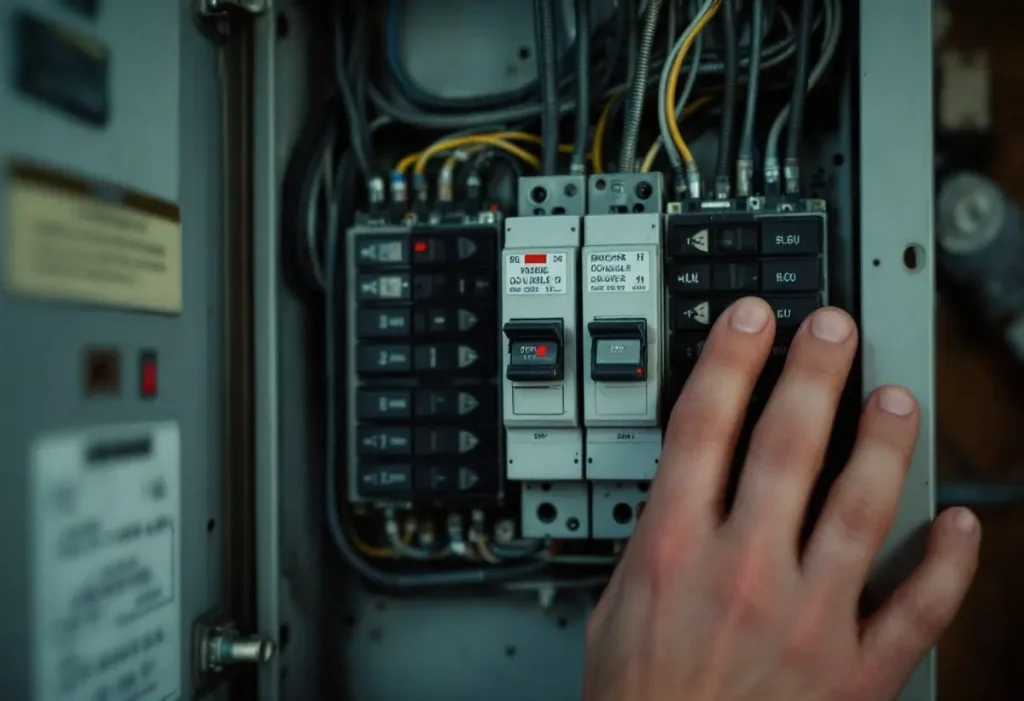
At least three, on two separate circuits. Carrier’s owner’s manual draws a main disconnect, an indoor disconnect and an outdoor disconnect, and warns: “There may be more than one electrical disconnect switch.” Its troubleshooting list starts with “Check the indoor and outdoor disconnect switches” and the panel breakers.
If the indoor blower runs but the outdoor unit stays silent, the 120 V side is fine and the 240 V side is open: a double-pole breaker in the middle position, or the pull-out at the outdoor AC disconnect box. Tecumseh’s compressor chart puts “Line disconnect open” and “Fuse removed or blown” at the top of its no-hum list.
Reset a tripped breaker once: firmly to OFF, then ON. Federal workplace rule 29 CFR 1910.334(b)(2) says a circuit opened by its protective device “may not be manually reenergized until it has been determined that the equipment and circuit can be safely energized,” and that repetitive reclosing “is prohibited.” At home, a second trip means a fault; our page on an AC that keeps tripping the breaker explains what the electrician will test.
Why is the AC unit buzzing or humming after the power outage?
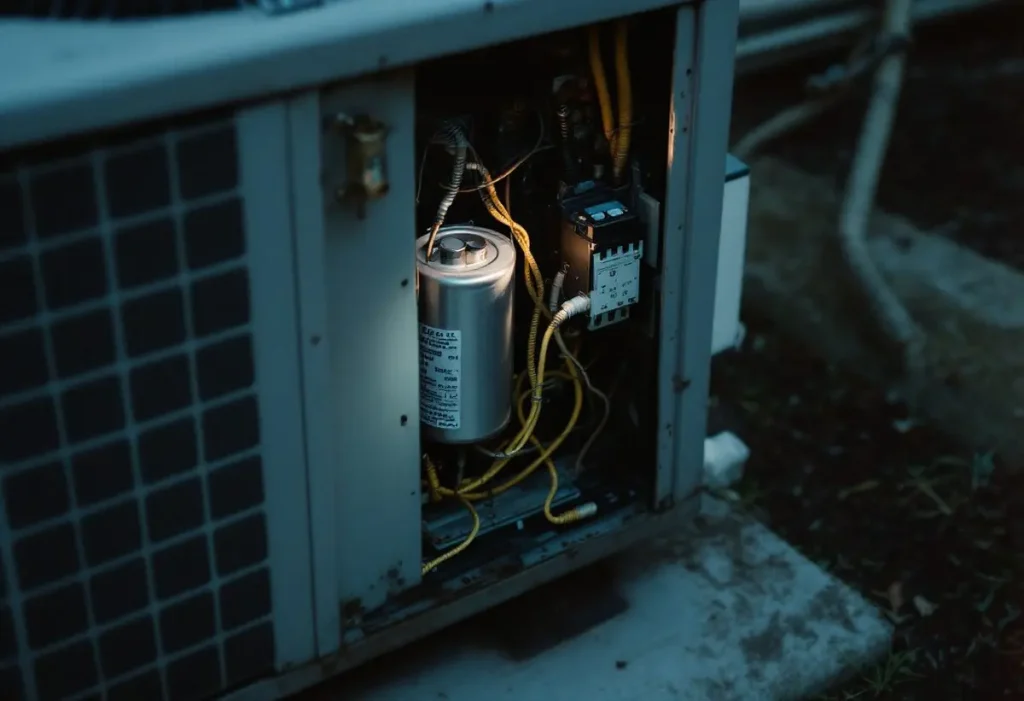
A hum with no fan rotation is a motor getting voltage but not starting. Tecumseh’s chart for a compressor that “hums but trips on overload protector” lists 7 causes: improper wiring, “Low voltage to unit,” a defective starting capacitor, a relay failing to close, a shorted or open winding, mechanical trouble and liquid refrigerant. Of those, low voltage is the only one that is a condition of the supply rather than a failed part.
Set the thermostat to Off so the compressor stops cycling on its overload. The capacitor and contactor sit on the 208/230 V side of the unit, so the stop line for an owner is the thermostat and the breaker. The technician measures the microfarad value against the printed rating, as our HVAC capacitor explainer shows, and reads voltage at the contactor during a start attempt.
Can low voltage after the power is restored stop the AC?
Yes, and briefly. Goodman’s GSXN4 specification gives a 208/230 V single-phase unit a “Min / Max Volts” range of 197/253. HVAC Brief calculation: 197 V is 14.3% below a 230 V nominal supply and 5.3% below 208 V, so a sag of about one seventh on a 230 V service puts the outdoor unit below its listed floor.
Inverter mini splits detect it. Daikin’s FTXR-T manual sets error U2 when its DC voltage detection circuit reads “below 180 ~ 196 V (depending on the model),” lists “Momentary power failure” among the causes, and restarts the compressor “automatically after 3-minute standby.” The same manual says “A power failure of 2 to 10 cycles stops air conditioner operation.” HVAC Brief calculation: at 60 Hz, 2 cycles is 33 ms and 10 cycles is 167 ms, shorter than a blink, so a unit can stop during a flicker you never noticed.
NIST’s SP 960-6 says “Sags are unlikely to damage most appliances,” but electronic controls “can be more susceptible.” Ready.gov says to turn appliances off because “Power may return with momentary surges or spikes that can cause damage.” For central air, that means the thermostat on Off until power is steady. Storm advice is on our page asking should I turn off AC during a thunderstorm, and what protectors stop is in our AC surge protector review.
Why didn’t the mini split turn back on by itself?
Its auto-restart may be switched off. Daikin’s FTXR-T manual says that after a power failure “(even a momentary one)” the system restarts “in the same conditions as before,” with a 3-minute standby. Its jumper table adds that jumper JC is connected for auto-restart at the factory; when cut, “The unit does not resume operation after recovering from a power failure. Timer settings are cleared.”
So a dark Daikin either has JC cut or has no power: check its breaker and outdoor disconnect, press ON at the remote and wait 3 minutes. If it starts and then flashes a code, look the code up by series on our Daikin mini split error codes table rather than resetting repeatedly.
What will a technician measure if nothing restarts?
Voltage first, at three points. Goodman’s furnace service instructions say that 24 volts coming off the transformer but “approximately 13 volts” between C and R on the terminal board means checking for a blown fuse; the board LED “Off” row reads “No power” or “Open fuse,” and the stated fix is to find the low-voltage short and replace the fuse “with 3-amp automotive type.”
Outdoors, the technician reads line voltage at the disconnect against the 197 to 253 V window, then the contactor coil, then the capacitor. If the furnace is also dead, see our furnace not working after power outage guide, and the general owner checklist in AC not turning on.
Frequently asked questions
Do I need to reset my AC after a power outage?
Usually no. Honeywell’s RTH6360 guide says to wait 5 minutes for the compressor delay, and Daikin’s FTXR-T mini split restarts by itself after a 3-minute standby. Reset only a breaker that is visibly tripped, and only once; a second trip means a fault.
Should I turn off my AC during a power outage?
Yes, at the thermostat. Ready.gov tells households to turn off or disconnect appliances because power may return with momentary surges or spikes. Switch back to Cool once the power has stayed on, and allow up to 5 minutes before the outdoor unit runs.
Can a power outage damage an AC unit?
Rarely by itself. NIST’s SP 960-6 says sags are unlikely to damage most appliances, but electronic controls can be more susceptible than mechanical ones. The restoration surge is the risk Ready.gov names, so control boards, thermostats and mini split boards are tested first.
Why is my AC unit loud after a power outage?
A loud hum from the outdoor unit with the fan still means a motor is energized but not starting. Tecumseh’s chart lists 7 causes for a compressor that hums and trips its overload, led by low voltage and a defective starting capacitor. Set the thermostat to Off and call a technician.
How we researched this
On 6 November 2026 we read the Honeywell RTH6360 guide, Carrier’s Cool On article and owner’s manual, Goodman RS6610004 and SS-GSXN4, Daikin SiUS041829EA (distributor copy), Tecumseh’s chart (retailer copy), NIST SP 960-6, Ready.gov and 29 CFR 1910.334, plus the hvac.com and fixurge.com pages that rank today; Angi’s page blocked automated reading. We excluded repair prices (no federal source publishes them) and Gree and Pioneer documents that repeat Daikin’s restart behavior. Percentages and milliseconds are our arithmetic.
Sources
- Resideo (Honeywell Home). “RTH6360 Series User Guide.” https://digitalassets.resideo.com/damroot/Original/10015/33-00201EF.pdf. Accessed November 2026.
- Carrier. “Cool On Flashing on Thermostat.” https://www.carrier.com/us/en/residential/hvac-resources/smart-thermostats/cool-on-flashing-on-thermostat/. Accessed November 2026.
- Carrier. “Split-System Air Conditioner Owner’s Manual.” https://res.cloudinary.com/ddi66icj4/image/upload/v1658097162/NH_Manual_Air_Conditioner_Carrier_R_Split_System_AC_410_A_Refrigerant_6ef95ef748.pdf. Accessed November 2026.
- Goodman. “Gas Furnace Service Instructions, RS6610004.” https://s3.amazonaws.com/s3.supplyhouse.com/product_files/Goodman-GMS951155DXA-Install-Instructions.pdf. Accessed November 2026.
- Goodman. “GSXN4 Product Specifications.” https://cdn.shopify.com/s/files/1/0766/1171/5363/files/GSXN402410.pdf. Accessed November 2026.
- Daikin. “FTXR-T Service Manual SiUS041829EA” (distributor copy). https://resource.ecmdi.com/is/content/Watscocom/Gemaire/daikin_rx-rmvju9_en_sm.pdf. Accessed November 2026.
- Tecumseh. “Trouble Shooting and Service Chart” (retailer copy). https://www.industrialstores.com/media/industrialstores/product/attachments/Tecumseh-Electrical-Service-Parts-Troubleshooting-Guide.pdf. Accessed November 2026.
- NIST. “Special Publication 960-6, surge practice guide.” https://nvlpubs.nist.gov/nistpubs/Legacy/SP/nistspecialpublication960-6.pdf. Accessed November 2026.
- Ready.gov (FEMA). “Power Outages.” https://www.ready.gov/power-outages. Accessed November 2026.
- OSHA. “29 CFR 1910.334, Use of equipment.” https://www.osha.gov/laws-regs/regulations/standardnumber/1910/1910.334. Accessed November 2026.
Leave a Reply