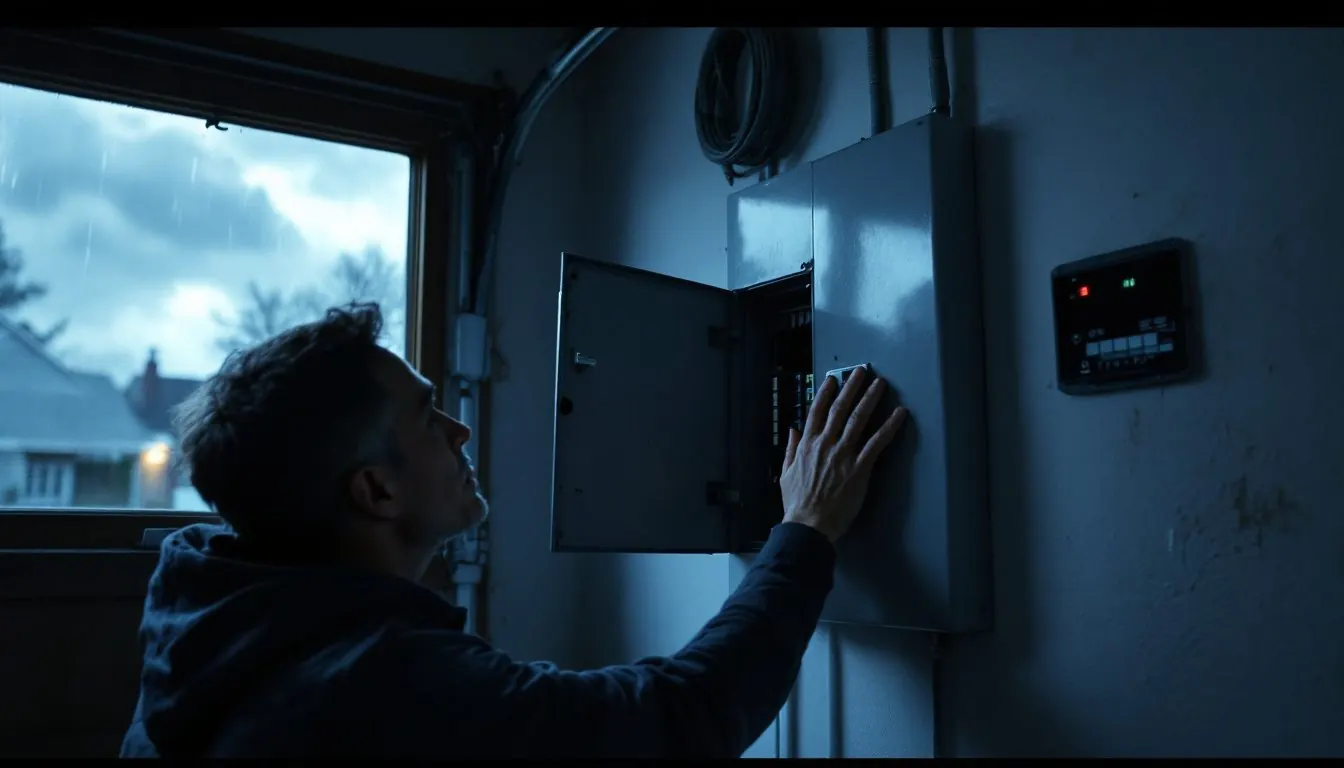
Should I turn off AC during thunderstorm weather? Yes, if lightning is forecast and you can do it before the first thunder: stop the system at the thermostat, then open its breaker. Once thunder is audible, stay put and use only an app or remote. Rain will not hurt it; surges can.
Thunder is already rumbling: should I still go flip the breaker?
No. The National Weather Service says you can normally hear thunder about 10 miles from a strike, and that lightning can strike that far from the storm, so audible thunder already puts you in range. Its indoor safety page says “Don’t touch electrical equipment” and “Do not unplug equipment during a thunderstorm as there is a risk you could be struck.” Its injury page adds anyone touching “anything connected to metal wires.” NWS does not name breaker panels or wall thermostats; we read both as inside that wording. A condenser can be replaced, so the switch-off belongs at the forecast stage.
| Where the storm is | Central AC or heat pump | Mini-split or window unit |
|---|---|---|
| Forecast, no thunder yet | Thermostat to Off. Once the outdoor unit stops, open the AC breaker if the panel is indoors and dry. | Remote off, then breaker. Window unit: unplug now. |
| Thunder audible at any distance | App to Off, or leave it running. No panel, no outdoor unit. | Remote off, which NWS calls safe. Do not unplug. |
| Away from home | App to Off if you have one. Otherwise nothing: only equipment is exposed. | Same. |
| Power out, 30 minutes past last thunder | Breaker off until utility power holds steady. | Breaker off or unplug. |
| Water has reached electrical parts | Do not restore power until evaluated. | Same. |
Compiled by The HVAC Brief from NWS, Ready.gov, NEMA and the manuals below.
What do AC makers actually say about lightning in their manuals?
Mini-split makers say cut the breaker. The Carrier and Trane central AC owner’s documents we read give no storm instruction, and Trane mentions lightning only to exclude it from the warranty.
| Maker and document | Exact wording | What to do with it |
|---|---|---|
| Mitsubishi Electric MSY-GL09NA (mini-split) | “Turn the breaker OFF when you hear thunder and there is a possibility of a lightning strike.” | Thunder is the NWS line for hands off. Act earlier. |
| Lennox MFMD user manual (mini-split) | “… during a thunder/lightning storm, cut the power at the circuit breaker.” Also: “Do not turn the mini-split off with the circuit breaker while it is operating.” | Stop it with the remote first. |
| Hessaire H Series manual 0923 (mini-split) | “Turn off the breaker during lightning or strong storms.” | Same advice, also triggered by wind. |
| Gree VIRU manual (mini-split) | For “interference, such as thunder”: “Disconnect power, put back power, and then turn on the unit again.” | Try a power cycle before a service call. |
| Carrier owner’s manual, 08/19 (central AC) | No mention of lightning, thunder or storms. | No instruction either way. Use the NWS timing. |
| Trane Owner’s Guide 22-5213 (central AC, heat pump) | Warranty excludes “any acts of God including, but not limited to, fire, water, storms, lightning, or earthquakes.” | Plan on insurance, not warranty. |
Compiled by The HVAC Brief from the six documents named. A sample, not a census.
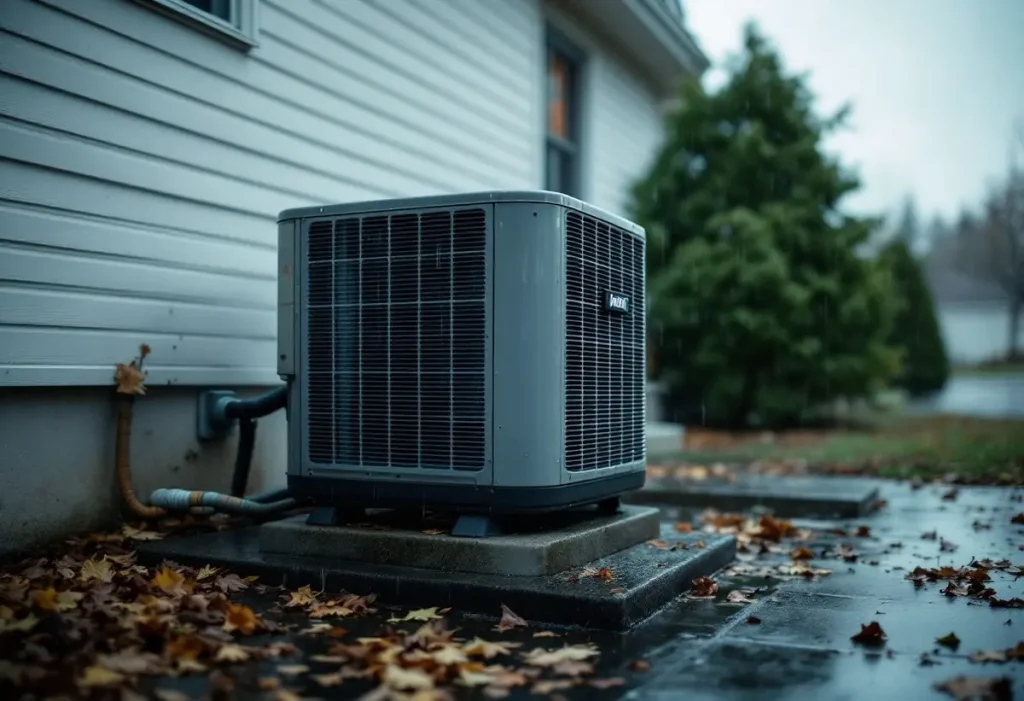
Which storm hazards actually hurt an AC, and does switching off help?
Only the electrical ones change when the unit is off. NWS defines a severe thunderstorm by hail of an inch or larger or gusts over 58 mph, and those hit a stopped condenser as hard as a running one.
| Hazard | What it does | Off helps? | Your move |
|---|---|---|---|
| Rain | Lennox: units “are designed to live and operate outdoors.” | Not needed | Keep cooling. No tarp. |
| Wind over 58 mph | NWS: can break off large branches. | No | Afterward, clear debris to Carrier’s 12 inch clearance. |
| Hail, 1 inch or larger | DOE: fins can bend and “block airflow.” | No | Photograph the coil. A contractor can use a fin comb. |
| Nearby strike | NWS: surges reach equipment “some distance from the actual strike.” | Partly | Off before thunder. |
| Power returning | Ready.gov: “momentary surges or spikes that can cause damage.” | Yes | Off during the outage, once safe to reach. |
| Direct strike | NIST: “rare,” limited to the object struck and its surroundings. | Little | No setting saves it. |
| Flood | NEMA: “extremely hazardous if reenergized without performing a proper evaluation.” | Stay off | Keep it dead. NEMA lists insulation and capacitor damage in flooded motors. |
Compiled by The HVAC Brief from the documents in Sources.
Why is the thermostat only half a shutoff for a condenser?
Because it ends the low voltage call, not the power feed. Honeywell’s T6 Pro wiring tables show the Y terminal driving the “Compressor contactor” on a 24VAC circuit, so Off lets the contactor drop out. Compressor and fan then sit behind open contacts, which helps, but the line stays live up to them. Carrier’s 38EYA instructions show it: to power only the crankcase heater, “set thermostat to OFF and close electrical disconnect.”
The breaker removes the utility route from the panel to the unit, but not the other routes NWS names: “through wires or pipes that extend outside the structure or through the ground.” NIST’s 2001 booklet Surges Happen! says appliances with electronic controls “can be more susceptible” than mechanical ones. It is general, not AC testing. Our reading: an inverter mini-split or variable speed system has more to lose than a single stage unit with only a contactor and capacitor.
Is it safe to flip the AC breaker, and in what order?
Yes, before thunder starts and if the panel is indoors and dry. Lennox warns that using the breaker on a running unit “may cause a spark and result in electric shock or fire,” which sets the order.
- Set the thermostat or remote to Off and wait until the outdoor fan and compressor stop.
- Open only the double pole breaker labeled AC or condenser. If nothing is labeled and thunder is close, skip it.
- Leave the outdoor AC disconnect alone. The Red Cross: “no place outside is safe when thunderstorms are in the area.”
- Panel in a garage or on bare concrete? Go early or not at all: NWS says stay out of open garages and do not “lean against concrete walls.”
Can a whole house surge protector let me leave the AC running?
For everyday grid surges it helps; for close lightning, NWS says “Typical surge protectors will not protect equipment from a lightning strike.” NEC 2020 section 230.67, as restated by EC&M, requires a Type 1 or Type 2 device at dwelling services and when service equipment is replaced, so older panels in many jurisdictions have none. Device types and the second layer at the unit are in our AC surge protector breakdown.
How long should I wait to turn the AC back on after a storm?
Wait 30 minutes after the last thunder, restore the breaker, then set the thermostat to Cool. The figure is the NWS outdoor rule for resuming activity; applying it to your panel is our extension. After an outage, also wait until power holds steady, since Ready.gov warns of surges on return. If the system still will not start once power is back, an AC not working after a power outage usually needs a short wait, then a check of the thermostat and both breakers.
Then expect a pause. Honeywell’s PRO 3000 guide says when “Cool On” flashes, “Wait 5 minutes.” Carrier mentions only unspecified time delays, so five minutes is common, not universal. If the pause never ends, you have a thermostat saying Cool On with the AC not running.
Do not leave the breaker off for days. Lennox’s XP25 instructions say a unit with a crankcase heater below 60°F should be energized 24 hours before start-up. That is a start-up rule; no document we read sets a threshold for a short storm shutoff.
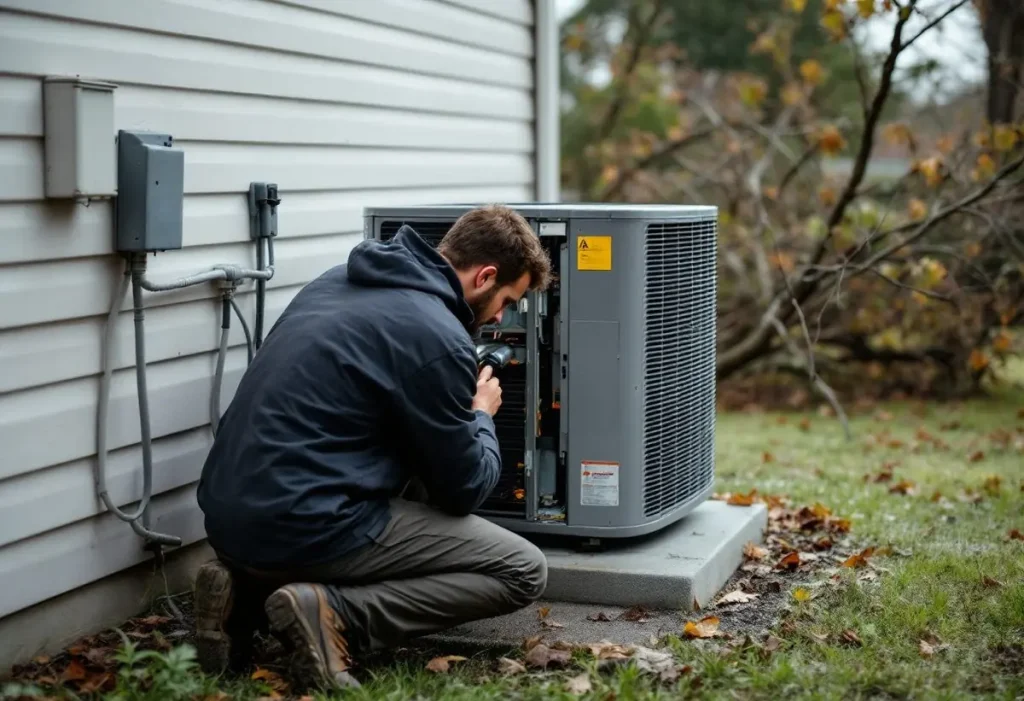
The AC won’t start after the storm: what will the technician test?
It depends on the symptom. Our AC not turning on guide has the owner checks; these are the readings behind them. Leave the breaker open at any burnt smell.
Thermostat blank. Check breakers. A technician reads 24VAC across R and C, then checks the transformer and board fuse.
Outdoor unit silent past 5 minutes. The technician reads 24VAC at the contactor coil and 208/230 volts at its line side. Both present with no pull-in points to the contactor.
Unit hums, fan still. Often a run capacitor, tested against its printed rating. Stop here: capacitors hold charge, and discharging one is a technician’s job.
Breaker trips again. Do not keep resetting it: OSHA 1910.334 says a tripped circuit “may not be manually reenergized until it has been determined that the equipment and circuit can be safely energized.”
Will insurance or the warranty pay for lightning damage to an AC?
Insurance is the likely payer. Besides Trane, Hessaire’s warranty excludes damage from “floods, fires, wind, lightning.” Triple-I counted 61,986 lightning claims on US homeowners policies in 2025, worth $1.65 billion, averaging $26,616, up 42.8% on 2024; Texas averaged $60,382. Those cover all lightning damage to a home, with no AC share published, so they do not price a condenser. Get the failed part and any burn evidence on the invoice, then check the wording in our homeowners insurance and HVAC review.
Frequently asked questions
Is it safe to run AC during a thunderstorm?
For you, yes, provided you are not touching it. The NWS indoor rules never mention running air conditioning; they warn against contact with electrical equipment and cords. The exposure from running is to the machine: NWS says surges can damage electronics “some distance from the actual strike.”
Should I unplug my window AC during a thunderstorm?
Only before the storm arrives. NWS says “Do not unplug equipment during a thunderstorm as there is a risk you could be struck.” Unplug at the forecast stage. Once thunder is audible, use the remote, which NWS says is safe, and leave the plug alone until 30 minutes after the last rumble.
Will heavy rain damage an outdoor AC unit?
No, rain alone is not a hazard. Lennox says modern units “are designed to live and operate outdoors,” and Carrier says not to cover one because it “needs unrestricted airflow.” Rising water differs: NEMA warns that electrical equipment exposed to water can be extremely hazardous if reenergized without evaluation.
How we researched this
In November 2026 we read the documents in Sources and searched each manual for lightning, thunder and storm. We excluded contractor blogs, appliance sites and manuals seen only as search snippets. Conclusions marked as our reading are ours. We ran no lightning or surge tests.
Sources
- National Weather Service. “Lightning Indoors.” https://www.weather.gov/safety/lightning-indoors Accessed November 2026.
- National Weather Service. “Understanding Lightning Science.” https://www.weather.gov/safety/lightning-science-overview Accessed November 2026.
- National Weather Service. “Five Ways Lightning Strikes People.” https://www.weather.gov/safety/lightning-struck Accessed November 2026.
- National Weather Service. “When a Safe Building or Vehicle is Nearby.” https://www.weather.gov/safety/lightning-outdoors Accessed November 2026.
- National Weather Service. “Severe Thunderstorm Safety.” https://www.weather.gov/safety/thunderstorm Accessed November 2026.
- Triple-I. “Facts + Statistics: Lightning.” https://www.iii.org/fact-statistic/facts-statistics-lightning Accessed November 2026.
- NIST. “Surges Happen! SP 960-6.” https://nvlpubs.nist.gov/nistpubs/Legacy/SP/nistspecialpublication960-6.pdf Accessed November 2026.
- Mitsubishi Electric. “MSY-GL09NA manual, via ManualsLib.” https://www.manualslib.fr/manual/54270/Mitsubishi-Electric-Msy-Gl09Na.html?page=3 Accessed November 2026.
- Lennox. “Mini-Split User Manual MFMD.” https://www.lennox.com/dA/61e7c59108/DB68-12939A-00.pdf Accessed November 2026.
- Hessaire. “H Series User Manual 0923.” https://images.thdstatic.com/catalog/pdfImages/08/08d39d98-6568-4e8e-a5fd-75f78e7fe209.pdf Accessed November 2026.
- Gree. “VIRU owner’s manual.” https://resource.ecmdi.com/is/content/Watscocom/Gemaire/gree_viru36hp230v1ao_article_2277393384685900_en_ii.pdf Accessed November 2026.
- Carrier. “Split-System Owner’s Manual 08/19, third-party copy.” https://res.cloudinary.com/ddi66icj4/image/upload/v1658097162/NH_Manual_Air_Conditioner_Carrier_R_Split_System_AC_410_A_Refrigerant_6ef95ef748.pdf Accessed November 2026.
- Carrier. “38EYA Instructions, archived copy.” https://archive.org/download/manualsonline-id-6371e5dc-7d07-46bd-9e20-9d37c2b8b668/6371e5dc-7d07-46bd-9e20-9d37c2b8b668.pdf Accessed November 2026.
- Trane. “Owner’s Guide 22-5213-WEB01, archived copy.” https://archive.org/download/manualsonline-id-0669dd0a-72b0-4432-9561-1ba4bdecfe5a/0669dd0a-72b0-4432-9561-1ba4bdecfe5a.pdf Accessed November 2026.
- Ready.gov. “Power Outages, archived copy.” https://web.archive.org/web/2025id_/https://www.ready.gov/power-outages Accessed November 2026.
- NEMA. “GD 1-2019, New Jersey DCA copy.” https://www.nj.gov/dca/codes/publications/pdf_other/NEMA_GD_1__2019.pdf Accessed November 2026.
- Honeywell. “PRO 3000 User Guide 69-1776EFS.” https://res.cloudinary.com/dzhpkjoqj/Resideo/69-1776EFS.pdf Accessed November 2026.
- Honeywell. “T6 Pro Instructions 33-00181EFS, archived copy.” https://web.archive.org/web/2025id_/https://customer.resideo.com/resources/techlit/TechLitDocuments/33-00000s/33-00181EFS.pdf Accessed November 2026.
- Lennox. “XP25 Instructions 507005-01.” https://www.lennox.com/dA/3afe37cae1/507005-01f.pdf Accessed November 2026.
- Lennox. “Should I Cover My AC Unit in the Winter?.” https://www.lennox.com/residential/lennox-life/consumer/should-i-cover-my-ac-unit-in-the-winter Accessed November 2026.
- US DOE. “Air Conditioner Maintenance, archived copy.” https://web.archive.org/web/2025id_/https://www.energy.gov/energysaver/maintaining-your-air-conditioner Accessed November 2026.
- EC&M. “Code Q&A: Protection of Dwelling Unit Services.” https://www.ecmweb.com/national-electrical-code/qa/article/21146819/code-qa-protection-of-dwelling-unit-services Accessed November 2026.
- OSHA. “29 CFR 1910.334.” https://www.osha.gov/laws-regs/regulations/standardnumber/1910/1910.334 Accessed November 2026.
- American Red Cross. “Thunderstorm Safety.” https://www.redcross.org/get-help/how-to-prepare-for-emergencies/types-of-emergencies/thunderstorm.html Accessed November 2026.
Leave a Reply