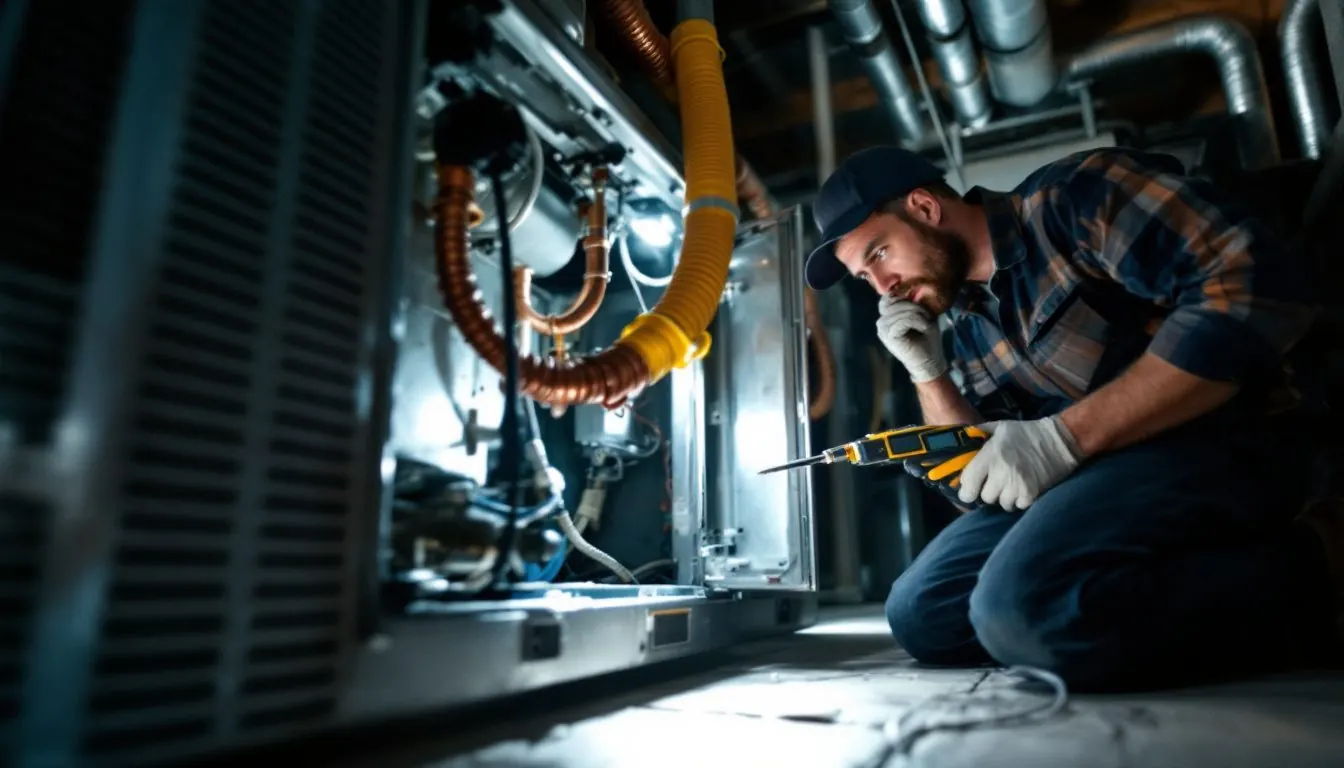
What causes an evaporator coil to leak? Four documented mechanisms: formicary corrosion, where acid vapors from household products tunnel through copper tubes; chlorine cleaners or drain tablets eating aluminum tubes; tubes rubbing on metal; and ice cracking a starved coil. Water on the floor is usually a blocked drain, not a tube leak.
| Cause | Where it shows | What the document says | What the technician checks | Usual outcome |
|---|---|---|---|---|
| Formicary (ant’s nest) corrosion | Copper tubes, mostly straight runs, outside surface | ARTI: pits invisible to the unaided eye; failures even before installation | Detector sweep, then nitrogen test on the isolated coil | Replace coil |
| Chlorine cleaners or pan tablets | Aluminum tubes and fin pack | Goodman SA-026: can cause premature aluminum coil failure | What went in the pan and on the coil | Replace coil, remove the chlorine |
| Wrong pH cleaner | Aluminum coils | Lennox CK40CT: damage below pH 5 or above pH 9 | Cleaner label | Rinse with water only |
| Rub-through | Return bends, feeder tubes, cabinet edges | Lennox CB26UH: tubing must not rub metal or other copper | Shiny wear or oil at a contact point | Braze repair if reachable |
| Freezing | Tubes inside an iced coil | Bosch: ice can crack the metal and leak refrigerant | Filter, blower speed, charge | Fix airflow or charge, then leak test |
| Shipping or factory damage | Anywhere on a new coil | Lennox CK40CT: ships at 10 ± 3 psi; no hiss means leak check | Holding charge at install | Warranty claim |
Compiled by The HVAC Brief from the 2005 Air-Conditioning and Refrigeration Technology Institute (ARTI) report, Goodman SA-026, Bosch BTC 760002111 A and Lennox 505059M and 508448-01.

Why does formicary corrosion eat through copper evaporator coils?
Because weak organic acids, chiefly formic and acetic acid, condense on the wet copper and dig branching tunnels through the tube wall. The ARTI report by Corrosion Testing Laboratories, archived by DOE’s OSTI library, calls it “an insidious form of localized pitting corrosion” and quotes Notoya: “In Japan, this type of corrosion is found in approximately 10% of cases of premature failure of copper tubes.”
Its review of about 60 papers gives the pattern: approximately 60% of attack starts on the outside tube surface and about 34% inside, and approximately 66% of failures are on straight tubing rather than bends. The vapor phase was the most critical factor, so the source can be a new floor or a paint can, not anything touching the coil.
The lab work explains why coils fail young. Copper held over formic acid solutions as weak as 20 ppm showed a pit 2.1 mils deep after 10 days, and formic acid beat acetic acid for aggression. That 20 ppm is the test liquid in the jar, not room air, a distinction our coil replacement guide and most summaries skip.
| Formic acid in test liquid | Test and cycle | Days exposed | Deepest pit reported | In millimeters |
|---|---|---|---|---|
| 20 ppm | 50-day test, 40/20°C | 10 | 2.1 mils | 0.053 mm |
| 50 ppm | 50-day test, 40/20°C | 10 | 2.1 mils | 0.053 mm |
| 100 ppm | 50-day test, 40/20°C | 10 | 6.1 mils | 0.155 mm |
| 100 ppm | Six-month test, 40/20°C | 182 | 3.0 mils | 0.076 mm |
| 10,000 ppm | Six-month test, 40/20°C | 14 | 6.1 mils | 0.155 mm |
HVAC Brief calculation: ARTI pit depths converted at 1 mil = 0.0254 mm. Duplicate tubes sometimes differed two to five fold.
Which household products and coil cleaners attack an evaporator coil?
For copper coils, anything giving off organic acid vapor; for aluminum, chlorine and strong acids or alkalis. Bosch’s 2024 bulletin lists foam insulation, particle board and plywood, poor quality drywall, cleaning solutions, VOCs, vinegar, cosmetics, latex paints, gasoline, smoking, wood burning, and carpet and vinyl flooring. The ARTI review adds braze fluxes, adhesives and manufacturing lubricants.
Goodman’s Service Bulletin SA-026 says chlorine cleaners and drain pan tablets can corrode its aluminum tube coils to premature failure, and recommends flushing any coil with plain water. Lennox’s CK40CT instructions warn against solutions below pH 5 or above 9 and say to rinse at under 50 psi.
For copper, Bosch says avoid chlorine and fluoride cleaners, which “may cause pitting corrosion”, and use ammonia or baking soda solutions to lift formic and acetic acids. Our coil cleaning guide sorts products by coil metal.
Can vibration, ice or a bad install make an evaporator coil leak?
Yes, and these leaks cluster at bends, feeder tubes and joints. Lennox’s CB26UH air handler instructions say to make sure “copper tubing does not rub against metal edges or other copper tubing”. Carrier’s 38EYA instructions ask installers to confirm factory tubing “has not shifted during shipment” and that feeder tube wire ties are tight.
Ice is the second mechanical cause. Bosch’s bulletin says insufficient refrigerant or restricted airflow can ice the coil, which “can lead to the metal cracking, and refrigerant leakage.” A slow leak can feed itself: lost charge freezes the coil and the ice stresses the tubes. Our guide to why an AC freezes up separates the airflow and charge causes.
Some coils arrive damaged. Lennox ships CK40CT coils holding 10 ± 3 psi of dry air and says to leak check any coil that does not hiss when the plug is pierced. ARTI records formicary failures “before installation”, so a leaking coil under a year old does not prove an install error.
Is the evaporator coil leaking water, refrigerant or oil?
Water is almost always a condensate fault; refrigerant leaves as invisible gas; oil marks where it escapes. Lennox’s CB26UH manual requires a 2 inch trap on the primary drain and a secondary drain pan where overflow could damage a finished space. A plugged line is the usual culprit, covered in our clogged drain line guide.
Water running down into the furnace below a cased coil points at the pan, the trap or melting ice. Lennox’s CK40CT manual adds that the coil pan must sit at least 2 inches from a gas furnace heat exchanger and 4 inches from an oil-fired one, or it can be damaged and leak. Other sources are in our furnace leaking water page.
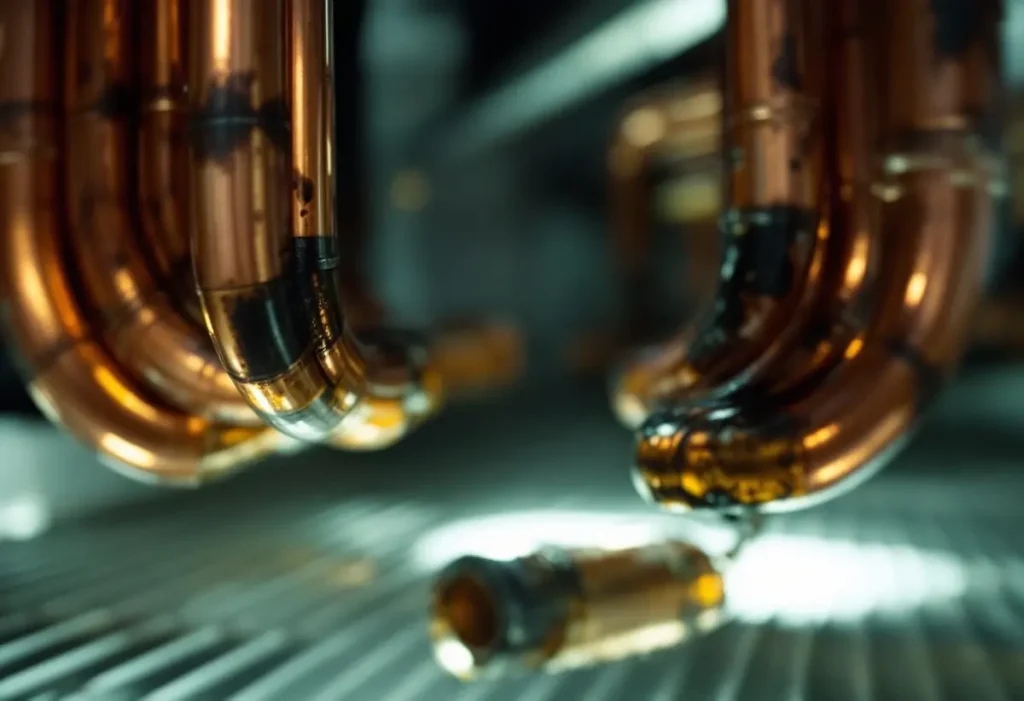
Oil is the tell for a refrigerant leak. Lennox’s XP25 instructions state the system “contains both refrigerant and oil”, and they circulate together, so a greasy patch on a return bend or braze joint marks escaping gas. Our refrigerant oil explainer covers the oils R-410A and R-454B use.
How can you tell if an evaporator coil is leaking refrigerant?
You see the effects, not the gas: longer run times, warmer supply air, ice on the coil or the larger suction line, and a system that needs refrigerant again within months. A sealed circuit does not consume refrigerant, so a repeat top-up means a hole, confirmed with gauges and a detector as in our refrigerant leak detection guide.
Ask for three checks. Superheat and subcooling against the maker’s chart show a short charge. An electronic detector sweep across the coil, return bends and distributor locates the escape. Because formicary pits are invisible, a coil showing no single bubble may need isolating and pressurizing with nitrogen. Newer R-454B coils such as the Lennox CK40CT also carry a factory-installed leak detection sensor.
Can an evaporator coil leak be fixed, or will it keep leaking?
A single rub-through or a cracked braze joint you can reach is often repairable; formicary corrosion usually is not, because the pit you find is unlikely to be the only one. ARTI notes the pits are “not visible to the un-aided eye”, so brazing one hole leaves the rest in place, which is why a patched coil keeps leaking.
Either repair means opening the system, and federal rules control that. 40 CFR 82.156 requires refrigerant recovery with certified equipment before an appliance is opened, and Lennox manuals repeat that the Clean Air Act of 1990 bans intentional venting. The leak repair rules at 40 CFR 84.106 start at 15 pounds and exclude residential air conditioning, as our leak rules explainer details.
When the coil is replaced, the metal matters. Trane markets its all-aluminum Comfort Coil as reducing leaks from salt and household cleaning products, tested to 500 hours of sea salt spray, and Bosch says its current IDS and IDP models use coated aluminum coils. Goodman’s chlorine bulletin shows aluminum trades one weakness for another. Replacement cost is in our evaporator coil replacement guide.
How often do evaporator coils leak, and how long should one last?
No U.S. federal dataset counts evaporator coil leak rates, so any precise percentage is an estimate. The closest published figure is Notoya’s, quoted in the ARTI report: formicary corrosion in about 10% of premature copper tube failures in Japan. Trane gives its Comfort Coil an expected service life of more than 15 years, a maker claim rather than field data.
Exposure risk is covered in what happens if freon leaks in your house.
Frequently asked questions
Why is my evaporator coil leaking water from inside the cabinet?
Usually the condensate is not leaving the pan: a plugged trap or line, a cracked pan, or ice melting faster than the drain can carry it. Lennox requires a 2 inch trap on the primary drain of its CB26UH air handlers and a secondary pan wherever overflow could damage a finished space. A refrigerant tube leak releases gas, not water.
Does an all-aluminum evaporator coil stop leaks?
It removes copper, so it cannot suffer copper formicary corrosion, but it has its own weakness. Goodman’s Service Bulletin SA-026 says chlorine cleaners and drain pan tablets can corrode its aluminum tube coils, and Lennox warns its aluminum coils may be damaged by solutions below pH 5 or above pH 9. Trane tests its aluminum coils to 500 hours of salt spray.
Why does my new evaporator coil keep leaking?
Check whether the coil held its factory charge. Lennox ships CK40CT coils with a 10 ± 3 psi dry air holding charge and tells installers to leak check if nothing escapes when the plug is pierced. The ARTI report also records formicary failures before installation and shortly after, so a young coil can fail from acid exposure, not only from install damage.
How we researched this
We read the full ARTI-21CR/611-50055-01 report (archived DOE OSTI copy), the Bosch and Goodman bulletins, five Lennox, Carrier and Trane documents, and the eCFR text of 40 CFR 82.156 and 84.106. We excluded contractor blogs and sealant makers’ test reports as sources and cite no repair prices. Research date: November 9, 2026.
Sources
- Corrosion Testing Laboratories for ARTI. “Development of a Reproducible Screening Method to Determine the Mechanism and Effect of Organic Acids and Other Contaminants on the Corrosion of Aluminum-Finned Copper-Tube Heat Exchange Coils” (archived copy of DOE OSTI 877662). https://web.archive.org/web/2025id_/https://www.osti.gov/servlets/purl/877662. Accessed November 2026.
- Bosch Thermotechnology. “Heat Pump Evaporator Copper Coil Premature Failure: Causes and Mitigation.” https://www.bosch-homecomfort.com/us/media/country_pool/documents/service-bulletins/heat_pumps_-_coil_corrosion_bulletin.pdf. Accessed November 2026.
- Goodman. “Service Bulletin SA-026: Aluminum Coil Cleaning Recommendations.” https://mobile.goodmanmfg.com/mobileapp/stellent/Toolkit/TechServices/SB/goodman/SA-All/SA-026+Aluminum+Coil+Cleaning+Recommendations.pdf. Accessed November 2026.
- Lennox. “CB(X)26UH Series Air Handlers Installation Instructions, 505059M.” https://www.lennox.com/lib/legacy-res/pdfs/installation_maintenance/lennox_cb26uh_cbx26uhr_iom.pdf. Accessed November 2026.
- Lennox. “CK40CT Series Coils, R454B, Installation Instructions, 508448-01.” https://www.lennox.com/dA/adcf7af85d/508448-01.pdf. Accessed November 2026.
- Lennox. “XP25 Heat Pumps Installation Instructions, 507005-01.” https://www.lennox.com/dA/3afe37cae1/507005-01f.pdf. Accessed November 2026.
- Trane. “Trane Comfort Coils” brochure. https://www.trane.com/residential/en/assets/product-brochures/trane-brochure-comfort-coils-032624.pdf. Accessed November 2026.
- eCFR. “40 CFR 82.156, Proper evacuation of refrigerant from appliances.” https://www.ecfr.gov/current/title-40/chapter-I/subchapter-C/part-82/subpart-F/section-82.156. Accessed November 2026.
- eCFR. “40 CFR 84.106, Leak repair.” https://www.ecfr.gov/current/title-40/chapter-I/subchapter-C/part-84/subpart-C/section-84.106. Accessed November 2026.
- Carrier. “38EYA Split-System Heat Pump Installation and Start-Up Instructions” (archived copy). https://archive.org/download/manualsonline-id-6371e5dc-7d07-46bd-9e20-9d37c2b8b668/6371e5dc-7d07-46bd-9e20-9d37c2b8b668.pdf. Accessed November 2026.
Leave a Reply