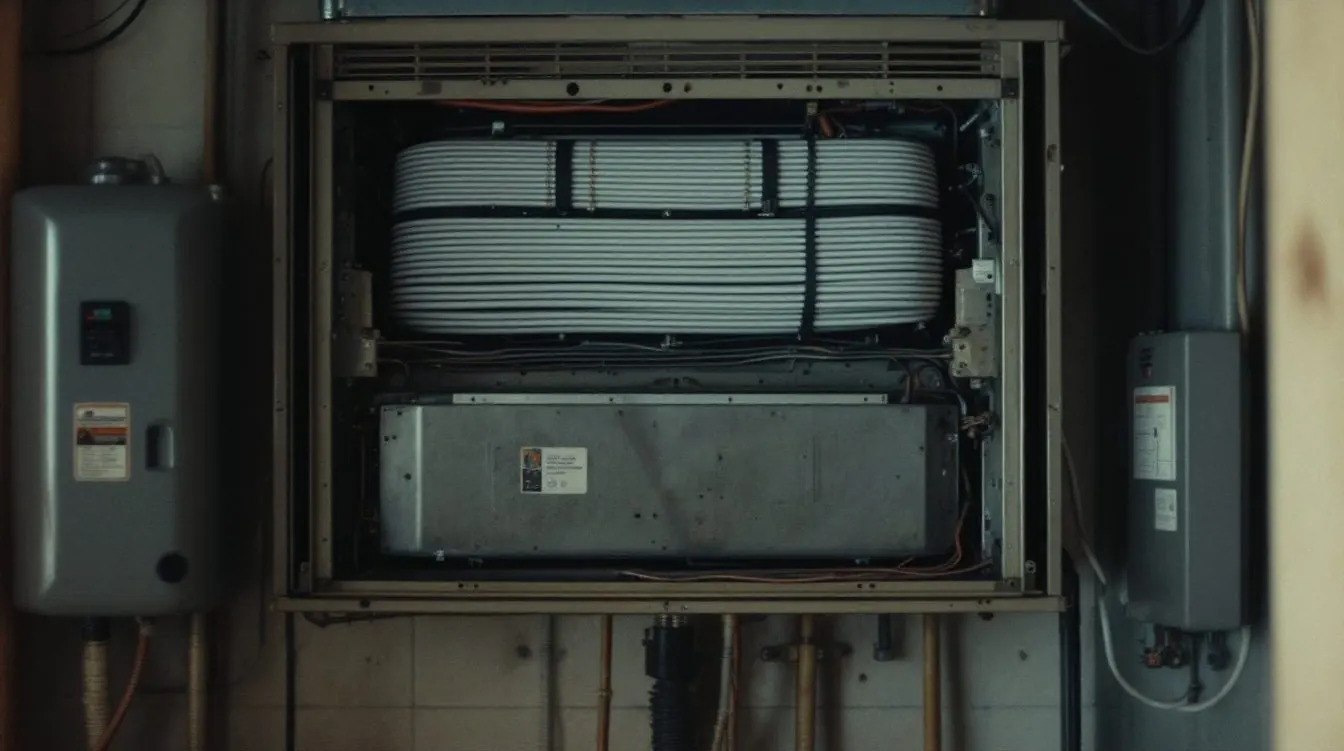
Do I need heat strips? You need heat strips when your heat pump’s rated output at your local 99% design temperature is below the house’s heat loss, or when the heat pump is your only heat source. Worked below: an Atlanta house needs about 3.2 kW; a Minneapolis house 4.4 to 8.9 kW.
Which three numbers decide whether you need heat strips?
Heat loss at the local design temperature, the heat pump’s certified output, and the design temperature itself. If output at design is below the loss, the gap is your minimum strip size; strips turn 1 kWh into 3,412 Btu, per the EIA conversion table.
- Heat loss at design. In Btu/h, from an ACCA Manual J load calculation for the house.
- Design temperature. The 99% heating dry bulb from the ASHRAE climatic tables: the outdoor temperature that is colder only 1% of the year, about 88 of 8,760 hours.
- Heat pump output. Every certified model’s 47°F, 17°F and, where tested, 5°F capacity is in the ENERGY STAR certified heat pump dataset, keyed by AHRI reference number.
We draw the house load as a straight line that reaches zero at 65°F, the base the EIA uses for heating degree days, and rises to the Manual J figure at the design temperature. Where it crosses the capacity line is the balance point, which DOE says “is usually well below 40°F for code-built homes” (DOE Energy Saver, archived copy).
House A, Atlanta: does a single-stage 3-ton heat pump need strips at 27°F?
Yes, but only about 3.2 kW of them, and only below 34.6°F. Atlanta Hartsfield-Jackson’s 99% heating design temperature is minus 2.7°C, which is 27°F, in the ASHRAE 2025 design data that ships with the climate.onebuilding.org file for station 722190.
Assume a Manual J heat loss of 36,000 Btu/h at 27°F and a Goodman GLZS5BA3610A* single-stage heat pump with an AMST42CU1300A* air handler (AHRI 215381162). ENERGY STAR lists it at 35,000 Btu/h at 47°F, 20,000 at 17°F and 17,600 at 5°F. Interpolated, it makes 25,000 Btu/h at 27°F.
The 11,000 Btu/h shortfall divided by 3,412 is 3.2 kW, so a 5 kW class kit covers it. Above 34.6°F this house never needs strip heat except during defrost, which is why AUX showing at 45°F is a fault worth chasing on the AUX and EM HEAT explainer.
House B, Minneapolis: does a cold-climate heat pump still need strips at minus 5°F?
Yes. Minneapolis-St. Paul’s 99% design temperature is minus 20.6°C, or minus 5°F, in the same ASHRAE 2025 data for station 726580, colder than any ENERGY STAR test point.
Give the house a 48,000 Btu/h loss at minus 5°F. A Goodman GZV9SA361CA* variable-speed unit on an AHVE48CP0300A* air handler (AHRI 216699916) is flagged cold climate and rated 33,400 Btu/h at 47°F, 32,000 at 17°F and 33,000 at 5°F, a COP of 2.10 at 5°F. Its balance point is 18.2°F. Holding the 5°F output flat down to minus 5°F, which flatters the machine, it is still 15,000 Btu/h, or 4.4 kW, short.
Swap in the single-stage GLZS5BA3610A* from House A and the balance point rises to 27.9°F and the shortfall at design to 30,400 Btu/h, 8.9 kW. The cold climate heat pump criteria cut the strip size in half here; they do not remove it.
| Case | Design temp | Heat loss | Heat pump at design | Balance point | Strips to fill gap | Strips for full backup |
|---|---|---|---|---|---|---|
| A: Atlanta, Goodman GLZS5BA3610A* single-stage | 27°F | 36,000 Btu/h | 25,000 Btu/h | 34.6°F | 3.2 kW (5 kW kit) | 10.55 kW |
| B: Minneapolis, Goodman GZV9SA361CA* cold climate | minus 5°F | 48,000 Btu/h | 33,000 Btu/h (5°F rating held) | 18.2°F | 4.4 kW (5 kW kit) | 14.07 kW |
| B with the single-stage unit | minus 5°F | 48,000 Btu/h | 17,600 Btu/h (5°F rating held) | 27.9°F | 8.9 kW (10 kW kit) | 14.07 kW |
HVAC Brief calculation: heat loss assumed; capacities from the ENERGY STAR certified dataset, read November 14, 2026; kW = Btu/h divided by 3,412 (EIA). Script kept with this article.
What size heat strips do I need: just the gap, or the whole house?
The gap is the minimum; full backup means sizing strips to the entire design load, so the house still heats if the compressor fails. House A’s full load is 10.55 kW and House B’s 14.07 kW, which is why so many air handlers ship with 10 or 15 kW kits. DOE describes strip banks as elements “each of which are typically rated at five kilowatts” that “activate in stages” (DOE Energy Saver, archived copy), so “how many heat strips” is roughly the kW divided by 5.
Check the supply voltage before choosing. Goodman’s SS-GHKR heat kit sheet tells installers to multiply the 240 volt rating by 0.75 at 208 volts, so its 9.6 kW kit gives 7.2 kW in a building fed at 208 volts. That would leave the House B single-stage case short of its 8.9 kW gap, and moves it up a kit size.
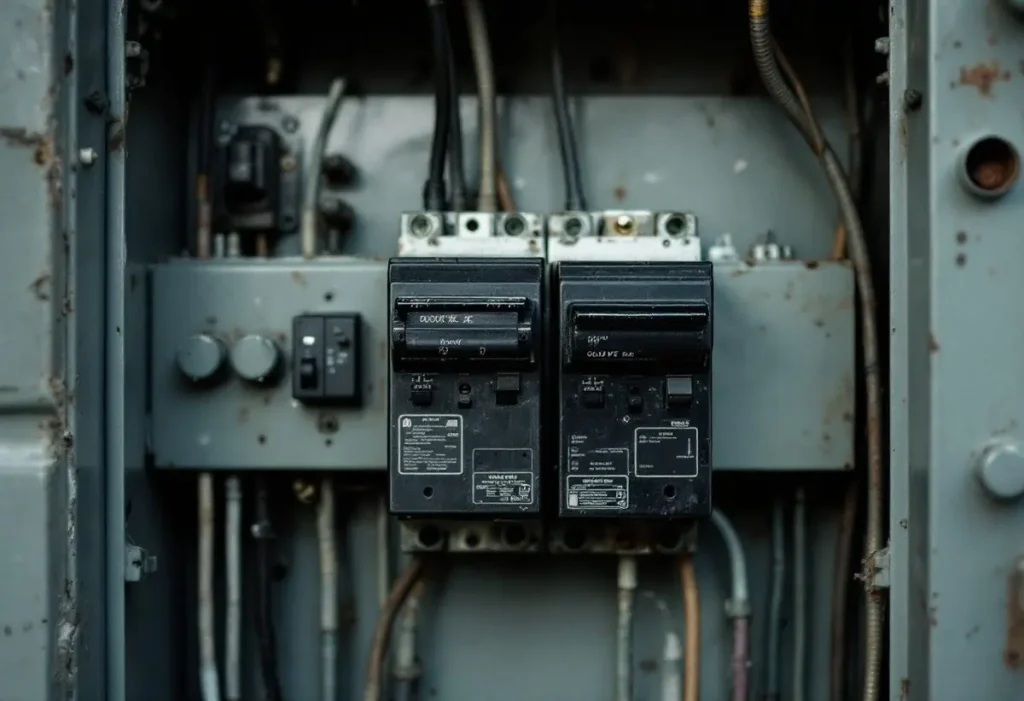
What size breaker do I need for 10, 15 or 20 kW heat strips?
Use the maker’s MOP (maximum overcurrent protection) figure for the exact air handler and kit, not the heater amps. Goodman’s sheet computes minimum circuit ampacity as heater amps plus motor amps times 1.25, and MOP as 2.25 times motor amps plus heater amps, so a 20 kW kit on a 4-ton Goodman cabinet needs either two breakers, 60 A and 50 A, or one 110 A single-point circuit.
| Goodman air handler and kit | kW at 240 V / 208 V | Heater amps (240 V) | Circuit 1 MCA / MOP | Circuit 2 MCA / MOP | Single-point MCA / MOP |
|---|---|---|---|---|---|
| AVPTC36C14 + HKS*05XC* | 4.8 / 3.6 | 20.0 | 32 / 35 | none | none |
| AVPTC36C14 + HKS*10XC* | 9.6 / 7.2 | 40.0 | 57 / 60 | none | none |
| AVPTC48D14 + HKSC15 | 14.4 / 10.8 | 40.0 + 20.0 | 57 / 60 | 25 / 25 | 82 / 90 |
| AVPTC48D14 + HKSC20D | 19.2 / 14.4 | 40.0 + 40.0 | 57 / 60 | 50 / 50 | 107 / 110 |
Compiled by The HVAC Brief from Goodman SS-GHKR, “Air Handler Electrical Data: AVPTC”, 240 volt columns; 208 volt kW uses Goodman’s 0.75 correction factor. Your nameplate overrides this table.
Wire is sized to the MCA (57 A for the 10 kW kit), the breaker no larger than the MOP. A breaker upsized past that figure to stop nuisance trips is the fire risk set out in our page on an HVAC breaker that keeps tripping. Wire gauge is set by the local electrical code.
Can I run my heat pump without the heat strips?
Yes, above the balance point, and in some houses all winter. Jim Goolsby, a training analyst at Alabama Power’s HVAC training center, told the utility’s newsroom that some heat pumps use a gas furnace as the auxiliary heat source, the setup weighed in our dual fuel switchover math. Skip strips in House A and it runs 11,000 Btu/h short on design nights.
Defrost is the other reason strips run. DOE says a reversing valve changes refrigerant flow “for the winter defrost cycle”, and that a demand-defrost control “will minimize defrost cycles, thereby reducing supplementary and heat pump energy use”; see the heat pump defrost cycle. DOE adds that “energy codes require that heat pumps with auxiliary electric resistance back-up heat have controls to prevent unnecessary heat strip operation”, and names an outdoor lockout thermostat as one fix. Below the balance point, a heat pump running constantly is doing its job.
Do heat strips use a lot of electricity, and can they cause a fire?
A 9.6 kW kit draws 9.6 kWh every hour it runs: $1.74 an hour at the August 2026 US residential average of 18.16 cents per kWh in EIA Table 5.3. State rates are in our page on the cost to run a heat pump.
Fire protection is built into the kit. Goodman lists a “fuse link secondary high-temperature limit control” on its HKR, HKA, HKP and HKS kits, behind the primary limit DOE describes as one that “may shut the furnace off if the blower fails or if a dirty filter is blocking the airflow”. A tripped limit or a hot electrical smell means power off at the breaker, then a technician who will check blower airflow, the filter, element resistance and the sequencers before anything is reset.
Frequently asked questions
Do heat pumps need heat strips?
Not all of them. Jim Goolsby, a training analyst at Alabama Power’s HVAC training center, told the utility’s newsroom that some heat pumps use a gas furnace as auxiliary heat instead. A ducted heat pump that is the only heat source needs strips when its output at the 99% design temperature, 27°F in Atlanta, is below the house’s heat loss.
What size breaker do I need for 20kw heat strips?
Read the nameplate. On a Goodman AVPTC48D14 air handler with an HKSC20D kit, Goodman’s SS-GHKR sheet lists two circuits at 240 volts: MCA 57 with a 60 A maximum breaker, and MCA 50 with a 50 A maximum. With a single-point kit the same 19.2 kW needs MCA 107 and a breaker no larger than 110 A.
How many heat strips do I need?
Divide the needed kW by about 5. DOE says electric furnace elements are “typically rated at five kilowatts” and come on in stages. In our worked cases the gap needs one 5 kW stage in Atlanta, and full backup for a 48,000 Btu/h Minneapolis house needs 14.07 kW, so three elements, a 15 kW kit.
At what temperature do heat strips turn on?
Below the balance point, or during defrost, or when the thermostat’s second stage calls. DOE says the balance point “is usually well below 40°F for code-built homes”; our Atlanta example lands at 34.6°F and the Minneapolis cold-climate example at 18.2°F. An outdoor lockout set near that temperature keeps the strips off in mild weather.
Do furnaces have heat strips?
Gas and oil furnaces do not; their heat comes from a burner. Electric furnaces are made of them: DOE describes a blower moving air over “a stack of three to seven electric resistance coils”, each typically 5 kW. A heat pump paired with a gas furnace uses the burner as backup instead of strips.
How we researched this
On November 14, 2026 we queried the ENERGY STAR certified air-source heat pump dataset (w7cv-9xjt) for Goodman 3-ton split systems and took rated 47°F, 17°F and 5°F capacities for two AHRI references. Design temperatures are the 99% heating dry bulb values from the ASHRAE 2025 Handbook of Fundamentals, Chapter 14, as restated in the climate.onebuilding.org design-day files; we did not read the ASHRAE handbook itself. Heater kit amps, MCA, MOP and the 208 volt factor come from Goodman’s SS-GHKR sheet. House heat losses are assumptions, labeled as such; the calculation script is kept with this article. Utility and contractor pages were not used for any number. The NEC is paywalled, so we used the maker’s MCA formula instead.
Sources
- ENERGY STAR. “ENERGY STAR Certified Air-Source Heat Pumps” dataset. https://data.energystar.gov/Active-Specifications/ENERGY-STAR-Certified-Air-Source-Heat-Pumps/w7cv-9xjt. Accessed November 2026.
- Goodman Manufacturing. “HKR / HKA / HKP / HKS Electric Heat Kits for Air Handlers and Packaged Electric Units” (SS-GHKR), dealer-hosted copy. https://gotductless.com/cdn/shop/files/HKSX_Heat_Kit_Specs.pdf. Accessed November 2026.
- climate.onebuilding.org. “USA_GA_Atlanta-Hartsfield-Jackson.Intl.AP.722190_TMYx.2009-2023” design-day file (ASHRAE 2025 design conditions). https://climate.onebuilding.org/WMO_Region_4_North_and_Central_America/USA_United_States_of_America/GA_Georgia/USA_GA_Atlanta-Hartsfield-Jackson.Intl.AP.722190_TMYx.2009-2023.zip. Accessed November 2026.
- climate.onebuilding.org. “USA_MN_Minneapolis-St.Paul.Intl.AP.726580_TMYx.2009-2023” design-day file (ASHRAE 2025 design conditions). https://climate.onebuilding.org/WMO_Region_4_North_and_Central_America/USA_United_States_of_America/MN_Minnesota/USA_MN_Minneapolis-St.Paul.Intl.AP.726580_TMYx.2009-2023.zip. Accessed November 2026.
- U.S. Department of Energy. “Air-Source Heat Pumps,” Energy Saver (archived copy). https://web.archive.org/web/20260101025734id_/https://www.energy.gov/energysaver/air-source-heat-pumps. Accessed November 2026.
- U.S. Department of Energy. “Electric Resistance Heating,” Energy Saver (archived copy). https://web.archive.org/web/20260101034530id_/https://www.energy.gov/energysaver/electric-resistance-heating. Accessed November 2026.
- U.S. Energy Information Administration. “Electric Power Monthly, Table 5.3.” https://www.eia.gov/electricity/monthly/epm_table_grapher.php?t=epmt_5_3. Accessed November 2026.
- U.S. Energy Information Administration. “Units and calculators explained.” https://www.eia.gov/energyexplained/units-and-calculators/. Accessed November 2026.
- U.S. Energy Information Administration. “Degree days.” https://www.eia.gov/energyexplained/units-and-calculators/degree-days.php. Accessed November 2026.
- Alabama News Center (Alabama Power). “Between the Lines: Strip heating can help warm your house and empty your wallet.” https://www.alabamapower.com/news/community-impact/between-the-lines-strip-heating-can-help-warm-your-house-and-empty-your-wallet-proceed-with-caution.html. Accessed November 2026.
Leave a Reply