
Boiler kettling is the rumbling, crackling or kettle-like hiss a hot-water boiler makes when water touching the heat exchanger flashes to steam and the bubbles collapse. The usual causes are scale or sludge insulating the metal, too little flow through the boiler, low system pressure or an oversized boiler.
Most ranking pages are written for UK combis. This one covers US cast iron and wall-hung condensing boilers, using causes Weil-McLain, Lochinvar, Lennox and Navien name in their manuals.
Which kettling sound points to which cause?
When the noise happens tells you more than its pitch. Match the pattern, then get the reading in column 3 before anyone orders parts.
| Sound pattern | Most likely cause | What the technician measures | Fix the maker points to |
|---|---|---|---|
| Popping or percolating on every burn, worse each winter | Mineral scale from constant makeup water | Fill valve activity, leaks, hardness and pH | Repair leaks, de-lime; Weil-McLain warns deposits can be too heavy to remove |
| Rumble a few minutes into a burn, hot supply pipe, cool return | Low flow: weak circulator, closed valve, air | Supply minus return temperature | Open valves, confirm circulator size, larger pump or bypass (Lochinvar) |
| Knocking or banging, relief valve weeping | Water flashing to steam inside the boiler | Gauge pressure hot and cold, relief valve discharge | Shut the burner down and get service; Lochinvar calls this “a knocking flash to steam” |
| Noise only when one zone calls, or on short burns | Small zone starving flow, or a boiler oversized for the load | Burner on time per cycle, which zone is open | Bypass; Lochinvar: noise “may also indicate an oversized boiler” |
| Hiss or crackle only while a tap runs (combi or coil boiler) | Scale on the domestic water side | Hardness of the incoming water | Descale the domestic heat exchanger or coil, soften or treat the water |
Compiled by The HVAC Brief from the Weil-McLain CGs user manual (part 550-110-592), the Lochinvar CB/CW manual (CB-CW(E)-I-S-07, 495,000 to 2,065,000 Btu/hr copper-tube boilers) and the Navien NCB-H manual.
Why can 180°F boiler water boil at all?
It does not boil on average; the thin film against the metal does. Scale, sludge or slow water keep heat in the wall and push that film past its boiling point, 244°F at 12 psig, while the gauge still reads normal.
System pressure sets how much margin the film has. Water boils at 212°F only at 0 psig. Navien gives 12 psi as “the typical cold water fill pressure for a residential system,” and at that pressure the boiling point is about 244°F, so a boiler that has lost pressure also loses margin against kettling.
| Gauge pressure at the boiler | Absolute pressure | Boiling point of water | Where you see this pressure |
|---|---|---|---|
| 0 psig | 14.7 psia | 212°F | A drained or air-bound high point |
| 5 psig | 19.7 psia | 227°F | A system that has leaked down |
| 12 psig | 26.7 psia | 244°F | Navien’s typical residential cold fill |
| 20 psig | 34.7 psia | 259°F | Inside Navien’s 12 to 30 psi operating range |
| 30 psig | 44.7 psia | 274°F | Lennox GWB9 relief valve opening point |
HVAC Brief calculation: IAPWS-IF97 saturation equation, checked against NIST Chemistry WebBook rows; sea level, 14.696 psia.
When the film boils, the bubbles are large for their mass. In the NIST row nearest 12 psig, saturated water weighs 58.992 lb per cubic foot and steam 0.065351 lb, so a bubble fills about 903 times the volume of the water it came from, then collapses in cooler water. That collapse is the crackle.
How slow does the circulator have to get before a boiler kettles?
Slower than most people expect, which is why low flow hides. The temperature rise across a boiler equals Btu/h divided by 500 times GPM.
| Flow through the boiler | Temperature rise (100,000 Btu/h output) | Supply temperature with a 160°F return |
|---|---|---|
| 10 GPM | 20°F | 180°F |
| 5 GPM | 40°F | 200°F |
| 3 GPM | 67°F | 227°F |
| 2 GPM | 100°F | 260°F |
HVAC Brief calculation: rise = Btu/h ÷ (500 × GPM). The 500 is 8.33 lb per gallon × 60 minutes × 1 Btu per lb°F; with NIST’s density of 60.200 lb per cubic foot at 196.62°F (8.048 lb per gallon) it is 485, which makes each rise about 3% larger.
At 3 GPM the average outlet water is already at 227°F, the boiling point at 5 psig, and the wall film is hotter still. Lochinvar states the result plainly: “Low system flow can result in overheating of the boiler water which can cause short burner ON cycles, system noise and in extreme cases, a knocking flash to steam.” The usual flow killers are a failing circulator pump, a stuck zone valve, a closed isolation valve after service, and air. A technician reads the rise with thermometers on the supply and return pipes.
Is your water too hard for what your boiler maker allows?
Check your own manual, because the limits differ between the four US-market documents below.
| Document | pH | Hardness | Other limit |
|---|---|---|---|
| Lennox GWB9 boiler IOM (heating water) | 7.0 to 8.0 | Below 7 grains | Chlorine and chloride under 100 ppm |
| Weil-McLain CGs user manual (heating water) | 7.0 to 8.5 | Not stated | Repair leaks to stop makeup water |
| Navien NCB-H combi (domestic water) | 6.5 to 8.5 | Up to 200 mg/l (12 grains/gallon) | TDS up to 500 mg/l |
| Lochinvar Knight service manual | Not stated | Not stated | Warns makeup water minerals overheat the stainless heat exchanger |
| USGS hardness classes | n/a | Hard 121 to 180 mg/L; very hard above 180 | Mg/L as calcium carbonate |
Compiled by The HVAC Brief from the manuals listed. 1 grain per gallon = 64.79891 mg ÷ 3.785 L = 17.12 mg/L, so the Lennox 7 grain limit is about 120 mg/L, where USGS “moderately hard” ends.
Every maker document here blames new water, not the original fill. The Knight manual says “Continual fresh make-up water will reduce boiler life,” because “Mineral buildup in the heat exchanger reduces heat transfer, overheats the stainless steel heat exchanger, and causes failure.” Peerless tells 211A installers to use water treatment “If the water hardness is high.” So a slow leak, a weeping relief valve or a waterlogged expansion tank that keeps the fill valve topping up is often the real cause behind a kettling boiler.
Can you keep using a kettling boiler?
Mild, intermittent kettling is a warning rather than an emergency, but the Knight manual says mineral buildup “overheats” the heat exchanger and “causes failure.” Shut the boiler off and call for service the same day if the noise turns to knocking or banging, the relief valve discharges, or the gauge climbs toward the 30 psig relief setting.
The checks a homeowner can safely make are short: the pressure gauge reading cold (Navien’s typical residential fill is 12 psi), whether every zone valve and isolation valve is open, and whether the pump is running. Burner, gas valve and relief valve work belong to a licensed technician.
How is a kettling boiler fixed: descale, flush, pump or replace?
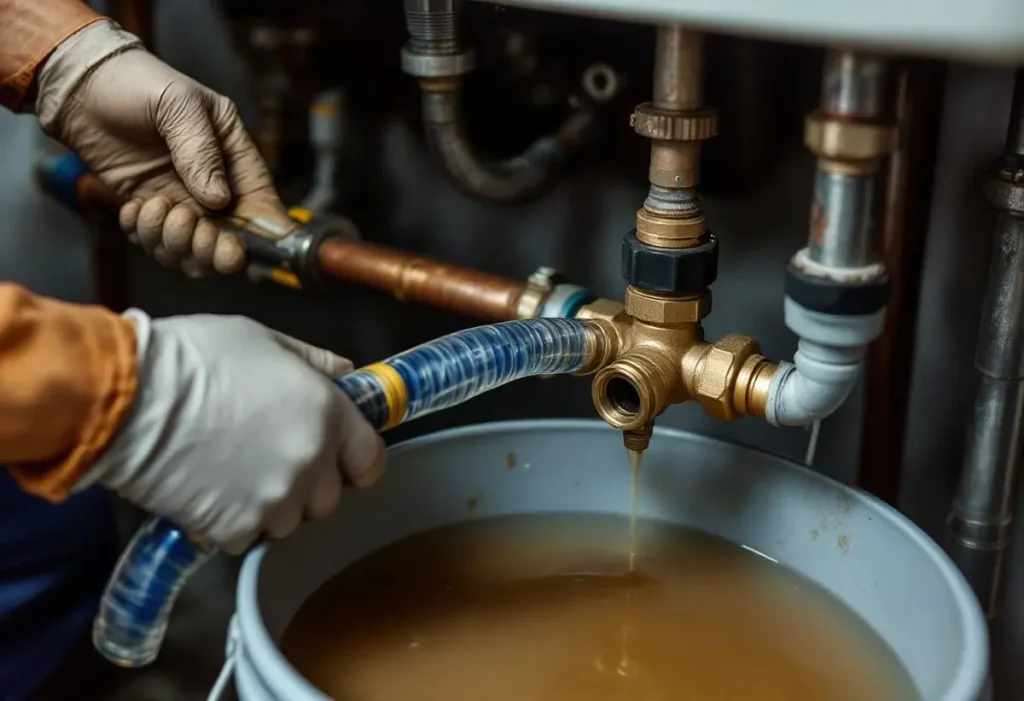
The fix follows the cause, in this order: stop the makeup water, restore flow, then clean the heat exchanger, and replace only if cleaning fails. Weil-McLain’s CGs table says to “de-lime boiler, if necessary,” and warns that “In some cases, deposits will be too heavy to remove with de-liming procedures.”
- Leaks first. Weil-McLain says to repair leaks; Lochinvar bans petroleum-based stop leak products.
- Flow. Lochinvar: increase boiler flow “by installation of a larger circulator pump or the installation of a system bypass.”
- Cleaning. Navien calls for boiler-specific cleaners and, for heavy limescale and sludge, “a heavier duty cleaner”; the Knight manual rules out “homemade cures.”
- Chemistry. Refill and test pH against the maker’s range in the table above.
Cleaning and testing can be folded into a yearly boiler service. If the noise started right after a new boiler went in, the Lochinvar oversizing note and the aquastat high limit setting are the first things to question. Lochinvar’s CB/CW manual calls leak-driven lime build-up “a non-warrantable failure.”
Why does the boiler kettle only when you run hot water?
Because the domestic side of a combi like the Navien NCB-H, or a coil boiler, sees a stream of fresh, mineral-laden water every time a tap opens, unlike the sealed heating loop.
Navien sets a ceiling of 200 mg/l total hardness for the NCB-H’s domestic water If your combi boiler crackles only during showers, or an older cast iron boiler with a tankless coil hisses only on hot water draws, descale that heat exchanger or coil and test the supply water. A storage tank making the same noise is a different problem, covered in water heater popping noise.
Frequently asked questions
What does boiler kettling mean?
It means water is boiling locally against the heat exchanger, which sounds like a kettle coming to the boil. Weil-McLain’s CGs manual calls the symptom a “popping or percolating noise” and links it to mineral deposits, incorrect pH and insufficient water flow.
Can a kettling boiler be repaired?
Usually, if caught early: repair leaks, restore flow with a correct circulator or bypass, and remove scale with a boiler cleaner. Weil-McLain warns some deposits are too heavy to remove by de-liming, and then the heat exchanger or boiler is replaced. Lochinvar treats leak-driven scale failures as non-warrantable.
How much does boiler kettling repair cost?
The HVAC Brief does not quote repair prices because no federal or national-lab source publishes them. The tier follows the cause: opening a valve or bleeding air is a short visit, a circulator is one part, a descale is labor plus cleaner, and a scaled-through heat exchanger can mean a new boiler. Ask the quote to state the measured temperature rise in °F.
Is boiler whistling safe?
Whistling has no row in the Weil-McLain troubleshooting table, which lists only popping or percolating noise, so treat it like kettling when the gauge rises with it. The Lennox GWB9 relief valve opens at 30 psig; a boiler whistling or knocking near that reading should be shut off until a technician checks pressure, flow and the expansion tank.
How we researched this
On 14 November 2026 we read the troubleshooting and water sections of six maker documents (Weil-McLain CGs, Lochinvar CB/CW and Knight, Lennox GWB9, Navien NCB-H, Peerless 211A). Boiling points and the steam volume ratio come from NIST saturated water data; flow and unit math is shown under each table. The top Google results (Ideal Heating, BOXT, a HeatingHelp thread) cited no maker document; forum anecdotes and product marketing were excluded.
Sources
- Weil-McLain. “CGs User’s Information Manual, 550-110-592, Common problems and solutions” (manualsdir.com copy). https://www.manualsdir.com/manuals/221695/weil-mclain-cgs.html?page=23. Accessed November 2026.
- Lochinvar. “Hydronic Heating Boilers and Domestic Water Heaters, 495,000 to 2,065,000 Btu/hr, Installation and Service Manual, CB-CW(E)-I-S-07.” https://assets.lochinvar.com/damroot/Original/10014/CB-CW(E)-I-S-07.pdf. Accessed November 2026.
- Lochinvar. “Knight Boiler Service Manual, KBII-SER Rev K.” https://assets.lochinvar.com/damroot/Original/10014/662034KBII-SER Rev K (Water Chemistry).pdf. Accessed November 2026.
- Lennox. “GWB9 Gas Fired Hot Water Boiler Installation, Operation and Maintenance.” https://www.lennox.com/lib/legacy-res/pdfs/installation_maintenance/lennox_gwb9_iom.pdf. Accessed November 2026.
- Navien. “NCB-H Condensing Combi-Boilers Installation and Operation Manual.” https://res.cloudinary.com/dzhpkjoqj/Navien/NCB-H_Installation___Operation_Manual_EN_201130_xo5ni5.pdf. Accessed November 2026.
- Peerless (PB Heat). “Series 211A Gas Boilers, Water: Installation, Operation and Maintenance Manual.” https://www.peerlessboilers.com/wp-content/uploads/2023/04/GG8052-211A-WATER-REV1_-R12_IOM-1025.pdf. Accessed November 2026.
- U.S. Geological Survey. “Hardness of Water.” https://www.usgs.gov/special-topics/water-science-school/science/hardness-water. Accessed November 2026.
- National Institute of Standards and Technology. “Thermophysical Properties of Fluid Systems: Water, saturation properties.” NIST Chemistry WebBook, SRD 69. https://webbook.nist.gov/chemistry/fluid/. Accessed November 2026.
Leave a Reply