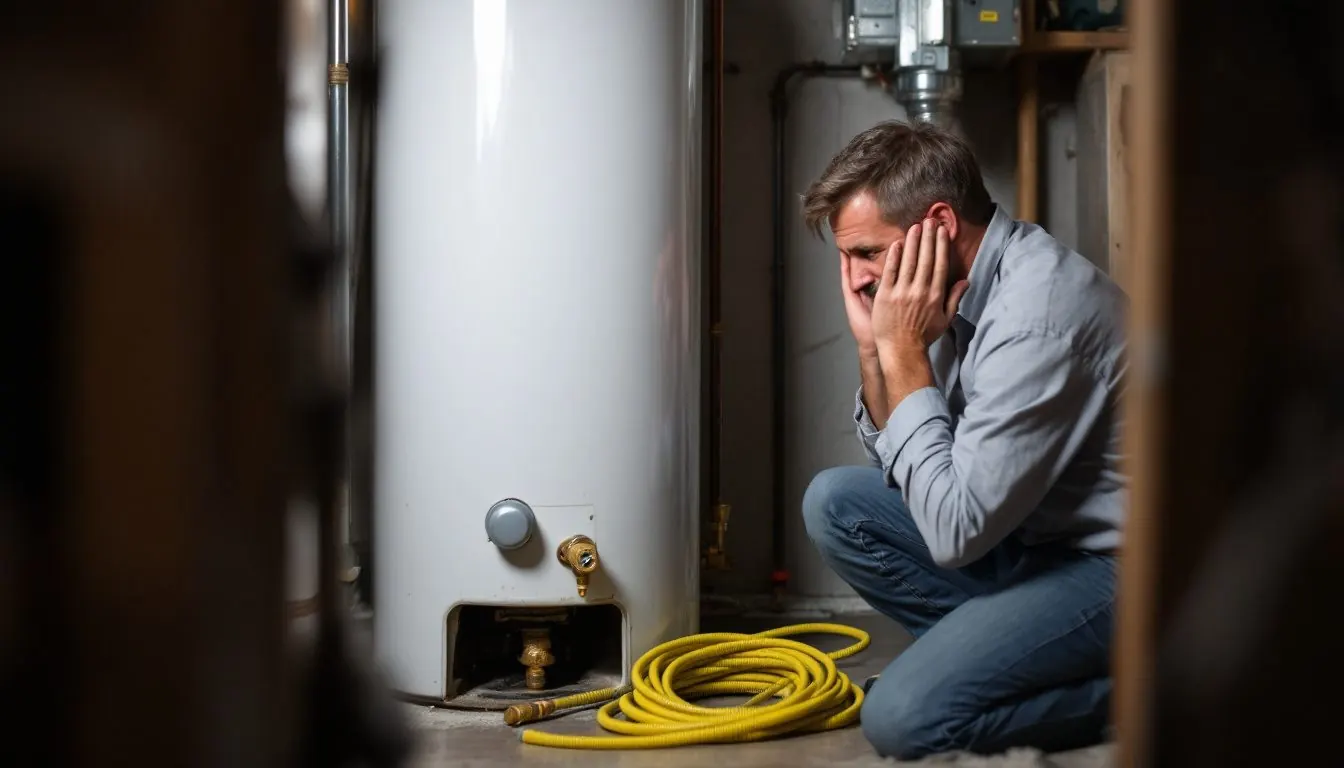
A water heater popping noise is almost always steam bursting through mineral sediment on the bottom of a gas tank, or scale on electric elements. A.O. Smith calls it rumbling or percolating and prescribes draining and flushing. A pop at the relief valve is different: Rheem traces it to thermal expansion that must be corrected.
Which sound is it, and where on the tank is it coming from?
Note where the sound comes from and when: popping and rumbling come from the bottom while the burner or elements run, sizzling from the burner after a cold refill, rattles from the top fittings while water runs, and a pop from the relief valve during recovery. Seven maker documents from A.O. Smith, Rheem, Bradford White, State and Rinnai give each combination its own cause.
| Sound | Tank type | When you hear it | Cause the maker gives | What the maker says to do |
|---|---|---|---|---|
| Popping, rumbling, percolating | Gas tank | Burner running | Sediment on the tank bottom (A.O. Smith 326940) | Drain and flush |
| Popping, rumbling, crackling | Electric tank | Elements heating | Lime; water trapped under deposits boils to steam (State bulletin 13) | Delime; flush |
| Sizzling, frying, drips | Gas tank | First fill, or after heavy use refills with cold water | Flue condensate dripping on the burner (A.O. Smith, Bradford White) | Normal; wait for the tank to heat |
| Singing or hissing | Electric tank | Elements on | Lime formation on elements (Bradford White 238-54711) | Remove and clean elements, replace as needed |
| Crackling, gurgling, popping | Electric tank under 6 months old | Water pH 8+ | Aluminum hydroxide from the aluminum anode (State bulletin 14) | Tradesman swaps to a magnesium anode |
| Popping at relief valve, or draining | Any tank | During recovery, no taps open | Thermal expansion in a closed system (Rheem AP21980) | Rheem: “an unacceptable condition and must be corrected” |
| Rattling | Any tank with heat traps | Water being drawn | Internal heat trap fittings (Rheem AP21980) | Normal; no service needed |
| Banging in the pipes | Any | A faucet or washer valve snaps shut | Water hammer (Rheem; State bulletin 11) | Water hammer arrestors |
| Air escaping at the hot faucet | Any | First draw after 2 weeks or more unused | Hydrogen gas (A.O. Smith, Bradford White) | Run the hot faucet several minutes; no smoking or flame nearby |
Compiled by The HVAC Brief from the A.O. Smith, Bradford White, Rheem and State manuals listed under Sources.
Why does a gas water heater pop while the burner is firing?
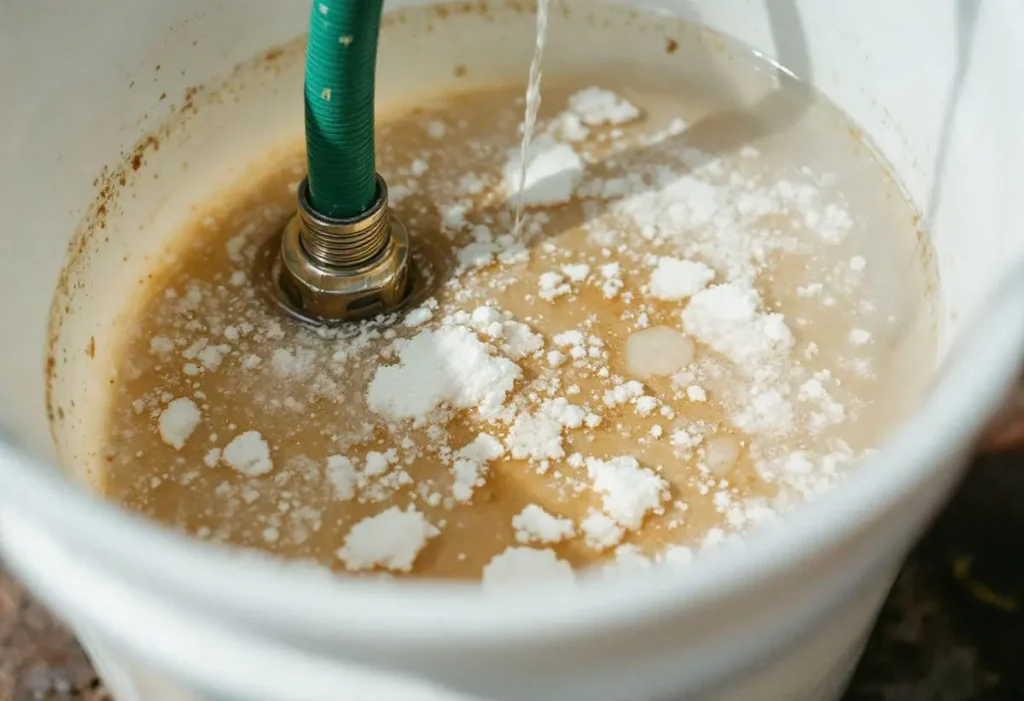
Because water gets trapped under a crust of lime on the tank bottom, directly over the flame, and flashes to steam. State’s electric service handbook puts it plainly in bulletin 13: symptoms “often include a popping of water trapped under lime deposits,” and adds that lime is inversely soluble: “the more you heat, the more lime comes out.”
A.O. Smith’s manual 326940 says sediment collecting over time “can result in ‘rumbling’ or ‘percolating’ sounds” and sends owners to its draining and flushing section, which recommends a drain and flush every 6 months. Its FVIR gas use and care guide adds the consequence: sediment or lime buildup can reduce efficiency, and heavy deposits can damage the water heater.
Intervals differ: Rheem AP21980 suggests draining a few quarts every month, and the DOE storage water heater page (archived copy) lists flushing a quart every three months. Steps are in our guide on how to flush a water heater. For scale a flush will not move, State bulletin 13 calls for a food-grade phosphoric acid delimer.
Why does the water heater pop and sizzle right after a shower?
Usually it is condensation, and it is normal. A.O. Smith lists three triggers for burner condensate, one of them “Large amounts of hot water are used in a short time and the refill water in the tank is very cold,” and says the drops “may fall onto the burner or other hot surfaces to produce a ‘sizzling’ or ‘frying’ noise.”
That makes November the noisy season. A.O. Smith says excessive condensate “may be noticed during the winter and early spring months when incoming water temperatures are at their lowest,” and that it should disappear once the water warms, in about 1 to 2 hours. Bradford White 238-51007 agrees it “does not indicate a leak.” The timing test: a sizzle that fades as the tank heats is condensate; a pop or rumble through every burn is sediment.
If the hot water also runs out sooner than it used to, the A.O. Smith FVIR guide names sediment or lime as a cause; our water heater not heating checklist covers the other suspects.
Is a water heater making popping noise dangerous?
Sediment popping on its own is a maintenance problem, not an alarm: A.O. Smith says noises from expansion and contraction during heat-up and cool-down “do not necessarily represent harmful or dangerous conditions.” Three variations are different and get a stop line.
- A pop, hiss or discharge at the relief valve. Rheem’s chart calls a relief valve “producing popping noise or draining” from thermal expansion “an unacceptable condition” and warns “DO NOT plug the relief valve outlet.” State bulletin 45 shows why: water in a closed tank at 50 psi, heated just 10 degrees, “will reach a pressure of 250 psi.”
- Large amounts of very hot water from the discharge pipe, or steam at a faucet. The A.O. Smith FVIR guide says to turn the gas supply off and call a qualified person; manual 326940 says not to operate a heater that “Produces steam or unusually hot water” until a technician checks it.
- Any gas smell. Leave the building first.
For the relief valve case, the technician reads static water pressure and looks for a check valve or pressure reducing valve that closed the system. The A.O. Smith guide wants 50 to 60 psi and a properly pressurized expansion tank before calling a dripping valve broken. Valve testing is in our water heater relief valve page; expansion tank rules in our water heater installation checklist.
What makes an electric water heater crackle, hiss or sing?
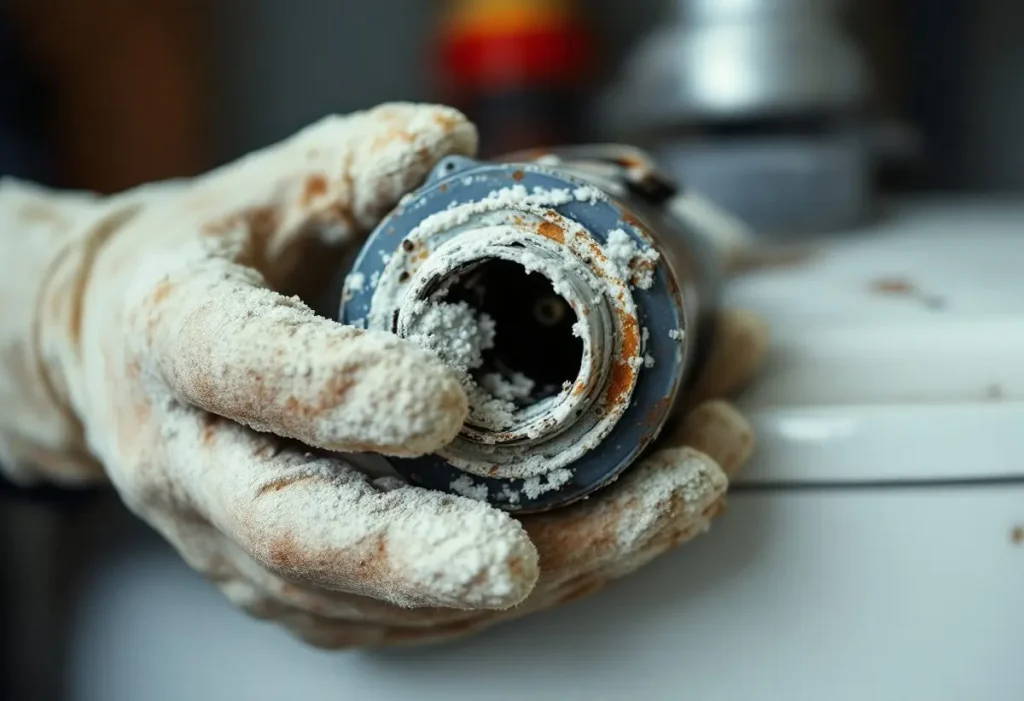
Lime on the elements. Bradford White’s service manual 238-54711 lists “Noisy (singing or hissing) Elements” with one cause, “Lime formation on elements,” and the fix “Remove and clean heating elements. Replace as needed.” Rheem’s AP21980 chart pins “Rumbling noise” on scale or mineral deposits on the elements, and adds that if the hissing or singing level “increases excessively,” the element may need cleaning.
A new tank is the exception. State’s electric service handbook (bulletin 14) ties “Crackling,” “gurgling,” or “popping” in heaters installed less than six months to water with a pH of 8+ reacting with the aluminum anode. Its fix, for someone “with abilities equal to a licensed tradesman,” is a magnesium anode. Anode metals are compared in our water heater anode rod guide, and element ohm tests in our water heater element guide. Elements run on line voltage: switch off the breaker and verify it is dead before opening the cover.
Does a tankless water heater pop from scale too?
Rinnai’s manual for its RU199i through RU130e condensing units describes no popping noise; scale shows up as codes instead. The installation and operation manual caps total hardness at 200 mg/L, says scale “can be accelerated if the water heater is set at a high temperature,” and tells technicians chasing code 14 (heat exchanger overheat) to check the exchanger for “hot spots which indicate blockage due to scale build-up.” An optional SS (Service Soon) code prompts a flush. The spec table lists sound levels of 47 to 53 dB.
So a tankless unit that pops or knocks has no maker-defined meaning in that manual: read the code history first, then check scale. Federal rules and sizing are in our tankless water heater guide.
How hard is your water, and how much mineral does a tank see?
The USGS classifies water by calcium carbonate content: 0 to 60 mg/L soft, 61 to 120 mg/L moderately hard, 121 to 180 mg/L hard, and more than 180 mg/L very hard. We converted those boundaries into the mineral load entering a heater per 1,000 gallons heated.
| Water | Hardness as CaCO3 | Hardness carried in per 1,000 gal heated |
|---|---|---|
| Upper edge of soft (USGS) | 60 mg/L | 227 g (0.50 lb) |
| Upper edge of moderately hard (USGS) | 120 mg/L | 454 g (1.00 lb) |
| Upper edge of hard (USGS) | 180 mg/L | 681 g (1.50 lb) |
| Rinnai condensing tankless maximum | 200 mg/L | 757 g (1.67 lb) |
HVAC Brief calculation: mg/L × 3.785 L per gallon × 1,000 gallons ÷ 1,000 mg per gram. This is the hardness that passes through, not what settles: only the share that drops out when heated becomes sediment, and no maker document we read gives that share.
State notes that higher usage, greater hardness and more heating surface all raise the odds of a “limed-up” heater. A hot-water boiler with the same scale problem makes a related sound, covered in our boiler kettling explainer.
Frequently asked questions
Is it normal to hear popping from your water heater?
Some sounds are normal. A.O. Smith says condensation “causes sizzling and popping within the burner area during heating and cooling periods and should be considered normal,” and Rheem calls rattling from heat trap fittings normal. Popping or rumbling that lasts through every burner cycle points to sediment, which A.O. Smith says to clear by draining and flushing.
Why is my Rheem water heater making a popping noise?
Rheem’s electric manual AP21980 lists two answers. Rumbling from inside the tank means scale or mineral deposits on the heating elements, fixed by removing and cleaning them. A relief valve producing popping noise or draining means thermal expansion in a closed system, which Rheem calls an unacceptable condition: call the water supplier or a plumbing contractor, and never plug the outlet.
Why is my water heater making popping noise when heating?
Heating is when trapped water boils. State’s service handbook says lime is inversely soluble, so more heat drops more of it, and the symptoms include “a popping of water trapped under lime deposits.” The noise starts when the burner or elements switch on and stops when they shut off, which separates it from condensate sizzle that fades within about 1 to 2 hours of a cold refill.
How common is it for a water heater to burst?
We found no federal count of tank ruptures to answer that with a number. The protections are known: every tank needs a working temperature and pressure relief valve, and the A.O. Smith FVIR guide warns that capping or plugging it “could cause an explosion.” The gas control in A.O. Smith manual 326940 also has a non-resettable high temperature shut-off. Sediment popping alone does not trigger either.
How we researched this
On 14 November 2026 we read the seven maker documents in Sources in full text, plus the USGS hardness classes and the archived DOE storage water heater page. The two ranking contractor articles cite no maker document; we used none of their figures. Excluded: Reddit, Quora, JustAnswer and video results (unverifiable), and RV water heaters, for which we opened no maker document. The hardness table is our arithmetic.
Sources
- A.O. Smith. “Residential Gas Water Heaters, Direct Vented Models, manual 326940.” https://assets.aosmith.com/damroot/Original/10001/326940.pdf. Accessed November 2026.
- A.O. Smith. “Residential Gas Water Heater (FVIR) Use and Care Guide.” https://assets.hotwater.com/damroot/Original/10017/100400765.pdf. Accessed November 2026.
- Bradford White. “Gas-Fired Water Heater manual 238-51007-00.” https://docs.bradfordwhite.com/I&O/238-51007-00_Current.pdf. Accessed November 2026.
- Bradford White. “Service Manual 238-54711-00.” https://docs.bradfordwhite.com/Service_Manual/238-54711-00_Current.pdf. Accessed November 2026.
- Rheem. “Electric Residential Water Heaters, manual AP21980.” https://files.rheem.com/blobazrheem/wp-content/uploads/sites/2/AP21980-Rev-02-Electric-Residential-WH-with-e-control-HIGH-TIER.pdf. Accessed November 2026.
- State Industries. “Residential Electric Water Heater Service Handbook.” https://assets.statewaterheaters.com/damroot/Original/10008/320990-000.pdf. Accessed November 2026.
- Rinnai. “N-Series Residential Condensing Tankless Manual.” https://media.rinnai.us/salsify_asset/s-6b715523-18d3-43c0-ab28-1ef5090e137c/100000467-N%20Series%20Residential%20Condensing%20Installation%20and%20Operation%20Manual.pdf. Accessed November 2026.
- U.S. Geological Survey. “Hardness of Water.” https://www.usgs.gov/special-topics/water-science-school/science/hardness-water. Accessed November 2026.
- U.S. Department of Energy. “Storage Water Heaters” (archived copy). https://web.archive.org/web/2025id_/https://www.energy.gov/energysaver/storage-water-heaters. Accessed November 2026.
Leave a Reply