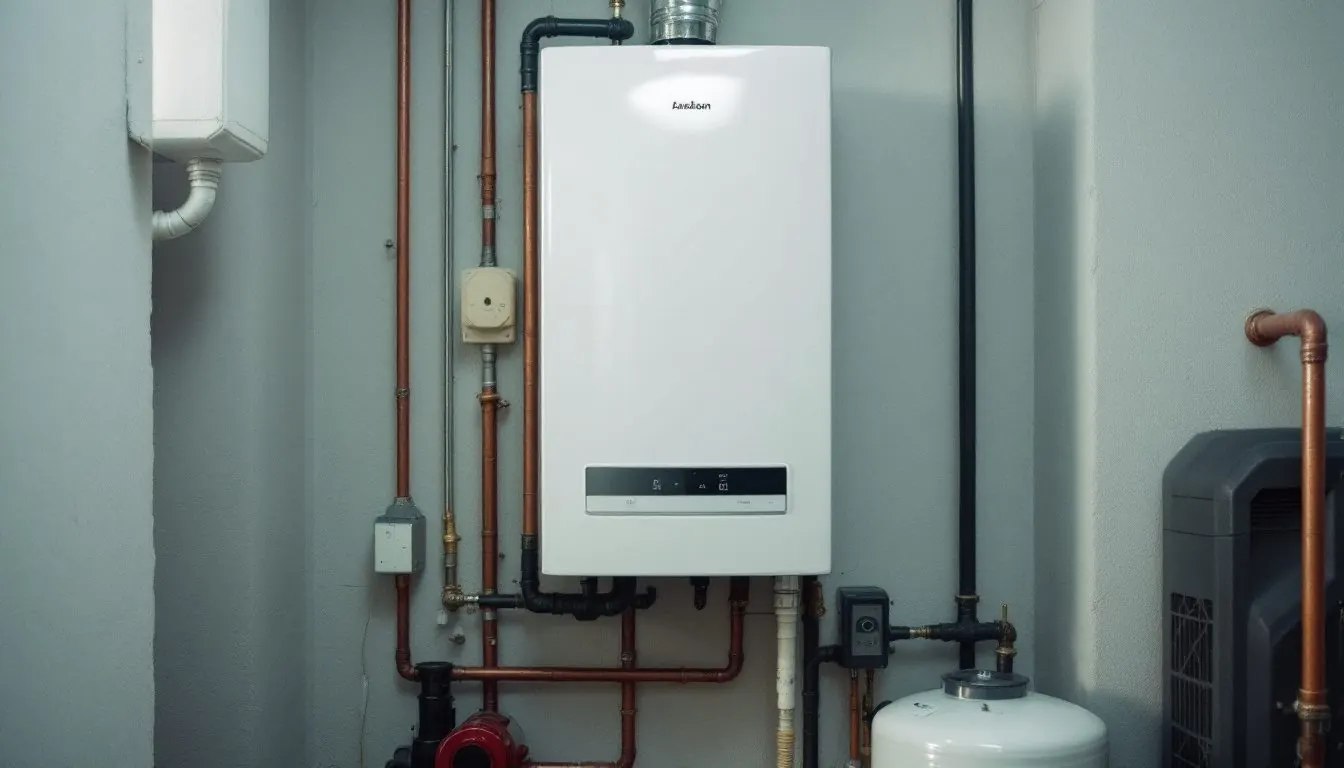
Boiler short cycling means the burner fires for a minute or less, hits its temperature limit and shuts off, again and again within one call for heat. In hot-water systems the usual cause is a boiler whose lowest firing rate dwarfs the zone calling; a tight differential, low flow, air and low pressure come next.
What is considered short cycling for a boiler, in minutes?
No maker we read publishes a cycles-per-hour threshold; the yardstick is the federal rating test. Brookhaven National Laboratory’s 2007 report restates the ASHRAE 103 conditions DOE adapted for boiler AFUE: a burner average on-time of 9.68 minutes and off-time of 33.26 minutes, with the boiler assumed oversized by a factor of 1.7 (Butcher, BNL). We calculated that as one cycle every 42.94 minutes, about 1.4 burner starts an hour.
Against that, a burner that runs 20 to 60 seconds and relights within minutes while the same thermostat is still calling is short cycling. Lochinvar’s Knight control blocks a new call for 1 to 10 minutes after the last one ends, default 1 minute, unless the inlet water drops 10°F first (Lochinvar KBII service manual). That timer acts between calls, not inside one.
Time it first. A circulator that keeps running while the burner is off means the boiler is cycling on its own temperature control; forced-air systems differ, per our furnace short cycling guide.

Why does one small baseboard zone make a 45,000 Btu/h boiler short cycle?
Because the zone sheds heat only as fast as its baseboard allows, and the boiler’s smallest flame is far bigger. Slant/Fin rates its Fine/Line 30 element at 510 Btu/h per foot at 170°F average water and 1 gpm, 580 at 180°F and 320 at 140°F (Slant/Fin ratings chart). A 12 foot bedroom run gives off 6,120 Btu/h at 170°F; our hot water baseboard guide has the full tables.
| Boiler (maker document) | Lowest firing rate | 12 ft zone at 180°F avg (6,960 Btu/h) | at 170°F avg (6,120) | at 140°F avg, outdoor reset (3,840) |
|---|---|---|---|---|
| Lennox GWB9 90-50, single input | 45 MBH heating capacity | 6.5 times the zone | 7.4 times | 11.7 times |
| Navien NCB-190/060H, modulating (5.5:1) | 11 MBH input | 1.6 times | 1.8 times | 2.9 times |
| Navien NCB-250/150H, modulating (10.7:1) | 14 MBH input | 2.0 times | 2.3 times | 3.6 times |
HVAC Brief calculation: lowest firing rate divided by 12 ft of Slant/Fin Fine/Line 30 output. Navien publishes only minimum input, so its ratios run slightly high. Sources: Lennox GWB9 IOM, Navien NCB-H manual.
Above 1.0, the water heats faster than the zone uses it, so the burner hits its limit; how fast depends on the water in the loop. The Lennox GWB9 boiler holds 2.6 gallons and its aquastat has a 5 to 30°F adjustable differential; Lennox notes that “the larger the differential, the longer the run cycle of the boiler” (Lennox GWB9 IOM). Using water at 8.10 lb per gallon near 175°F (NIST SRD 69), each 20°F swing of 2.6 gallons stores only 421 Btu.
| Water in the loop | Differential | Burner on | Burner off | Starts per hour |
|---|---|---|---|---|
| 2.6 gal (boiler only) | 20°F | 39 s | 4.1 min | 12.6 |
| 2.6 gal (boiler only) | 30°F | 59 s | 6.2 min | 8.4 |
| 5 gal | 20°F | 75 s | 7.9 min | 6.5 |
| 12.6 gal (10 gal added) | 20°F | 3.2 min | 20 min | 2.6 |
HVAC Brief calculation: same boiler and zone as the chart. Real loops hold more than the boiler’s 2.6 gallons, so the first rows are a worst case.
Is my boiler too big for the house, and how much fuel does that cost?
Often yes. A DOE Building America guideline (Arena, 2014) cites the convention of sizing “no larger than 110% of the design loads,” rising to about 1.5 to 2 times for night setback recovery (DOE measure guideline). Its rule: if minimum output exceeds the design load, “choose a smaller boiler or add a buffer tank.” Like-for-like swaps repeat oversizing; our boiler replacement guide covers sizing.
Brookhaven’s lab data put a number on the penalty: moving the same boiler from 2 times to 3 times oversized cut annual efficiency by an amount that tracks its idle loss.
| BNL unit | Idle loss (% of input) | Annual efficiency, 2x oversized | 3x oversized | Points lost |
|---|---|---|---|---|
| 2: oil cast iron boiler with indirect tank | 2.1 | 72.9% | 65.1% | 7.8 |
| 10: old cast iron boiler | 2.1 | 64.5% | 60.4% | 4.1 |
| 4: oil condensing boiler | 1.5 | 84.2% | 80.3% | 3.9 |
| 11: gas condensing, modulating | 0.60 | 85.3% | 83.6% | 1.7 |
| 3: oil steel boiler with purge control | 0.15 | 85.7% | 85.3% | 0.4 |
Compiled by The HVAC Brief from Butcher, BNL 2007, Table 3 (oversize factors are modeled, not the tested firing rate). Sorted by points lost, which we calculated.
A low idle loss or modulating burner barely notices extra size; a cast iron boiler with 2.1% idle loss gives up 7.8 points. For larger plants, DOE’s steam tip sheet recommends “a burner with a high turndown ratio” to avoid short cycling (DOE Steam Tip Sheet #16).
Which boiler settings stop short cycling: differential, anti-cycle or outdoor reset?
Widen the differential first; it is the only setting that lengthens every burner run. Peerless’s 211A chart (a commercial cast iron line) lists one cause for “Rapid Cycling”: “Temperature control differential too narrow,” fix “Adjust Control Differential” (Peerless 211A IOM). A Lochinvar Knight’s space heating differential runs 0 to 60°F, default 20°F; our aquastat settings guide covers older Honeywell and Beckett controls.
Outdoor reset cuts both ways: 10 CFR 430.32(e)(2)(iv) requires hot water boilers to adjust water temperature to the inferred load, letting single-input boilers comply by firing only when the load “cannot be met by the residual heat of the water in the system” (eCFR). Cooler water helps a condensing boiler but shrinks baseboard output: Fine/Line 30 drops from 510 to 320 Btu/h per foot between 170°F and 140°F, so the Navien ratios climb in the last column. On a mod-con that short cycles only on mild days, check the reset curve’s minimum supply temperature against the smallest zone.
Why does a boiler short cycle when it is cold out, or with every zone calling?
Because the cycle rate peaks near half load, not at light load. With the same 2.6 gallon, 20°F model we calculated 12.6 starts an hour at 12 ft of baseboard (14% load), 26.7 at 44 ft (50%) and 9.0 at 80 ft (91%). An oversized boiler sits near half load in January, where cycling is worst.
If the boiler is not oversized, suspect flow: a slowed circulator, a stuck zone valve or trapped air lets the boiler’s own water hit the limit while rooms stay cold. Air is cheapest to clear; our guide on how to bleed baseboard heaters covers bleeders and purge valves.
Check pressure against the 12 to 30 psi range in the Navien NCB-H manual or our boiler pressure guide. Cycling that ends in a lockout code is a safety control tripping, such as the 300°F casting switch Lennox fits to shut the GWB9 down on loss of water. Never jumper a limit or low water cutoff; a technician should prove flow with supply and return temperatures and check circulator amperage.
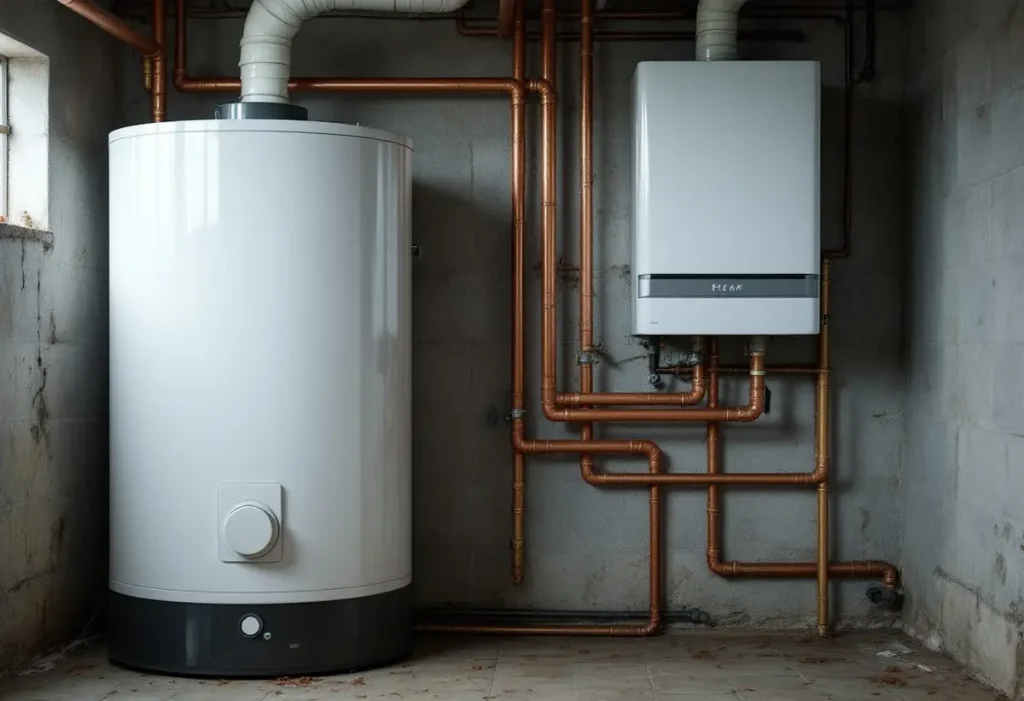
Why does my boiler short cycle on hot water only?
On a combi, because a slow tap draws less heat than the burner’s smallest flame. Navien’s NCB-190/060H fires domestic hot water down to 10,700 Btu/h input and lists a 0.5 GPM minimum flow (Navien NCB-H manual). We calculated what a 0.5 GPM tap absorbs: 11,259 Btu/h at a 45°F rise but 6,255 at a 25°F rise, below that minimum, so the burner overshoots and cycles. Our combi boiler guide has the flow tables.
With an indirect tank, Lochinvar’s Knight defaults to shutting off 10°F above its DHW set point and relighting 20°F below it, and lets the installer cap firing when “the tank is unable to accept all of the BTU’s available from the boiler.” A small tank coil short cycles a boiler like a small zone; priority wiring is covered in our indirect water heater guide.
What fixes boiler short cycling, cheapest first?
Stop when the timing changes; the first three are adjustments, not parts.
| Order | Cause | Reading that confirms it | Fix |
|---|---|---|---|
| 1 | Air or low pressure | Gauge below fill range, gurgling | Purge air, refill |
| 2 | Differential too narrow | Relights after a few degrees | Widen it (Lennox 5 to 30°F, Knight 0 to 60°F) |
| 3 | Reset curve or anti-cycle setting | Short runs on mild days only | Raise minimum supply temp, lengthen anti-cycle |
| 4 | Low flow | Wide supply to return split, rooms cold | Circulator or zone valve repair |
| 5 | Micro-zone | Cycling only when one small zone calls | Join zones or add baseboard (DOE example: 103 feet to absorb 30,000 Btu/h) |
| 6 | Too little water | On-times under a minute | Buffer tank (DOE guideline option) |
| 7 | Boiler oversized | Minimum output above the design heat load | Smaller or higher turndown boiler at replacement |
Compiled by The HVAC Brief from the Peerless 211A, Lennox GWB9 and Lochinvar KBII manuals and the DOE Arena 2014 guideline. Order reflects scale of work, not prices.
Frequently asked questions
Should I turn my boiler off if it is short cycling?
Not if the house needs heat and there is no lockout code, gas smell or leak; the limits are doing their job, at a cost in fuel and wear. Shut it down and call for service if it locks out repeatedly: switches such as the 300°F casting switch on a Lennox GWB9 trip on loss of water.
How much does a boiler short cycling fix cost?
No federal or national-lab source publishes repair prices, so we quote none. The order of cost follows the work: purging air or changing a differential or anti-cycle setting (1 to 10 minutes on a Lochinvar Knight) is a service call, a circulator or zone valve is a parts job, and a buffer tank or new boiler is a piping project.
What does boiler short cycling mean on a mod-con display?
Lochinvar’s Knight control shows anti-cycling on the display after a space heating call ends and holds the next call for its set time, default 1 minute, unless the inlet water falls 10°F first. That status is normal; repeated burner starts inside one call are the problem.
How we researched this
Researched November 17, 2026. We read the Lennox GWB9, Lochinvar Knight, Navien NCB-H, Peerless 211A and Weil-McLain ECO Tec series 2 manuals, the Slant/Fin Fine/Line 30 chart, the DOE condensing boiler measure guideline (Arena, 2014), Brookhaven’s 2007 hydronic systems report, DOE Steam Tip Sheet #16 and 10 CFR 430.32. Cycle times are our calculation (water density from NIST SRD 69). Contractor blogs and forums were excluded from all figures, as were steam boilers, which cycle on the pressuretrol.
Sources
- Butcher, T. Brookhaven National Laboratory. “Performance of Integrated Hydronic Heating Systems” (BNL-79814-2008-IR). https://www.bnl.gov/isd/documents/41399.pdf. Accessed November 2026.
- Arena, L. U.S. Department of Energy, Building America. “Measure Guideline: Condensing Boilers, Optimizing Efficiency and Response Time During Setback Operation.” https://www1.eere.energy.gov/buildings/publications/pdfs/building_america/measure_guide_condensing_boilers.pdf. Accessed November 2026.
- Slant/Fin. “Ratings Chart, Residential Baseboard, Fine/Line 30.” https://www.slantfin.com/images/stories/Technical-Literature/ratings_fineline30_r.pdf. Accessed November 2026.
- Lennox Industries. “GWB9 Installation Instructions.” https://www.lennox.com/lib/legacy-res/pdfs/installation_maintenance/lennox_gwb9_iom.pdf. Accessed November 2026.
- Lochinvar. “Knight Boiler Service Manual, KBII-SER Rev K.” https://assets.lochinvar.com/damroot/Original/10014/662034KBII-SER%20Rev%20K_100161472_2000013391%20(Water%20Chemistry).pdf. Accessed November 2026.
- Navien. “NCB-H Condensing Combi-Boilers Installation and Operation Manual.” https://res.cloudinary.com/dzhpkjoqj/Navien/NCB-H_Installation___Operation_Manual_EN_201130_xo5ni5.pdf. Accessed November 2026.
- Peerless Boilers. “Series 211A Gas Boilers, Water, Installation, Operation and Maintenance Manual.” https://www.peerlessboilers.com/wp-content/uploads/2023/04/GG8052-211A-WATER-REV1_-R12_IOM-1025.pdf. Accessed November 2026.
- U.S. Department of Energy, Advanced Manufacturing Office. “Minimize Boiler Short Cycling Losses, Steam Tip Sheet #16.” https://www.energy.gov/sites/prod/files/2014/05/f16/steam16_cycling_losses.pdf. Accessed November 2026.
- eCFR. “10 CFR 430.32, Energy and water conservation standards and their compliance dates.” https://www.ecfr.gov/current/title-10/chapter-II/subchapter-D/part-430/subpart-C/section-430.32. Accessed November 2026.
- NIST. “Chemistry WebBook, SRD 69, Thermophysical Properties of Fluid Systems (water, saturated liquid).” https://webbook.nist.gov/chemistry/fluid/. Accessed November 2026.
Leave a Reply