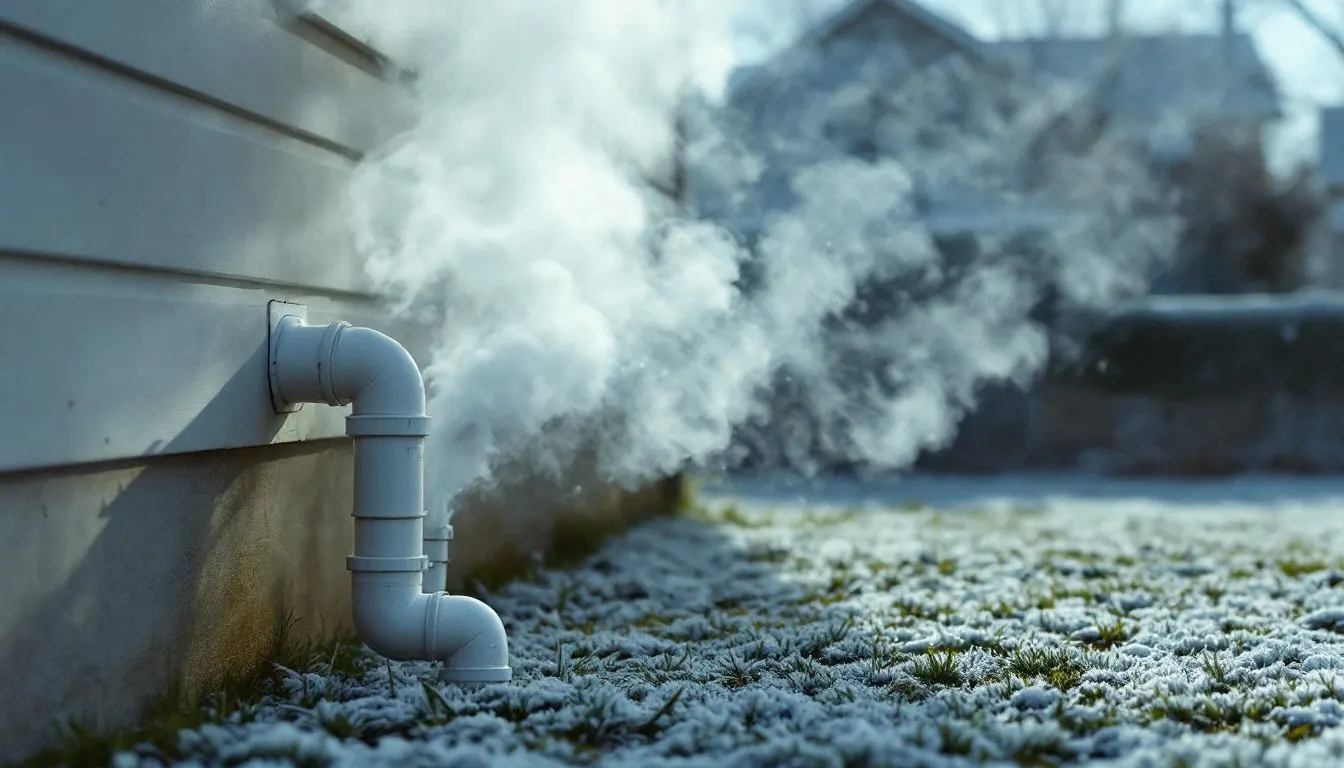
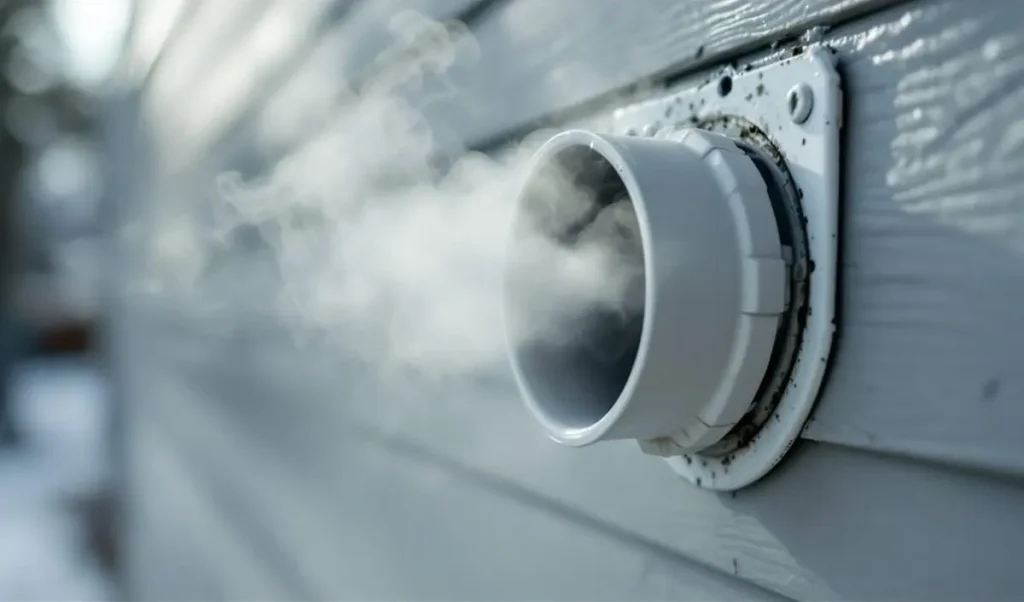
White smoke coming from furnace exhaust is almost always water vapor, not smoke. Burning natural gas makes two molecules of water for every molecule of methane, and a condensing furnace sends that out at under 140°F, so it fogs in cold air. Worry only if it is gray or black, smells, or shows up indoors.
| What you see | What it is | What to do |
|---|---|---|
| White cloud from a white PVC pipe on the side of the house or roof, fading as it drifts, no odor | Water vapor from a condensing (90%+) furnace condensing in cold air | Nothing. Keep the pipe end clear of snow and ice |
| White cloud from a metal flue cap or chimney, mostly on days near or below freezing | Water vapor from an 80% furnace, boiler or water heater, whose hotter flue gas fogs only in colder air | Nothing, unless it comes with soot or an indoor smell |
| Gray, blue or black smoke, or soot streaks on the cap or siding | Incomplete combustion: fuel burning without enough air | Shut the furnace off at its switch and book a combustion test |
| Exhaust smell, haze or a CO alarm inside the house | Flue gas spilling indoors through a leak, a backdraft or a blocked vent | Get everyone outside, then call the gas utility or 911 |
| Smoke from the furnace cabinet or the supply registers, not the pipe | Not exhaust: overheated wiring, a motor or burning dust inside the unit | Turn the furnace off; a hot plastic smell means it stays off |
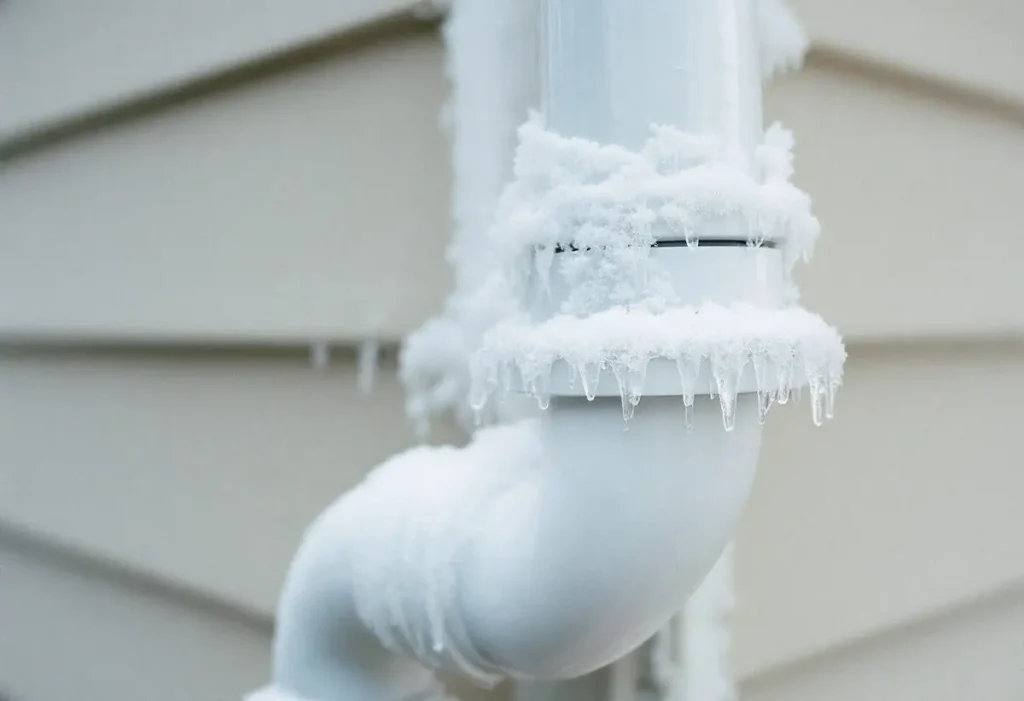
| Ice building on the exhaust or intake pipe, or the plume drifting into the intake | The plume freezing on the termination or being re-breathed | Clear the ice; have the termination spacing checked |
Compiled by The HVAC Brief from Carrier 59MN7B instructions, the PNNL furnace guide, the Beckett AF/AFG manual and our calculations.
Why does a furnace blow white smoke out the exhaust pipe in cold weather?
Because the exhaust is full of water. Methane burns as CH4 + 2O2 → CO2 + 2H2O, and the NIST Chemistry WebBook gives methane’s heat of combustion as 890.7 kJ/mol. We calculated that a 60,000 Btu/h input therefore burns about 71 moles of methane an hour and makes 5.65 lb of water an hour, about 0.68 gal.
A condensing furnace drains some of that water as liquid, the subject of our page on a frozen furnace condensate line. The rest stays as vapor. The DOE Building America guide written by PNNL says Category IV exhaust leaves “under 140°F” after two heat exchangers, which is why it can run in PVC. That gas is saturated, so cold air turns part of its vapor into droplets: a white cloud.
| Exhaust temperature leaving the furnace | Share of combustion water still vapor | Vapor out the pipe, 60,000 Btu/h furnace | Liquid to the drain |
|---|---|---|---|
| 140°F | 100% | 5.65 lb/h | 0 lb/h |
| 120°F | 87% | 4.90 lb/h | 0.75 lb/h |
| 100°F | 46% | 2.60 lb/h | 3.05 lb/h |
HVAC Brief calculation: pure methane at 50% excess air in dry air (NASA: dry air is 20.95% oxygen), exhaust saturated at the stated temperature, sea level, vapor pressure from the NWS formula.
Even a furnace that condenses well sends most of its water outdoors: at a 120°F exhaust, 4.90 lb an hour leaves as vapor, more than six times the liquid reaching the drain.
At what outdoor temperature does furnace exhaust start to look like smoke?
For a condensing furnace, at almost any temperature below the exhaust temperature. Air holds water according to a steep curve; the National Weather Service vapor pressure formula, es = 6.11 × 10(7.5T/(237.3+T)) mb, gives 117 mb at 120°F but only 6 mb at 32°F. When exhaust mixes with outdoor air, the mix lands on a straight line between the two, and wherever that line sits above the curve, droplets form.
Saturated exhaust always crosses the curve, so a condensing furnace plumes even at 50°F. Weather changes how long the plume is; we calculated the dilution needed before the last droplet evaporates:
| Outdoor air (80% RH) | Condensing furnace: dilution to clear | Condensing: peak droplets | 80% furnace: dilution to clear | 80%: peak droplets |
|---|---|---|---|---|
| 50°F | 1 in 30 | 14.0 g/kg | no plume | 0 g/kg |
| 40°F | 1 in 50 | 16.9 g/kg | no plume | 0 g/kg |
| 32°F | 1 in 73 | 19.1 g/kg | 1 in 44 | 0.7 g/kg |
| 20°F | 1 in 132 | 22.3 g/kg | 1 in 111 | 2.8 g/kg |
| 0°F | 1 in 353 | 26.9 g/kg | 1 in 361 | 6.6 g/kg |
HVAC Brief calculation: linear mixing of temperature and vapor pressure, NWS saturation formula, condensing exhaust saturated at 120°F, 80% furnace gas at 300°F with 132 mb of vapor. “1 in 30”: the plume lasts until exhaust is 1 part in 30 of the mix. Peak droplets: grams of liquid per kilogram of mixed gas.
Humidity matters as much as cold: at 50% relative humidity the condensing plume clears at 1 in 53 at 20°F, less than half the 80% figure.
Why does an 80% furnace or a chimney only show white smoke below freezing?
Because its flue gas leaves hot and unsaturated. The Nordyne G6RA/G6RK service manual (an 80+ AFUE line) puts its flue gas temperature “between 300°F and 325°F” measured near the furnace. We calculated the water dew point of methane flue gas at 139°F with no excess air, 125°F at 50% excess air (7.5% oxygen, dry basis) and 115°F at 100% excess air, so 300°F gas is far from condensing.
Mixing that gas into outdoor air, our calculation finds no plume at all above 30°F at 50% relative humidity, 37°F at 80% and 51°F in saturated fog. In deep cold both plumes run long, but the 80% plume carries a quarter or less of the droplets. The metal vent types and why they differ are on our furnace vent pipe page.
Should I be worried about white smoke from the exhaust?
Not if it is white, fades as it drifts and has no smell. Three things change that answer:
- Color. Water vapor is white and vanishes as it drifts. Gray, blue or black smoke, or soot on the cap, means unburned fuel. On oil burners, the Beckett AF/AFG manual has the technician set the air band until “a trace of smoke” appears, then add air until the smoke reading is zero. Visible smoke from an oil flue means a burner out of adjustment, and soot warns of an oil furnace puffback.
- Smell indoors. A plume outside is normal; flue gas smell inside is not. Our sibling page on furnace exhaust smell in the house covers what to do in what order.
- Where it comes from. A cloud at a pipe joint, the intake or the cabinet means a leak, a recirculating plume or something burning inside.
A big plume is not a sign of a cracked heat exchanger; a crack lets flue gas into the house air, it does not add water outdoors. Combustion is better judged at the burner, as our guide to furnace flame color explains.
Can the plume freeze on the pipe or damage the siding?
Yes, and the maker manuals plan for it. Carrier’s 59MN7B installation instructions call a roof termination preferred, saying it is “less prone to icing conditions, and it often has less visible vent vapors.” For sidewall vents Carrier warns that building surfaces may need “sealing or shielding” because of the corrosive properties of combustion products, and says to place the termination where “vent vapors will not damage plants/shrubs, air conditioning equipment or utility meters.”
The same Carrier manual warns that an oversized vent can cause “excessive vent terminal icing or freeze-up,” because slower gas cools sooner. The PNNL guide adds that the intake must be separated from the exhaust “to prevent frost buildup on the cold air intake pipe” and that the exhaust must sit high enough that frozen condensate on the ground cannot block it. The condensate is acidic too: PNNL puts it at pH ≤3. When ice closes the pipe, the furnace locks out on its pressure switch; our sibling page on a furnace vent blocked by snow covers clearing it safely.
Is the white smoke from a water heater, boiler or heat pump the same thing?
From a gas water heater or boiler, yes: condensing models with PVC vents plume like a condensing furnace, atmospheric models like the 80% column above. A heat pump burns nothing; its winter cloud is frost melting off the outdoor coil during the heat pump defrost cycle. Cold-start car exhaust vapor is the same water physics.
What does a technician check if the plume does not look right?
A combustion test, not a look at the cloud. The Nordyne G6 manual has the technician make a small hole in the vent near the furnace and compare flue temperature with its 300°F to 325°F range; high readings point to too much gas pressure or too little airflow. On oil, the Beckett procedure finds a trace of smoke, cuts CO2 by 1.5 to 2 percentage points (13.5% down to 11.5% in its example) and confirms smoke is zero. With clean oxygen, flue temperature and CO readings, a white plume is just water.
Frequently asked questions
What does white smoke from the exhaust indicate on a furnace?
On a gas furnace it indicates water vapor condensing in cold air. Methane burns to two molecules of water per molecule of fuel, so a 60,000 Btu/h furnace makes about 5.65 lb of water an hour by our calculation, and most of it leaves the pipe as vapor. It only indicates a problem if it is gray or black, smells, or appears indoors.
Why is there more white smoke on some mornings than others?
Cold and humidity both lengthen the plume. By our calculation a condensing furnace plume at 20°F needs dilution to 1 in 132 before it clears at 80% relative humidity, but only 1 in 53 at 50%. A damp, still morning makes a long cloud; dry wind clears it close to the pipe.
Is white smoke from a neighbor’s chimney a problem?
Usually not. An 80% furnace or atmospheric water heater sends flue gas up at about 300°F to 325°F, the range in the Nordyne G6 service manual, and our calculation shows that gas only fogs below about 30°F to 37°F at ordinary humidity. White, odorless and fading is water; gray or black smoke or soot on the cap is worth mentioning to them.
How we researched this
We read the Carrier 59MN7B installation instructions, the Nordyne G6RA/G6RK service manual, the Beckett AF/AFG oil burner manual and the PNNL furnace guide for DOE Building America. The chemistry uses NIST’s methane heat of combustion and NASA’s dry air composition; vapor pressures use the NWS formula. Plume figures are our calculations (pure methane, dry combustion air, sea level, linear mixing). The top search results, forum threads and contractor posts citing no documents, were excluded as sources. We publish no exhaust pipe replacement prices because no federal or national lab source publishes them. Research date: November 17, 2026.
Sources
- NIST. “Methane, Chemistry WebBook, SRD 69.” https://webbook.nist.gov/cgi/cbook.cgi?ID=C74828&Mask=1. Accessed November 2026.
- NASA NSSDC. “Earth Fact Sheet.” https://nssdc.gsfc.nasa.gov/planetary/factsheet/earthfact.html. Accessed November 2026.
- National Weather Service, El Paso. “Vapor Pressure.” https://www.weather.gov/media/epz/wxcalc/vaporPressure.pdf. Accessed November 2026.
- Pacific Northwest National Laboratory, DOE Building America Solution Center. “Combustion Furnaces.” https://basc.pnnl.gov/resource-guides/combustion-furnaces. Accessed November 2026.
- Carrier. “59MN7B Modulating 4-Way Multipoise Condensing Gas Furnace: Installation, Start-up, Operating and Service and Maintenance Instructions (59MN7B-01SI).” https://www.shareddocs.com/hvac/docs/1009/public/0a/59mn7b-01si.pdf. Accessed November 2026.
- Nordyne. “G6RA, G6RK Service Manual,” archive.org copy. https://archive.org/download/696e76616c69640a2e2f746573742f/furnace.pdf. Accessed November 2026.
- Weil-McLain and R.W. Beckett. “Ultra Oil AF/AFG Burner Manual.” https://www.weil-mclain.com/wp-content/uploads/RW-Beckett-AFG-Burner-Manual-for-Ultra-Oil-VBL-0321.pdf. Accessed November 2026.
Leave a Reply