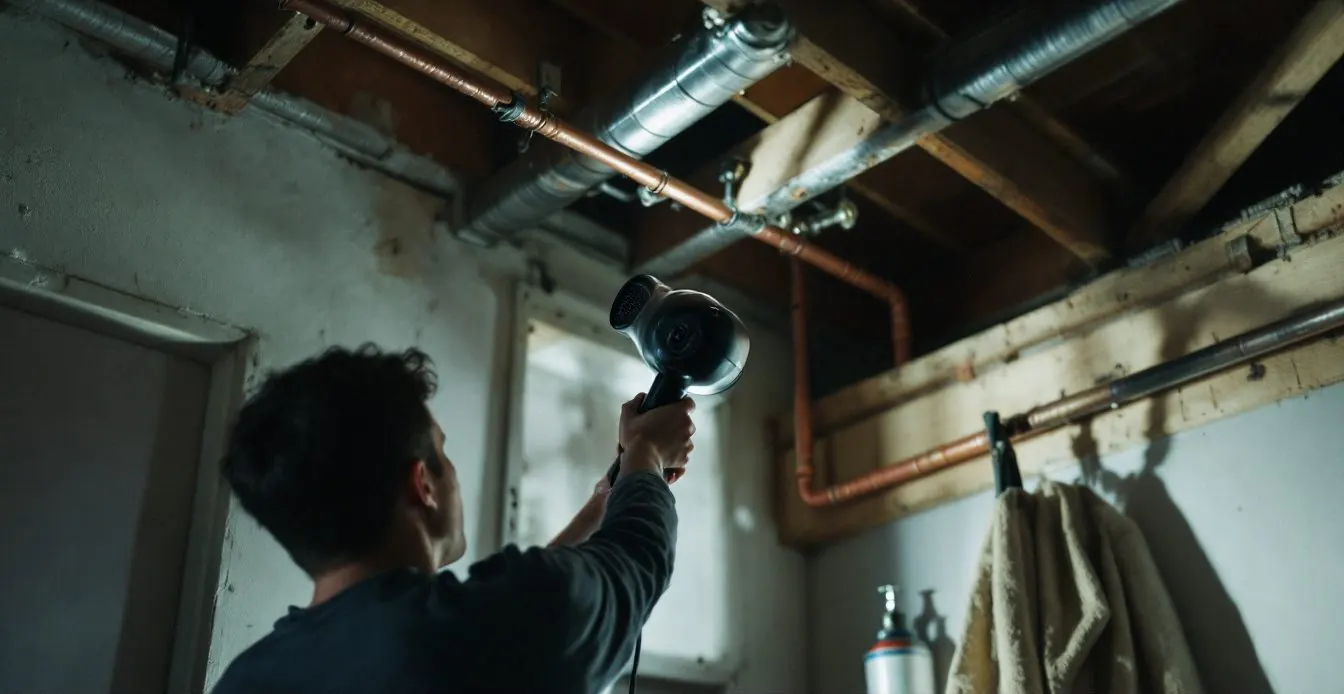
How to thaw frozen pipes: open the faucet the frozen line feeds, then warm that pipe with an electric heating pad, hair dryer, hot wet towels or a space heater kept 3 feet from anything flammable, until full pressure returns. Never use a torch or other open flame. If water appears, shut the main valve.
That is the American Red Cross procedure. Below, plastic pipe bulletins, a RIDGID thawing machine manual and HUD rules fill in what it leaves out. Why pipes freeze at all is covered in what temperature pipes freeze at.
Is one faucet frozen, one room, or the whole house?
Open every faucet, hot and cold, and note which run. The pattern locates the ice in about 2 minutes and decides who thaws it.
- One faucet dry, the next on the same line running: the ice is between them. The RIDGID KT-190/KT-200 manual uses this test and says it is normally “in an outside wall or in a crawl space with poor insulation.”
- Only a trickle: the Red Cross says suspect a frozen pipe, starting at exterior walls and where the service enters through the foundation.
- No water anywhere: RIDGID reads this as the service line frozen between curb valve and house; Lakeway MUD, a Texas utility, says that happens “typically below 20 degrees Fahrenheit.”
- Neighbors dry too: call the utility. PPFA says to check an outside underground meter first; a frozen meter is the utility’s job.
Should you shut off the main or leave water flowing while the pipe thaws?
Leave the faucet open in every case. Keep the main on only if you can see the frozen pipe and it is intact; the Red Cross and Lakeway MUD give opposite advice.
The Red Cross says “running water through the pipe will help melt ice in the pipe,” which needs the main on. Lakeway MUD shuts the main first, because a split pipe floods once its ice melts. RIDGID’s manual describes why the open faucet matters: as the pipe warms, water “with pressure behind it” melts the ice and flushes it “out of the faucet.”
Our rule from those three documents: if the pipe is exposed under a sink or in a basement and you can watch it, keep the main on, open the faucet and heat from the faucet side back toward the ice so melt water has a path out. If the ice is inside a wall or ceiling, or the pipe shows a bulge or split, close the main first and open the faucets. Pressure builds between an ice plug and a closed fixture, which is why the burst often sits away from the ice.
Which heat source is safe on copper, PEX, CPVC or PVC pipe?
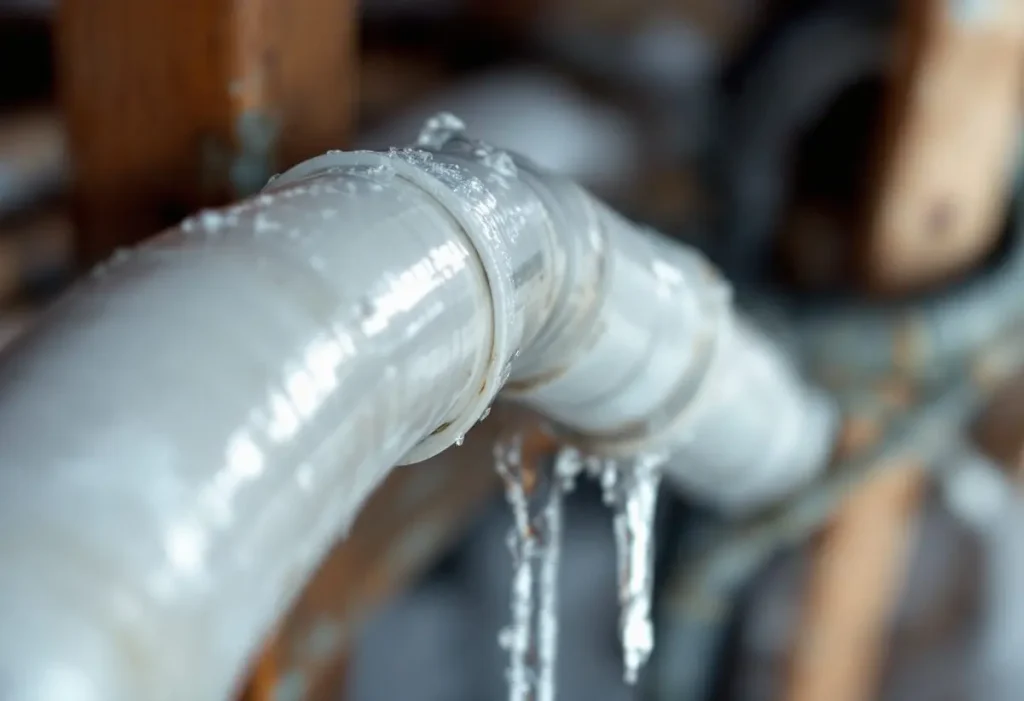
Gentle electric heat is safe on all of them; the limits come from the plastics. PPFA User Bulletin 10-20 (2020) says CPVC, PEX and PE-RT “may be heated to 180°F,” other plastic piping “should be limited to 150°F,” and an IR thermometer can judge pipe temperature. The print line on the pipe tells you which plastic it is.
| Heat source | Copper or steel | PEX, CPVC, PE-RT | PVC and other plastics | Rule and source |
|---|---|---|---|---|
| Hot water soaked towels | Yes | Yes | Yes | Rewrap as each cloth cools (PPFA); never boiling water (PPFA) |
| Hair dryer or electric heating pad | Yes | Yes, pipe under 180°F | Yes, pipe under 150°F | Red Cross; PPFA names the hair dryer as a “low capacity heater/blower” |
| Hot air gun | Yes, with care near solder and nearby wood | Only if the pipe stays under 180°F | Risky: 150°F limit | PPI TR-52 (2020) allows it on PEX within 180°F |
| Portable electric space heater | Yes | Yes | Yes | At least three feet from combustibles, plugged into a wall outlet (CPSC) |
| Self-regulating heat cable | Yes | Only cable listed for plastic pipe | Only cable listed for plastic pipe | PPI TR-52; check the PEX maker’s approval |
| Electric thawing machine (welder style) | Yes, plumber’s tool | No | No | RIDGID: “will not work with plastic pipe”; PPI TR-52 Note 6 |
| Torch, kerosene or propane heater, charcoal | No | No | No | Red Cross; PPFA; PPI TR-52 Figure 2 |
Compiled by The HVAC Brief from the Red Cross, PPFA 10-20, PPI TR-52, the RIDGID KT-190/KT-200 manual and CPSC (2026).
Plastic pipe hides damage. The Plastics Pipe Institute’s TR-52 report warns PEX thawed with flame, excessive heat or an electric thawing device “may not show any visible damage” yet should be replaced. TR-52 adds that PEX frozen in a slab or compacted soil “may suffer damage.”
How do you thaw a frozen pipe inside a wall or ceiling?
Shut the main, then move warm room air into the cavity. If that fails, a plumber uses a RIDGID-type thawing machine on metal pipe or cuts a small hole in the drywall.
Open the cabinet or closet on that wall, as the Red Cross suggests, and raise the house temperature; Lakeway MUD suggests above 55°F when you cannot reach the blockage. PPFA’s first method is to expose the area and “direct a small fan into the area to circulate warmer air from the occupied space into the wall cavity.” Expect it to be slow on plastic, which PPFA notes conducts heat poorly.
A plumber’s RIDGID KT-200 clamps onto copper or steel pipe on each side of the frozen section and pushes 300 amps at 4.5 to 7.6 volts through the pipe itself, so it “does not require that you know exactly where the frozen section is,” with a maximum reach of 150 feet. It does nothing for PEX, CPVC or a metal line with a plastic or rubber coupling; there, the answer is opening the wall.
How do you thaw frozen pipes in a crawl space?
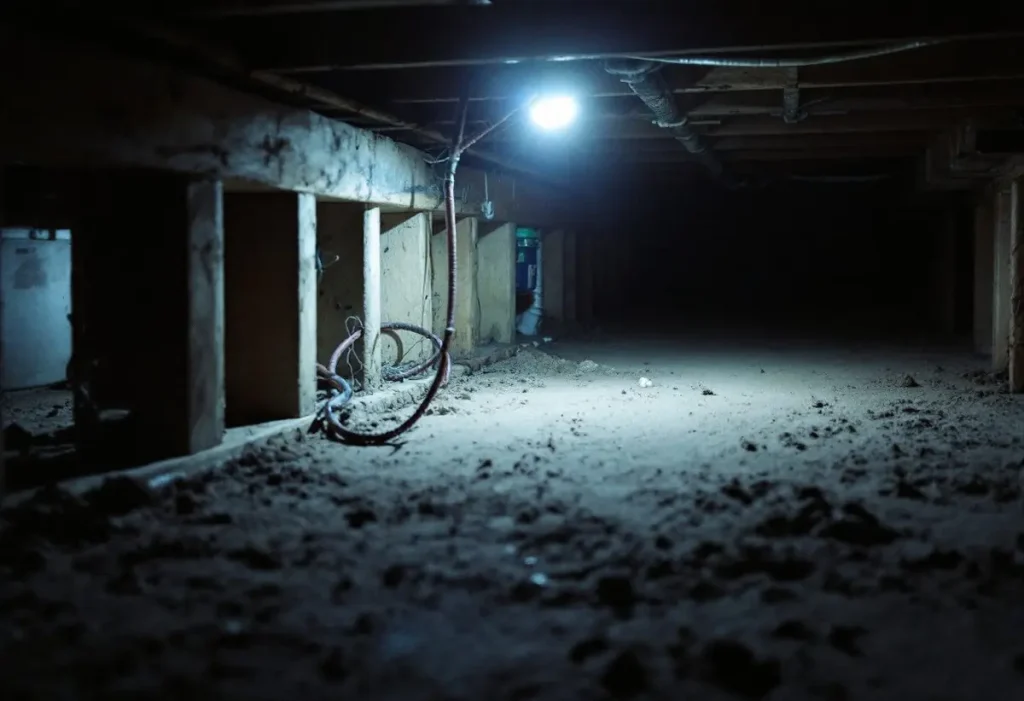
Warm the pipe directly with hot towels or a hair dryer on a GFCI outlet; a space heater only fits where the CPSC rules can be met. Open crawl space vents make this the coldest run in most houses, as our crawl space ventilation guide explains.
The CPSC 2026 winter release (archived copy) says to keep a portable heater “at least three feet away” from combustibles and to plug it into a wall outlet, never an extension cord or power strip. Few crawl spaces have an outlet, and paper-faced insulation and dry joists are the combustibles CPSC means. Our space heater fire data shows why the distance rule exists.
Once water runs, insulate the pipe and consider self-regulating cable; the heat tape guide covers lengths, GFCI rules and the CPSC fire record.
How do you thaw frozen pipes in a mobile home?
Start at the heat tape outlet under the home. HUD rules require one, and a tripped GFCI on it leaves the supply riser unprotected.
Under 24 CFR 3280.806(d)(10), the outlet for pipe heating cable or heat tape sits on the underside of the home “within 2 feet of the cold water inlet,” on a GFCI-protected circuit. Find the riser, check the tape is plugged in, and reset the GFCI. 24 CFR 3280.603(b) requires heat tape to be “listed or certified for its intended purpose” and says plastic piping “shall not be exposed to heat in excess of manufacturers recommendation.”
If the tape had power and the riser is still frozen, use hot towels or a hair dryer within the PPFA limits for the plastic printed on the pipe. RIDGID’s machine cannot thaw plastic, and the Red Cross rules out any open flame near the belly wrap and floor insulation.
What about an outside faucet or a frozen underground service line?
An outside faucet line is drained, not thawed; a buried service line is a job for the utility or a plumber.
The Red Cross says to close the inside valve to a hose bib and open the outside faucet so water “can expand without causing the pipe to break.” For buried plastic, PPFA describes exposing the pipe or feeding a tube in from the basement to inject warm water, “only by an experienced plumber”; PPI TR-52 caps that water at 180°F (82°C) for PEX. On metal service pipe, RIDGID clamps one cable in the basement and one on the curb key.
Stop and call
Shut the main and call a licensed plumber if you cannot find or reach the frozen section, if heat restores nothing, or if a pipe shows a split, bulge or wet stain; the Red Cross lists the first 2. Keep out of water that reaches outlets or the panel. If the heat failed first, see a furnace not working after a power outage or what counts as an HVAC emergency.
How long does thawing take, and how do you know if the pipe burst?
No primary source gives a household thawing time. RIDGID says its machines take “a few seconds to several hours,” and the Red Cross says to heat “until full water pressure is restored.”
Lakeway MUD says gurgling or banging is normal as ice moves. A split shows only after the ice melts, so stay with the pipe, then check every other faucet: the Red Cross warns “if one pipe freezes, others may freeze, too.” If you closed the main, reopen it slowly and watch for leaks. Photograph damage; coverage turns on policy wording, as our page on what homeowners insurance covers explains.
Frequently asked questions
Will frozen pipes thaw out on their own?
Yes, once temperatures rise above freezing, says Lakeway MUD, a Texas water utility, but waiting is risky: ice can keep growing, and any split floods at thaw. The American Red Cross advises opening the faucet and applying gentle heat instead.
What do plumbers use to thaw frozen pipes?
On copper or steel, an electric thawing machine such as the RIDGID KT-200, which sends 300 amps through the pipe between two clamps and reaches 150 feet without opening walls. On plastic, which those machines cannot thaw, plumbers use warm air, hot towels, heat cable or hot water injection, per PPFA and PPI.
How to thaw frozen pipes fast?
Open the faucet, find the exact frozen section, and put the heat on that pipe, not the room: a hair dryer on the right 1 foot of pipe beats a heater on the wrong wall. Do not rush it with a torch or boiling water; PPFA bans both, and PPI warns overheated PEX can fail later.
Can you pour boiling water on frozen pipes?
No. PPFA User Bulletin 10-20 says “Never pour boiling water or use an open flame heating source on the pipe,” and limits CPVC, PEX and PE-RT to 180°F and other plastics to 150°F. Towels soaked in hot tap water, rewrapped as they cool, are what PPFA lists instead.
How we researched this
Researched November 19, 2026. We read the Red Cross frozen pipes page, PPFA User Bulletin 10-20, PPI TR-52, the RIDGID KT-190/KT-200 manual, the CPSC 2026 winter release (archived copy), 24 CFR 3280.603 and 3280.806, and the Lakeway MUD guide. Forums, contractor and insurer blogs were excluded as number sources. No primary source gives a typical thawing time or a national count of torch thawing fires, so neither appears.
Sources
- American Red Cross. “Frozen Pipes.” https://www.redcross.org/get-help/how-to-prepare-for-emergencies/types-of-emergencies/winter-storm/frozen-pipes.html. Accessed November 2026.
- Plastic Pipe and Fittings Association. “User Bulletin 10-20: Thawing Thermoplastic Water Pipes” (April 2020). https://cdn.ymaws.com/www.ppfahome.org/resource/resmgr/attach/UB10-20_Final.pdf. Accessed November 2026.
- Plastics Pipe Institute. “TR-52: Resistance of PEX Pipe and Tubing to Breakage When Frozen (Freeze-Break Resistance)” (2020). https://conduitcalc.plasticpipe.org/pdf/tr-52-2020.pdf. Accessed November 2026.
- Ridge Tool Company. “Model KT-190 and KT-200 Pipe Thawing Units, Operator’s Manual.” https://nmrcdn.s3.amazonaws.com/optimized/1063/assets/responsive/657000/657037/Pipe%20Thawer%20Ridgid.pdf. Accessed November 2026.
- U.S. Consumer Product Safety Commission. “Keep Warm and Safe This Winter: Tips for Using Generators, Furnaces and Space Heaters” (2026), archived copy. https://web.archive.org/web/2026id_/https://www.cpsc.gov/Newsroom/News-Releases/2026/Keep-Warm-and-Safe-This-Winter-Tips-for-Using-Generators-Furnaces-and-Space-Heaters. Accessed November 2026.
- eCFR. “24 CFR 3280.806 Receptacle outlets.” https://www.ecfr.gov/current/title-24/subtitle-B/chapter-XX/part-3280/subpart-I/section-3280.806. Accessed November 2026.
- eCFR. “24 CFR 3280.603 General requirements” (plumbing). https://www.ecfr.gov/current/title-24/subtitle-B/chapter-XX/part-3280/subpart-G/section-3280.603. Accessed November 2026.
- Lakeway Municipal Utility District. “Tips for Thawing Frozen Pipes.” https://lakewaymud.org/update/tips-for-thawing-frozen-pipes/. Accessed November 2026.
Leave a Reply