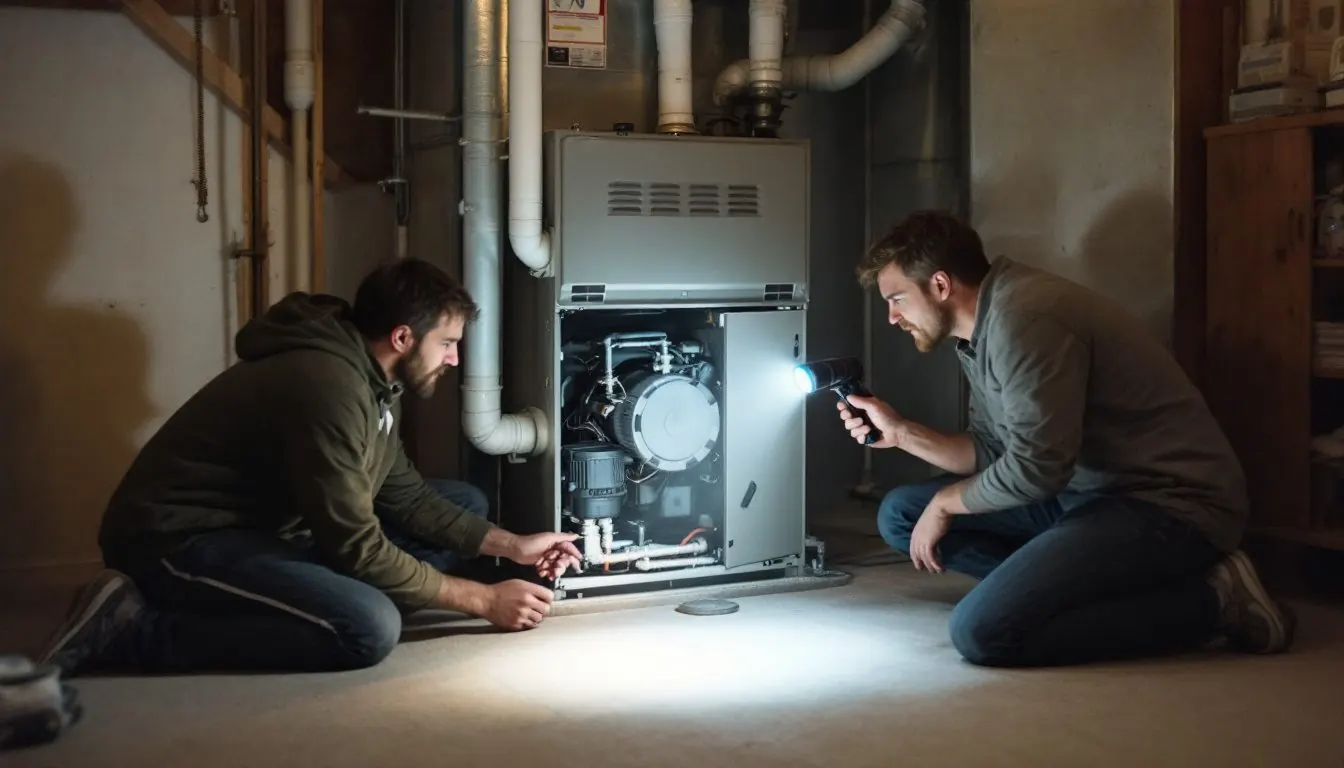
A furnace blower not turning on is a power, control or motor fault, and two tests sort it: does the fan start with the thermostat fan set to ON, and do the burners light on a heat call? Wait out the delay first: Goodman starts the blower 30 seconds after flame, Rheem 20 seconds after the gas valve opens.
How many seconds after the burners light should the furnace blower kick on?
Between 20 and 45 seconds at the factory settings of the three controls we checked, and the clock starts at ignition, not at the thermostat click. The Goodman GM9S80 installation manual lists the order: inducer, pre-purge, igniter, gas valve, then “After 30 seconds the indoor blower is energized on heating speed.”
| Furnace or control | Blower on, heat call | Blower off after heat | Fan ON (G) and cooling |
|---|---|---|---|
| Goodman GM9S80 / GC9S80, single-stage board | 30 seconds after flame is sensed | 90 seconds by default, adjustable from 30 to 180 | Cooling starts after a cool-on delay; speed set as F01 to F09 on the display |
| Rheem (-)801T upflow series | 20 seconds after the main gas valve is energized | 90 seconds default; 120, 160 or 180 by dip switch | Display shows F for a continuous fan call, H for gas heat |
| Copeland 50M56D-751 (replacement board for Carrier single-stage furnaces with PSC blowers) | 45 seconds default; 66 seconds on the alternate setting | 135 seconds default; 90, 180 or 225 by switch | 1 second on delay for fan only; 2 seconds on delay in cooling |
Start a stopwatch at flame and give the blower one minute. The table also explains a fan that runs 90 seconds after the burners stop; the normal length of a furnace cycle is worked out separately.
Which of the four branches is your furnace in?
Run the four checks in the chart in order; each “No” names a part, and the table gives the reading that decides it.
| What you see | What it points to | Reading that decides |
|---|---|---|
| No LED, nothing runs in any mode | Breaker, furnace service switch, blower door switch, transformer or the board’s low-voltage fuse | 115 VAC from line H to line N on the board, then 24 VAC from R to C; Goodman says about 13 volts on R to C points to a blown fuse |
| Board lit; no fan on FAN ON and none on a heat call | G circuit, fan relay, motor feed or the motor | 24 VAC from G to C with the fan called; Goodman energizes the blower by jumpering R to G and expects 115 volts ± 10 percent at the line connections while it runs |
| FAN ON works; burners light; no blower in heat | Heat output, heat speed lead or tap, or ECM heat program | On a multi-speed ECM, 24 VAC from COM to the heat tap; Genteq notes a signal on an unprogrammed tap gives no operation |
| Burners light, run a few minutes, go out, repeat | Blower dead in heat; the main limit is doing the shutting off | Rheem flags code 61 when the main limit stays open more than 150 seconds; Copeland’s board logs 33 (limit or rollout open) and 13 (limit or rollout lockout) |
| Motor hums, wheel does not turn | PSC run capacitor, seized bearings or something jamming the wheel | Capacitor microfarads inside the tolerance printed on its can; wheel spins freely by hand with power off |
Why do the burners light, then shut off after a few minutes, when the blower never starts?
Because with no air crossing the heat exchanger the main limit switch opens and kills the gas, then closes as it cools and the board relights: the furnace cycles on its safety, not its thermostat. Rheem’s (-)801T instructions list “a problem affecting the main blower” among the causes of an open limit.
Newer boards give up on their own: the Rheem (-)801T control declares the blower dead when the main limit has been open for more than 150 seconds, shows code 61, enters a one-hour soft lockout and, after the fourth dead-blower call in one heat call, a hard lockout. This is the stop line: if the burners light and drop out with no air at the registers, set the thermostat to OFF and leave it there. The limit switch page covers how a technician tests each trip.
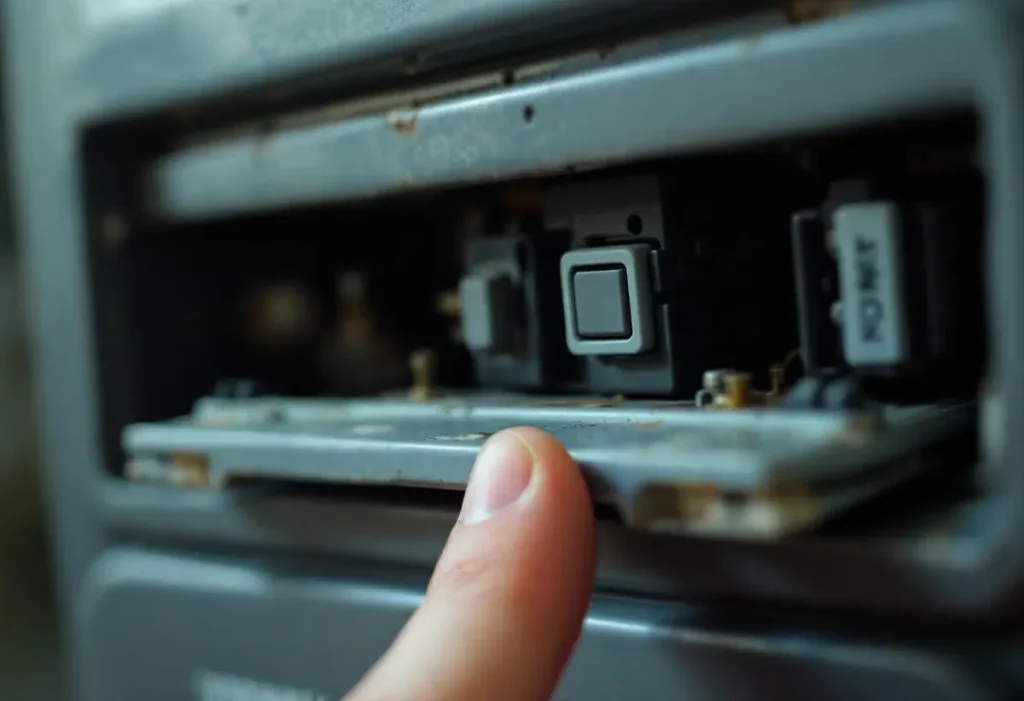
Is the blower door switch or a blown board fuse cutting the power?
Check these first when the board shows no light at all. The Goodman RS6612022R1 service manual describes a blower door interlock switch that “interrupts unit voltage when the blower door is opened,” and Rheem prints the same warning: the blower door safety switch must not be disabled. A blower door that is not fully seated after a filter change leaves that switch open, and the whole furnace looks dead.
In Goodman’s manual, a transformer putting out 24 volts while R to C reads “approximately 13 volts” means check for a blown fuse. Copeland’s 50M56D-751 board flags the same failure as red code 24, “Secondary Voltage Fuse is Open.” Goodman pairs an open fuse with a short in the low-voltage wiring; the furnace control board page covers why that fuse keeps going.
Does the blower come on with the thermostat fan set to ON?
If it starts within seconds (Copeland’s 50M56D-751 uses a 1 second on delay for fan only), the motor, its capacitor or module and the fan relay work, and the fault is on the heat side. If nothing happens, the fan call (the G wire) is the next suspect. Goodman’s thermostat check removes the thermostat wires at the board and jumpers R to Y to G; if the blower then starts, “the trouble is in the thermostat or wiring.”
Rheem’s control shows F when it sees a continuous fan call, and the Copeland board flashes green 44 for “Normal Fan Mode (G).” A board that reports the fan call while the motor sits still narrows it to the board output, the motor wiring or the motor. A fan that only lags on AUTO is usually the delay above; see fan ON vs AUTO.
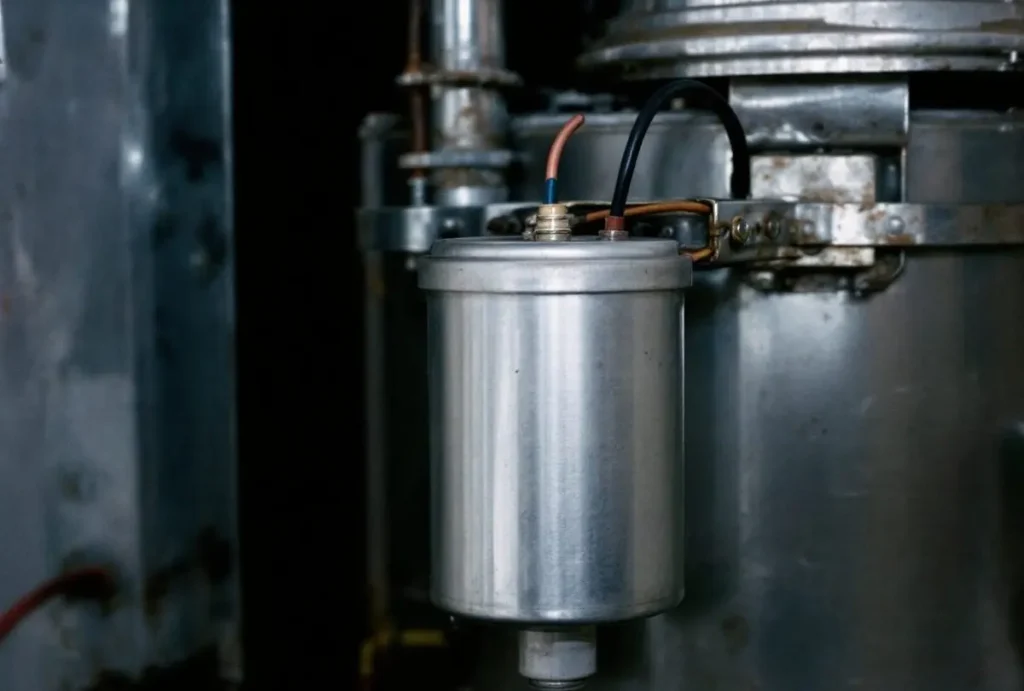
PSC or ECM: which reading says the motor is dead and not the board?
Voltage at the motor decides it: power present and no rotation condemns the motor side; power absent sends you back to the board. A PSC motor needs only line voltage, which Goodman checks at 115 volts ± 10 percent at the furnace’s line connections with the blower running, plus a working run capacitor. Goodman’s multi-speed ECM needs two things at once: line voltage on the main harness (black to CIRC H, white to neutral) “as well as a signal on one of the speed taps (T1-T5),” and from COM to the energized tap “you should read 24 VAC.”
For a PSC motor that hums without turning, the capacitor is the cheap suspect: its measured microfarads must fall inside the tolerance printed on the can. Cornell Dubilier’s SF run capacitor catalog lists ±10% as standard with ±6% and ±3% available, so a 10 µF part marked ±6% passes between 9.4 and 10.6 µF. A good capacitor and a wheel that will not spin by hand with power off point to bearings or a jam; the furnace humming noise page sorts those hums by timing.
The Genteq ECM Service Guide tells technicians to disconnect power and wait at least 5 minutes before opening the control on 2.0, 2.3, 2.5, Eon, X13 and 3.0 motors so internal capacitors discharge. Its tests check the motor before the control is condemned, because a new control fitted to a failed motor “will result in no operation.” Motor types, ratings and replacement are on the furnace blower motor page; capacitor basics are in HVAC capacitors explained.
What if the blower runs for the AC but not for heat, or the reverse?
A blower that works in one mode has a good motor, so the fault is in that mode’s signal. The Goodman GM9S80 board energizes the heating speed only after flame is proven, so burners that never light mean an ignition or venting fault, and a furnace that clicks but will not light is the place to start. The summer case, an outdoor unit running with the indoor fan dead, has its own test sequence in outside AC unit running but inside fan not.
Frequently asked questions
Can a furnace work without a blower?
Not safely: with no air crossing the heat exchanger, the main limit opens and shuts off the gas. Rheem’s (-)801T control declares the blower dead once the limit has been open more than 150 seconds, shows code 61 and enters a one-hour lockout. Set the thermostat to OFF rather than letting it cycle on the limit.
Why is my furnace turning on but not blowing?
Either the blower is still inside its delay (Copeland’s 50M56D-751 board waits 45 seconds by default) or the heat output has failed. If nothing moves one minute after you see flame, switch the fan to ON: a blower that starts then has a heat-side fault.
Is there a reset button on a furnace blower motor?
None of the maker procedures we read includes one. Goodman’s RS6612022R1 blower check starts with power off, looking for anything that keeps the wheel from turning. What resets is the board: Rheem soft lockouts clear when power is cycled or the heat call is cycled off for more than 2 seconds but less than 20.
Why is my furnace blower not turning off?
Check for a fan ON call first; the Genteq ECM Service Guide says to rule out a continuous fan call on the G terminal. Rheem also runs the blower 90 seconds after the burners stop. Goodman’s chart adds a fault case: an open primary limit makes the board run the circulator continuously. The rest is covered in furnace won’t turn off.
Why is my furnace blower not blowing hard enough?
Rheem’s (-)801T instructions list the same airflow problems that trip the limit: a dirty filter or cooling coil, restricted return or supply ducts, the wrong speed tap, failing motor bearings, low voltage to the motor, a dirty blower wheel and a wheel slipping on its shaft. Genteq adds a test: if pulling the filter fixes the airflow, the filter is too restrictive.
How we researched this
Research date: 19 November 2026. We read five maker documents in full (Goodman GM9S80 and RS6612022R1, Rheem (-)801T, Copeland 50M56D-751, Genteq ECM Service Guide) and the Cornell Dubilier SF catalog. Delays and codes apply only to the series each covers. Contractor blogs and forums were excluded as number sources; no repair prices appear because no federal or national-lab source publishes them.
Sources
- Goodman Manufacturing. “Installation Instructions for *M9S80 / *C9S80 Gas Furnaces.” https://documents.alpinehomeair.com/product/goodmangm9s8gc9s8installationmanual.pdf. Accessed November 2026.
- Goodman Manufacturing. “Service and Troubleshooting: GM9S92 / GM9S96 / GC9S96 Single Stage Gas Furnaces (RS6612022R1).” https://mobile.goodmanmfg.com/mobileapp/stellent/pdf/infoPdf/Lit/RS6612022R1.pdf. Accessed November 2026.
- Rheem Manufacturing. “Installation Instructions, (-)801T Upflow Series.” https://resource.gemaire.com/is/content/Watscocom/Gemaire/rheem_r801t_en_ii.pdf. Accessed November 2026.
- Copeland (White-Rodgers). “50M56D-751 Installation Instructions.” https://media.copeland.com/7b1c16cb-45cd-45fe-8e23-b16b0109fc57/0037-7757001%20%2D%2050M56D-751%20Instruction%20Sheet%20(EF).pdf. Accessed November 2026.
- Regal-Beloit (Genteq). “ECM Service Guide.” https://cdn.hackaday.io/files/1668027136456768/ECM%20Service%20Guide.pdf. Accessed November 2026.
- Cornell Dubilier. “Type SF Motor Run Capacitors.” https://www.cde.com/resources/catalogs/SF.pdf. Accessed November 2026.
Leave a Reply