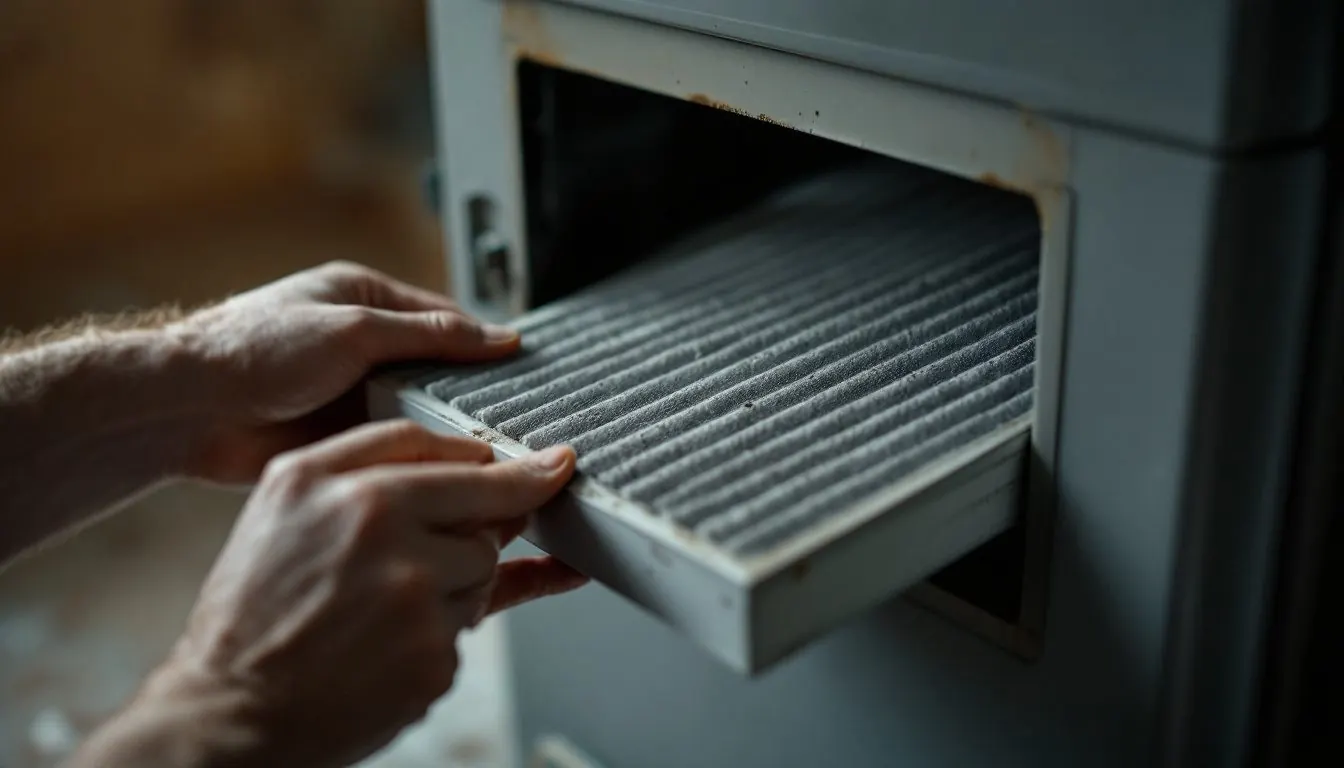
A furnace whistling noise is almost always air forced through a gap or restriction: a loaded filter, a small return grille, closed registers or a leaky cabinet seam. Goodman’s service manual lists exactly those causes. The exception is a whistle or hiss that starts with the flame or at the gas meter: treat that as a gas problem.
When does the whistle start, and what just switched on at that moment?
The second the whistle begins names the part that made it, because the inducer, burners and blower start one at a time. On a Goodman furnace with a White-Rodgers 50A55 control, the inducer pre-purges, the igniter warms for 5 seconds up to a 17-second maximum, the gas valve opens, and the blower follows after a “fixed thirty (30) second blower on delay.” At shutdown the inducer runs a 15-second post purge and the blower a selectable 90, 120, 150 or 180 seconds (Goodman RS6610004). Other makers differ in timing, not order.
| When it whistles | Where it is loudest | Most likely cause | Quick check | Who fixes it |
|---|---|---|---|---|
| With the blower, also on FAN ON | Filter slot, return grille, cabinet | Loaded or restrictive filter, filter door gap, small return | Filter door open 10 seconds: quieter? | You; technician for return ducts |
| With the blower, in one or two rooms | Supply registers | Closed registers or dampers | Open every register and door | You |
| With the blower, at joints | Duct, cabinet or panel seams | Air leaks; Goodman: “Check for air whistling thru seams” | Hand along joints, fan on | You (foil tape) or duct contractor |
| Since a new furnace or ECM blower | Grilles and registers | Constant airflow motor on undersized ducts | Static pressure vs rating plate | Technician |
| First 15 seconds, before flame | Vent, intake or inducer | Inducer, vent or intake path | Also during post purge? | Technician |
| With the flame, or at the meter | Gas valve, piping, meter | Gas side; a listed leak warning sign | Smell for gas; never use a flame | Gas utility, now |
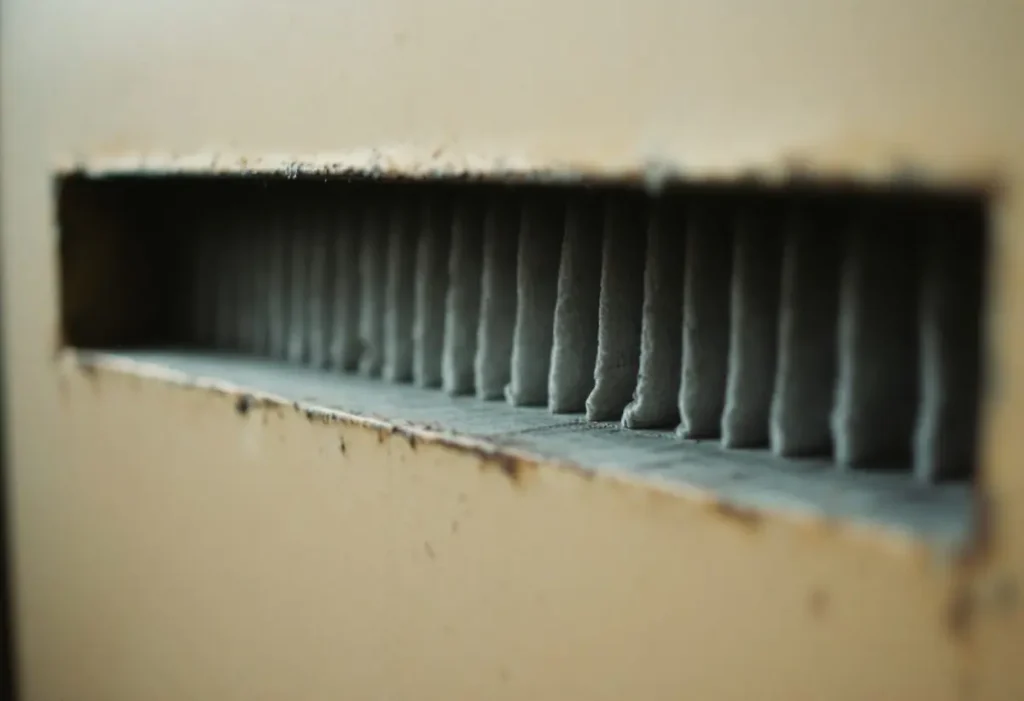
Does the whistle stop when you pull the filter or open the filter door? The 2-minute test
If the whistle drops the moment the filter door opens, the air side is the cause, not a failing furnace part. Goodman’s ECM troubleshooting chart asks the same thing, “Does removing panel or filter reduce ‘puffing’?”, blaming high static, dirty filters and incorrect ductwork (Goodman RS6610004).
- 0:00. Thermostat to OFF, fan to ON. In Goodman’s fan-only sequence only the blower runs; no gas.
- 0:30. Walk it: return grille, filter slot, cabinet, registers. Find the loudest spot.
- 1:00. Slide the filter halfway out for 5 to 10 seconds, then refit it. Do not pull the blower door: on most furnaces that opens the blower door safety switch and kills power, which proves nothing.
- 1:30. Open every register and interior door. Fading whistle: closed registers.
- 2:00. Silent on FAN ON? Return to heat and note which step brings it in.
Why does a dirty or MERV 13 filter make a furnace whistle?
A filter more restrictive than the ducts were sized for raises return suction, so air pulls hard through every gap at the filter door. Goodman’s IOG-2038E installation manual tells installers to “avoid using highly restrictive 1″ filters which produce static pressure loss greater than .25″ W.C.” and suggests a deep pleated MERV 8 media filter instead (Goodman IOG-2038E).
John Proctor’s 2012 ASHRAE Journal column on 34 California systems with furnaces found that filter pressure drop averaged 0.282 in. w.c., with a range of 0.075 to 0.792, against the roughly 0.10 in. w.c. that ACCA manuals assume. Total external static pressure averaged 0.887 in. w.c., and none of the 34 was at or below 0.50 in. w.c., the common furnace rating point (Proctor, ASHRAE Journal). Our MERV and airflow page has filter numbers by rating.
An uncovered filter slot becomes a second, unfiltered return opening, and its edges whistle. Where supply ducts serve rooms outside the furnace space, Goodman’s IOG-2038E requires the return to be “handled by duct(s) sealed to the furnace casing”; foil tape or the maker’s slot cover closes the gap.
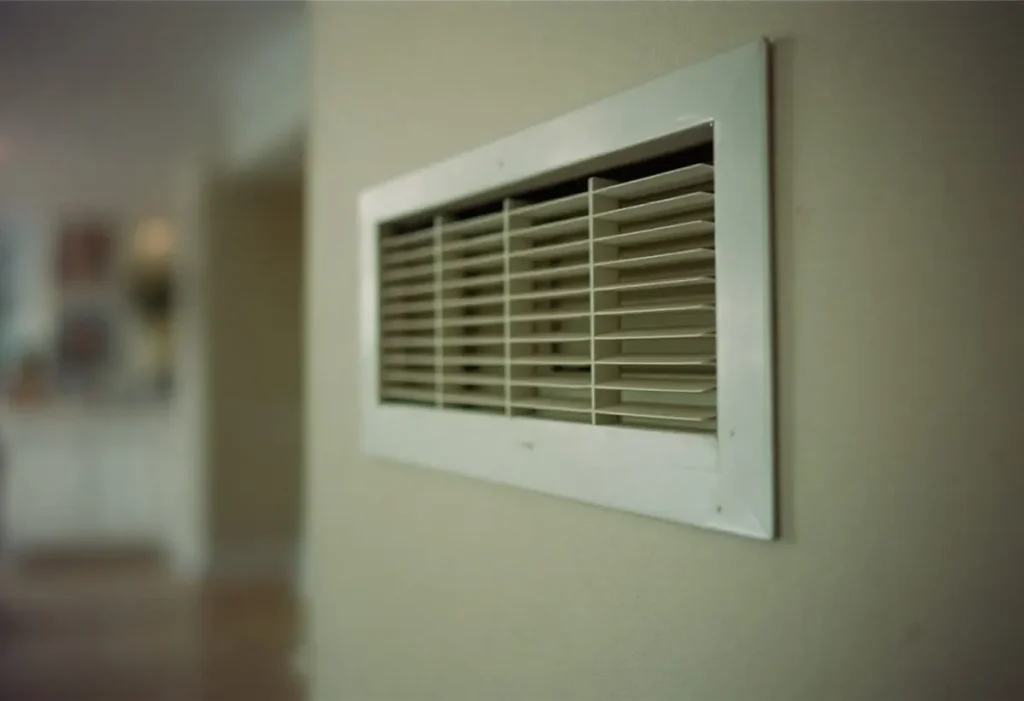
How small does a return grille have to be before it whistles?
At 930 CFM, a lone 12 x 12 or 14 x 14 inch return grille moves air two to three times faster than a 20 x 20, and Nailor’s noise ratings climb with it.
| Listed grille size (in.) | Core area (sq ft) | Air speed through the core | Noise criterion (NC) | Pressure lost at the grille |
|---|---|---|---|---|
| 12 x 12 | 0.90 | 1,033 ft/min | Past the table; NC 42 at 1,000 ft/min | More than 0.344 in. w.c. |
| 14 x 14 | 1.24 | 750 ft/min | About NC 34 | 0.194 in. w.c. |
| 16 x 16 | 1.64 | 567 ft/min | About NC 26 | 0.111 in. w.c. |
| 20 x 20 | 2.61 | 356 ft/min | Below the lowest listed value (NC 19 at 400 ft/min) | 0.045 in. w.c. |
| 24 x 24 | 3.79 | 245 ft/min | Below the lowest listed value | 0.022 in. w.c. |
A 12 x 12 grille alone uses over two thirds of the 0.50 in. w.c. budget. Nailor’s NC values assume 10 dB room absorption and ANSI/ASHRAE Standard 70 tests; NC is a room noise rating, not pitch, but on the 20 x 20 row each added 100 ft/min raises it 3 to 6 points (Nailor 67FB45). Fixes are ranked on our page about a return duct that is too small, and a sofa against the grille is covered in what happens if you cover a return vent.
Why did the whistling start after a new furnace or new blower motor?
A variable-speed (ECM) blower speeds up as resistance rises, so on cramped ducts it pushes air harder than the old motor did. Goodman’s service manual warns that “in some undersized duct installations this may cause noise or high airflow complaints” (Goodman RS6610004).
The reading that settles it is total external static pressure, return plus supply, measured with clean filters; Goodman’s example adds -0.1 and 0.3 to 0.4 in. w.c. If it exceeds the maximum on the rating plate, “check for closed dampers, registers, undersized and/or oversized poorly laid out duct work.” Our static pressure guide explains the test.
Closed registers do the same thing at the room end. PNNL’s Building America Solution Center warns that balancing by closing register dampers “can result in unacceptable noise at the registers (e.g., whistling) due to increased air velocity” (PNNL BASC). Our page on what happens when you close an air vent has the numbers.
Is a whistle or hiss near the gas valve or gas meter dangerous?
Treat it as dangerous. The South Dakota Public Utilities Commission lists “hissing, whistling or roaring noise” as a warning sign at a gas meter and says that if you sense it, “get out of the house, go somewhere safe and call for help” (SD PUC). Peoples Gas lists “an unusual hissing noise” among the signs of a natural gas leak (Peoples Gas).
In winter, the SD PUC warns that dripping snowmelt can freeze on meter vent pipes and “affect proper operation”; clear it by hand or broom, never by kicking the meter. If you smell gas, leave first and call from outside; our furnace smells like gas page has the step order.
The technician measures gas pressure with a manometer: Goodman’s IOG-2038E allows a natural gas inlet pressure of 4.5 to 10.0 in. w.c. and a 3.5 in. w.c. high stage manifold on natural gas, then soap-tests every joint. Not a homeowner job.
What does a whistle from the vent pipe or inducer mean?
A whistle during the 15 second prepurge that returns in the 15-second post purge comes from the inducer side, the only fan moving then. Goodman’s manual lists no whistle under inducer faults, so start with leaks at vent and intake joints.
Check outside terminations for frost or snow. Goodman’s IOG-2038E says that when a furnace is installed without a combustion air pipe, “a 90° elbow should be used on the combustion air intake to guard against blockage.” A grinding squeal is a bearing, not air: see our inducer motor and furnace squealing pages.
Frequently asked questions
Is it normal for my furnace to whistle?
A faint air rush is normal; a distinct whistle is not. Goodman’s service manual files whistling under air leaks and high static. In Proctor’s 34 measured California systems, none ran at or below the 0.50 in. w.c. furnace rating point, so restricted airflow is common.
Why is my furnace making a high-pitched noise when running?
If it follows the blower, it is air at a restriction: loaded filter, small return or closed registers. If it persists on FAN ON, the burner is not involved. Goodman tells installers to avoid 1 inch filters with more than .25 in. w.c. of pressure loss.
Why is my furnace making a hissing noise?
A hiss at a register or filter door is air. A hiss at the gas valve, pipe or meter is different: Peoples Gas lists an unusual hissing noise as a gas leak sign, and the South Dakota PUC says to leave the house and call for help.
Why is my furnace whining when running?
A steady whine that follows blower speed is often an ECM motor pushing against undersized ducts. Goodman notes these motors can cause “noise or high airflow complaints” in some undersized duct installations. Ask a technician to compare static pressure with the rating plate maximum.
Why is there a whistling noise from my HVAC vents?
Air is leaving the register too fast, usually because other registers are closed or the duct is small. PNNL’s Building America Solution Center warns that closing register dampers can cause whistling due to increased air velocity. Open all registers first.
How we researched this
On November 20, 2026 we read Goodman RS6610004 Rev. 9 and IOG-2038E, Nailor 67FB45 grille data, Proctor’s 2012 ASHRAE Journal column (table read from the page image), PNNL BASC, and SD PUC and Peoples Gas safety pages. The grille table is our calculation from Nailor’s data at one Goodman blower setting. Top ranking articles were read for gaps only; they cite no documents. Car heater whistles are a different system and are excluded. No prices.
Sources
- Goodman Manufacturing. “Service Instructions, 80%, 90%, 95% Gas Furnaces, RS6610004 Rev. 9.” https://s3.amazonaws.com/s3.supplyhouse.com/product_files/Goodman-GMS951155DXA-Install-Instructions.pdf. Accessed November 2026.
- Goodman Manufacturing. “*R9T96 and *D9T96 Two-Stage Gas Furnaces Installation Instructions, IOG-2038E.” https://mobile.goodmanmfg.com/mobileapp/stellent/pdf/infoPdf/Lit/IOG-2038E.pdf. Accessed November 2026.
- Nailor Industries. “Model 67FB45 Fixed Blade Return Grilles and Registers, Performance Data.” https://nailor.com/sites/default/files/documents/PDHC67FB45.pdf. Accessed November 2026.
- Proctor, John. “Residential AC Filters.” ASHRAE Journal, October 2012. https://mail.proctoreng.com/dnld/ASHRAE2012.pdf. Accessed November 2026.
- Pacific Northwest National Laboratory, Building America Solution Center. “Pressure Balancing Supply and Return Ducts in Existing Homes.” https://basc.pnnl.gov/information/pressure-balancing-supply-and-return-ducts-existing-homes. Accessed November 2026.
- South Dakota Public Utilities Commission. “Natural Gas Meter Safety.” https://puc.sd.gov/consumer/ngmetersafety.aspx. Accessed November 2026.
- Peoples Gas. “If You Smell Gas.” https://peoplesgas.com/safety/if-you-smell-gas. Accessed November 2026.
Leave a Reply