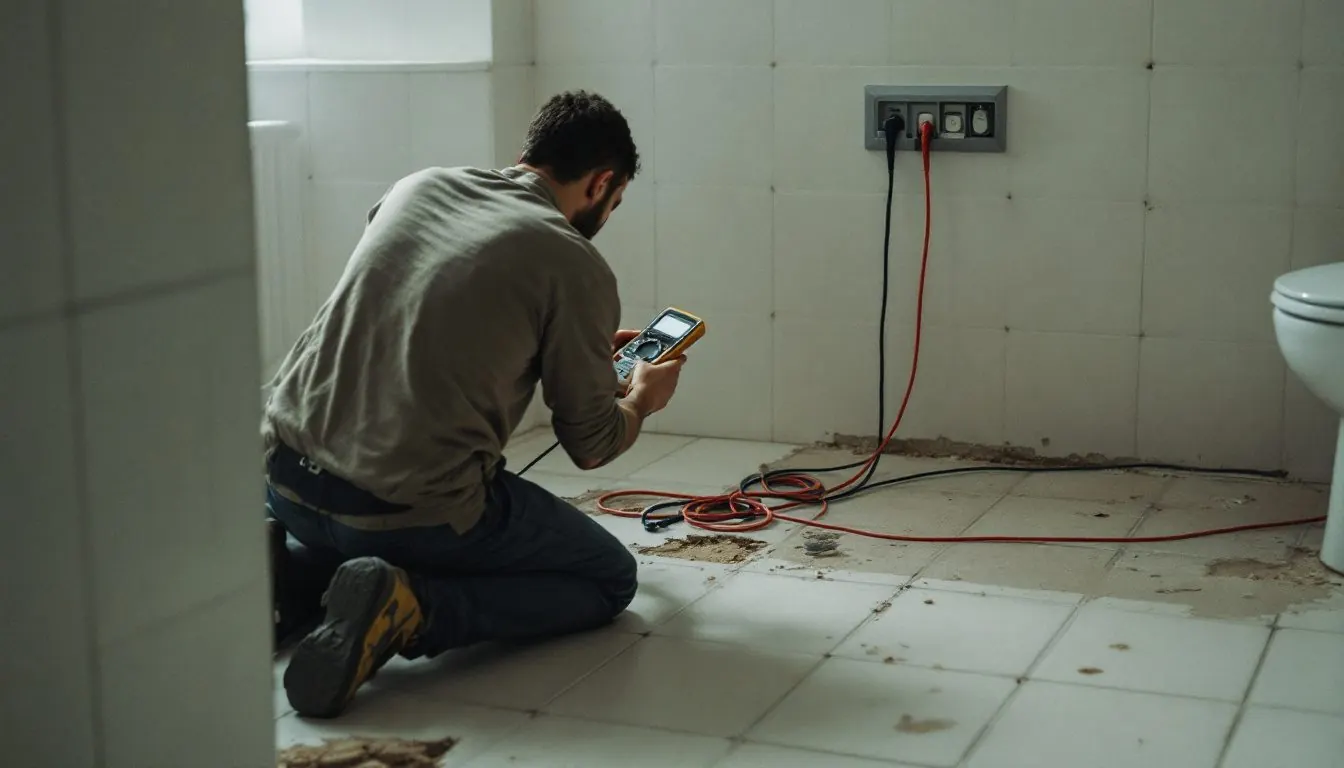
When electric floor heating is not working, read the thermostat first. A red light or GFCI message means its built-in 5 mA ground-fault protection tripped; a sensor error means the floor probe reads open or shorted; a normal screen over a cold floor points to the heating cable, which an ohmmeter checks against the label value.
What does the floor heat thermostat show: blank, red light, error code or normal?
The display sorts the fault into five branches before you touch a meter, the same split the SunTouch TapeMat manual from Watts Radiant uses in its troubleshooting table.
Red GFCI light: does one reset fix it, or does it trip on the next heat call?
One reset is normal; a second trip the moment heat is called means current is leaking from the cable to its ground braid, and the floor stays off until an electrician tests it. Nuheat, Schluter, WarmlyYours and SunTouch thermostats carry the ground-fault interrupter inside; Schluter’s handbook gives the rating: “A Class A (5 mA) ground fault circuit interrupter (GFCI) is required for each circuit.” The National Electrical Code requires it for cables in concrete or masonry floors of bathrooms and kitchens under Section 424.44(E), as restated by EC&M’s Code Q&A; the local inspector decides which edition applies.
Nuheat publishes the clearest sequence. Press reset once and set the thermostat to Heat. If the light will not clear, switch the breaker off for 10 seconds. If it trips “as soon as the heating indicators are displayed,” or the light shows a fast blink, which “indicates that there is a ground fault in the heating system,” call an electrician (Nuheat red light steps). Pressing the GFCI Test button also shows “GFCI Error”; Nuheat calls that normal.
Some trips are not the cable. A GFCI breaker feeding a GFCI thermostat can fight it: WarmlyYours wants “a non-GFCI circuit breaker” and Nuheat says to swap a GFCI breaker for a standard one. Watts Radiant adds that “an electric motor or a ballasted light source” on the circuit can false-trip it. A plug-in heater tripping a GFCI outlet is a different case, covered under space heater tripping the breaker. WarmlyYours says it twice: never bypass a tripped GFCI.
Electric underfloor heating thermostat not working at all: is 120 or 240 volts reaching it?
A dead screen is a supply problem until a meter proves otherwise: the SunTouch table’s first cause for “Control is not working at all” is “No power is supplied,” so check the breaker, then voltage at the control and every connection back to the panel. SunTouch 120 VAC mats have black and white leads, 240 VAC mats black and blue; a 240 V mat on 120 V makes a quarter of its heat, since resistance heat follows voltage squared. Line-voltage testing in the box is electrician work. After a power cut, Nuheat’s Solo flashes its clock if it “was without power for more than 2 hours,” so re-enter the schedule. Low-voltage furnace thermostats fail differently; see thermostat not working.
Sensor error, “HI” or E02: how many ohms should a 10k floor sensor read?
A floor sensor is a 10 kΩ NTC thermistor: it reads about 10,000 ohms at 77°F and more as it gets colder, so a reading of 12,000 to 13,000 ohms in a 65 to 68°F bathroom is healthy, not a fault. Open reads OL; shorted reads near zero. Nuheat’s troubleshooting page lists E02 for a floor sensor that “is damaged or not connected properly,” and the Signature’s Thermostat Info screen shows the sensor status as “Fail.” SunTouch shows “HI” or a floor temperature over 100°F when the sensor “is not wired properly, or is located incorrectly.”
| Floor temperature | Schluter DITRA-HEAT sensor | SunTouch floor sensor | Nuheat, WarmlyYours (range only) |
|---|---|---|---|
| 50°F (10°C) | 19.9 kΩ | Nuheat mat guide: 8 to 12 kΩ at room temperature | |
| 55°F (13°C) | 17,000 ohms | ||
| 59°F (15°C) | 15.7 kΩ | ||
| 65 to 68°F (18 to 20°C) | 12.5 kΩ at 68°F | 13,000 ohms at 65°F | |
| 75 to 77°F (24 to 25°C) | 10.0 kΩ at 77°F | 10,000 ohms at 75°F | |
| 85 to 86°F (29 to 30°C) | 8.1 kΩ at 86°F | 8,000 ohms at 85°F |
Compiled by The HVAC Brief from the Schluter DITRA-HEAT handbook (04/2023), SunTouch TapeMat Table 3, the Nuheat mat guide. Sensor disconnected, meter on 20 kΩ.
The “12k” figure in forum threads matches Schluter’s 12.5 kΩ at 68°F: a 10k sensor in a cool room, not a different part. Schluter adds two look-alikes: an extension made with anything but 22 AWG 2-wire cable “will result in a false reading or an error code,” and a rug over the probe raises its reading, shutting the floor off early. A dead probe is buried in thinset, which is why Schluter ships two and WarmlyYours offers a backup. Until one is wired in, Nuheat’s Signature can run on air temperature (Temp. control set to Air/Room Temp).
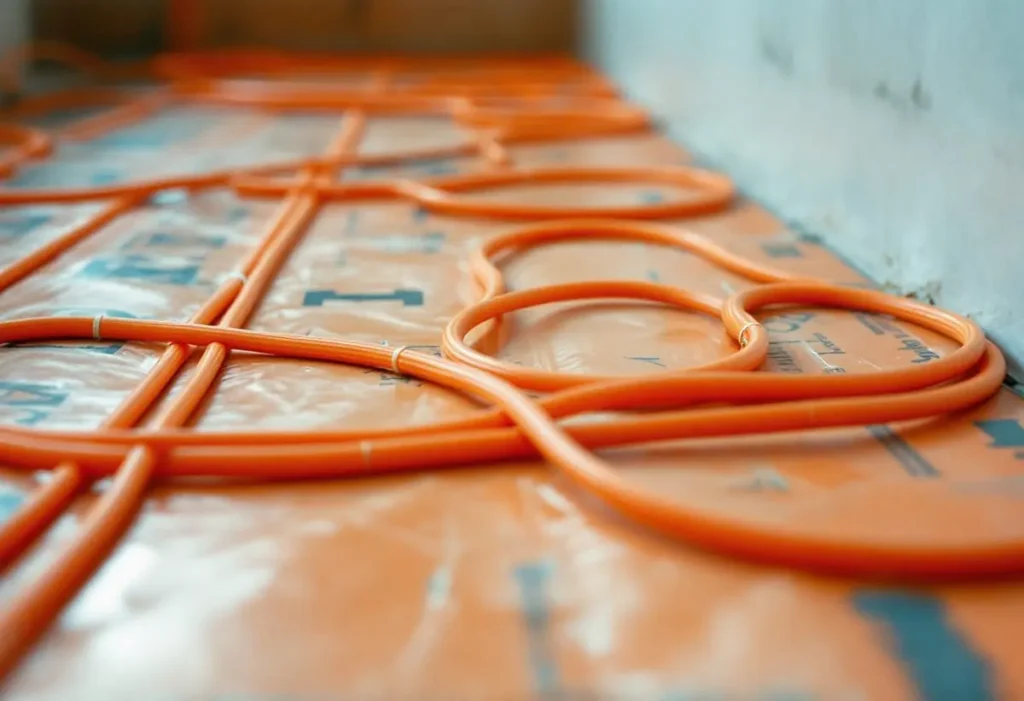
Electric underfloor heating not working but thermostat is: what do the cable ohms say?
If the thermostat outputs full voltage on a heat call (WarmlyYours’ first electrician check), the cable is next: breaker off, cold leads off the thermostat, and three readings against the label tied to the cold lead.
| Test (power off, leads disconnected) | Pass | Fail means | Maker |
|---|---|---|---|
| Conductor resistance, lead to lead, vs label | Within 10% of the factory value | OL: cable broken. Well below label: turns shorted together | Schluter DITRA-HEAT |
| Conductor resistance vs label | -5/+10% at 68°F (example label 105.3 ohms: 100.0 to 115.8 ohms) | Outside the band: cable damaged, or meter on the wrong scale | WarmlyYours TempZone cable, Nuheat mats |
| Each power lead to ground braid, multimeter | OL or infinity | Any reading: cable touches its shield; the GFCI will trip | Schluter, Nuheat, WarmlyYours |
| Insulation resistance, megohmmeter | 1 gigaohm or more at 1000 V | Pinhole insulation damage a multimeter cannot see | Schluter DITRA-HEAT |
| Insulation resistance, megohmmeter | 20 megohm minimum at 500 VDC | Same: leakage to ground | WarmlyYours custom-fit mats |
HVAC Brief calculation and compilation from the Schluter handbook Tests 1 to 4, WarmlyYours TempZone cable manual section 8 and Custom Fit manual, Nuheat mat guide section 1.5, and the 105.3 ohm example label in the WarmlyYours Ohm Reading Guide: 105.3 × 0.95 = 100.0; 105.3 × 1.10 = 115.8.
The megohmmeter row matters because a nicked cable can read perfectly lead to lead: Schluter says small insulation breaks “often remain undetected during the continuity test” yet leak enough for the GFCI to trip, the classic floor that trips weeks after tiling. Two meter errors cause false alarms: WarmlyYours warns some continuity checkers cannot drive current through cables over 200 Ω, and Watts says mats measured while wired together give “false resistance readings.”
A break under tile can often be repaired locally if it can be found. WarmlyYours locates faults with a time domain reflectometer, which “will not be able to find a break without an installation plan,” or a high-potential tester plus an infrared camera; Nuheat sells a Mat Repair Kit for a known break. That is why Schluter, Nuheat and WarmlyYours tie their warranties to a resistance log and Schluter asks for layout photos before tiling.
Why is only part of the floor warm when several mats share one thermostat?
Usually the mats are wired in series instead of parallel. SunTouch: “Multiple mats must be connected in parallel (or black-to-black, white-to-white).” Two equal mats in series each get half the voltage and a quarter of their heat. A sharp cold patch in a warm floor instead points to one of several mats failed open, which the per-mat resistance test shows. Schluter allows cables on one thermostat up to its 15 amp limit but recommends no more than two. A corner over uninsulated slab can stay cool on a working system; our guide to heating a basement covers slab losses.
Slow to warm or never warm enough: fault or design limit?
Often it is the design limit. SunTouch says listing requirements cap regular mats at 12 watts per square foot and cables at 15 watts per square foot; 12 W is 40.9 Btu/h per square foot (12 × 3.412), the “41 Btu/h/sqft” on the TapeMat spec. WarmlyYours says a floor may take “as little as 30 minutes or as long as 3 hours” to reach temperature, and SunTouch tells installers on an uninsulated slab to allow 5 to 8 hours before suspecting damage.
Schluter’s handbook documents four more limits. A 240 V cable on 208 V loses 25%, down to 9.5 W/ft² at 3-stud spacing. Concrete soaks heat: a DITRA-HEAT-DUO thermal break cut a 68 to 78°F lab warm-up by about 90 minutes. Under vinyl, laminate or wood the thermostat “must be set at 82°F (28°C) or lower at all times,” and adhered engineered wood surfaces reached 75 to 77°F where tile reached 82°F. New floors cure 7 days after grouting before use.
Some slow floors are settings: Nuheat’s Signature preheats when Early Start is on and ignores the floor sensor when control is set to Room. And a warm floor is not a room heater: Schluter calculates 5.5 W/ft² from an 82°F floor in a 72°F room. Our radiant floor heating comparison covers full-heat floors, and heating a room without central heat covers stopgaps while the floor is down.
Frequently asked questions
How do you reset a heated floor?
Press the reset or on/off button on the thermostat once, then set it to Heat. Nuheat’s procedure says that if the red light will not clear, switch the floor-heat breaker off for 10 seconds and back on. If the GFCI trips again as soon as heating starts, stop resetting and have the cable tested.
Electric underfloor heating stopped working right after new tile: is the cable damaged?
Possibly. Compare today’s lead-to-lead reading with the logged factory value: Schluter allows 10%, Nuheat and WarmlyYours cable allow minus 5% to plus 10%. Check the cure time too: Schluter says to wait 7 days after grouting before switching DITRA-HEAT on.
Can I bypass the GFCI on my floor heating thermostat?
No. WarmlyYours’ cable manual says “Do NOT bypass the GFCI under any circumstances,” and the NEC requires GFCI protection for heating cables in bathroom and kitchen floors under Section 424.44(E), as restated by EC&M. A trip that returns after one reset means current is leaking to ground through the floor.
What is the average lifespan of an electric underfloor heating system?
None of the maker manuals we read publishes a service-life figure. Warranties are the best published signal: Watts Radiant covers SunTouch mats and cables for 25 years from manufacture but its thermostats for 2 years, and Schluter’s DITRA-HEAT system warranty runs 15 years. The thermostat is the shorter-lived part on paper.
How we researched this
On November 20, 2026 we read the testing and troubleshooting sections of the Schluter DITRA-HEAT handbook (04/2023), two WarmlyYours manuals and its Ohm Reading Guide, the SunTouch TapeMat manual, and Nuheat’s mat guide and troubleshooting pages. The NEC rule comes from an EC&M restatement; we did not read NFPA 70 itself. Forum threads, videos and installer blogs were excluded as sources for numbers. Each threshold applies only to its maker’s products.
Sources
- Schluter Systems. “Schluter DITRA-HEAT Installation Handbook” (04/2023). https://www.lowes.com/pdf/DITRA_HEAT_Installation_Handbook.pdf. Accessed November 2026.
- WarmlyYours. “TempZone Floor Heating Cable Installation Instructions” (manual B). https://www.warmlyyours.com/en-CA/publications/TEMPZONE-FLOOR-HEATING-CABLE-MANUAL-B.pdf. Accessed November 2026.
- WarmlyYours. “TZ Custom Fit Manual A.” https://www.warmlyyours.com/en-CA/publications/TZ-CUSTOM-FIT-MANUAL-A.pdf. Accessed November 2026.
- WarmlyYours. “TempZone Ohm Reading Guide” (30032 A). https://www.warmlyyours.com/en-US/publications/OHM-READING-30032-A.pdf. Accessed November 2026.
- Watts Radiant. “SunTouch TapeMat Series D12 Installation Manual” (via SupplyHouse). https://s3.amazonaws.com/s3.supplyhouse.com/product_files/Suntouch%20%2D%2081008786%20%2D%20Install%20Instructions.pdf. Accessed November 2026.
- Nuheat (nVent / Chemelex). “Troubleshooting.” https://www.nuheat.com/customer-care/troubleshooting. Accessed November 2026.
- Nuheat. “Home: The Red Light Is On/Blinking, Troubleshooting Steps.” https://www.nuheat.com/docs/default-source/default-document-library/home_redlightblinking_troubleshootingsteps. Accessed November 2026.
- Nuheat. “Nuheat Mat Installation Guide” (IM H59307). https://www.nuheat.com/docs/default-source/nvent-documents/mats/nuheat-im-h59307-matinstallationguide-en-1805-web. Accessed November 2026.
- EC&M (Mike Holt). “Code Q&A: Protection of Electric Heating Cables.” https://www.ecmweb.com/national-electrical-code/qa/article/21213948/code-qa-protection-of-electric-heating-cables. Accessed November 2026.
Leave a Reply