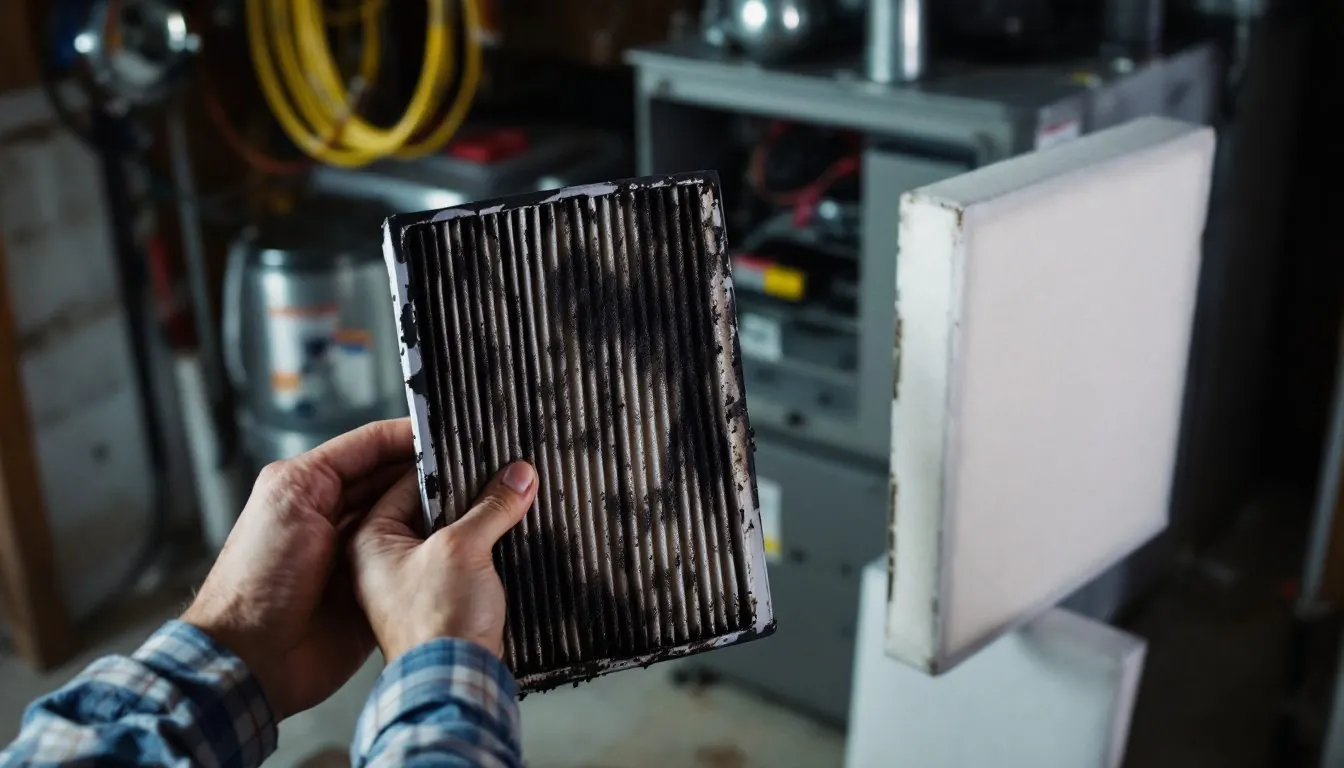
A furnace filter turned black has either trapped soot (candles, gas logs, fireplaces, traffic) or stayed in long enough for dust to go near-black. Speed separates them. Shut the furnace off and call a technician if you also see soot on its cabinet, yellow flames or a sounding CO alarm.
Why is my furnace filter black? Match the look, the speed and the clue beside it
Color alone will not settle it. The 1998 Home Energy ghosting investigation by Frank Vigil says “Soot is generally black” but that dust, left long enough, can be near-black in color. Read three things together: the surface, the weeks in service, and one clue elsewhere in the house.
| Cause | Filter looks like | How fast | Clue | Document |
|---|---|---|---|---|
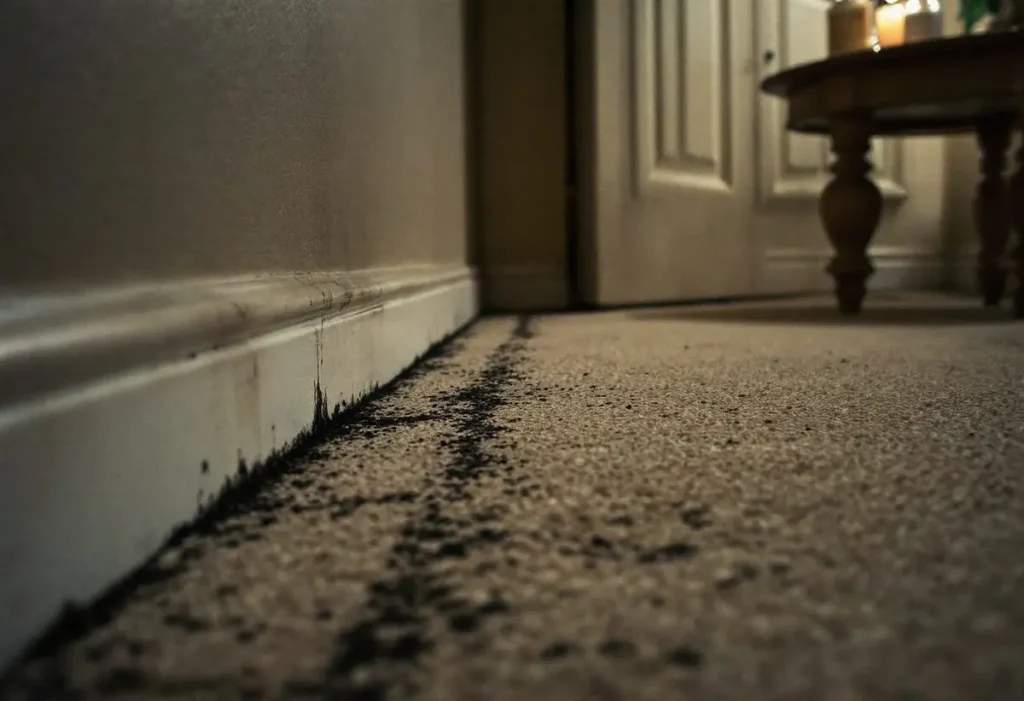
| Candle soot | Even matte black powder, smears | 2 to 6 weeks of regular burning | Black lines at carpet edges; film on plastics, TV screens | EPA 2001; Krause 1999 |
| Gas logs, pilots, fireplace, wood stove | Same powder | Weeks into burning season | Long or yellow pilot; pilot touching the log | Vigil 1998 |
| Furnace sooting (stop) | Black powder, no new habit to explain it | Sudden | Sooting at the furnace, falling soot, yellow flames, moisture inside windows | CPSC; Goodman |
| Traffic, garage air, neighbor’s chimney | Even dark gray to black | Every filter | Busy road; return duct leaking to the garage | Vigil 1998 |
| Smoke | Gray to black, smells of smoke | Days to weeks | Timing matches the smoke | Vigil 1998; wildfire is our inference |
| Mold or mildew | Patchy, not always black | After a wet event | Damp filter, leak nearby | EPA; Vigil 1998 |
| Ordinary dust, left in | Thick gray felt going near-black | 3 months or more | Nothing else marked | Vigil 1998; Goodman |
| New construction dust | Gray, not black | During the work | Recent remodel; if truly black, keep looking | Vigil 1998 |
Compiled by The HVAC Brief from the documents in the last column. The looks and speed columns are our field inference, not measured cut-offs.
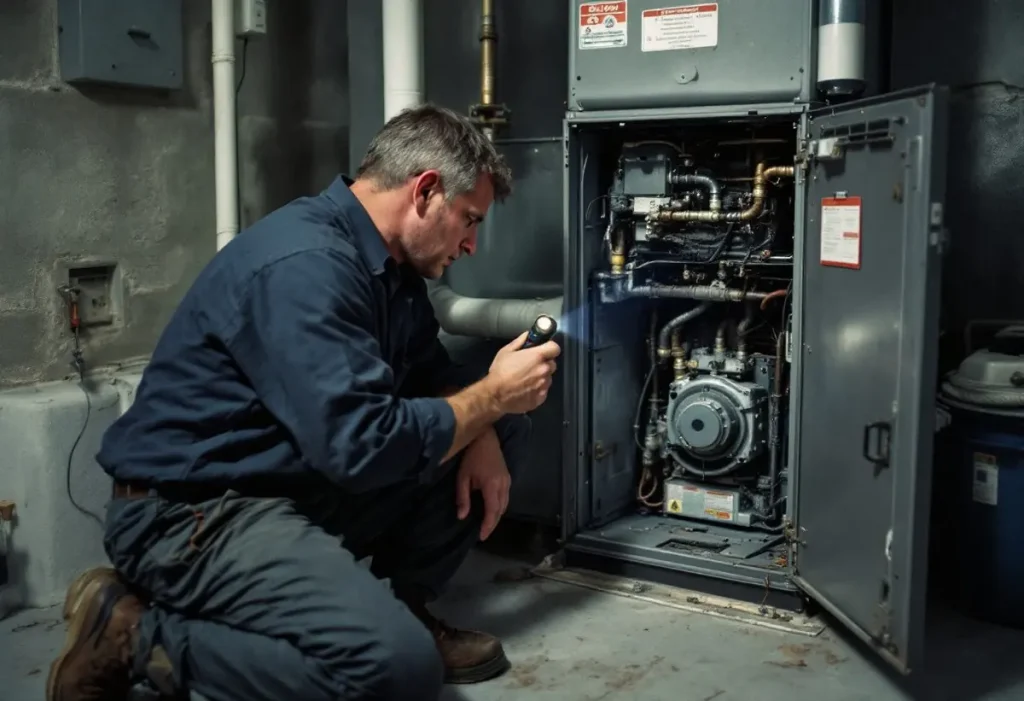
When does a black filter mean shut the furnace off and test for CO?
When the filter is not the only clue. The CPSC list of carbon monoxide clues includes “Sooting” and “Debris or soot falling from chimney, fireplace, or appliances.” On burner flames, Goodman’s service instructions say “They should not be yellow.” Our guide to what flame color can prove explains why a blue flame still does not clear a furnace.
Turn the furnace off and book a technician. If a CO alarm is sounding, go outside first and call from there; the steps are on our CO alarm placement and response page. In a CPSC staff review of 28 in-depth investigations of modern gas furnaces from 1987 to 2001, a sooted heat exchanger was listed 5 times, a sooted burner 2 times, and 13 deaths were associated with the set. CPSC says the file is not a statistical sample.
Ask for readings. Compare ambient CO with EPA’s 0.5 to 5 ppm average for homes without gas stoves; in 13 of the 19 CPSC cases with a recorded level, the peak exceeded 100 ppm. Flue CO comes from a combustion analyzer. CPSC staff once proposed a shutdown above 400 ppm, a proposal and not a service limit. Add a spillage check: EPA names back-drafting as a CO source.
Why can a furnace filter go black after 2 weeks or one month?
Because very little soot darkens a filter. At the 7.5 m²/g that Bond and Bergstrom recommend for fresh light-absorbing carbon, a 16×25 inch filter face (0.258 m²) absorbs 63% of incoming light at about 34 mg of elemental carbon. Krause’s 1999 thesis found a median 32% elemental carbon in candle soot, so that is about 108 mg of soot. In Krause’s 91 candle test, 63% of the 80 scented candles produced detectable soot, at 20 to 3,100 µg per minute per wick, clustered at 180 and 1,650.
| Soot rate (µg/min/wick) | Emitted in 30 days | Light absorbed: 14 days, 5% reaches filter | 30 days, 5% | 30 days, 20% |
|---|---|---|---|---|
| 20 (lowest sooting candle) | 108 mg | 2% | 5% | 18% |
| 83 (non-scented mean) | 448 mg | 9% | 19% | 57% |
| 180 (scented, lower cluster) | 972 mg | 19% | 36% | 84% |
| 1,650 (scented, upper cluster) | 8,910 mg | 86% | 98% | about 100% |
HVAC Brief calculation: one wick, 3 hours a day, elemental carbon at 32% of soot. Absorbed = 1 minus e^(minus 7.5 x carbon in g / 0.258 m²). A three-wick jar triples the rate.
Black after 2 weeks takes a high-output candle or several wicks; black after one month fits a 180 µg candle if a fifth of its soot lands on the filter. We found no study measuring that share, so 5% and 20% are placeholders, and these are lab burn rates. The math shows the masses are plausible; it does not predict your filter. Candles burned under a clay pot are one winter source of that soot, and terracotta pot heaters explains why a pot set low over the flames crowds them the way a glass jar does.
The filter does not catch all of it. A 2001 report prepared for EPA (archived copy) says soot can circulate through home air-conditioning filters and deposit on carpets and charged surfaces such as TVs, the ghosting pattern.
Is black after 3 months normal, or was the filter in too long?
If nothing else in the house is marked, it was probably in too long. Goodman’s service instructions call for disposable filters to be replaced “every two months or as required,” so a 3 month filter is a month past that maker’s interval. Our filter size and replacement guide covers intervals, and if the whole house is gray, start with what house dust is made of.
Why did my filter start turning black after I upgraded to MERV 13?
It may simply be catching more. EPA’s MERV table shows MERV 13 at 50% or better for 0.30 to 1.0 µm particles, while MERV 8 has no listed efficiency below 1.0 µm. Krause measured candle soot at 0.045 to 0.2 µm and Vigil gives soot as 0.03 to 3 microns, so much of it is smaller than anything MERV 8 is rated on. The new filter loads faster, so check the airflow limits of a higher MERV. Walls darkening while the filter stays clean is a different problem: why a furnace filter never gets dirty.
Can a cracked heat exchanger turn the filter black?
Not directly, and none of the federal or maker documents we read names a black filter as a crack symptom. Goodman says the installer “must supply a means of filtering all of the return air,” which places the filter before the blower and exchanger. A crack leak enters the air after the filter and reaches the rooms first. That same position is why the arrow on the frame should face the blower, as putting a furnace filter in backwards explains.
Back-drafting can reach the filter: spilled flue gas enters room air and the return pulls it in. Vigil’s checklist pairs “signs of soot or cracked heat exchangers” with “Don’t forget to examine the return air filter,” so treat the filter as a reason to inspect. Our cracked heat exchanger page covers how technicians confirm one.
Is the black on my filter mold or soot?
You cannot settle it by eye. EPA’s air duct guidance says a positive determination “can be made only by an expert and may require laboratory analysis.” Even loading suggests soot; blotches, a damp filter or a nearby leak point to moisture. The filter goes in the trash either way, so the real question is the water source. For growth beyond the filter, confirm mold in the ducts before paying for removal.
My furnace filter keeps turning black: how do I find the source?
Remove sources one at a time and watch a test surface. Home Energy’s version uses pieces of white acrylic plastic around the house, with all sources but one eliminated, examined after several days.
- Install a new filter, date the frame, and photograph it at 2 weeks.
- Stop candles and incense first. Vigil: the longer the wick, the more soot.
- Check gas log and appliance pilots. Excessively long or yellow pilots are possible soot sources; adjustment is technician work.
- Check the return. Vigil describes a leaky return in a garage acting like a vacuum for auto exhaust.
- Rule out the outdoors: high traffic, industry, construction, a neighbor’s fireplace.
Frequently asked questions
Why is my furnace filter so black?
It has trapped particles that absorb light very well, and soot is the strongest of them. On Bond and Bergstrom’s 7.5 m²/g figure, our calculation puts about 108 mg of candle soot at 63% of the light absorbed on a 16×25 inch filter face. Dust needs far more time.
Is a black furnace filter dangerous?
The filter is not the hazard; what it may point to can be. CPSC lists sooting and falling soot as visible carbon monoxide clues, so pair the filter with a look at the furnace and a working alarm. The 2001 report for EPA found no research on health effects of residential candle soot.
My furnace filter comes out black: do I need duct cleaning?
Not on the filter alone. EPA does not recommend routine duct cleaning, only as needed, such as substantial visible mold, vermin or ducts clogged so particles come out of supply registers. EPA does recommend fuel-burning furnaces be serviced before each heating season. Our air duct cleaning page covers when it pays.
How do I stop candles from turning my furnace filter black?
The 2001 report for EPA says sooting can be reduced by keeping wicks short, drafts to a minimum and burning unscented candles. It also says glass containers raise soot output and cutting the wick eliminates smoldering emissions. Krause found detectable soot from 45% of 11 non-scented candles against 63% of 80 scented.
How we researched this
In November 2026 we read the EPA report, the published extract of Krause’s thesis, Vigil 1998, Bond and Bergstrom 2006, two CPSC documents, Goodman’s service instructions, and EPA’s CO, duct and MERV pages. We took no numbers from ranking pages, which cite at most agency home pages. We found no CPSC candle soot document and no primary source tying dryer lint to black filters, so that cause is out.
Sources
- Eastern Research Group for U.S. EPA. “Candles and Incense as Potential Sources of Indoor Air Pollution,” EPA-600/R-01-001 (archived copy). https://web.archive.org/web/20191013204549id_/https://nepis.epa.gov/Adobe/PDF/P1009BZL.pdf. Accessed November 2026.
- Krause, J. David. “Characterization of Scented Candle Emissions and Associated Public Health Risks,” 1999 thesis (extract, The LEAD Group). https://mail.lead.org.au/lanv7n4/US_Scented_Candles_Study.pdf. Accessed November 2026.
- Vigil, Frank. “Black Stains in Houses: Soot, Dust, or Ghosts?” Home Energy, 1998. https://www.aivc.org/sites/default/files/airbase_11251.pdf. Accessed November 2026.
- Bond and Bergstrom. “Light Absorption by Carbonaceous Particles.” Aerosol Science and Technology, 2006. https://www.cfa.harvard.edu/hitran/HITRAN2012/Aerosols/papers/bond_aerscitech_2006.pdf. Accessed November 2026.
- CPSC. “Sources of and Clues to a Possible Carbon Monoxide (CO) Problem.” https://www.cpsc.gov/s3fs-public/pdfs/resident.pdf. Accessed November 2026.
- CPSC staff. “In-Depth Investigations of Carbon Monoxide (CO) Incidents Associated with ‘Modern’ Gas Fired Furnaces,” 2002. https://www.cpsc.gov/s3fs-public/pdfs/cofurnace.pdf. Accessed November 2026.
- Goodman. “Service Instructions: 80%, 90%, 95% Gas Furnaces” (distributor copy). https://s3.amazonaws.com/s3.supplyhouse.com/product_files/Goodman-GMS951155DXA-Install-Instructions.pdf. Accessed November 2026.
- U.S. EPA. “Carbon Monoxide’s Impact on Indoor Air Quality.” https://www.epa.gov/indoor-air-quality-iaq/carbon-monoxides-impact-indoor-air-quality. Accessed November 2026.
- U.S. EPA. “Should You Have the Air Ducts in Your Home Cleaned?” https://www.epa.gov/indoor-air-quality-iaq/should-you-have-air-ducts-your-home-cleaned. Accessed November 2026.
- U.S. EPA. “What is a MERV rating?” https://www.epa.gov/indoor-air-quality-iaq/what-merv-rating. Accessed November 2026.
Leave a Reply