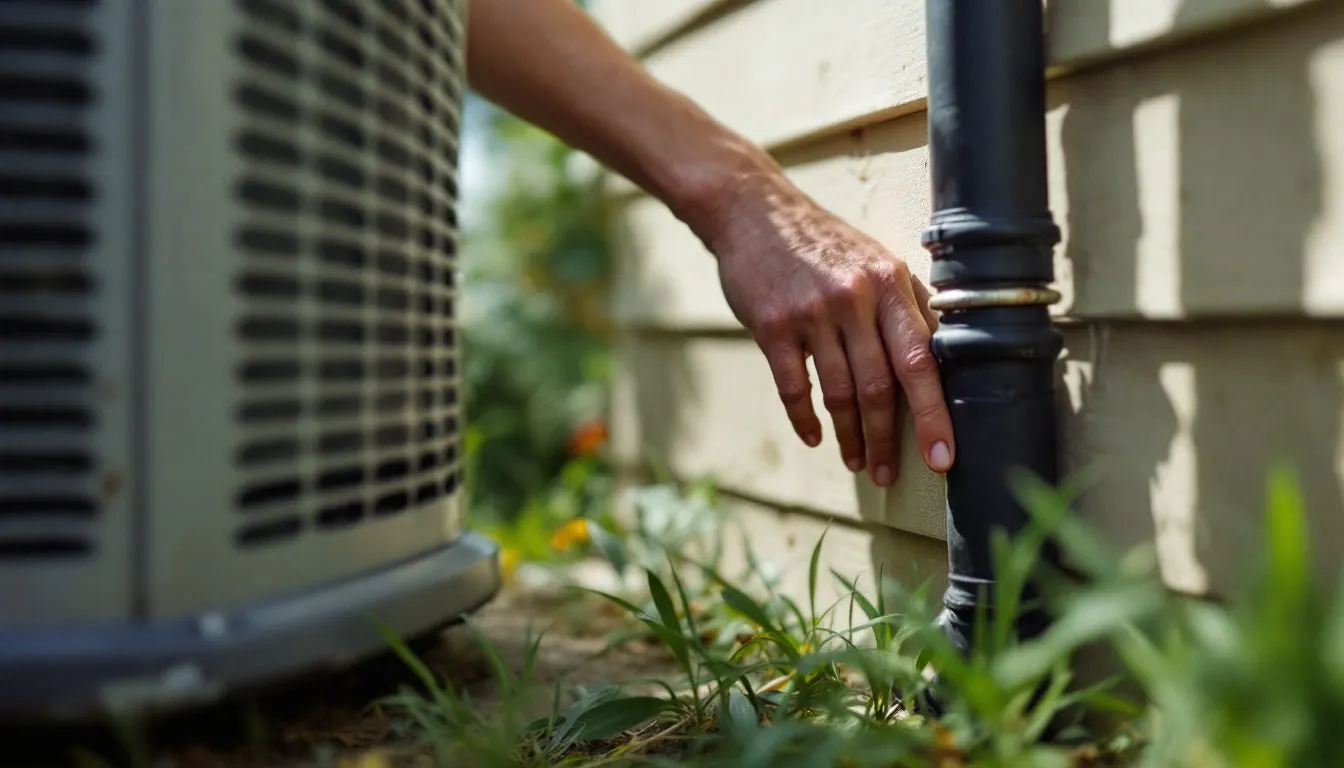
Why is my freon line hot? If it is the small bare line and the AC is cooling, warm is normal: Goodman’s own data put it about 4 to 9°F above the outdoor air. The large insulated line should be cool, near 53 to 65°F. On a heat pump in heating mode, a hot large line is normal too.
The table sorts each pipe and mode. Numbers come from a matched Goodman GSX14 system with a TXV, converted with the Bonneville Power Administration R-410A pressure-temperature chart.
| Mode | Line you touched | Normal | Abnormal | Causes Goodman lists | First check |
|---|---|---|---|---|---|
| Cooling | Small bare (liquid) | Warm, about 4 to 9°F above outdoor air | Hot, 20°F or more above outdoor air | Dirty outdoor coil, recirculation of condensing air, overcharge, noncondensibles | Is the outdoor fan spinning? Is the coil matted? |
| Cooling | Large insulated (suction) | Cool, about 53 to 65°F, may sweat | Warm, close to outdoor air | Shortage of refrigerant, restricted liquid line, restricted expansion device, inefficient compressor | Technician: superheat and subcooling |
| Cooling | Large insulated (suction) | Cool, not white | Frost or ice on the copper | Dirty air filter, dirty indoor coil, not enough air across the indoor coil, shortage of refrigerant | Filter and blower first |
| Cooling | Both lines | One warm, one cool | Both near outdoor temperature while the fan runs | Compressor not running: capacitor, overload, contactor | Stop: line voltage work |
| Heat pump heating | Large line | Hot, above the supply air (about 97°F supply at 47°F outdoors) | Cool for more than a defrost cycle | Faulty reversing valve, faulty defrost control | Wait out one defrost, then call |
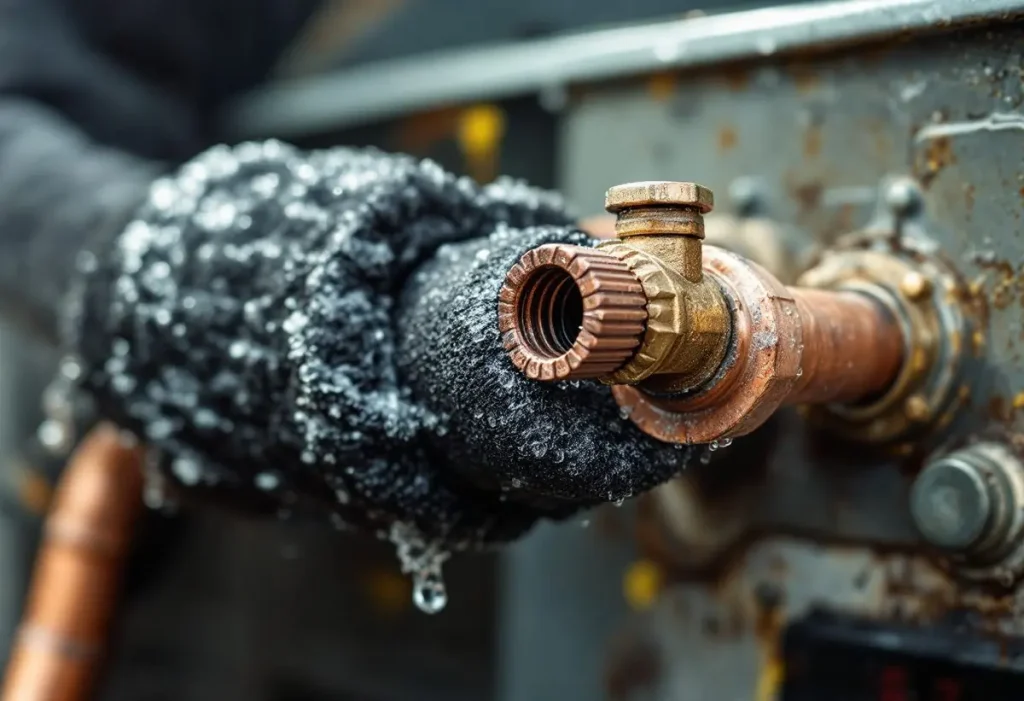
Which freon line is the hot one: the small bare pipe or the big insulated pipe?
In cooling, the small bare pipe is the warm one and the big insulated pipe is the cool one. The small liquid line carries warm, high-pressure liquid to the indoor coil; the larger suction line returns cool vapor to the compressor. The refrigerant line set page covers sizes and routing.
Goodman’s installation manual IOG-4002A says “always insulate the suction line” and recommends Armflex with a 3/8 inch minimum wall, or 1/2 inch in hot, humid areas, because insulation is “necessary to prevent condensation from forming and dropping from the suction line.” So a sweating large line in July is a pipe doing its job; a dripping one is an insulation problem.
How hot should the AC liquid line be at 65°F, 95°F and 115°F outside?
A healthy liquid line runs about 9°F above the outdoor air at 65°F, shrinking to about 4°F above at 115°F. We calculated this from Goodman’s expanded cooling table for the GSX140191 with a TXV, which lists liquid pressure (“HI PR”, read at the service valve) at each outdoor temperature.
Each pressure converts to a saturated condensing temperature on the BPA chart. Goodman’s IOG-4002A sets a TXV target of “8°F +/- 1°F” subcooling and the same superheat, so the expected liquid line is the condensing temperature minus 8°F and the expected suction line is the saturated suction temperature plus 8°F.
| Outdoor air | Liquid pressure | Condensing temp | Expected liquid line | Above outdoor air | Suction pressure | Expected suction line |
|---|---|---|---|---|---|---|
| 65°F | 244 psig | 82.2°F | 74.2°F | +9.2°F | 131 psig | 53.1°F |
| 75°F | 282 psig | 91.9°F | 83.9°F | +8.9°F | 139 psig | 56.3°F |
| 85°F | 321 psig | 100.9°F | 92.9°F | +7.9°F | 145 psig | 58.7°F |
| 95°F | 364 psig | 110.0°F | 102.0°F | +7.0°F | 151 psig | 60.9°F |
| 105°F | 409 psig | 118.7°F | 110.7°F | +5.7°F | 156 psig | 62.8°F |
| 115°F | 458 psig | 127.3°F | 119.3°F | +4.3°F | 163 psig | 65.3°F |
On a 95°F afternoon the small line should sit near 102°F, hot to a hand but normal, and the large line near 61°F. A piston system or another brand will read differently, so the unit’s own charging chart is the reference, and the R-410A pressure chart explains the conversion.
Why is my small freon line 20°F or more hotter than the outdoor air?
A liquid line that far above ambient points to high head pressure, meaning the outdoor coil is not shedding heat. In the Goodman table the saturated condensing temperature never ran more than 17.2°F above the outdoor air, so a liquid line 20°F above ambient is hotter than the refrigerant should even condense on that system.
Goodman’s troubleshooting chart in IOG-4002A lists the causes and remedies: “Dirty Outdoor Coil” (inspect coil, clean), “Recirculation of Condensing Air” (remove obstruction to air flow), “Overcharge of Refrigerant” (recover part of charge) and “Noncondensibles” (recover charge, evacuate, recharge). A stopped outdoor fan does the same thing faster; the condenser fan motor page covers that test.
Owner checks: confirm the top fan spins whenever the compressor runs, clear plants back from the coil, and with power off at the disconnect, look for lint matted on the fins; the coil cleaning guide covers rinsing. Overcharge and noncondensibles need gauges and a recovery machine.
Why is the big insulated line warm while the AC is cooling?
A warm suction line in cooling usually means too little refrigerant is boiling in the indoor coil, so the vapor returns to the compressor heavily superheated. Goodman’s chart lists “Shortage of Refrigerant” (test for leaks, add refrigerant), “Restricted Liquid Line”, “Expansion Device Restricted” and “Inefficient Compressor” among the causes a technician sorts through.
The technician separates them with two numbers. In Goodman’s IOG-4002A, superheat equals suction line temperature minus saturated suction temperature, and subcooling equals saturated liquid temperature minus liquid line temperature. Rheem’s troubleshooting table, summarized in our superheat and subcooling worked examples, pairs high superheat and low subcooling with an undercharge; high readings of both point to refrigerant held back by a restriction.
If both lines sit near the outdoor temperature while the outdoor fan runs, the compressor is probably not running at all. Goodman’s chart lists capacitor, compressor overload and contactor faults among no-cooling causes; all are line voltage parts, so this is the stop line for owners.
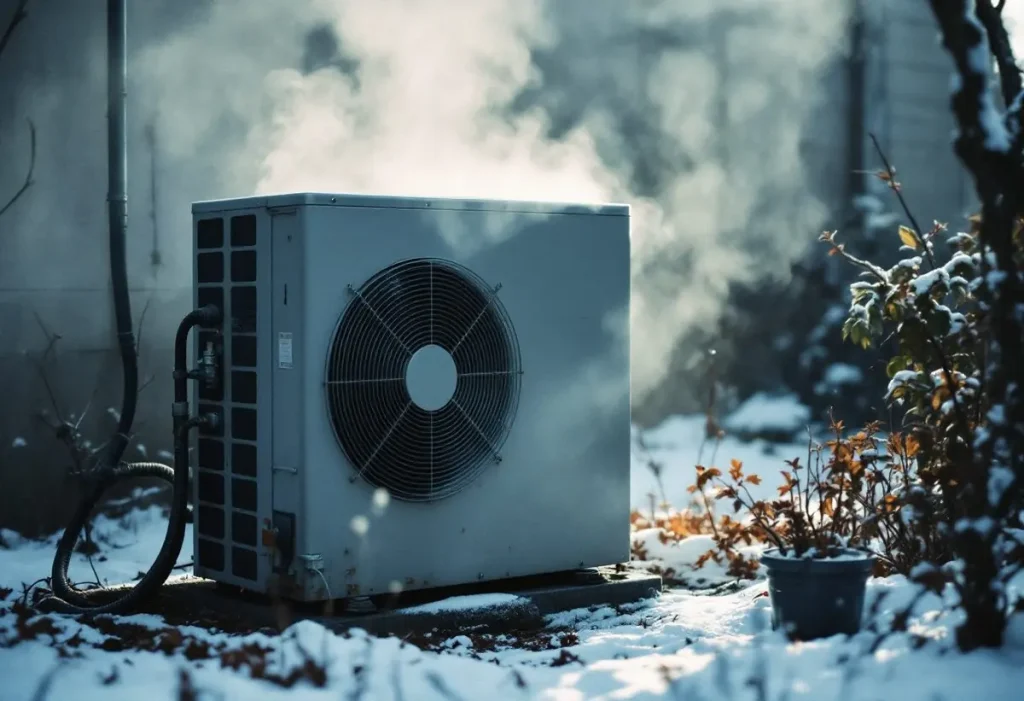
Is a hot freon line normal on a heat pump in heating mode?
Yes. In heating, the large line is the hottest pipe because it carries compressor discharge gas to the indoor coil. The DOE EnergySaver guide (archived copy) says “a reversing valve changes the direction of refrigerant flow for cooling and for the winter defrost cycle.”
That pipe must be hotter than the air it heats. Goodman’s GSZ14 heating table, based on “70°F indoor dry bulb,” lists a temperature rise of 27.32°F for the GSZ140181 at 47°F outdoors, about 97°F supply air. At 17°F outdoors the rise drops to 15.18°F, about 85°F supply air, so in a cold snap the large line can feel merely warm without any fault.
A large line that turns cool for a few minutes is usually defrost, when the system briefly runs in cooling; Goodman’s control offers “defrost intervals of 30, 60, or 90 minutes”. The heat pump defrost cycle page explains timing; a large line that stays cool in heating points at the reversing valve, which Goodman’s chart lists with “Replace Valve or Solenoid.”
Should the freon line be cold, sweating or frozen?
Cold and sweating, yes; frozen, no. R-410A boils at 32°F at about 101.6 psig on the BPA chart, while Goodman’s table shows 131 to 163 psig suction, a 45°F to 57°F evaporator. Frost means the coil fell below freezing.
The usual cause is air, not charge: Goodman lists “Dirty Air Filter”, “Dirty Indoor Coil” and “Not enough air across Indoor Coil” alongside refrigerant shortage. Switch the system to fan only to thaw it. The AC freezing up at night and ice on the outside unit pages trace the airflow and low-ambient causes.
What should a technician measure before adding refrigerant?
Pressures and pipe temperatures after a stable run. Goodman’s procedure: run the system “for 10 minutes to allow pressures to stabilize,” then clamp insulated thermometers on the liquid line at the service valve and on the suction line 4 to 6 inches from the compressor.
Charge is set to the maker’s target: superheat for a piston, subcooling for a TXV. Goodman warns that running a scroll compressor below 20 psig suction for more than 5 seconds damages it. Releasing refrigerant is illegal: 40 CFR 82.154 bars anyone servicing an appliance from knowingly venting it. Where a line feels hot because charge is leaking, the freon leak in the house page covers indoor risk.
Frequently asked questions
Should freon line be hot or cold?
Both, depending on the line. In cooling, the small liquid line should be warm, about 102°F on a 95°F day in our calculation from Goodman GSX14 data, and the large suction line cool, about 61°F. In heat pump heating mode the large line becomes the hot one, carrying compressor discharge gas to the indoor coil.
Why is my freon line making noise?
Most line noise is vibration carried into the house. Goodman’s IOG-4002A says lines must not touch plumbing, ductwork, joists or studs, gaps at walls should be filled with silicone caulk, RTV or vibration damping material, and hangers should be insulated or suspension type. A hiss at a joint can be a leak.
Should freon line in fridge be frozen?
Refrigerators differ from central AC and each model’s service manual sets its normal frost pattern, so this page does not rate fridge frost. One caution: 40 CFR 82.154 lists isobutane (R-600a) among refrigerants used in household refrigerators and freezers, and isobutane is flammable, so never pierce or heat a fridge tube to test it.
Why are both freon lines hot on my heat pump?
In heating mode the large line is hot by design and the small line returning liquid outdoors is warm, so both feeling warm is normal. Goodman’s GSZ14 data show about 27°F of supply air temperature rise at 47°F outdoors. If both lines are hot in cooling mode, the reversing valve may be stuck in heating, a fault Goodman’s chart lists under “Faulty Reversing Valve.”
How we researched this
Researched on 9 November 2026. We read Goodman SS-GSX14 (expanded cooling data), Goodman SS-GSZ14 (expanded heating data), Goodman IOG-4002A (charging procedure and troubleshooting chart), the BPA R-410A chart, an archived DOE EnergySaver page and 40 CFR 82.154. Temperatures were interpolated between adjacent 2 psig chart rows. We excluded the top-ranking pages for this query as sources: none cites a maker document, and two misstate the refrigeration cycle. Numbers apply to one matched Goodman system.
Sources
- Goodman Manufacturing. “SS-GSX14 Split System Air Conditioner Specification Sheet (Expanded Cooling Data).” https://cdn.shopify.com/s/files/1/0253/0852/8730/files/Goodman_GSX14_Spec_Sheet.pdf. Accessed November 2026.
- Goodman Manufacturing. “Installation and Service Reference IOG-4002A.” https://cdn.shopify.com/s/files/1/0253/0852/8730/files/Goodman_GSZ16_Installation_Manual__1.pdf. Accessed November 2026.
- Goodman Manufacturing. “SS-GSZ14 Split System Heat Pump Specification Sheet (Expanded Heating Data).” https://apps.goodmanmfg.com/brochures/files/5f3d53a6dc964SS-GSZ14.pdf. Accessed November 2026.
- Bonneville Power Administration. “R-410A Pressure-Temperature Chart.” https://www.bpa.gov/-/media/Aep/energy-efficiency/residential/residential-ptcs-essentials/r-410a-pressure-temperature-chart.pdf. Accessed November 2026.
- U.S. Department of Energy. “Air-Source Heat Pumps” (EnergySaver, archived copy). https://web.archive.org/web/2025id_/https://www.energy.gov/energysaver/air-source-heat-pumps. Accessed November 2026.
- U.S. Government Publishing Office, eCFR. “40 CFR 82.154 Prohibitions.” https://www.ecfr.gov/current/title-40/chapter-I/subchapter-C/part-82/subpart-F/section-82.154. Accessed November 2026.
Leave a Reply