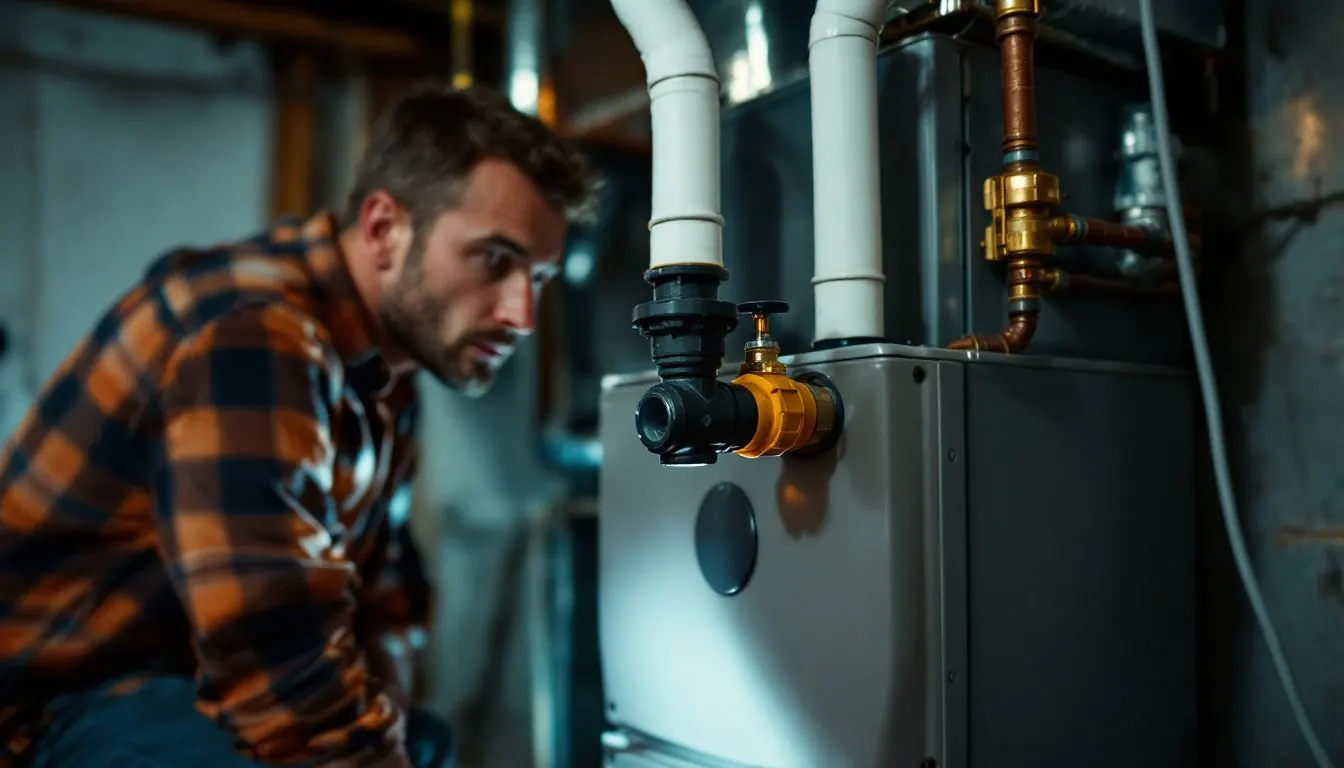
To tell if your HVAC is gas or electric, check the indoor unit. Gas means a 1/2 inch gas line with a shutoff valve, a flue pipe, and a rating plate listing input in Btu/h and a gas type. Electric means no gas line or vent, a 208/230 volt circuit, and a heater rated in kW.
No single check is enough: a heat pump and an electric furnace both lack a gas line, and a gas furnace still has a 115 volt power cord. Run all six.
| Check | Natural gas or propane furnace | Oil furnace or boiler | Electric furnace or air handler with heat kit | Heat pump |
|---|---|---|---|---|
| 1. Pipe into the cabinet | Gas line with shutoff valve (1/2″ FPT on Goodman) | Oil line from a tank to a gun burner | No fuel line; heavy power cable only | Two copper refrigerant lines to an outdoor unit |
| 2. Vent or flue | Two PVC pipes, or metal B1 vent or lined chimney | Flue pipe to chimney | None | None |
| 3. Rating plate | Input in Btu/h; natural gas or propane | Oil firing rate and nozzle | Volts 208/230, heater kW, MCA and MOP | Indoor heater kW if strips fitted |
| 4. Model number | Goodman GM.., Carrier 59.. | Varies by maker | Goodman MBVC + HKR kit; Carrier FV4C + KFCEH kit | Varies by maker |
| 5. Outdoor unit on a cold morning | Idle (unless dual fuel) | Idle | Idle | Running in heat mode |
| 6. Utility bill | Gas usage line in therms or ccf (propane: tank deliveries) | Oil deliveries in gallons | kWh only, high in winter | kWh only |
Which pipe runs into the furnace cabinet: a gas line, an oil line or only wires?
A gas line means gas. Goodman’s spec sheet for the GM9S96 furnace lists the “Gas Service Connection 1/2″ FPT”, so look for a 1/2 inch threaded pipe with a manual shutoff valve entering the side of the cabinet near the burner compartment [1]. The same line serves propane: Carrier ships its 59SC5A furnace for natural gas and says a CSA listed conversion kit is required for propane, so the fuel is set by a kit, not by a different pipe [3].
An oil burner looks different. Beckett’s AF/AFG manual covers a burner “fuel unit”, a nozzle and the oil tank supply system, and tells owners to check the tank level weekly [6]. A burner with a motor bolted to the front of the furnace or boiler is oil; our oil heating system guide covers tanks and burners.
No fuel line at all leaves three electric answers: an electric furnace, an air handler with a heat kit, or a heat pump. Goodman’s MBVC air handler runs on 208/230 volt power and accepts field-installed electric heater kits from 3 kW to 25 kW [2]. Our electric furnace explainer covers how those elements stage and what circuit they take.
Do two white PVC pipes or a metal flue mean the furnace burns gas?
Yes. Either vent means combustion, and an electric unit has no vent. Condensing gas furnaces vent through plastic: Goodman calls for “one or two PVC pipes”, the flue outlet pipe required and the combustion air pipe optional, 2 or 3 inches in diameter [1]. Carrier describes the 59SC5A as a condensing furnace vented “for direct vent/two-pipe” or with ventilated combustion air [3].
Non-condensing gas furnaces vent through metal. Lennox’s SL280UHV manual classifies that model as a “fan-assisted Category I” furnace and vents it into type B1 double-wall vent or a tile-lined or metal-lined masonry chimney; unlined masonry chimneys are prohibited [5]. Oil appliances also have a metal flue, so pair this check with check 1. The furnace vent pipe rules page covers slope, clearances and B vent sizing.
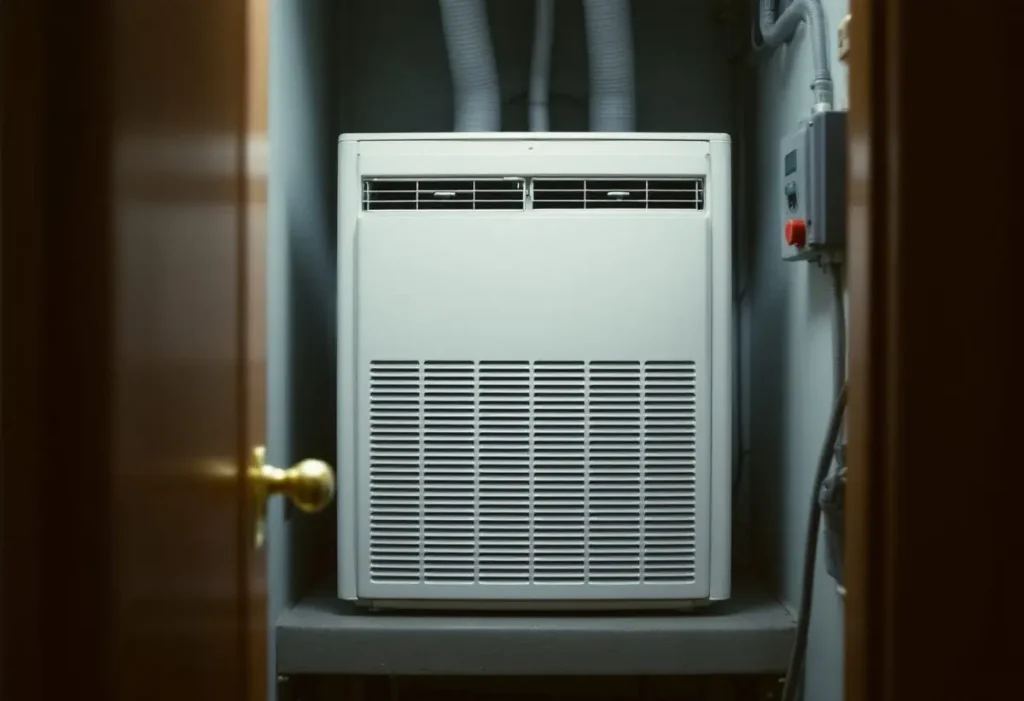
What does the rating plate say: Btu/h input and gas type, or kW and amps?
The rating plate settles it in one read. Gas furnaces are rated by fuel input: Goodman’s GM9S96 runs from 40,000 to 120,000 Btu/h input, footnoted “Natural Gas BTU/h” [1]. Carrier certifies its 59SC5A for natural and propane gases and says capacity ratings appear on the rating plate [3]. Electric heat is rated in kilowatts: Carrier lists FV4C heaters such as the KFCEH0501N05 at 5 kW at 240V, up to 30 kW in three-phase versions [4].
Read the plate on the indoor unit, not the outdoor condenser; our HVAC serial number lookup shows where each brand puts its label.
How do you decode a Goodman or Carrier model number for gas or electric?
For Goodman and Carrier the first characters give it away, and Goodman’s GM9S96 key even has a field for the gas valve [1].
| Example on the label | Maker’s decode | What it tells you |
|---|---|---|
| Goodman GM9S960403AN | S = 1 stage gas valve; 96 = 96% AFUE; 040 = 40,000 BTU/h | Gas furnace |
| Goodman MBVC1201AA-1 | MB = Modular Blower; 1 = 208-230/60/1 electrical | Electric air handler; heat comes from a kit |
| Goodman HKR-05 | HKR = heater kit for air handlers and packaged units; 5 = 4.75 kW at 240 volts | Electric resistance heat |
| Carrier 59SC5A060S17 | 59 family; S = single stage; 5 = 95 AFUE; 060 = 60,000 BTU | Gas furnace (Carrier titles it a condensing gas furnace) |
| Carrier FV4CNB003 | F = Fan Coil; N = 208/230v, 1ph-60 Hz | Electric fan coil; heat from a KFCEH kit |
| Carrier KFCEH0501N05 | 5 kW at 240V, 230/1 | Electric resistance heat |
Goodman also codes heater kits HKA (air handlers) and HKP (packaged units), up to 20 for 19.00 to 19.60 kW [2]. Carrier’s 59SC5A key puts AFUE in the fifth character (0 for 90 up to 7 for 97) [3]. We did not verify Trane, Lennox, Rheem or York prefixes from a maker nomenclature page for this guide, so read those plates rather than guessing from the prefix.
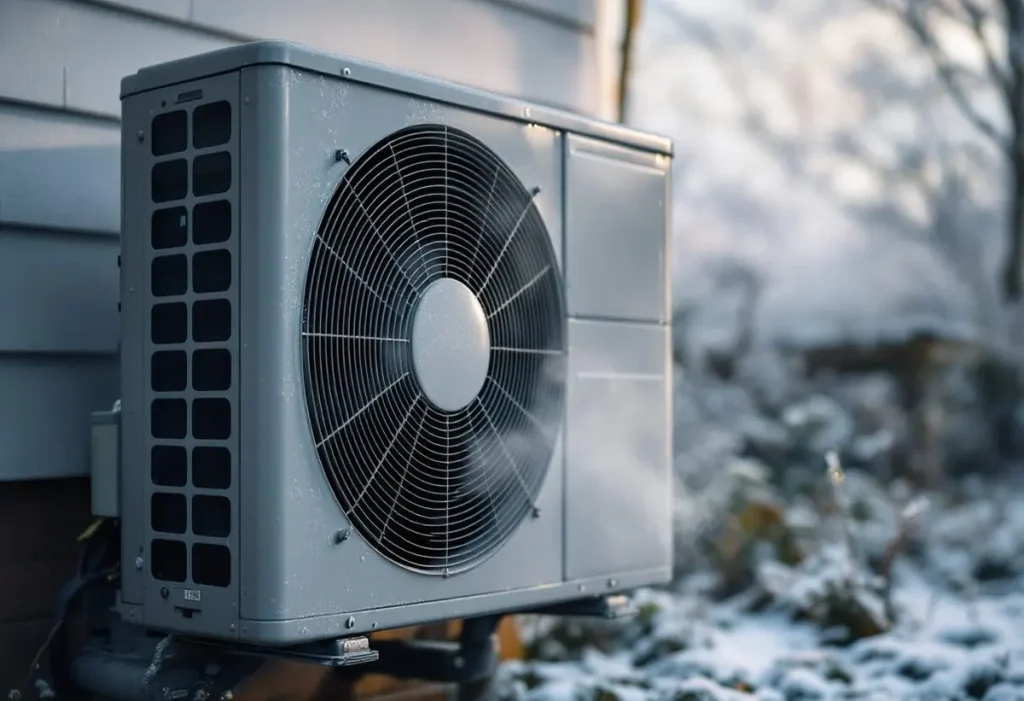
Is the outdoor unit running at 30°F? Then the heat is electric
A heat pump runs on electricity: EIA’s 2020 Residential Energy Consumption Survey files all 16.13 million homes heated mainly by a ducted heat pump under electricity, with no gas heat pump row [7]. With the heat on, a heat pump’s outdoor unit runs; a gas furnace with central AC leaves it silent. Our guide to whether the outside unit runs when the heat is on covers defrost cycles and the five-minute heat pump test.
Two cases blur this. A heat pump air handler often carries backup strips (the HKR or KFCEH kits above), so a kW label inside does not rule out a heat pump. A dual fuel system pairs an outdoor heat pump with a gas furnace inside, so it passes both the gas pipe check and the outdoor unit check. If yours turns out to be gas, the heat pump vs gas furnace running cost comparison shows what each costs to run by state.
What are the odds a furnace is gas? EIA’s 2020 count by fuel
About 72 in 100. Of 74.42 million US homes whose main heat was a central warm-air furnace in 2020, 53.26 million burned natural gas and 13.82 million were electric [7]. Add ducted heat pumps and, across all homes with ducts and registers, gas drops to 58.8% while electric heat (resistance plus heat pump) rises to 33.1%.
| Main heating equipment | Homes, 2020 (million) | Share of furnaces | Share of ducted systems |
|---|---|---|---|
| Natural gas furnace | 53.26 | 71.6% | 58.8% |
| Electric furnace | 13.82 | 18.6% | 15.3% |
| Ducted heat pump (electric) | 16.13 | not a furnace | 17.8% |
| Propane furnace | 4.03 | 5.4% | 4.5% |
| Oil or kerosene furnace | 3.10 | 4.2% | 3.4% |
That is 15.3% electric furnaces plus 17.8% heat pumps: a ducted house is electric about one time in three. The full mix of fuels and equipment, region by region, is on our types of home heating systems page.
What does the utility bill show for gas or electric heat?
A gas usage line in therms or ccf means a gas appliance somewhere in the house; a bill with only kWh means no utility gas. A gas water heater or range also puts gas on the bill, so this proves gas service, not a gas furnace. Propane and oil arrive by delivery and never show on a utility bill.
Stop line: a rotten egg smell at the gas pipe means leave the house and call the gas utility from outside. Our page on a furnace that smells like gas sets out the order of steps.
Frequently asked questions
Can a gas furnace work without electricity?
No. A gas furnace needs power for its igniter, inducer, controls and blower. Goodman states that all GM9S96 furnaces are manufactured for a 115 VAC, 60 Hz, single-phase supply, and Carrier fits a blower access panel switch that shuts off 115 volt power to the controls. In a power outage a gas furnace stops along with an electric one.
How to tell if a boiler is gas or electric?
A gas pipe and a flue mean gas, an oil line and burner motor mean oil, wiring only means electric. EIA’s 2020 survey counted 9.29 million homes heated mainly by steam or hot water; 6.51 million burned natural gas and 1.62 million fuel oil or kerosene, so about 70.1% of boilers were gas.
How to tell if a baseboard heater is electric or gas?
No baseboard burns gas. An electric baseboard is wired, at 240/208 volts on Marley’s 2500 series, with no pipes. A hot water baseboard is a run of 3/4 inch copper tube with aluminum fins, per Slant/Fin’s Fine/Line 30 ratings, fed by a boiler that may be gas or oil. Pipes at each end mean hydronic.
How to tell if a water heater is electric or gas?
A gas tank has a combination gas control knob near the bottom and a burner and pilot behind an access cover; several Bradford White service procedures begin “Turn off gas supply to water heater”. An electric tank has none of those.
Do I have a gas furnace or electric?
If there is a pilot, a burner or an igniter, gas. Those parts exist only on a fuel-burning appliance. Goodman’s GM9S96 uses a silicon nitride igniter, and its rating plate lists input in Btu/h; an electric furnace has heating elements and a plate listing kW at 240 volts, as on Carrier’s KFCEH heater kits.
How we researched this
On 14 November 2026 we read the ten maker and EIA documents listed under Sources, including the Goodman and Carrier nomenclature pages and EIA RECS 2020 table HC6.1; odds-table shares are our arithmetic on HC6.1. We excluded contractor blogs, forums, and brand prefixes with no maker nomenclature page opened. PG&E’s help article and the InterNACHI thread in the search results would not load and were not used.
Sources
- Goodman. “SS-GM9S96/GC9S96 Specification Sheet.” https://cdn.shopify.com/s/files/1/0794/3104/1346/files/GM9S96_GC9S96_Spec_Sheet.pdf. Accessed November 2026.
- Goodman. “SS-GMBVC Specification Sheet.” https://apps.goodmanmfg.com/brochures/files/6052441c046b3SS-GMBVC.pdf. Accessed November 2026.
- Carrier. “59SC5A Condensing Gas Furnace, Product Data.” https://www.shareddocs.com/hvac/docs/1009/Public/04/59SC5A-14PD.pdf. Accessed November 2026.
- Carrier. “FV4C Fan Coil, Product Data.” https://www.shareddocs.com/hvac/docs/1009/Public/03/PDSFV4C-05.pdf. Accessed November 2026.
- Lennox Industries. “SL280UHV Installation Instructions.” https://www.lennox.com/dA/0891b8032a/508245-01b.pdf. Accessed November 2026.
- R.W. Beckett. “AF/AFG Burners Instruction Manual.” https://www.weil-mclain.com/wp-content/uploads/RW-Beckett-AFG-Burner-Manual-for-Ultra-Oil-VBL-0321.pdf. Accessed November 2026.
- U.S. EIA. “RECS 2020 Table HC6.1, Space heating in U.S. homes.” https://www.eia.gov/consumption/residential/data/2020/hc/xls/HC%206.1.xlsx. Accessed November 2026.
- Marley Engineered Products. “2500 Series Electric Baseboard Submittal.” https://www.marleymep.com/wp-content/uploads/MEP_2500-Baseboard-Q_Submittal_2023-12-web.pdf. Accessed November 2026.
- Slant/Fin. “Fine/Line 30 Ratings.” https://www.slantfin.com/images/stories/Technical-Literature/ratings_fineline30_r.pdf. Accessed November 2026.
- Bradford White. “Water Heater Service Manual.” https://www.gtsanders.com/userfiles/documents/Bradford_White_LG155H803N-475_Manual.pdf. Accessed November 2026.
Leave a Reply