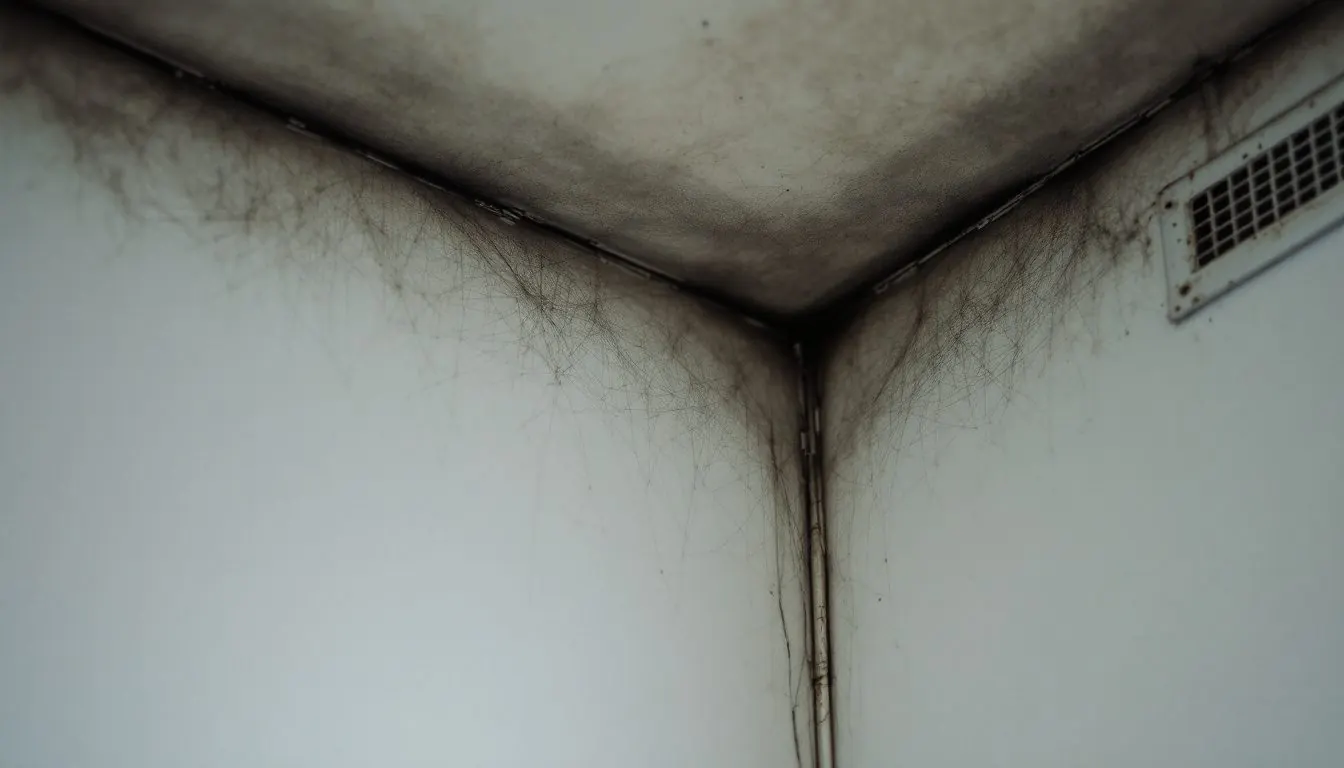
An oil furnace puffback is a small explosion in the combustion chamber: oil sprayed during a failed start hangs as vapor, then lights all at once and blows soot out through the burner, flue and barometric damper into the house. Beckett’s AFG manual links it to wrong nozzles, unprimed pumps and restarting a flooded chamber.
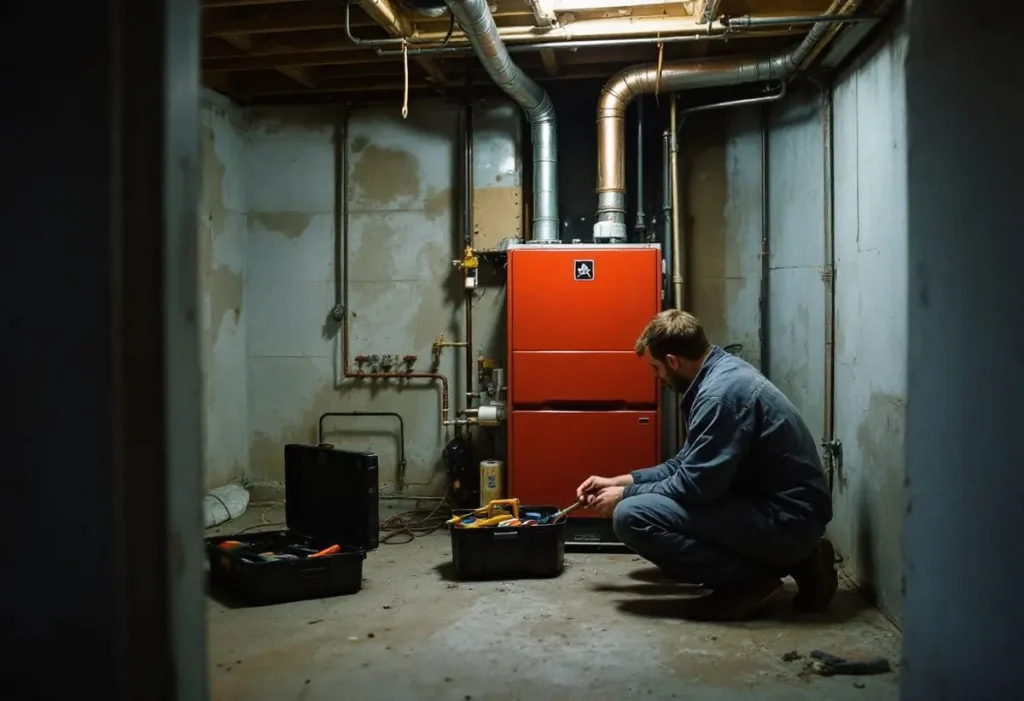
What happens in the seconds before an oil furnace puffs back?
A puffback starts when oil reaches the chamber before a flame does. On a Beckett GeniSys 7505 or Honeywell R7184 primary control, the danger sits in one 15 second window.
The Beckett AF/AFG burner manual lays out the R7184P sequence: a 3 to 10 second safe start check, then a 15 second valve-on delay in which the igniter and motor run with no oil, then the trial for ignition, when the oil valve opens and a flame “should be established within the 15 second lockout time.” If the cad cell sees no flame by then, the control shuts the burner off and locks out. The oil sprayed during those seconds stays behind.
The puff comes when that vapor finds a flame late: a weak spark that catches partway into the 15 second trial, or a restart that lights oil pooled in a hot chamber. Beckett’s startup page says “Do not attempt to start the burner when excess oil has accumulated in the appliance, the appliance is full of vapor, or when the combustion chamber is very hot,” and lists “hot gas puff-back” among the results of ignoring it. A partly plugged nozzle spraying off center is one cause of that late light, and why the oil burner nozzle is replaced at every service rather than cleaned comes down to a polished orifice that cleaning can neither restore nor verify.
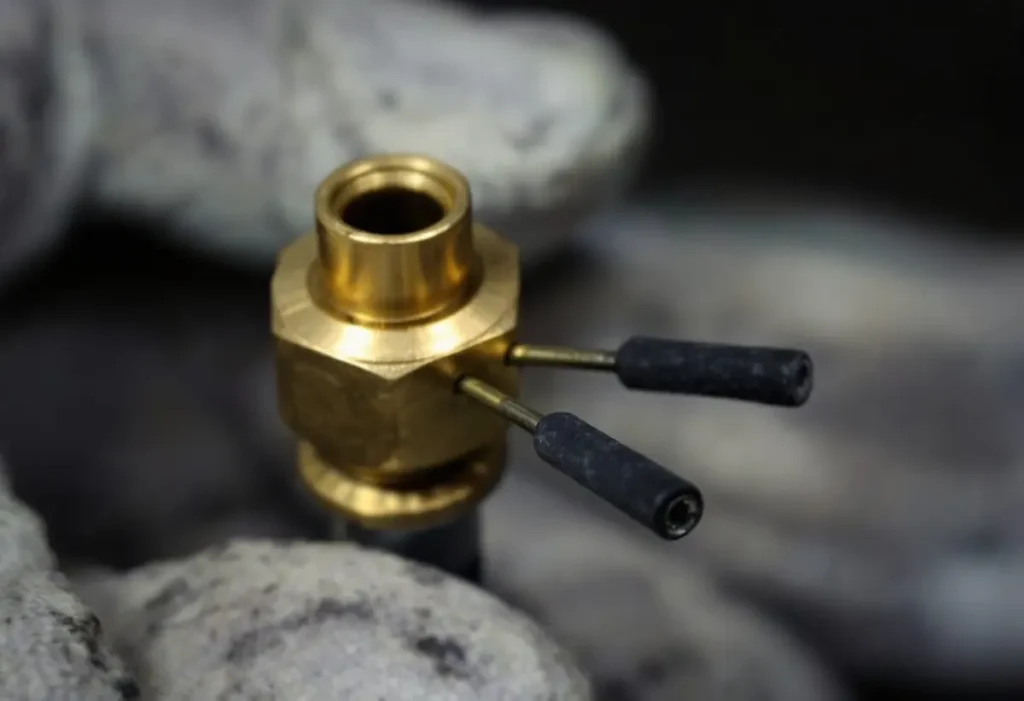
What causes puff back in an oil furnace, fault by fault?
Seven faults that the Beckett AFG manual guards against can end in delayed ignition or a smoky, unstable fire, and each leaves its own evidence for a technician to find.
| Fault | How it leads to a puff | What the manual says | What the technician checks |
|---|---|---|---|
| Wrong or worn nozzle | Poor spray pattern lights unevenly and smokes | Incorrect nozzles “could result in impaired combustion, underfiring, over-firing, sooting, puff-back of hot gases” | Nozzle brand, gph and angle against the appliance spec; annual checklist calls for an exact-spec nozzle |
| Air in the oil line, pump not primed | Sputtering spray, flame drops out and relights | “Failure to prime the pump properly could result in unstable combustion, hot gas puff-back and heavy smoke” | Bleed until oil is free of bubbles; supply lines free of water and sludge |
| Weak ignition | Spark catches the spray late | Replace electrodes “if tips are rounded”; clean or replace corroded igniter contacts | Electrode gap and position, igniter spring contacts |
| Oil not cut off cleanly | Oil dribbles into a hot chamber after shutdown | Annual item: “Check the pump pressure and cutoff function”; gravity feed needs backup “oil flow cut-off protection” | Pump cutoff test, solenoid valve, anti-siphon valve |
| Blocked or acid-damaged chimney | Gases cannot leave; burner fires into a pressurized box | Blockage means flue gases “could vent out the barometric damper into the living space” | Draft reading; soot in flue pipe and chimney offsets |
| Outside air kit installed wrong | Starved or unstable combustion air | Failure to follow the kit “could result in impaired combustion, appliance soot-up, puffback of smoke” | Kit parts and instructions match the burner |
| Repeated resets | Each failed trial adds unburned oil | Hard lockout exists “to limit accumulation of unburned oil in the combustion chamber” | Lockout history on the 7505 display or LED; why the first start failed |
Compiled by The HVAC Brief from the Beckett AF/AFG burner manual and Honeywell R7184 guide 69-1384. Beckett’s checklist also says “Replace the oil supply line filter.”
A gas furnace can do something similar, but the mechanism and fixes differ; our page on a gas furnace that bangs when it lights covers delayed gas ignition.
How much oil collects if you press reset three times?
About 1.6 fl oz on a 1.00 gph burner, holding roughly 1,731 Btu. That upper bound assumes every drop sprayed during each failed 15 second trial stays in the chamber.
| Burner and control | Oil sprayed | Volume | Heat content |
|---|---|---|---|
| 0.75 gph, 15 s trial, 1 failed start | 0.0031 gal | 0.4 fl oz (12 mL) | 433 Btu |
| 0.75 gph, 15 s trial, 3 failed starts | 0.0094 gal | 1.2 fl oz (35 mL) | 1,298 Btu |
| 1.00 gph, 15 s trial, 3 failed starts | 0.0125 gal | 1.6 fl oz (47 mL) | 1,731 Btu |
| 1.00 gph nozzle run at 140 psig (1.18 gph), 15 s, 3 starts | 0.0147 gal | 1.9 fl oz (56 mL) | 2,043 Btu |
| 1.00 gph, 45 s trial (R7184 option), 3 starts | 0.0375 gal | 4.8 fl oz (142 mL) | 5,194 Btu |
HVAC Brief calculation: gallons = gph × trial seconds × failed starts ÷ 3,600; heat at the EIA figure of 138,500 Btu per gallon of heating oil. Trial lengths: 15, 30 or 45 seconds per the R7184 guide; the 1.18 gph row is Beckett’s own pressure example.
A 1.00 gph burner normally releases those 1,731 Btu over 45 seconds of steady flame. In a puffback the collected vapor burns at once inside a closed chamber. This is why the Honeywell R7184 guide says three lockouts in a row put the control into restricted lockout “to prevent repetitious resetting by the homeowner,” cleared only by holding the button 30 seconds. Our furnace and oil burner reset guide explains the one press owners should try.
Is puff back covered by insurance under the smoke peril?
On forms that use the standard Insurance Services Office (ISO) wording, the soot damage falls under a named Smoke peril and the furnace repair does not. The same forms exclude the wear and breakdown that caused the puff.
The CSAA homeowners form HS 00 03 OK 10 14, on file with the Oklahoma Insurance Department and marked as including ISO copyrighted material, defines the peril this way: “sudden and accidental damage from smoke, including the emission or puffback of smoke, soot, fumes or vapors from a boiler, furnace or related equipment.” The only smoke it carves out is “smoke from agricultural smudging or industrial operations.”
The same form’s dwelling coverage excludes “Wear and tear” and “Mechanical breakdown, latent defect,” so the failed nozzle, pump or burner is your cost, then says “any ensuing loss” not otherwise excluded “is covered.” The word “sudden” matters: soot that built up over a season reads as gradual. Our explainer on what homeowners insurance covers for heating equipment walks through the other perils; your own declarations page and endorsements decide the claim.
What should you do in the first hour after a puffback?
Turn the burner off at its emergency switch, do not press reset, and keep it off until a technician finds why the start failed. Get people out if a CO alarm sounds. Beckett’s instruction for a vapor-filled appliance is to “allow the unit to cool off and all vapors to dissipate”; for an oil-flooded one, shut off power and oil and “clear all accumulated oil before continuing.”
- If the condition still looks unsafe, Beckett’s manual says to contact the fire department and follow their directions.
- Check that CO alarms are working on every level; our CO detector placement rules show where they belong.
- Photograph the soot in each room before anyone touches it, then notify the insurer: the CSAA form’s first duty after a loss is “Give prompt notice to us or our agent.”
- The same form requires you to “Protect the property from further damage” and to keep “an accurate record of repair expenses,” and asks for an inventory of damaged personal property.
On a forced air oil furnace, a filter that turns black right after the event has likely caught soot; our guide to a furnace filter that turned black covers telling the two apart.
Which signs mean small puffbacks are happening on every start?
A thump as the burner lights and black streaks around the barometric damper point to delayed ignition repeating at low strength, the same path Beckett’s AFG manual describes for flue gas that cannot leave the chimney. Beckett’s annual list tells the technician to “Inspect the vent system and chimney for soot accumulation or other restriction” and to clean “all flue passages and flue pipe.”
The chimney can be the slow cause: Beckett says cooler flue gas from flame retention burners condenses into sulphuric acid that attacks “chimney mortar, brick and clay liners,” and it strongly recommends an insulated stainless steel liner. Our chimney liner rules cover when code requires one.
What does a tune-up measure that prevents an oil furnace puffback?
Smoke, draft and CO2, measured on instruments. Beckett says “a qualified service technician must service this burner annually” and that adjustment “requires technical training and skillful use of combustion test instruments.”
Its four step method: open the air until a trace of smoke appears, read CO2 at that point, add air to drop CO2 by 1.5 to 2 percentage points, then confirm smoke “should be Zero.” On natural draft appliances the over-fire draft is typically -0.01 or -0.02 in. w.c. With flame present, a normal cad cell reading on a 7505 is 0 to 1600 ohms. Our oil heating system explainer covers the rest of the annual list.
Frequently asked questions
What is puff back in a furnace?
A puffback is a delayed ignition: oil or vapor collects in the combustion chamber, lights all at once and pushes smoke and soot back out through the burner and flue. Beckett’s AFG burner manual lists “hot gas puff-back” as a result of wrong nozzles, poor pump priming, outside air kit errors and starting a burner when the appliance is full of vapor.
What causes blowback in a gas furnace?
In a gas furnace the comparable bang is also delayed ignition: gas flows before the burners light evenly, then catches all at once. The parts differ: a gas furnace has no oil nozzle, pump or cad cell, so none of the 7 oil faults in the table above applies. Our page on a furnace that bangs when it turns on covers the gas version.
What does puffback mean on an insurance policy?
On homeowners forms that use ISO wording, puffback is named inside the Smoke peril: “sudden and accidental damage from smoke, including the emission or puffback of smoke, soot, fumes or vapors from a boiler, furnace or related equipment.” The Oklahoma CSAA form we read excludes only smoke from agricultural smudging or industrial operations.
How we researched this
In November 2026 we read the Beckett AF/AFG burner manual (Weil-McLain edition), the Beckett GeniSys 7505 manual (form 61649), Honeywell R7184 guide 69-1384, CSAA Oklahoma homeowners form HS 00 03 OK 10 14 and the EIA heat content table. We opened the top search results (a restoration contractor blog, a claims vendor article and a heating forum thread) to see what they leave out. We excluded restoration and contractor sites as sources for any figure, published no cleanup costs because no federal source reports them, and left out IICRC soot cleanup standards because we did not read them.
Sources
- R.W. Beckett Corporation / Weil-McLain. “Ultra Oil AF/AFG Burner Manual.” https://www.weil-mclain.com/wp-content/uploads/RW-Beckett-AFG-Burner-Manual-for-Ultra-Oil-VBL-0321.pdf. Accessed November 2026.
- R.W. Beckett Corporation. “GeniSys 7505 Advanced Burner Control, Form 61649.” https://zoro.com/static/cms/enhanced_pdf/Metropac%20Industries%20Inc_61649xxGeniSysxx7505xxControlxxManualxx144726.pdf. Accessed November 2026.
- Honeywell (Resideo). “R7184 Series Primary Controls, Technician’s Quick Reference Guide 69-1384.” https://inspectapedia.com/heat/Honeywell-R7184-Guide-69-1384.pdf. Accessed November 2026.
- CSAA General Insurance Company, via Oklahoma Insurance Department. “Oklahoma Homeowners Policy HS 00 03 OK 10 14.” https://www.oid.ok.gov/wp-content/uploads/2022/04/HS-00-03-OK-10-14.pdf. Accessed November 2026.
- U.S. Energy Information Administration. “British thermal units (Btu).” https://www.eia.gov/energyexplained/units-and-calculators/british-thermal-units.php. Accessed November 2026.
Leave a Reply