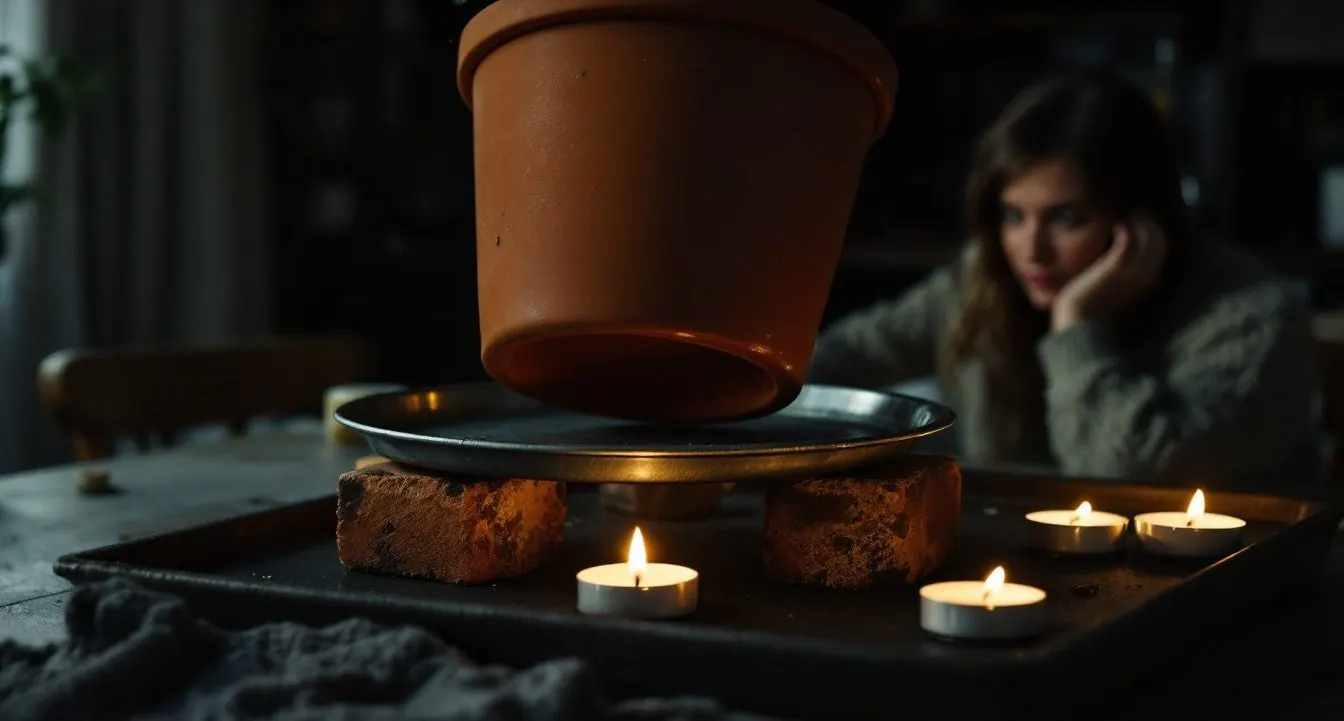
Do terracotta pot heaters work? Not as heaters. The pot adds no energy: four tealights release at most about 157 W with or without clay over them, roughly a tenth of a 1,500 W space heater. The terracotta only stores that heat, delays it, and gives it back after the flames go out.
How many watts does one tealight under a clay pot really give off?
About 39 W at the very most, and the pot does not change it. We found no published tealight measurement, so we worked it out from the maker’s label and NIST’s combustion data.
IKEA lists its GLIMMA unscented tealight with a burning time of 4 hr and a 24 pack net weight of 0.31 kg, aluminium cups included (IKEA product page). That is 12.9 g per tealight. If every gram were wax, the flame would burn 0.054 g per minute. NIST measured paraffin candle wax releasing an effective 43.8 kJ/g in its cone calorimeter (Hamins, Bundy and Dillon, NIST, 2005). Multiply the two and you get 39 W. The cup and wick weigh something, so the true figure is lower.
The same NIST study timed a 21 mm white paraffin taper at a mean 0.105 g/min and calculated its steady heat release as 77 W, plus or minus 9 W. A dinner candle is about two tealights.
| Heat source | Heat output | Btu per hour | How many equal one 1,500 W heater | Basis |
|---|---|---|---|---|
| One IKEA GLIMMA tealight | 39 W or less | 134 | 39 or more | 0.31 kg per 24 pack, 4 hr burn, 43.8 kJ/g |
| One 21 mm paraffin taper | 77 W, measured | 263 | 20 | NIST mass loss 0.105 g/min |
| Typical pot heater, 4 tealights | 157 W or less | 536 | 10 | 4 x 39 W |
| Large pot heater, 8 tealights | 314 W or less | 1,072 | 5 | 8 x 39 W |
| Plug-in electric space heater | 1,500 W | 5,118 | 1 | EIA: 1 kWh = 3,412 Btu |
Btu figures use EIA’s conversion of 1 kilowatthour to 3,412 Btu (EIA units and calculators). Our space heater cost and fire data page runs the same conversion for the 1,500 W heater and prices its electricity.
Why can’t a terracotta pot make four candles hotter?
Because the clay is not a fuel. Energy in equals energy out: 157 W of burning wax goes into the room whether it leaves the flame directly or passes through a pot first. A pot that weighs the same before and after the evening has burned nothing.
NIST found that only 0.17 of a candle flame’s heat leaves as radiation; the rest rides up in the hot plume (Hamins et al. 2005). A bare tealight therefore sends most of its 39 W straight to the ceiling. Put a pot over it and the clay intercepts the plume, gets hot, and sheds the same energy from a wider, cooler surface you can feel at arm’s length. The warmth is closer and softer, not larger.
Does the clay keep heating after the candles go out?
Yes, for a while, but that heat was borrowed from the first part of the burn. A cold pot absorbs the flames’ 157 W before it warms the room, then pays it back after the wax is gone.
We calculated that four 39 W tealights burning their full 4 hr release about 0.63 kWh. A 1,500 W heater delivers that in 25 minutes. Stacking a second or third pot, plugging the drainage hole or adding a bolt and washers changes the shape of the dashed line, never the 0.63 kWh under it.
Can you heat a room with a terracotta pot in a power outage?
Not in any useful sense. In a room that a 1,500 W heater can just keep 30°F warmer than it would sit unheated, four tealights would hold it about 3°F warmer. That is our steady state calculation, shown below.
A room’s heat loss scales with the gap between inside and outside. If 5,118 Btu per hour (1,500 W) holds a 30°F gap, the room loses 170.6 Btu per hour for each degree. Four tealights supply 536 Btu per hour, so 536 divided by 170.6 is a 3.1°F rise once everything has warmed up; one tealight gives 0.8°F and eight give 6.3°F. Our guide to heating one room without central heat prices the options that do move the thermometer.
During a blackout the stakes change. NFPA’s candle tip sheet says to have flashlights and battery lighting ready for a power outage, then puts it plainly: “Never use candles” (NFPA Candle Safety). The hour by hour plan for keeping a house warm in an outage covers the steps that hold heat in: one room, sealed doors, layers.
Is a terracotta pot heater a fire hazard?
It breaks two of the maker’s own rules. IKEA’s GLIMMA instructions say “Keep candles at least 3 cm apart” and “Do not place near a heat source.” A pot heater packs tealights side by side under a hot clay dome, so every candle sits next to a heat source.
The IKEA listing adds “Never leave a burning candle unattended.” NFPA says to keep candles at least 1 foot from anything that can burn and to blow them out before leaving a room or going to bed, yet a pot heater is pitched as something to run for hours.
The fire data backs the caution. The U.S. Fire Administration, citing NFPA, says “On average, 20 home candle fires are reported each day” (USFA Candle Fire Safety), and NFPA’s tip sheet names December as the peak month for home candle fires. Our home heating fire statistics report puts those numbers beside furnace and space heater fires.
Fox 5 Atlanta also warns of pots cracking from trapped moisture and crowded wax pools igniting together, but names no document for either; we found no primary test, so both stay unverified.
Does a candle pot heater make soot or carbon monoxide?
Soot, more likely than not; carbon monoxide, unmeasured. A 2001 literature review for the EPA found that “candles in glass containers produce more soot because the container causes unsteady air flow and disturbs the flame shape,” and that a flame starved of oxygen soots more (EPA-600/R-01-001, archived copy).
A pot set low over the flames does the same thing as a glass jar: it crowds the flame and disturbs its airflow. The EPA review also says a small, stable flame emits less than a large flickering one. If gray film appears on the pot’s underside, the wall above it or the furnace filter, that is the soot; our page on why a furnace filter turned black shows how little candle soot it takes.
On carbon monoxide, the EPA review’s only measured figure was for incense, not candles, and we found no federal test of tealights under a pot. Any flame in a closed room uses oxygen, so the practical check is a working CO alarm placed by the rules in our carbon monoxide detector placement page, not a guess about the pot.
What gives more heat than candles when the furnace or power is out?
With power, a 1,500 W electric heater gives about ten times the heat of a four tealight pot. Without power, keeping heat in one closed room and on your body beats any open flame you can safely run indoors.
If the furnace is down but the outlets work, run one listed electric heater in the room you use, on its own wall outlet; the night rules are in whether it is safe to sleep with a space heater on. Do not swap one improvised heat source for another: our sibling page on heating a house with the oven explains why a gas oven is a CO source. If the power is out, remember the scale: the 0.63 kWh a pot heater delivers over 4 hr is what a 1,500 W heater makes in 25 minutes.
Frequently asked questions
Do clay pot heaters work well?
They work as candles with a heat sink, nothing more. Four tealights give 157 W or less, our calculation from IKEA’s 4 hr GLIMMA label and NIST’s measured 43.8 kJ per gram of paraffin. The clay spreads that warmth over a larger, cooler surface and keeps it coming after the flames die, but the total heat is identical to four bare tealights, about a tenth of a 1,500 W heater.
Do clay pot heaters work in a greenhouse?
Only in the sense of a degree or two in a small, closed greenhouse, and only while someone watches the flames. The ratio from our room calculation holds: four tealights supply 536 Btu per hour against 5,118 for a 1,500 W heater, so they give about a tenth of the rise that heater would. IKEA’s GLIMMA label also says never to leave a burning candle unattended, which rules out an overnight frost guard.
How many tealights does it take to heat a room?
About 39 or more to equal one 1,500 W space heater. Our calculation puts an IKEA GLIMMA tealight at 39 W at most (0.31 kg per 24 pack, 4 hr burn, NIST’s 43.8 kJ per gram). Forty open flames would break IKEA’s 3 cm spacing rule and NFPA’s 1 foot clearance, so the honest answer is that candles cannot safely heat a room.
Can you burn stuff in a terracotta pot?
Not indoors. Paper, wood, alcohol gels or charcoal in a clay pot make an open fire with no chimney, which is far more than the tealight hack and has none of a stove’s venting. NFPA’s candle tip sheet already says to keep even a candle at least 1 foot from anything that can burn, and to use flashlights, never candles, in a power outage.
How we researched this
In November 2026 we read NIST’s “Characterization of Candle Flames” (Hamins, Bundy and Dillon, 2005) for wax heat of combustion, mass loss rate, heat release and radiative fraction; IKEA’s GLIMMA unscented tealight listing for burn time, net weight and safety text; EIA’s Btu conversion; NFPA’s candle safety tip sheet; the U.S. Fire Administration candle page; and the 2001 EPA candles and incense review. The three top ranking articles cite no measured candle figure, so we took no numbers from them. The 30 to 40 W tealight figure that circulates online has no source we could open; our 39 W is an upper bound calculated from the maker’s label.
Sources
- National Institute of Standards and Technology (Hamins, A., Bundy, M., Dillon, S. E.). “Characterization of Candle Flames.” Journal of Fire Protection Engineering 15(4), 2005. https://tsapps.nist.gov/publication/get_pdf.cfm?pub_id=101159. Accessed November 2026.
- IKEA. “GLIMMA Unscented tealight, 24 pack.” https://www.ikea.cn/cn/en/p/glimma-unscented-tealight-00144937/. Accessed November 2026.
- U.S. Energy Information Administration. “British thermal units (Btu).” https://www.eia.gov/energyexplained/units-and-calculators/british-thermal-units.php. Accessed November 2026.
- National Fire Protection Association. “Candle Safety” tip sheet. https://content.nfpa.org/-/media/Project/Storefront/Catalog/Files/Safety-tip-sheets/CandleSafetyTips.pdf?rev=2aa815a63b38458296ed60caab0f8842. Accessed November 2026.
- U.S. Fire Administration. “Candle Fire Safety.” https://www.usfa.fema.gov/prevention/home-fires/prevent-fires/candle/. Accessed November 2026.
- Eastern Research Group for U.S. EPA. “Candles and Incense as Potential Sources of Indoor Air Pollution: Market Analysis and Literature Review,” EPA-600/R-01-001, January 2001 (archived copy). https://web.archive.org/web/2019id_/https://nepis.epa.gov/Adobe/PDF/P1009BZL.pdf. Accessed November 2026.
Leave a Reply