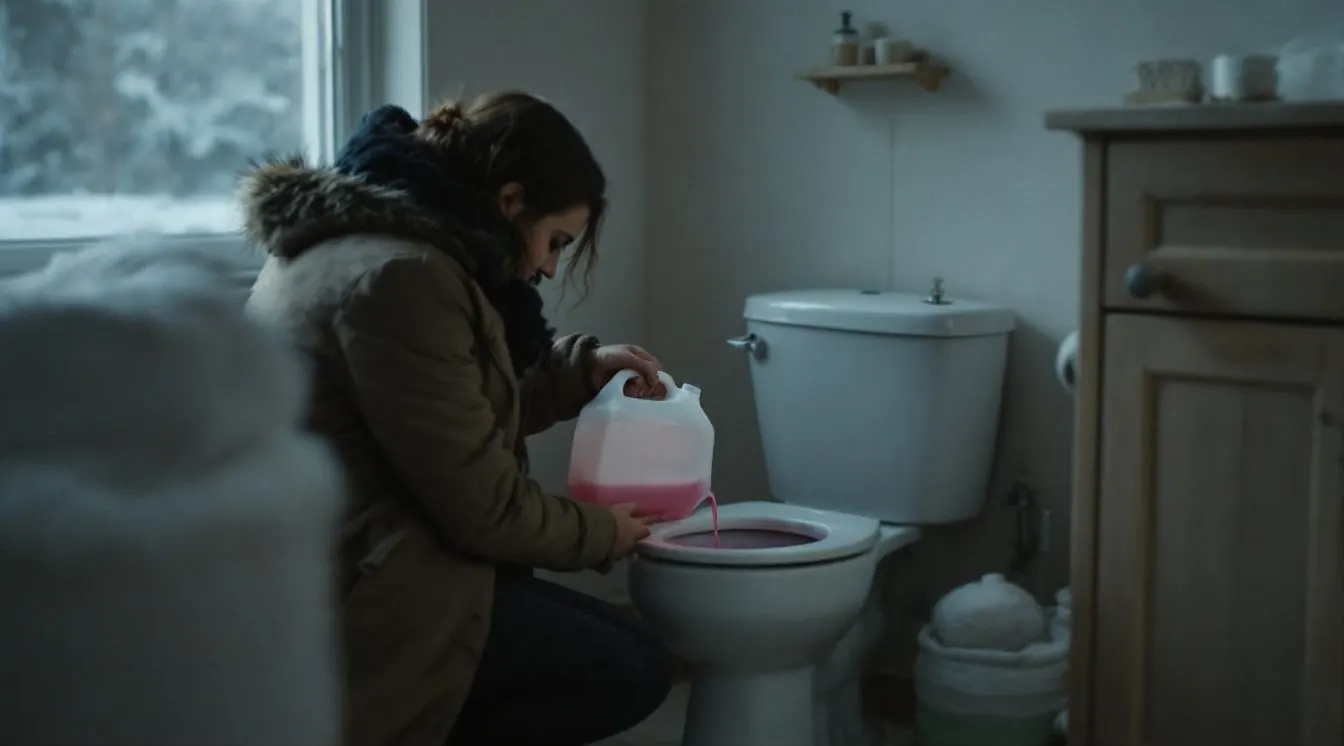
How to winterize a house with no heat: close the main water valve, shut off and drain the water heater, open every faucet and drain the lines from the lowest point, blow out what gravity leaves, then pour nontoxic RV antifreeze into toilets and drain traps and have any boiler drained or glycol filled.
A drained pipe cannot burst, but one holding water between a closed valve and an ice plug can, which is why the American Red Cross tells you to leave an outside hose bib open after draining it, so that “any water remaining in the pipe can expand without causing the pipe to break” (Red Cross). How cold that takes is on our page about what temperature pipes freeze at.
In what order do you winterize a house with the heat turned off?
Water off first, water heater second, lines third, traps and appliances fourth, heating system last. That is the sequence in the City of Hopkins, Minnesota handout “Winterizing a Home”; the table adds each maker’s manual.
| Order | System | What to do with the heat off | Source |
|---|---|---|---|
| 1 | Water service | Close the main valve, or ask the water utility to close the curb stop | Hopkins step 1 |
| 2 | Tank water heater (gas or electric) | Gas or breaker off, close cold inlet, open a hot faucet, drain by hose | A.O. Smith: drain for a freezing shutdown, leave the valve open |
| 3 | Tankless water heater | Power off, gas off, drain at the unit’s drain valve and filter | Rheem: freeze protection needs power |
| 4 | Supply piping | Open every faucet, drain the lowest point, blow out with air | Hopkins: gravity leaves standing water |
| 5 | Private well | Pump breaker off, drain the pressure tank with the house lines | Hopkins step 3 |
| 6 | Softener, filters, treatment | Drain or bypass and drain the housings | Hopkins step 5 |
| 7 | Toilets and drain traps | Flush the toilet empty, then fill bowl and traps with nontoxic RV antifreeze | Hopkins step 6 |
| 8 | Washer, dishwasher, ice maker line | Drain or disconnect; washers get RV antifreeze per the maker | Frigidaire FFTW1001PW manual |
| 9 | Condensing furnace and AC drains | Drain or protect the trap and any condensate pump | Hopkins step 9 |
| 10 | Boiler, radiators, radiant floor | Professional drain down or glycol fill | Hopkins step 10 |
| 11 | Hose bibs, lawn sprinklers, pool lines | Drain, leave the outside valve open, no antifreeze unless the installer says so | Red Cross |
| 12 | Breakers, gas, signs | Appliance breakers off, panel tagged, “Winterized” signs posted | Hopkins steps 8, 11, 12 (its 180 day gas rule is local) |
Compiled by The HVAC Brief from the City of Hopkins MN handout, A.O. Smith GAHH 40 to 100 and Rheem AP13592 water heater manuals, the Frigidaire FFTW1001PW washer manual and the American Red Cross frozen pipes page, November 2026.
How do you get the last water out of the pipes without compressed air?
Open the highest fixture first so air can enter, then open the lowest one, such as a basement hose bib, a boiler drain on the cold line or the main’s drain cock, and leave every faucet and fixture stop open. Hopkins says plainly that this is not always enough: “Though gravity may be sufficient to drain the plumbing in many homes, standing water will remain in some pipes,” and that leftover water “may strain some fittings,” with CPVC “prone to cracking.” Its fix is to blow the lines out with an air compressor.
Without a compressor, open the lowest fitting on each run that dips under a joist or down to an island sink. The Red Cross lists the places pipes freeze most often as basements, crawl spaces, attics, garages, kitchen cabinets and runs against poorly insulated exterior walls, so those are the runs to check twice. A house on a well adds one more vessel: Hopkins says the pressure tank “should also be drained.”
Which traps, toilets and appliances get RV antifreeze instead of draining?
Anything that holds water by design gets nontoxic RV antifreeze: toilet bowls after the tank is flushed empty, sink, tub and shower P traps, floor drains and the washer. Hopkins specifies “special non-toxic RV type antifreeze solution (pink in color).”
Washers come with their own instructions. The Frigidaire FFTW1001PW manual has you turn off the supply faucets, drain the hoses, add nontoxic RV antifreeze to the empty tub and run rinse and spin for 1 minute, noting “Not all of the RV antifreeze will be expelled.” Dishwashers and ice maker lines get “drained and/or disconnected,” per Hopkins.
A condensing furnace trap left full in a cold house is the failure on our frozen furnace condensate line page, with the maker warnings for unoccupied houses at 32°F and below.
Does the water heater have to be drained, and is a tankless heater different?
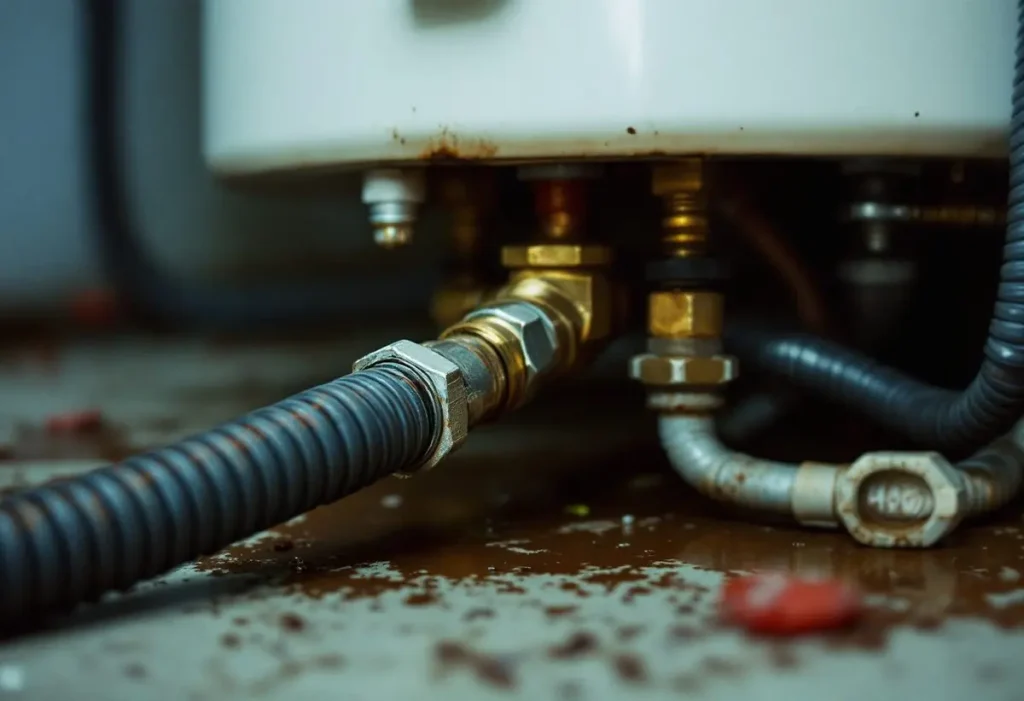
Yes, a tank heater in an unheated house gets drained. A.O. Smith’s GAHH manual says the water heater “should be drained if being shut down during freezing temperatures” and that for an extended shutdown “the drain valve should be left open” (A.O. Smith manual). Electric heaters go off at the breaker first, Hopkins adds. The hose procedure, and how to clear a clogged drain valve, is in our water heater flushing guide.
A tankless water heater holds little water but has narrow passages. Rheem’s AP13592 manual says its built in freeze protection heater works “as long as the electricity is supplied to the water heater,” down to about minus 30°F ambient, and “does NOT protect piping and valves” (Rheem manual). With the power off, that protection is gone, so drain it: power and gas off, hot faucets open, water shutoff closed, filter out, drain valve open. Rheem says about 21 oz comes out.
How do you winterize a house with radiators or baseboard heat?
A hot water or steam system is the one part of the house not to drain yourself. Hopkins “VERY strongly” recommends a professional for boilers and radiant floors because they “sometimes circulate water instead of a freeze-resistant fluid, or may interconnect with the plumbing system and/or hot water heater.” The standard insurance form names heating systems in its freezing clause, so a full loop in a cold house can fall outside coverage.
On hot water baseboard heat the two options are a full drain down, opening the boiler drain and every low point, or filling the loop with inhibited propylene glycol at a concentration matched to the coldest expected temperature. Our sibling page on antifreeze in a boiler system covers which glycol, what mix and what it costs in heat output. Glycol keeps the loop full, so the boiler can restart without a refill; drain down leaves nothing to freeze.
Will homeowners insurance pay for frozen pipes in a vacant house with the heat off?
Only if you did one of two things. The ISO Homeowners 3 form (HO 00 03 05 11) excludes damage from “Freezing of a plumbing, heating, air conditioning or automatic fire protective sprinkler system or of a household appliance,” but the exclusion does not apply if you “used reasonable care to: (a) Maintain heat in the building; or (b) Shut off the water supply and drain all systems and appliances of water” (HO 00 03 05 11, archived copy filed with Maine). A half drained house, boiler or water heater still full, meets neither test.
- Fire sprinklers change the rule. In a sprinklered building “you must use reasonable care to continue the water supply and maintain heat in the building for coverage to apply,” so heat off is not an option under this wording.
- Sump pumps and gutters are outside it. For this clause, the plumbing system “does not include a sump, sump pump or related equipment or a roof drain, gutter, downspout.”
- 60 days vacant ends other coverage. Vandalism is excluded once the dwelling “has been vacant for more than 60 consecutive days immediately before the loss,” and glass breakage has the same limit.
Insurers file their own versions and vacancy endorsements, so your policy decides. Other perils are on our page about homeowners insurance and HVAC.
Is leaving the heat at 55°F safer than draining the house?
Usually yes, as long as someone can tell when the heat fails. Hopkins calls leaving the heating system running at a minimum setting, with the water turned off, “the simplest solution and least risky alternative to winterizing.” The Red Cross says that if you will be away in cold weather, leave the heat on “set to a temperature no lower than 55° F.”
Heat on only works while fuel and power last. Travelers (vacant home page) advises a low temperature sensor and a water flow sensor on the main, tied to a monitored alarm or a phone, plus scheduled fuel deliveries and someone checking the house. A furnace that stops in an outage takes that protection with it, the scenario in our guide to keeping a house warm during a power outage. The safest setup combines both: heat at 55°F or higher with the main closed and the lines drained.
Frequently asked questions
How do you winterize a house with well water?
Turn the well pump off at its breaker, drain the house as on city water, and add the pressure tank: Hopkins says that on a well “the pressure tank should also be drained.” Drain the softener and filters too. On return, close every faucet and fixture stop before the pump goes back on, the reversal Hopkins warns about.
How do you winterize a house with a crawl space?
Treat crawl space piping as the first place water will freeze: the Red Cross lists supply pipes in crawl spaces among those that freeze most often. Open the lowest drain in the crawl space last and longest, check for sags under joists, and blow those runs out with air. Insulation only slows heat loss and heat tape for pipes works only while the power is on, so a heat off house still needs the lines drained.
How do you winterize a mobile home with no heat?
The same drain down applies: close the main, drain the water heater, open every faucet, drain from the lowest point and put nontoxic RV antifreeze in the toilets and traps. Hopkins notes gravity leaves standing water in some pipes, so blow the lines out with compressed air. If a line has already frozen, our guide to thawing frozen pipes has a mobile home section.
How do you winterize a house with no power?
With no power the house is already heat off, so drain it the same way: close the main, drain the water heater, open all faucets, drain the low point and fill traps and toilets with RV antifreeze. A tankless heater is the one to drain first, because Rheem says its freeze protection works only “as long as the electricity is supplied.” Without power for a compressor, open the low fittings on each sagging run.
How we researched this
On 21 November 2026 we read the seven documents listed below, including the ISO HO 00 03 05 11 form as filed with the Maine Bureau of Insurance (archived copy). We read the top Google results but used no contractor blog or lead generation site for any figure, and left out antifreeze volumes and burst ratings because no maker label we could open stated them.
Sources
- City of Hopkins, Minnesota. “Winterizing a Home.” https://www.hopkinsmn.com/DocumentCenter/View/1252/Winterizing-A%2D%2DVacant-Home-PDF. Accessed November 2026.
- Insurance Services Office. “HO 00 03 05 11 Homeowners 3, Special Form” (archived Maine filing). https://web.archive.org/web/2025id_/https://www.maine.gov/pfr/insurance/sites/maine.gov.pfr.insurance/files/inline-files/ho00-03-05-11-homeowners3-special-form.pdf. Accessed November 2026.
- American Red Cross. “Frozen Pipes.” https://www.redcross.org/get-help/how-to-prepare-for-emergencies/types-of-emergencies/winter-storm/frozen-pipes.html. Accessed November 2026.
- A.O. Smith. “GAHH 40 to 100 Manual.” ManualsOnline. https://tv.manualsonline.com/manuals/mfg/ao_smith/gahh_40_100.html?p=15. Accessed November 2026.
- Rheem. “AP13592 User Manual.” ManualsDir. https://www.manualsdir.com/manuals/195100/rheem-ap13592.html?page=24. Accessed November 2026.
- Frigidaire. “FFTW1001PW Manual.” ManualsOnline. https://lawnandgarden.manualsonline.com/manuals/mfg/frigidaire/fftw1001pw.html?p=12. Accessed November 2026.
- Travelers. “Snowbirds: Winterize Your Vacant Home.” https://www.travelers.com/resources/home/safety/snowbirds-winterize-your-vacant-home. Accessed November 2026.
Leave a Reply