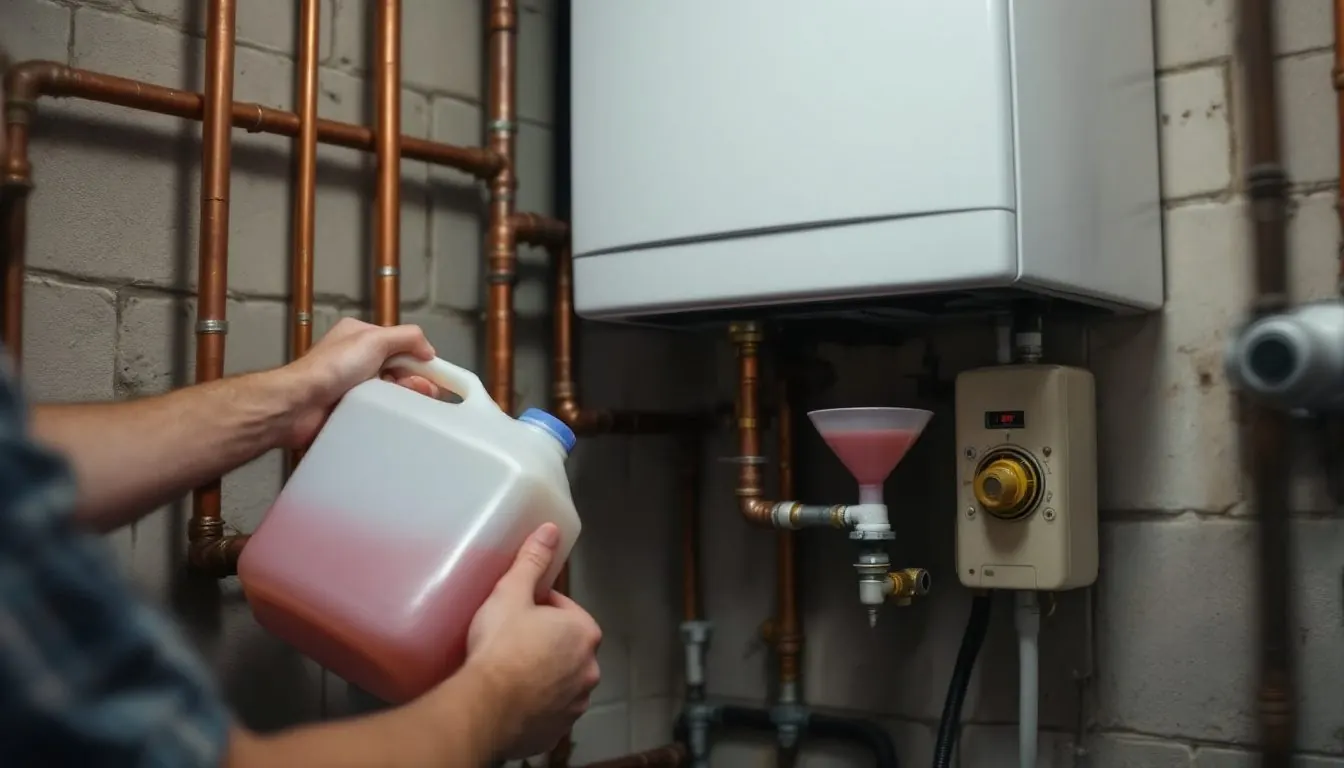
Antifreeze in a boiler system is only needed where the hydronic water can freeze: a vacant or unheated building, a snowmelt slab, a coil in a cold attic. Use inhibited propylene glycol made for hydronic heat, never automotive or ethylene glycol. Weil-McLain says a 50% mix protects to about minus 30°F and should not be exceeded.
Which boiler systems need antifreeze, and which are better left on plain water?
A boiler heating an occupied house, with every pipe inside the heated envelope, normally runs on water alone: glycol costs heat output and pump head every hour it is in the loop. Antifreeze earns its place where system water can sit below 32°F. Weil-McLain’s CGi Series 4 manual lists “lack of antifreeze in boiler water causing system and boiler to freeze and leak” among problems to fix when replacing a boiler.
| Situation | Glycol? | Why, and the alternative |
|---|---|---|
| Occupied house, all piping inside heated space | No | Water carries more heat per gallon than any glycol mix (see the penalty table below); keep the heat on and add a low temperature alarm |
| Vacation home or vacant house with the heat off or fuel at risk | Yes, or drain | Weil-McLain warns that unattended buildings, power outages or component failures in severe cold “could result in frozen plumbing and water damage in a matter of hours” |
| Zone through an unheated crawl space, garage or overhang | Usually | The whole loop must be treated; there is no partial dose for one zone on a shared boiler |
| Snowmelt slab or driveway loop | Yes | The tubing sits in frozen ground by design |
| Hydro-air coil in an attic | Yes, or a freeze control | Coil water stops moving between calls for heat |
| Outdoor wood boiler with buried lines | Per the maker | EPA describes these heaters as heating “water or a water/anti-freeze solution” |
A heated driveway loop is designed around glycol from day one, and the attic coil in a hydro-air system needs glycol or a freeze control. For a house sitting empty with the heat off, draining the boiler is the other route, covered in how to winterize a house with no heat.
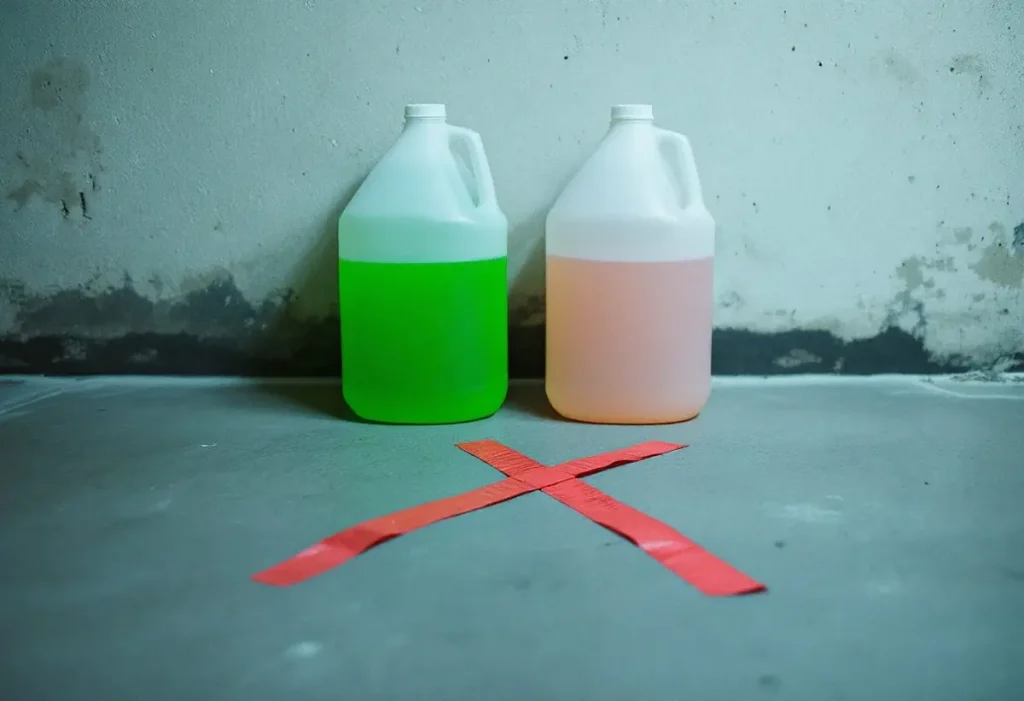
Can you put automotive antifreeze or RV antifreeze in a boiler system?
No to both. Weil-McLain’s CGi Series 4 manual says to “use antifreeze made especially for hydronic systems. Inhibited propylene glycol is recommended,” and then: “Do not use ethylene glycol, automotive or undiluted antifreeze. Severe personal injury or death can result.” The WGO guide also bans petroleum-based antifreeze. IBC’s VX Series manual says the same about “automotive-type ethylene or other types of automotive glycol antifreeze” and recommends “only using non-toxic propylene glycol.”
RV and plumbing antifreeze fails for a different reason: it is sold ready to use as burst protection for drained water lines, not as a heat transfer fluid. Recochem’s Econo Plumbing Antifreeze label states, in capitals, “THIS PRODUCT IS NOT DESIGNED AS A HEAT TRANSFER FLUID FOR CLOSED LOOP SYSTEMS.” If the jug does not name closed loop heating, it does not go in a boiler.
Toxicity matters beyond the boiler room. If the boiler also makes domestic hot water through a tankless coil or an indirect tank, the 2024 IRC model text, Section P2902.5.2, says heat exchangers using an “essentially toxic transfer fluid” must have double-wall construction with an air gap between the walls.
What percentage of glycol protects to 0°F, and is freeze protection the same as burst protection?
For 0°F, Dow’s DOWFROST data sheet lists 37.7% by volume for freeze protection and 25.1% for burst protection. Freeze protection keeps the fluid pumpable. Burst protection only means the slush will not split pipes or sections; nothing circulates until it warms. A loop that must keep heating needs the freeze number; an idle loop only needs the burst number.
Dow advises picking a table temperature “at least 3°C (5°F) lower than the expected lowest ambient temperature.” Between minus 20°F and minus 30°F the freeze curve crosses Weil-McLain’s 50% ceiling, so below that range a loop can only be given burst protection, not full freeze protection.
How much glycol does a boiler system take? A worked example
Dose against the whole system volume. Weil-McLain says to “determine antifreeze quantity according to system water content” and to “remember to include expansion tank water content.” The boiler is a small share: Table 11 of the CGi Series 4 manual lists 2.1 gallons for a CGi-4.
Example: 18 gallons measured from the piping and baseboard, plus the CGi-4’s 2.1 gallons, plus 1 gallon allowed for the expansion tank, gives 21.1 gallons. The coldest spot the pipes see is minus 5°F; Dow’s 5°F margin moves the design point to the minus 10°F row.
| Design temperature | Freeze protection, volume % | Gallons for freeze protection | Burst protection, volume % | Gallons for burst protection |
|---|---|---|---|---|
| 20°F | 18.8 | 4.0 | 12.6 | 2.7 |
| 10°F | 30.4 | 6.4 | 20.9 | 4.4 |
| 0°F | 37.7 | 8.0 | 25.1 | 5.3 |
| Minus 10°F (example) | 44.0 | 9.3 | 29.3 | 6.2 |
| Minus 20°F | 48.2 | 10.2 | 31.4 | 6.6 |
| Minus 30°F | 52.4 | 11.1, above the 50% ceiling | 34.6 | 7.3 |
Full freeze protection needs 9.3 gallons of fluid and burst protection 6.2 gallons, water making up the rest. Premix in a clean drum: Weil-McLain and IBC both ban undiluted antifreeze, and a premix keeps later top-ups at strength.
What does glycol cost you in heat output, pump head and expansion?
A gallon of glycol mix carries less heat than a gallon of water and is thicker to pump. We calculated volumetric heat capacity (density times specific heat) from Dow’s DOWFROST tables and NIST water data.
| Mix, % by volume | Heat carried per gallon at 194°F, vs water | Extra flow for the same BTU at 149°F | Viscosity vs water at 149°F | Viscosity vs water at 50°F |
|---|---|---|---|---|
| 30% | 98.1% | 2.9% | 2.1 times | not tabulated |
| 40% | 95.9% | 5.6% | 2.7 times | 5.5 times |
| 50% | 93.0% | 9.2% | 3.6 times | 8.2 times |
The 50% row lines up with the maker figure: IBC’s VX manual says a 50/50 mix needs “gpm up 10%” and “system head (up 20%)” to match straight water. Cold starts are worse: at 50°F, Dow lists 10.65 cP for a 50% mix against NIST’s 1.31 cP for water. Check the circulator pump curve against the higher head, not the old water duty point.
Lower thermal conductivity also cuts what baseboard and radiant tubing can deliver, which is why Weil-McLain’s WGO guide warns that the “percent of solution will affect sizing of heat distribution units, circulator and expansion tank.” Glycol expands more than water when heated, so the expansion tank should be resized with the tank maker’s glycol tool rather than reused on habit.
How do you put antifreeze in a boiler system without diluting it or trapping air?
Pump premix in through one hose valve while displaced water and air leave a purge valve into a drum, until glycol shows at the outlet. First fix every weep: Weil-McLain warns that “glycol will leak before the water begins to leak,” and the CGi Series 4 manual says leaking glycol is a fire hazard because “all glycol is flammable when exposed to high temperatures.” Never store glycol near the boiler.
Then deal with the fill valve. If the system keeps an automatic fill, Weil-McLain says to install a water meter to watch make-up, because fresh water quietly “will dilute the antifreeze, reducing the freeze protection level.” Trapped air after the fill is bled as in how to bleed baseboard heaters, catching the fluid in a container.
Does a boiler with glycol need a reduced pressure backflow preventer?
In many jurisdictions, yes. The 2024 IRC model text, Section P2902.5.1, allows a backflow preventer with an intermediate atmospheric vent (ASSE 1012) on a plain water boiler, but “where chemicals will be introduced into a boiler,” the potable supply must be protected “by an air gap or a reduced pressure principle backflow prevention assembly complying with ASSE 1013, AWWA C511 or CSA B64.4.” The code text does not name glycol; the local inspector decides whether antifreeze counts as a chemical, so plan for the reduced pressure assembly or an air gap unless told otherwise. Weil-McLain’s wording is simply that local codes may require a backflow preventer “or actual disconnect from city water supply.”
How often should glycol in a heating system be tested or changed?
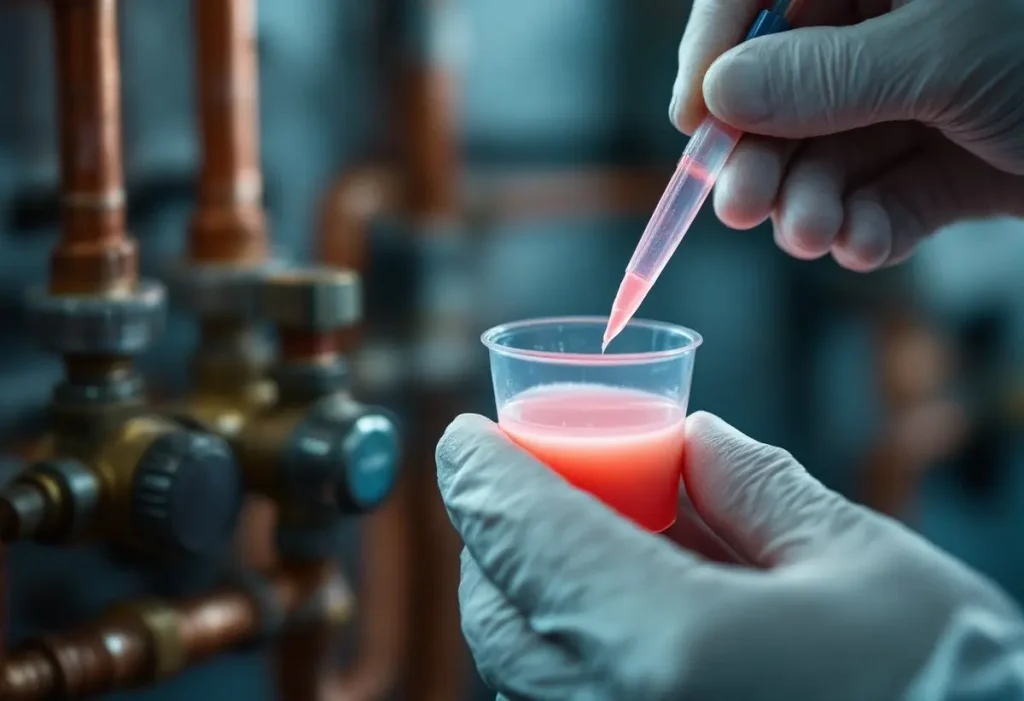
Test it at every annual service and change it when the test fails; no maker document we read sets an interval in years. Strength: a refractometer reading against Dow’s table, where a 35% by weight mix reads a refractive index of 1.3733 and 50% reads 1.3903. Inhibitor health: Dow lists pH 9.0 to 10.0 for a 50% DOWFROST solution, and IBC warns that improper mixtures can damage both ferrous and non-ferrous metals. Low strength gets premix; low pH gets the fluid maker’s inhibitor or a full change.
Frequently asked questions
What is glycol used for in boilers?
Glycol lowers the freezing point of boiler water so pipes, coils and sections survive cold. Dow lists DOWFROST, an inhibited propylene glycol, for “freeze and burst protection of pipes” and secondary heating loops, with a recommended use range of minus 50°F to 250°F. It also carries corrosion inhibitors, which is why plain glycol or RV fluid is not a substitute.
Can you put antifreeze in an outdoor wood boiler?
Yes, if the maker allows it. EPA’s Burn Wise program describes outdoor hydronic heaters as transferring heat to “either water or a water/anti-freeze solution, which is piped to the area to be heated.” EPA notes these heaters may be pressurized or unpressurized, so use only the fluid and percentage the boiler maker approves for your model and check the mix at each service.
Is propylene glycol boiler antifreeze toxic?
Inhibited propylene glycol is the low-toxicity option: Dow says DOWFROST fluids have “low acute oral toxicity” and are used where food or beverage contact could occur. It is still not drinking water. The 2024 IRC model text still requires a reduced pressure backflow preventer or air gap where chemicals go into a boiler, and Weil-McLain warns glycol is flammable at high temperatures.
How we researched this
In November 2026 we read Dow’s DOWFROST data sheet (Form 180-01314-1019), Weil-McLain’s CGi Series 4, Ultra Oil and WGO documents, IBC’s VX manual (manualslib copy), the 2024 IRC Chapter 29 model text as reproduced by Washington’s code council, a Recochem label, EPA Burn Wise and NIST water data. Penalty and dosing tables are our arithmetic; the 18 gallon piping figure is an example. Contractor blogs, forums and retailers were excluded as number sources, and other glycol brands’ tables were not mixed in because percentages differ by product.
Sources
- Dow. “DOWFROST Heat Transfer Fluid Technical Data Sheet,” Form 180-01314-1019 (distributor-hosted copy). https://cdn.shopify.com/s/files/1/0299/3356/8138/files/DOWFROST_Inhibited_Food_Grade_Propylene_Glycol_Heat_Transfer_Fluid_Technical_Data_Sheet.pdf. Accessed November 2026.
- Weil-McLain. “CGi Series 4 Gas-Fired Water Boiler, Boiler Manual,” 550-142-302/0124. https://www.weil-mclain.com/wp-content/uploads/CGi-S4-Boiler-Manual-0124.pdf. Accessed November 2026.
- Weil-McLain. “WGO Maintenance and Service Guide.” https://www.weil-mclain.com/wp-content/uploads/wgo-maintenance-and-service-guide_1.pdf. Accessed November 2026.
- Weil-McLain. “Ultra Oil Series 1 Boiler Manual.” https://www.weil-mclain.com/wp-content/uploads/ultra-oil-series-1-manual_1.pdf. Accessed November 2026.
- IBC Technologies. “VX Series Installation and Operating Manual,” page 47, Propylene glycol usage (manualslib copy). https://www.manualslib.com/manual/2061050/Ibc-Vx-Series.html?page=47. Accessed November 2026.
- Washington State Building Code Council. “Chapter 29 Water Supply and Distribution” (2024 IRC model text, Sections P2902.5.1 and P2902.5.2). https://sbcc.wa.gov/sites/default/files/2025-09/Ch%2029%20alt%20proposal_0.pdf. Accessed November 2026.
- Recochem. “Econo Plumbing Antifreeze” sell sheet. https://recochem.com/wp-content/uploads/2021/07/Econo-Plumbing-Antifreeze_CANADA_ENGLISH_Sell-Sheet-1.pdf. Accessed November 2026.
- US EPA Burn Wise. “Choosing the Right Hydronic Heater.” https://www.epa.gov/burnwise/choosing-right-hydronic-heater. Accessed November 2026.
- NIST Chemistry WebBook. “Thermophysical Properties of Fluid Systems: Water.” https://webbook.nist.gov/chemistry/fluid/. Accessed November 2026.
Leave a Reply