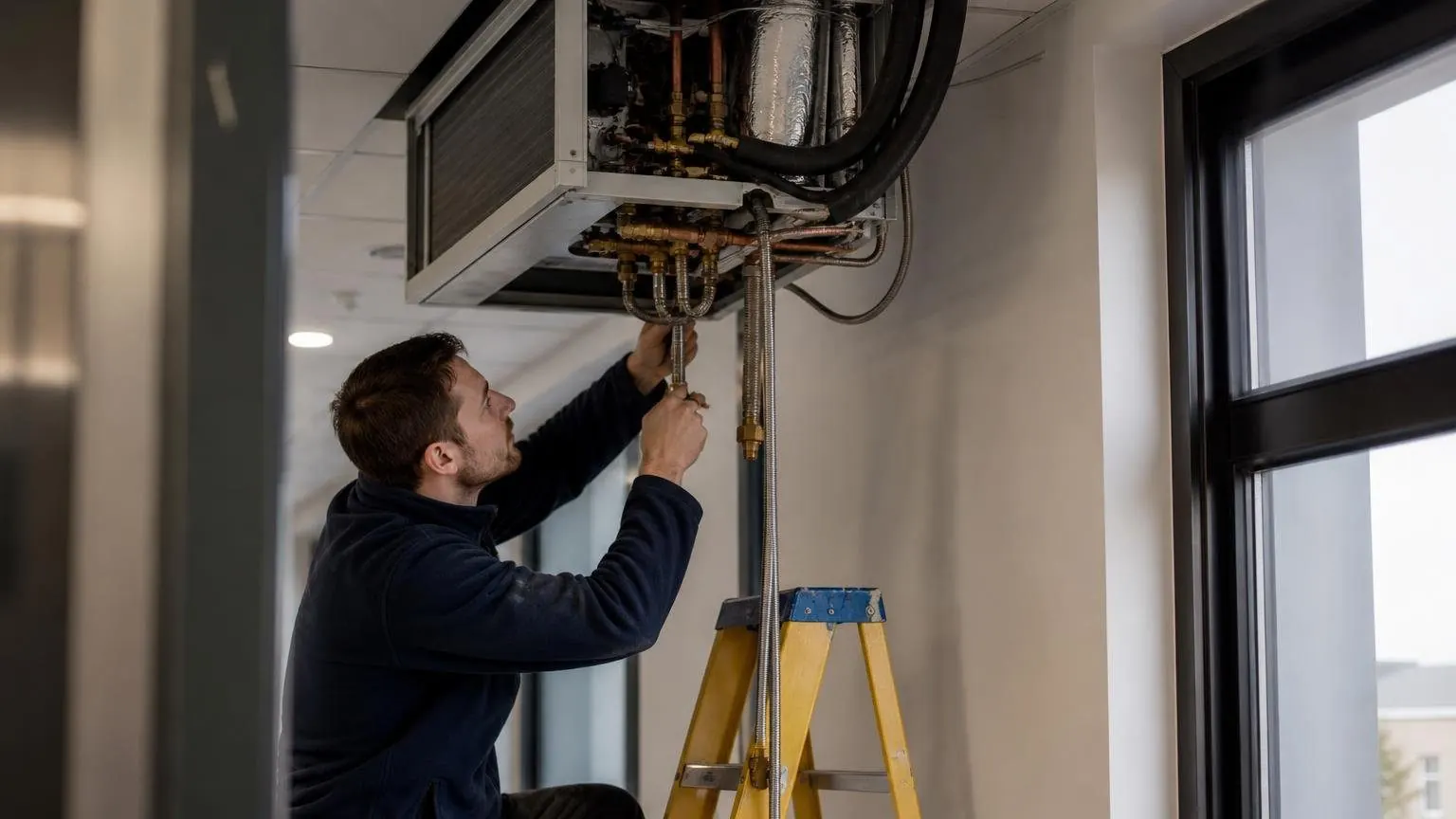
What is a water source heat pump? A water source heat pump is a reversible heat pump that trades heat with a circulating water loop instead of outdoor air. In most commercial buildings a boiler and cooling tower hold that shared loop between about 60°F and 90°F.
Key Takeaways
- Federally, a water-source heat pump uses a “circulating water loop” as heat source and sink, per 10 CFR 431.92.
- Since October 9, 2015 the minimums are EER 12.2 below 17,000 Btu/h, EER 13.0 up to 135,000 Btu/h and COP 4.3, per 10 CFR 431.97.
- ISO 13256-1:1998 rates water-loop units at 86°F entering water for cooling and 68°F for heating (Table 1 and Table 2).
- Those ratings exclude the building loop pump, boiler and tower, as DOE explained in its December 2023 test procedure rule.
- DOE assumes a mean life of 19 years, borrowed from air-cooled air conditioners, in its 2015 final rule.
- ClimateMaster’s installation manual says filters “should be inspected every month” and recommends 3 gpm per ton of loop flow (maker guidance).
What is a water source heat pump?
A water source heat pump (WSHP) is a packaged heat pump whose outdoor coil is replaced by a refrigerant-to-water heat exchanger. In cooling it dumps heat into water; in heating it pulls heat out of water. The water, not the air outside, is its source and sink.
The federal definition in 10 CFR 431.92 lists a compressor, refrigerant-to-water and refrigerant-to-air heat exchangers, expansion devices, a reversing valve that flips the unit between modes, and an indoor fan. The cycle is the one described in how any heat pump moves heat.
Units are zone-sized and sit in ceilings, closets or under windows. Daikin Applied lists its lines from 1/2 ton consoles to 25 tons (maker product page). That layout suits offices, hotels, schools and apartment towers.
How does a water source heat pump system work with a boiler and cooling tower?
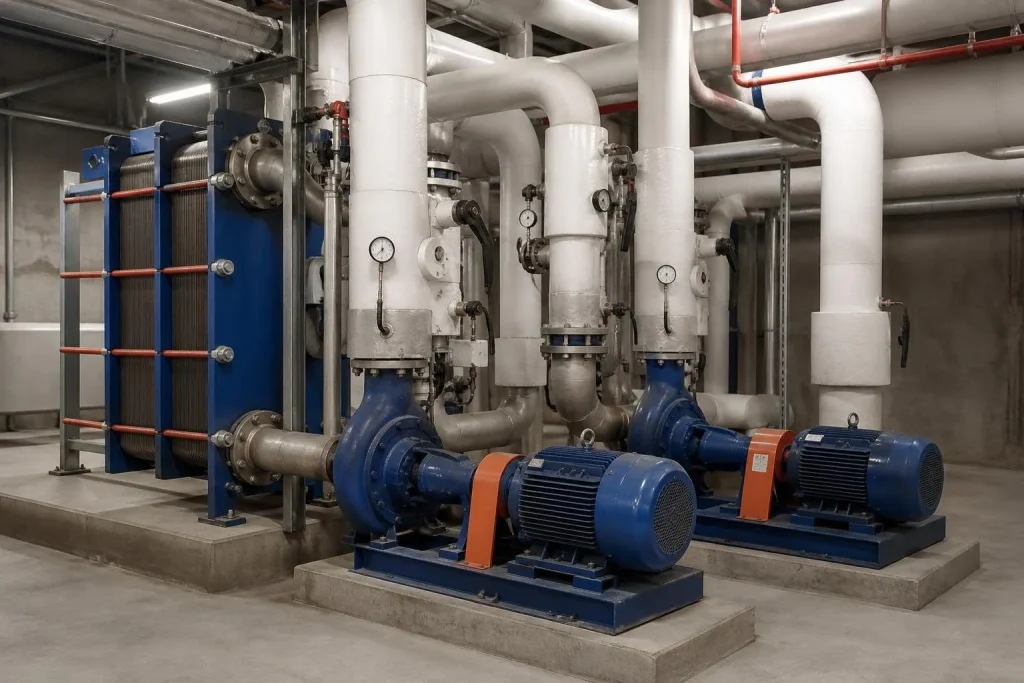
In a boiler/tower system, many WSHPs share one closed water loop. A boiler adds heat when the loop runs cold, a cooling tower sheds heat when it runs warm.
- Each zone runs its own unit. Heating units take heat from the loop; cooling units reject heat into it.
- The loop carries heat between zones. Natural Resources Canada calls this heat recovery: heat from a building’s core “can be transferred to its outer zone (or perimeter area) by the circulating water” (NRCan).
- The boiler covers a heating shortfall. When heating dominates, the loop cools until the boiler fires.
- The tower covers a cooling surplus. When cooling dominates, the loop warms until the tower rejects heat.
- Pumps run whenever units run. A loop circulating pump holds flow at every unit; ClimateMaster recommends 3 gpm per ton.
ClimateMaster’s product guide claims that in winter, with the core cooling and the perimeter heating, “both the boiler and the heat rejector remain off much of the time” (maker claim). That holds only when the two loads roughly cancel.
What loop temperature does a water source heat pump need?
A boiler/tower loop is usually held between 60°F and 90°F, the band ClimateMaster gives in its Tranquility 16 installation manual. The rating standard is wider: ISO 13256-1:1998 notes that a water loop “is usually mechanically controlled” between 15°C and 40°C, which is 59°F to 104°F.
Practice is drifting lower. DOE wrote in 2023 that loops were once kept above 60°F by a boiler, but current installations “are typically controlled to allow water-loop temperatures to drop to temperatures closer to 50 °F” (88 FR 84188, December 4, 2023). A cooler loop keeps the boiler off longer but trims each unit’s heating capacity.
Two loop rules from the maker manual
ClimateMaster recommends a closed-circuit tower with a secondary heat exchanger between tower and loop, and unit insulation whenever loop water is expected below 60°F, to stop condensation.
Water source vs geothermal vs air source heat pump: what is the difference?
The machine is the same; the water source differs. ISO 13256-1:1998 defines three applications, each tested at its own entering water temperature.
| Type | Heat source and sink | Typical water range (ISO 13256-1 notes) | Rating water temp, cooling / heating |
|---|---|---|---|
| Water-loop heat pump (boiler/tower) | Shared building loop, boiler and tower | 59°F to 104°F | 86°F / 68°F |
| Ground-loop heat pump (closed loop geothermal) | Brine in buried or submerged pipe | 23°F to 104°F | 77°F / 32°F |
| Ground-water heat pump (open loop) | Water pumped from a well, lake or stream | 41°F to 77°F for deep wells | 59°F / 50°F |
| Air-source heat pump | Outdoor air | Follows the weather | Not rated under ISO 13256-1 |
Water source vs geothermal is a question of loop: a ground-coupled system swaps boiler and tower for the earth, and our guide to geothermal loops and ENERGY STAR ratings covers those designs. Because ground loops can run below freezing, ISO tests them with a 15% salt brine, which DOE notes “can withstand temperatures as low as 14 °F.”
Water source vs air source comes down to what the coil sees. A conditioned loop does not fall toward single digits as winter air can, so the capacity loss in our cold-weather heat pump data largely does not apply. The trade is running and maintaining a loop plant.
Do you need a well or a lake? No. A boiler/tower WSHP runs on a closed loop of recirculated water, and its water use is mainly makeup for the evaporative cooling tower.
How efficient is a water source heat pump, and what is the federal minimum?
Water source heat pump efficiency is rated as EER (cooling) and COP (heating). Minimums in 10 CFR 431.97, Table 6 have applied since October 9, 2015, and test results come from ISO 13256-1:1998 under Appendix C to Subpart F of Part 431.
Most models beat the floor. In its 2015 final rule, DOE’s review of the AHRI directory found an average EER of 15.2 and COP of 4.9 for units from 17,000 to 65,000 Btu/h.
Correction: a WSHP’s EER is not the system’s efficiency
ISO 13256-1:1998 counts only the pump power needed to push water through the unit itself, using an assumed pump efficiency of 0.3. DOE stated plainly that it “does not reflect the pump power needed to overcome liquid ESP from the water loop.” Boiler fuel and tower fan energy sit outside the rating too, so a 13.0 EER unit on a busy loop delivers less than the label suggests.
DOE’s 2023 rule adopted AHRI 600-2023 metrics, IEER and ACOP, that add system pump power and, for cooling, tower power. ACOP is tested at 50°F entering water instead of 68°F, and IEER’s lowest point is 55°F. Those metrics become mandatory only when DOE adopts amended standards in IEER terms; as of the October 2026 eCFR, Table 6 still sets EER and COP.
What maintenance does a WSHP need?
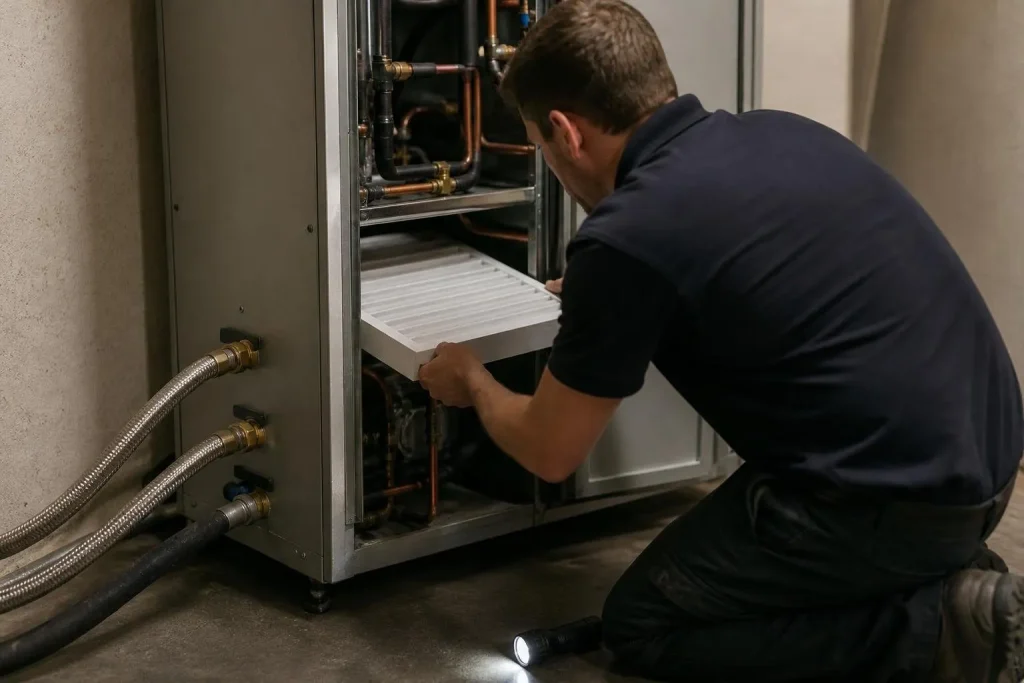
WSHP maintenance covers each unit and the shared loop. This unit schedule is from ClimateMaster’s Tranquility 16 (TC) manual; follow your own unit’s manual.
- Filters, every month. Inspect monthly and replace as needed; never run a unit without a filter. Our filter ratings explainer covers MERV choices.
- Condensate drain, twice a year. Inspect for plugging; where slime grows, the manual suggests an algaecide about every three months.
- Air coil, once a year. Check it and brush or vacuum clean if dirty.
- Compressor and fan motor, once a year. Amp draw should be no more than 10% above the serial plate value. Fan motors are permanently lubricated; do not oil them.
- Water coil, as needed. Closed loops “generally” need no coil maintenance, but flow above 3 gpm per ton can erode the heat exchanger wall.
The loop needs strainers, air elimination, water treatment and a treated tower. Often a building automation system watches loop temperature and stages the boiler, tower and pumps, so its trend logs are the first stop when units trip on water temperature.
How long does a water source heat pump last?
There is no measured federal figure for water source heat pump life. The closest number is DOE’s modelling assumption: a mean lifetime of 19 years, used in its 2015 standards analysis.
DOE was open about the limit. A WSHP-specific retirement curve “was not available,” so it borrowed the one for air-cooled air conditioners, asked for better data, and “did not receive any comments” (DOE 2015 final rule). Treat 19 years as a planning average, not a promise.
A failed zone unit can be swapped alone, a contrast with a central chiller plant. For scale, WaterFurnace told DOE that about 200,000 units a year sell under AHRI and ISO 13256 certification, a maker figure DOE recorded but did not verify.
How we researched this
Researched October 13, 2026. We read 10 CFR 431.92, 431.96, 431.97 and Appendix C (eCFR, October 1, 2026 edition), the ISO 13256-1:1998 text incorporated by reference, DOE’s 2015 and 2023 rules and Natural Resources Canada; ClimateMaster and Daikin Applied documents are labelled maker data. Top ranking pages were read for gaps only. Excluded: installed prices (no federal series for WSHPs), contractor blogs, and Reddit.
Frequently asked questions
Is a water source heat pump the same as a geothermal heat pump?
Not quite. A geothermal unit is a water source heat pump on a ground loop or well. ISO 13256-1:1998 rates the ground-loop version at 77°F entering water for cooling and 32°F for heating, against 86°F and 68°F for a boiler/tower water-loop unit.
What is the difference between a water source heat pump and a fan coil unit?
A WSHP carries its own compressor and reversing valve, per 10 CFR 431.92. A fan coil has no compressor; it blows air over a coil fed with chilled or hot water from a central plant. See our fan coil unit explainer.
Is a water source heat pump better than VRF?
They solve the same zoning problem differently. A WSHP system moves heat in water between packaged units; VRF moves refrigerant from a central condenser. Water-source VRF also exists, with its own rows in 10 CFR 431.97, separate from the EER 13.0 WSHP minimum.
How much water flow does a water source heat pump need?
ClimateMaster’s Tranquility 16 manual sets loop flow between 2.25 and 3.5 gpm per ton and recommends 3 gpm per ton for most water loop jobs. It warns that more than 3 gpm per ton can erode the heat exchanger wall.
What happens if the loop gets too cold?
A low water temperature cutout stops the unit to protect the heat exchanger. On ground loops that use antifreeze, ClimateMaster says freeze protection should sit 15°F below the lowest expected entering loop temperature; boiler/tower loops rely on the boiler instead.
Does every water source heat pump need a cooling tower?
No. A boiler/tower system does, but a ground loop or well replaces both boiler and tower. Where a tower is used, ClimateMaster recommends a closed-circuit tower with a heat exchanger, and says an open tower run continuously needs chemical treatment and filtering.
Sources
- eCFR. “10 CFR 431.97, Table 6.” https://www.ecfr.gov/current/title-10/chapter-II/subchapter-D/part-431/subpart-F/section-431.97. Accessed October 2026.
- eCFR. “10 CFR 431.92, Definitions.” https://www.ecfr.gov/current/title-10/chapter-II/subchapter-D/part-431/subpart-F/section-431.92. Accessed October 2026.
- eCFR. “Appendix C to Subpart F of Part 431.” https://www.ecfr.gov/current/title-10/chapter-II/subchapter-D/part-431/subpart-F/appendix-Appendix%20C%20to%20Subpart%20F%20of%20Part%20431. Accessed October 2026.
- ISO. “ISO 13256-1:1998, Water-source heat pumps, Part 1.” https://law.resource.org/pub/us/cfr/ibr/inc/iso/iso.13256-1.1998.pdf. Accessed October 2026.
- US DOE. “Energy Conservation Program: Test Procedure for Water-Source Heat Pumps.” 88 FR 84188, December 4, 2023. https://www.govinfo.gov/content/pkg/FR-2023-12-04/html/2023-25921.htm. Accessed October 2026.
- US DOE. “Energy Conservation Standards and Test Procedures for Commercial Heating, Air-Conditioning, and Water-Heating Equipment.” Final rule, 2015. https://www.energy.gov/sites/prod/files/2015/06/f24/ashrae_finalrule_1.pdf. Accessed October 2026.
- Natural Resources Canada. “Internal water-loop heat pumps, commercial.” https://natural-resources.canada.ca/energy-efficiency/product-energy-ratings/internal-water-loop-heat-pumps-commercial. Accessed October 2026.
- ClimateMaster. “Tranquility 16 Compact (TC) Series Installation Manual.” https://files.climatemaster.com/97b0075n07-climatemaster-commercial-tranquility-16-compact-tc-series-water-source-heat-pump-installation-manual.pdf. Accessed October 2026.
- ClimateMaster. “Water-Source Heat Pump Product Guide.” https://files.climatemaster.com/ep012-climatemaster-50hz-water-source-heat-pump-product-guide-english.pdf. Accessed October 2026.
- Daikin Applied. “Water Source Heat Pumps.” https://www.daikinapplied.com/products/water-source-heat-pumps. Accessed October 2026.
Leave a Reply