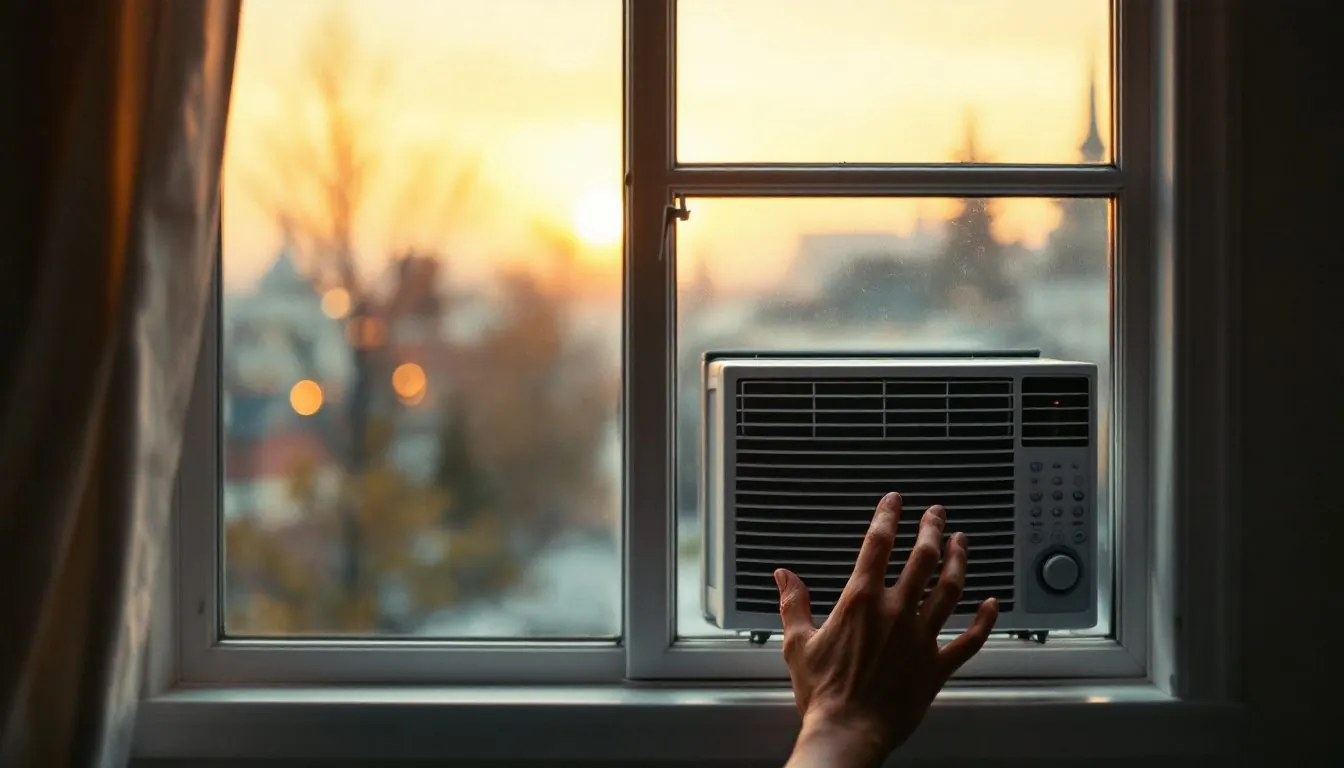
Is it safe to use window AC during wildfire smoke? Yes, for most homes, if the outdoor air damper is closed and the side gaps are sealed. EPA’s June 2026 smoke guide tells owners to run recirculation mode, but the unit does not clean smoke, so add a portable air cleaner.
Is a window AC safer in smoke than a portable, a mini split or a swamp cooler?
Yes, against a single-hose portable, an unfiltered swamp cooler or open windows. The EPA indoor air page tells owners of those portables and coolers to consider other options and names the window air conditioner as one. The June 2026 Wildfire Smoke Guide adds that homes with air conditioning “generally have lower concentrations of PM2.5 from the outdoors” than homes cooled with open windows.
| Cooling type | How smoke gets in | What to do |
|---|---|---|
| Window AC | Open vent, panel gaps | Recirculate, close damper, seal gaps, add air cleaner |
| Mini split | No added path, per EPA | Run it, add air cleaner |
| Central air | Fresh air intake, leaky attic or crawlspace ducts | Close intake, fan always on, MERV 13 if compatible |
| Dual-hose portable | EPA: usable “without restriction.” DOE lab: 87 to 196 cfm net still drawn from the room | Run it, seal the window kit |
| Single-hose portable | Exhausts room air; DOE lab: 175 to 285 cfm leaks back | Use sparingly |
| Swamp cooler | Large outdoor airflow; PM2.5 falls only 10 to 40 percent unfiltered | Cover intakes with 4 inch MERV 13 (about 50 percent less for 0.3 to 0.5 micron particles) or use sparingly |
Compiled by The HVAC Brief from EPA’s 2026 guide section 3.4, EPA’s smoke and heat fact sheet, and DOE Table III.4 (80 FR 10212).
Which lever position on my window AC keeps smoke out?
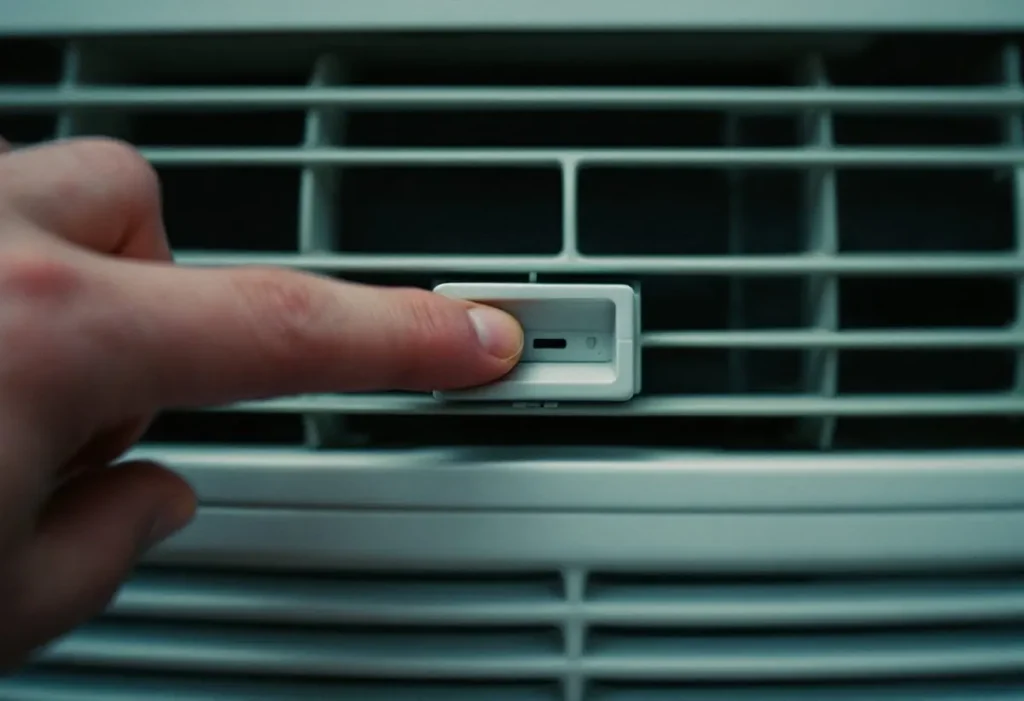
The position labelled Closed, Close or Re-Circulate. The trap is the other label: “Vent Open” means opposite airflow directions in two Frigidaire documents, so read your own manual.
| Maker document | Smoke position | What the other positions do |
|---|---|---|
| Frigidaire support article | Vent Closed | Fresh Air draws air in. Vent Open expels indoor air. |
| Frigidaire 220218A007 manual | Vent Closed | Vent Open draws air in. Vent and Exhaust Open exchanges air. |
| GE PWDV08 to PWDV14 manual: “12k and 14k only” | Vent Closed | Vent Open draws air in. Exhaust Open exhausts room air. |
| GE AJEM 10 manual: card behind the grille, held by a screw | CLOSED | OPEN “allows outdoor fresh air exchange.” |
| LG LW7010HR manual | CLOSE | OPEN: “The damper is opened and room air is drawn out.” |
| Friedrich SS08 manual | Re-Circulate | Fresh Air admits outside air. Exhaust expels stale air. |
| Kenmore 35932 manual (through the wall) | CLOSE | OPEN exhausts room air. |
Compiled by The HVAC Brief from the maker documents listed under Sources. We found no Midea or Hisense vent document.
Exhaust is not the safe setting it sounds like. Kenmore’s manual says that with the vent open, “Fresh air is drawn into the room through your home’s normal air passages.” In smoke, those passages are the cracks and door gaps EPA calls infiltration. We found no federal measurement of how much air a window unit’s vent moves, so we quote no cfm figure for it.
No lever at all is normal: 10 CFR 430.2 says a room air conditioner “may include additional means for ventilating.” If a lever will not close, EPA says to “consider preparing other cooling options like a fan.” Do not pull the chassis to free it mid-event, because line voltage and a charged run capacitor sit behind those panels. A technician will check whether the damper linkage has come off the lever.
Does a window AC filter wildfire smoke out of the room air?
No. EPA’s smoke and heat fact sheet says these units “typically do not have filters designed for the PM2.5 in smoke.” GE’s PWDV manual describes a filter you wash in soapy water at least every 30 days. The protection comes from keeping windows shut; an air cleaner does the removal. How often smoke reaches unhealthy levels in your state is tracked in our wildfire smoke and air quality statistics.
| What you do | Indoor PM2.5, share of outdoor | At 150 µg/m³ outdoors (example) |
|---|---|---|
| Windows open | Similar to outdoors | About 150 µg/m³ |
| Windows closed, AC, no air cleaner | 55 to 60 percent (homes range 30 to 100) | About 83 to 90 µg/m³ |
| Same, plus portable air cleaner | About 19 to 21 percent | About 29 to 32 µg/m³ |
HVAC Brief calculation from EPA’s 2026 guide: sections 3.1 and 3.5, average air cleaner reduction 65 percent (55 x 0.35 = 19; 60 x 0.35 = 21).
EPA’s sizing rule is a tobacco smoke CADR of at least two-thirds of floor area, so CADR 80 for a 10 by 12 foot room. Our air purifier sizing page works a larger room, and a Corsi-Rosenthal box is the DIY route. With ducted air too, check MERV 13 against your blower first.
How do I find the leaks around the side panels of a window AC?
Look for daylight and feel for moving air around the whole perimeter, which EPA’s 2026 guide calls the easy test. GE’s PWDV parts list includes a side curtain frame, two foam top window gaskets and a foam insert, so confirm each is in place, then fill remaining gaps from the room side. EPA warns against anything that makes it hard to leave the room in an emergency. Leave the outdoor louvers clear, because the condenser rejects heat there. The same gaps leak heat in winter, which is one reason it is bad to leave a window AC in the window all year.
Ignore the claim that a running window unit pressurizes the room against smoke. No EPA or maker document we read says so, and a closed-damper unit returns the same room air it takes.
How much outdoor air does a single-hose portable pull in, compared with a window unit?
Roughly 175 to 285 cfm in DOE’s lab, against no room air used for condenser cooling in a window unit. DOE’s 2015 proposed test procedure set infiltration equal to condenser exhaust flow for single-duct units and published it per unit.
| DOE test units | Net air from the room | Share of exhaust | Added air changes per hour |
|---|---|---|---|
| Single-hose, median of 18 | 247 cfm | 100 percent | 1.03 |
| Single-hose, highest | 285 cfm | 100 percent | 1.19 |
| Dual-hose, median of 7 | 101 cfm | 37 percent | 0.42 |
| Dual-hose, highest | 196 cfm | 72 percent | 0.82 |
HVAC Brief calculation from DOE Table III.4 (80 FR 10212): cfm x 60 / 14,400 cubic feet (an 1,800 sq ft house at 8 ft). Dual-hose shares ran 37 to 72 percent.
Here the documents disagree. EPA calls dual-hose units usable “without restriction”; DOE found they “also draw a portion of their condenser air from the conditioned space,” and 10 CFR 430.2 allows it. A dual hose beats a single hose but is not neutral. These are 2015 lab airflows, not smoke measurements, and DOE notes replacement air may come from a basement, attic or garage. Single-hose units also lose cooling capacity. EPA applies the same pressure logic to range hoods, bath fans, dryers and any whole house fan.
What if the room gets dangerously hot and every cooling option lets smoke in?
Cool down first. EPA’s fact sheet says “for most people, heat is more immediately dangerous,” and that you “may need to allow smoke inside while using night air for cooling.” By that logic, a single-hose portable beats a room you cannot cool, and US heat death counts show the stakes. With no AC, EPA says to shut windows and shades by day, open up with fans at night, close once cool, then filter. Do not aim a fan at yourself above 90°F. If you cannot stay cool, go to a cooling center or library, or call 2-1-1. An evacuation notice overrides this page.
How can I tell whether my window AC setup is keeping smoke out?
Compare an indoor PM2.5 reading with the outdoor one in the same units. Home monitor accuracy is limited, so read trends over single numbers.
- Near 100 percent of outdoors: something is open. Check the vent lever, sashes, range hood, bath fan and dryer.
- Around 55 to 60 percent: normal for a closed home with no cleaner. Add one in the AC room.
- Around 20 percent: matches EPA’s average with a cleaner.
When outdoor readings drop, EPA’s guide says to air out, even briefly. Our natural ventilation page has the AQI bands for that call.
Frequently asked questions
Does a window AC pull in smoke from outside?
Not through the cooling loop when the damper is closed. EPA’s 2026 guide says most air conditioners are designed to recirculate indoor air. Smoke still reaches the room through an open vent, gaps around the side panels and ordinary leaks at cracks and doors, which is why closed homes average 55 to 60 percent of outdoor PM2.5.
Should I turn off my window AC during wildfire smoke?
Not because of the smoke alone. EPA’s 2026 guide lists window air conditioners among the ways to stay cool in a cleaner air room, and its fact sheet says heat is more immediately dangerous for most people. Shut it off only if the damper is stuck open and a fan can keep you cool.
Why does my room still smell like smoke with the AC running?
Many gases in smoke are odorous, and particle filters do not stop them. EPA’s 2026 guide says cleaners that remove those gases use activated carbon or chemisorbent media, which are generally quite expensive and often short-lived. It also says to replace a filter once it starts to release smoke odors.
Does wildfire smoke damage a window air conditioner?
We found no federal or maker data measuring smoke damage to a window unit. GE’s PWDV manual does mention soot: outdoor coils “should be checked regularly,” and if clogged with dirt or soot “they may be professionally cleaned.” Wash the filter after the event, then look at the coils.
How we researched this
In November 2026 we read sections 3.1, 3.4, 3.5 and 3.8 of EPA’s June 2026 guide, two EPA fact sheets and EPA’s indoor air page, extracted and recalculated DOE Table III.4, read 10 CFR 430.2, and opened manual pages for seven units. Most manuals were read as extracted ManualsLib text, not original PDFs. Contractor blogs, retailers and news summaries were excluded as number sources. CDC’s wildfire page failed to load.
Sources
- U.S. EPA, CARB, OEHHA, CDC, USFS. “Wildfire Smoke Guide for Public Health Officials, EPA-452/B-26-001, June 2026 (OEHHA copy).” https://oehha.ca.gov/sites/default/files/media/2026-06/wildfiresmokeguide.pdf. Accessed November 2026.
- U.S. EPA. “Protect Yourself From Smoke and Heat.” https://www.epa.gov/system/files/documents/2026-06/heat-and-smoke-factsheet_1.pdf. Accessed November 2026.
- U.S. EPA. “Wildfires and Indoor Air Quality.” https://www.epa.gov/indoor-air-quality-iaq/wildfires-and-indoor-air-quality-iaq. Accessed November 2026.
- U.S. DOE. “Test Procedures for Portable Air Conditioners, 80 FR 10212, Table III.4.” https://www.federalregister.gov/documents/2015/02/25/2015-03589/energy-conservation-program-test-procedures-for-portable-air-conditioners. Accessed November 2026.
- eCFR. “10 CFR 430.2.” https://www.ecfr.gov/current/title-10/chapter-II/subchapter-D/part-430/subpart-A/section-430.2. Accessed November 2026.
- GE. “PWDV08 manual (ManualsLib).” https://www.manualslib.com/manual/3407639/Ge-Pwdv08.html?page=16. Accessed November 2026.
- GE. “AJEM 10 manual (ManualsLib).” https://www.manualslib.com/manual/1190161/Ge-Ajem-10.html?page=8. Accessed November 2026.
- Frigidaire. “What is the additional vent located under my air louvers?.” https://owner.frigidaire.com/support-articles/article/1847767-room-air-conditioners-what-is-the-additional-vent-located-under-my-air-louvers-. Accessed November 2026.
- Frigidaire. “220218A007 manual (ManualsDir).” https://www.manualsdir.com/manuals/103247/frigidaire-220218a007.html?page=9. Accessed November 2026.
- LG. “LW7010HR manual (ManualsLib).” https://www.manualslib.com/manual/350346/Lg-Lw7010hr.html?page=18. Accessed November 2026.
- Friedrich. “SS08 manual (ManualsLib).” https://www.manualslib.com/manual/521308/Friedrich-Ss08.html?page=17. Accessed November 2026.
- Kenmore. “35932 manual (ManualsLib).” https://www.manualslib.com/manual/770933/Kenmore-35932.html?page=13. Accessed November 2026.
Leave a Reply