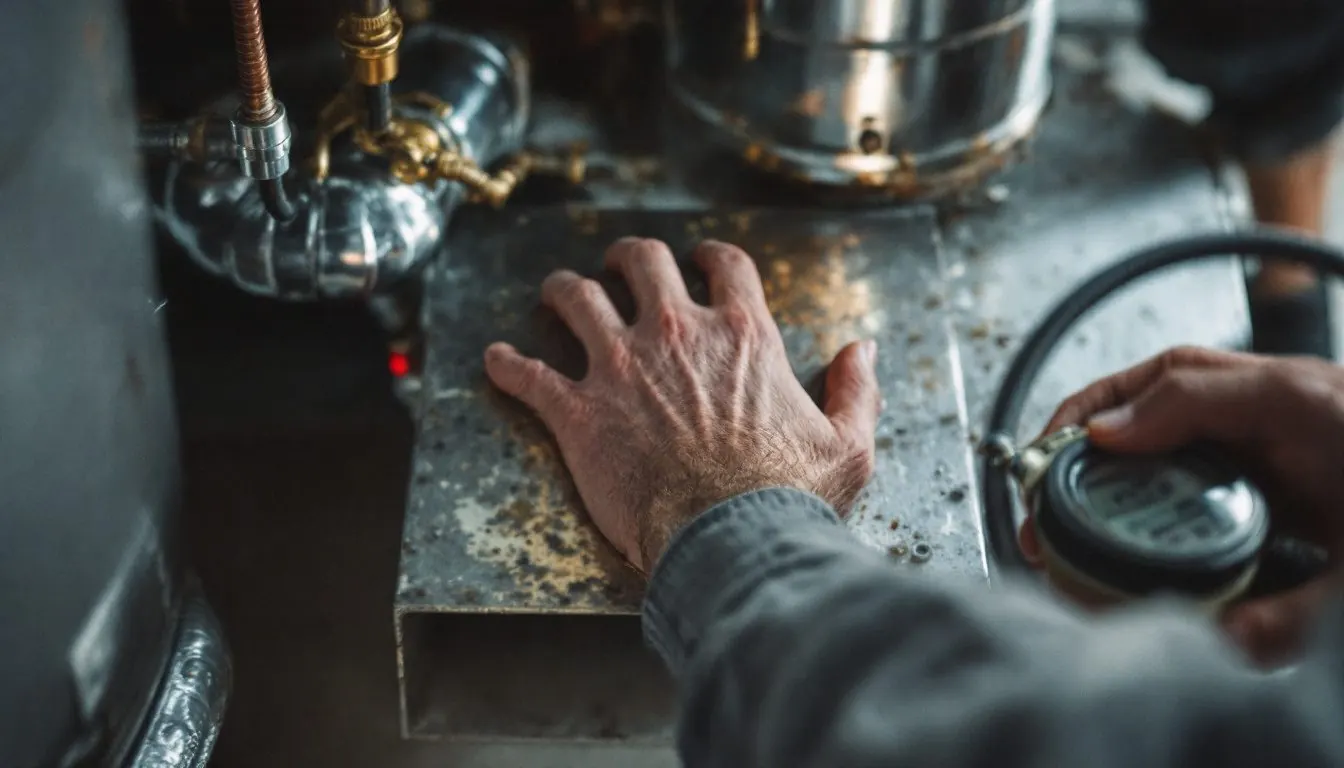
Ductwork popping when the furnace turns on is sheet metal moving. A flat duct panel snaps outward when the blower pressurizes it, about 30 seconds after the burners light, then the steel ticks as it heats and grows about 0.10 inch along a 20 foot trunk. A single boom before the blower starts comes from the furnace, not the ducts.
Which pop do you have? Time it against the furnace’s start sequence
The second the noise happens tells you what is moving. Goodman’s IOG-2038E manual lays out the heating sequence: inducer, pre-purge, igniter, gas valve, flame, and only then “After 30 seconds the indoor blower is energized on heating speed.” That 30 second gap separates a burner problem from a duct problem; time it with a phone stopwatch from the moment the burners light. Hums and whistles are on our HVAC noise chart.
| When you hear it | What is moving | Quick check | Fix that matches |
|---|---|---|---|
| Before the blower runs, as the burners light | Late gas ignition in the furnace | Boom comes from the burner area of the cabinet | Shut it off; technician checks ignition |
| About 30 s after the flame, when the blower starts | A flat panel snapping outward under supply pressure (oil canning) | Hand flat on the panel while a helper starts the fan | Stiffen that panel; lower static pressure |
| Scattered ticks over the first minutes of the run | Steel expanding and slipping at hangers, joints and framing | Ticks come from along the run, not from one spot | Pad contact points; flexible connector |
| When the blower stops, 30 to 180 s after the burners go out | The same panel springing back flat as pressure drops to zero | One pop, same spot as the start pop | Same as the start pop |
| Slow ticks after everything is off | Steel contracting as it cools | Fades as the trunk reaches room temperature | Pad contact points; it is not a fault |
Compiled by The HVAC Brief from the Goodman IOG-2038E sequence and delay menu and the Goodman GM9S80 manual. Goodman lets installers set the heat-on blower delay from 5 to 30 seconds, so time your own unit.
Why does the duct bang the instant the blower starts?
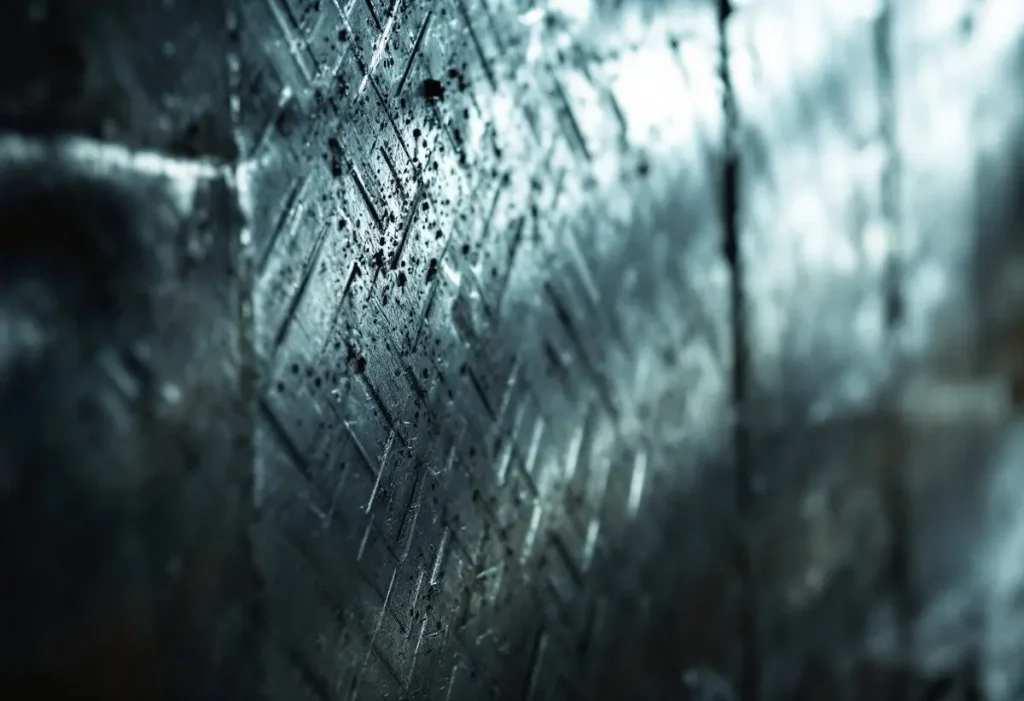
A thin flat sheet is suddenly loaded. The worked example in Goodman IOG-2038E reads +0.3 in. w.c. in the supply duct and negative 0.1 in. w.c. in the return. Pushing outward on a 20 by 60 inch panel, that supply pressure adds up to about 13.0 lb, applied in the time it takes the blower to spin up.
| Duct pressure (in. w.c.) | Pascals | Load per sq ft | Load on a 20 x 60 in panel (8.33 sq ft) |
|---|---|---|---|
| 0.1 (Goodman example return, pulling in) | 24.9 Pa | 0.52 lb | 4.3 lb |
| 0.3 (Goodman example supply, pushing out) | 74.7 Pa | 1.56 lb | 13.0 lb |
| 0.5 (furnace airflow table column) | 124.5 Pa | 2.60 lb | 21.7 lb |
HVAC Brief calculation: in. w.c. x 249.0889 Pa, divided by 47.88026 Pa per lb/sq ft (NIST SP 811), times our example panel area.
The metal is thin enough to flex. In jurisdictions that adopt the IRC, Table M1601.1.1 in the IRC duct chapter (Seattle 2021 reprint) allows galvanized rectangular duct 8 inches or smaller to be 0.013 inch thick at 1/2 inch water gauge, while 19 to 20 inch duct needs 0.024 inch at the same pressure. A wide, flat panel with no stiffening bows like the bottom of an old oil can: it holds its shape, then flips over center with a bang. A steady rattle from the same trunk, instead of a single bang, points to loose sheet metal, a damper or a joint, which furnace rattling noise separates from the furnace itself by where you hear it. The higher the static pressure in the ducts, the harder it flips.
How much does a 20 foot trunk grow when 133°F air hits it?
About a tenth of an inch. Steel’s coefficient of thermal expansion is 6.5 x 10⁻⁶ in/in/°F in the WisDOT Bridge Manual, which cites AASHTO LRFD 6.4.1. Supply air is return air plus the furnace’s temperature rise; Goodman’s GM9S80 manual lists rise ranges of 25 to 55°F, 20 to 50°F and 35 to 65°F depending on the model. With 68°F return air and the top of the 35 to 65°F range, supply air reaches 133°F.
| Duct starts at | Supply air | Swing | 10 ft run | 20 ft run | 40 ft run |
|---|---|---|---|---|---|
| 68°F (conditioned basement) | 103°F (35°F rise) | 35°F | 0.027 in | 0.055 in | 0.109 in |
| 68°F (conditioned basement) | 133°F (65°F rise) | 65°F | 0.051 in | 0.101 in | 0.203 in |
| 40°F (vented crawlspace in winter, our assumption) | 133°F (65°F rise) | 93°F | 0.073 in | 0.145 in | 0.290 in |
HVAC Brief calculation: length in inches x 6.5 x 10⁻⁶ x swing. Upper bounds; steel far from the plenum runs cooler. Goodman requires return air between 55°F and 100°F while heating.
Straps, screws and joists hold that 0.10 inch of growth until friction lets go, and each release is a tick. Pressure noise, by contrast, is one loud pop at a fixed spot 30 seconds after flame.
Why does ductwork pop when the furnace or the AC turns off?
When the blower stops, duct pressure drops to zero and the bowed panel springs back. On Goodman’s two-stage board the blower keeps running after the burners shut off for a heat-off delay the menu table sets from 30 to 180 seconds (default 90). The same manual’s text instead lists a factory setting of 150, so read your own board.
Ductwork popping when the AC turns off has the same cause with no heat involved. Goodman’s cool-off delay defaults to 65 seconds and can be set from 0 to 120 seconds, so the pop lands at the end of that delay.
How do you stop ductwork popping without replacing the ducts?
A pressure pop at blower start needs a stiffer panel or less static pressure; expansion ticks need the duct to slide. Work cheapest first.
1. Find the panel. Lay a hand on wide, flat panels near the plenum while a helper sets the thermostat fan to ON; the oil-canning one flexes under your palm.
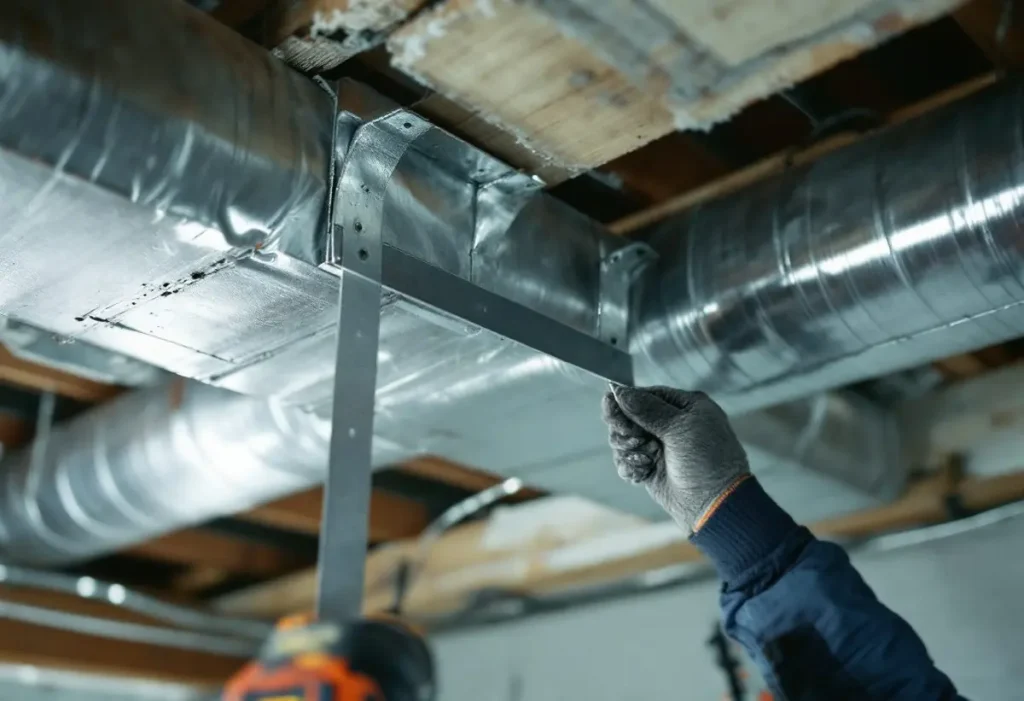
2. Stiffen it. Screw a length of sheet-metal angle or a 1 by 2 across the flat span,, or replace the section with one cross-broken (a shallow X bend) or beaded. The IRC sends ducts wider than 20 inches to the SMACNA standard for reinforcement; we could not open it, so we give no threshold. Round spiral duct has no flat panel to flip.
3. Lower the pressure. Goodman’s GM9S80 manual says to compare total external static against the maximum on the furnace rating plate and, if it is over, “check for closed dampers, registers, undersized or poorly laid out duct work.” Swap a loaded filter (our furnace filter guide compares types), reopen closed registers, and ask the technician for a manometer reading. A starved return is a common culprit, covered in what happens if the return duct is too small.
4. Soften the start. Pressure loss in a duct rises with velocity squared, per the DOE and AMCA fan sourcebook equation. On the Goodman *R9T960303AN table, low fire on tap F01 moves 568 CFM against 930 CFM on high fire tap F05 at 0.50 in. w.c., so the same ducts see about 37% of the pressure at low fire (our arithmetic: 568 divided by 930, squared). Nordyne’s variable-speed blower kit ramps to about 1/3 of cooling airflow for 30 seconds, then about 3/4 for another 30 seconds; in gas heat it runs “at a very low speed” for 30 seconds before ramping. See single-stage vs variable-speed.
5. Let the steel slide. Where a trunk rubs a joist or a hanger strap pinches it, pad the contact with felt or rubber and loosen screws driven into framing. Goodman’s manuals say supply and return connections “may be made with flexible joints to reduce noise transmission,” and IRC section M1601.2 limits vibration isolators between equipment and metal ducts to 10 inches long.
6. Expect less from insulation. Wrap muffles a pop, but the steel inside still heats toward 133°F supply air and expands; our duct insulation guide covers its energy case.
When is the bang not the ductwork at all?
When it happens in the 30 seconds between flame and blower start on a Goodman sequence. A boom as the burners light points to delayed ignition: shut the furnace off and do not keep resetting it. What the technician measures on a furnace that does this is set out in why a furnace makes a loud bang when turning on.
The technician should watch several ignitions, check burner crossover and measure manifold pressure. Goodman allows final manifold pressure to vary by no more than 0.3 in. w.c. either way from the specified setting on natural gas. Goodman’s rollout limits, which “guard against burner flames not being properly drawn into the heat exchanger,” are manual-reset switches; a tripped rollout switch plus a boom is a stop sign. Our cracked heat exchanger guide explains what that inspection involves.
Two other noises get mistaken for ducts. The furnace vent pipe ticks as flue gas heats it on 80% Category I furnaces such as the GM9S80. A steady hum with no pop is electrical or mechanical, not metal movement, and belongs on our furnace humming noise page.
Frequently asked questions
Why is my ductwork popping?
Either pressure or heat is moving the steel. A single pop when the blower starts or stops is a flat panel flexing under duct pressure; Goodman’s example reads +0.3 in. w.c. on the supply side, about 13.0 lb on a 20 by 60 inch panel by our math. Ticks spread over several minutes are the trunk expanding about 0.10 inch per 20 feet and slipping at supports.
Why does my ductwork keep popping every cycle?
Because the cause repeats every cycle: the blower pressurizes the same panel and the steel heats through the same swing each time. It stays until the panel is stiffened, static pressure is lowered below the rating plate maximum, or contact points are freed. A 20 foot trunk grows about 0.10 inch on a 65°F swing.
Is a ductwork popping noise dangerous?
Duct popping is a nuisance, not a hazard. The exception is timing: a boom before the blower runs comes from the burners, and Goodman’s sequence starts the blower 30 seconds after flame. A noise in that window, especially with a tripped manual-reset rollout switch, means shut the furnace off and have ignition and manifold pressure checked.
Will insulating the ducts stop the popping?
It muffles the sound but does not stop the movement. The steel sits inside the wrap and still heats toward supply air, which can reach 133°F with 68°F return air and a 65°F rise. Insulation adds no stiffness, so pressure pops continue too.
Does a variable-speed furnace stop ductwork popping?
Often it softens it, because the blower ramps instead of slamming on. Nordyne’s variable-speed kit runs at a very low speed for 30 seconds in gas heat before ramping to full heating airflow. Nordyne’s FG6 spec sheet, hosted in Rheem’s literature archive, describes “quiet, gradual starts and stops.” A constant-airflow motor also holds airflow as static rises, so an undersized duct can still oil-can at full speed.
How we researched this
Researched November 7 and 8, 2026. We read two Goodman furnace manuals (IOG-2038E, GM9S80), two Nordyne blower documents, the 2021 Seattle Residential Code duct chapter (an amended IRC reprint), the WisDOT Bridge Manual, NIST SP 811 and the DOE and AMCA fan sourcebook. Top results from Angi, This Old House, The Money Pit and a contractor blog gave no numbers and are not cited. The SMACNA standard was not available to us. Expansion and loads are our calculations.
Sources
- Goodman Manufacturing. “*R9T96 & *D9T96 Two-Stage Gas Furnaces Installation Instructions (IOG-2038E).” https://mobile.goodmanmfg.com/mobileapp/stellent/pdf/infoPdf/Lit/IOG-2038E.pdf. Accessed November 2026.
- Goodman Manufacturing. “Installation Instructions for *M9S80 & *C9S80* Gas Furnace.” https://documents.alpinehomeair.com/product/goodmangm9s8gc9s8installationmanual.pdf. Accessed November 2026.
- City of Seattle. “2021 Seattle Residential Code, Chapter 16: Duct Systems.” https://www.seattle.gov/documents/Departments/SDCI/Codes/SeattleResidentialCode/2021SRCChapter16.pdf. Accessed November 2026.
- Nordyne. “Installation Instructions: Variable Speed Blower Kit for Gas Furnace Applications (7083950).” https://files.rheem.com/LiteratureArchive/7083950.pdf. Accessed November 2026.
- Nordyne. “FG6RK Series with Variable Speed Blower: Technical Specifications.” https://files.rheem.com/LiteratureArchive/a496b.pdf. Accessed November 2026.
- Wisconsin Department of Transportation. “WisDOT Bridge Manual, Chapter 9: Materials.” https://wisconsindot.gov/dtsdManuals/strct/manuals/bridge/ch9.pdf. Accessed November 2026.
- National Institute of Standards and Technology. “NIST Guide to the SI, Appendix B.8: Factors for Units Listed Alphabetically.” https://www.nist.gov/pml/special-publication-811/nist-guide-si-appendix-b-conversion-factors/nist-guide-si-appendix-b8. Accessed November 2026.
- U.S. Department of Energy and AMCA. “Improving Fan System Performance: A Sourcebook for Industry.” https://www.energy.gov/sites/prod/files/2014/05/f16/fan_sourcebook.pdf. Accessed November 2026.
Leave a Reply