
What is an infrared heater? An infrared heater is a radiant heater that warms people and objects in its line of sight instead of the room air. Electric models turn every watt into heat like any resistance heater, so they save money only when you heat a spot, not a house.
Key Takeaways
- The Department of Energy says radiant heaters are the more efficient choice when you will be in a room for only a few hours and can stay in the heater’s line of sight (DOE Energy Saver, archived copy).
- DOE calls electric resistance heating 100% efficient, so a 1,500 watt infrared heater uses 1.5 kWh an hour, the same as any 1,500 watt heater (DOE, archived copy).
- At the August 2026 US residential average of 18.16 cents per kWh, that hour costs about 27 cents (EIA Table 5.6.A).
- EIA’s 2020 RECS counts 25.08 million homes using portable electric heaters as secondary heat and 3.03 million as main heat (RECS Table HC6.1).
- A 2025 revision of UL 1278 requires a tip-over switch on movable electric heaters, effective December 12, 2028 per Intertek (Intertek notice).
- Modine’s gas infrared tube heater manual lists 54 to 106 inches of clearance below the tube and says the unit is not for use in residential dwellings (Modine IPT manual).
What is an infrared heater, and how is it different from a convection heater?
An infrared heater moves heat by radiation: a hot element emits infrared energy that warms whatever surface it strikes, including skin. A convection heater warms air, which then circulates. An oil filled radiator is the slowest convection type, holding its heat in a sealed reservoir of oil. DOE’s Energy Saver guidance puts it plainly: radiant heaters “emit infrared radiation that directly heats objects and people within their line of sight” (DOE).
That is why the heat vanishes when you step behind a sofa. It is the same physics as radiant floor heating, only concentrated in a small, hot emitter instead of a warm floor.
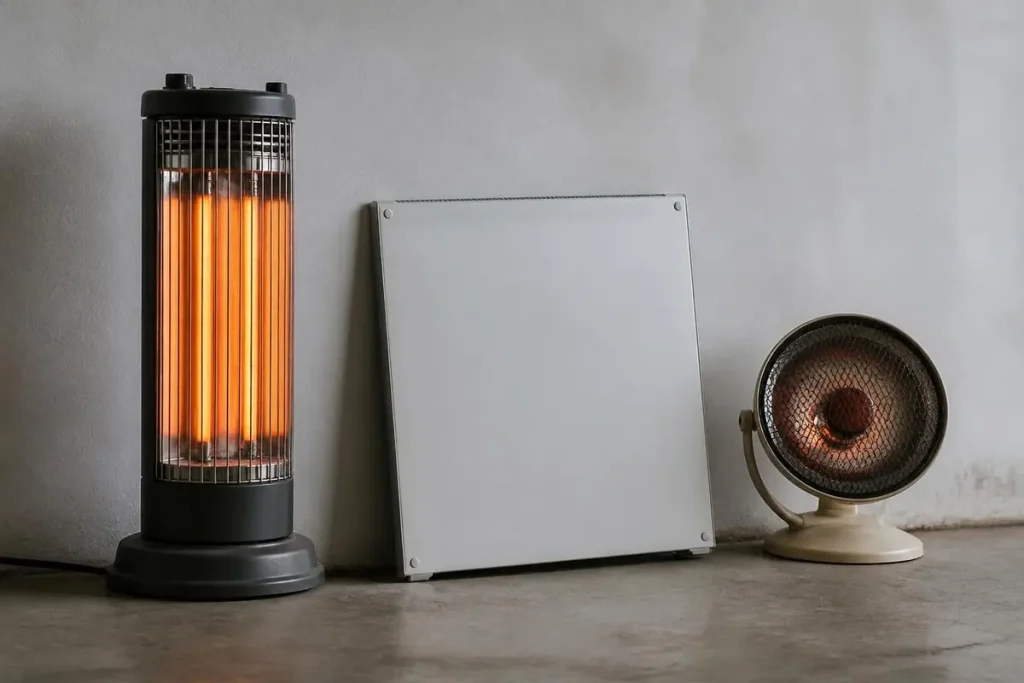
What types of infrared heater are there?
Infrared heaters split into electric emitters for rooms and patios and gas fired emitters for shops, warehouses and outdoor spaces. The tall propane patio heater seen at restaurants is the best known gas fired example, built for open air only.
| Type | Fuel | Typical use | What to check |
|---|---|---|---|
| Quartz or carbon element heater | Electric, 120 V plug in or hardwired | Spot heat at a desk, bench or patio | UL 1278 listing for movable or wall hung units; outdoor rating |
| Cabinet “infrared” space heater | Electric, plug in | Single room | Whether it has a fan; a fan makes part of the heat convective |
| Far infrared wall or ceiling panel | Electric, usually hardwired | Supplemental room heat, additions | Line of sight; ceiling panels heat heads and shoulders first |
| Low intensity gas tube heater (Modine IPT) | Natural gas or propane, vented | Shops, warehouses, commercial garages | Clearances below the tube, mounting height, “not for use in residential dwellings” |
| Portable propane infrared heater | Propane cylinder, unvented | Job sites, outdoor work | Indoor rating, carbon monoxide risk |
DOE notes that “most commercially available radiant panels for homes are electrically heated,” and that radiant panels “have the quickest response time of any heating technology” (DOE, archived copy). Before you treat a portable propane unit as an indoor heater, read our guide to which propane heaters are rated for indoor use.
Do infrared heaters use a lot of electricity?
An electric infrared heater uses exactly its rated wattage while the element is on: 1.5 kWh for every hour at 1,500 watts. DOE says electric resistance heating “is 100% energy efficient in the sense that all the incoming electric energy is converted to heat,” and that applies to quartz, carbon, ceramic and panel heaters alike (DOE).
Myth check
Retail guides often call infrared heaters “more efficient.” No electric heater converts more than 100% of its electricity to heat; infrared saves only when you keep the room air cooler and heat just yourself.
The worked hour: 1.5 kWh multiplied by the August 2026 US residential average of 18.16 cents per kWh is about 27 cents (EIA). Four hours a day for 30 days is 180 kWh, or about $32.69 at that price. Check the price in your state, and see our space heater running cost breakdown for other wattages.
Is an infrared heater cheaper than a heat pump?
No, not for the same amount of heat. DOE says heat pumps “easily cut electricity use by 50% when compared with electric resistance heating,” and infrared heaters are resistance heaters (DOE). The UK’s Energy Saving Trust puts the gap at “typically two to four times less” electricity for a heat pump (EST, archived copy).
Infrared wins only on a smaller job, such as warming one person while the main system stays turned down. For whole house numbers, see our sibling piece on what a heat pump costs to run and the baseboard versus heat pump math.
RECS does not separate infrared models from other portable electric heaters, so no federal count of infrared heaters exists (EIA). The 25.08 million figure is about one in five of the 123.53 million homes in the survey.

Where does an infrared heater make sense?
Infrared makes sense where heating the air is wasteful: big volumes, high ceilings, open doors and outdoor seating. Where cold air pours through a doorway that stays open, an air curtain over the opening attacks the infiltration itself. The Army Corps of Engineers TechNote 15 says radiant heating “is especially beneficial in buildings containing large air volumes or with a high infiltration load, such as warehouses, air hangars, and other high bay facilities” (WBDG).
- Drafty garages and shops: heat the bench, not the air that leaves when the door opens. Size the job with our garage heat loss guide.
- High bays: Modine recommends mounting its tube heaters from 10 to 12 feet for the 50,000 Btu/h size up to 20 to 30 feet for the 200,000 Btu/h size (Modine).
- Greenhouses and covered patios: radiant heat reaches plants and people directly; compare it with the fan and heater sizing in our greenhouse heating guide.
- A cold room used briefly: DOE says radiant heaters suit a room used “for only a few hours” when you stay in the heater’s line of sight.
Infrared is not the way to keep a slab or driveway clear of snow; embedded cables do that job, as our heated driveway explainer shows.
What are the downsides of an infrared heater?
The main downsides are line of sight comfort, resistance heat running costs and burn or fire risk. DOE says radiant panels operate on a “line-of-sight basis,” and some people find ceiling panels uncomfortable because they heat “the top of their heads and shoulders” more than the rest of the body (DOE).
The Energy Saving Trust adds a moisture point that contradicts retail claims about mold: lower air temperature on surfaces, with less warm air circulating, “could lead to” condensation, dampness and mould. For a permanent room heater, a fan forced wall heater may spread heat more evenly.
How do you use an infrared heater safely?
Buy a listed unit with a tip-over switch, plug it straight into a wall outlet and keep 3 feet clear on every side. CPSC’s safety sheet says to keep all sides of the heater “at least 3 feet from beds, clothes, curtains, papers, sofas” and never to power it with an extension cord or power strip (CPSC).
- Look for the UL label, which DOE tells buyers to check, and a thermostat to avoid overheating the room.
- Choose a tip-over switch now. Intertek’s notice on the May 29, 2025 UL 1278 revision says “a moveable heater shall employ a tip-over switch,” effective December 12, 2028; wall or ceiling hung units and heaters rated 208 V or more are exempt.
- Never run the cord under rugs, and never leave the heater on while unattended or while you sleep, per CPSC.
- For gas tube heaters, keep the certified clearances; Modine says they “also apply to vehicles parked below the heater.”
- DOE says unvented combustion heaters are not recommended inside a home because of carbon monoxide risk. Any fuel burning heater calls for a CO alarm, placed per our CO detector placement guide.
How we researched this
Research date: October 28, 2026. We consulted 17 sources and cite 10: three DOE Energy Saver pages (archived copies, as the live pages now redirect or return 404), two EIA datasets, CPSC, an Intertek standards notice, a Modine manual, an Army Corps of Engineers TechNote and the Energy Saving Trust.
Excluded: retailer efficiency and savings claims (no measurement), health claims for infrared, Wikipedia’s uncited temperatures and efficiencies, a DTIC field study (blocked) and installed prices (no federal series). Reddit was skipped because electrical and combustion safety are involved.
Frequently asked questions
Is it safe to leave an infrared heater on overnight?
Not a portable one. CPSC’s portable heater safety sheet says never leave the heater operating while unattended or while you are sleeping. The Energy Saving Trust says professionally installed wall or ceiling panels may be designed for overnight use, but to check with the installer and never cover a panel.
Do infrared heaters dry out the air or burn oxygen?
Electric models burn nothing, and DOE notes electric space heaters avoid indoor air quality problems. Fuel burning units differ: DOE says unvented combustion heaters risk carbon monoxide, add nitrogen oxide and introduce water vapor that can cause mold.
How much does an infrared heater cost to run per month?
A 1,500 watt heater run four hours a day for 30 days uses 180 kWh. At EIA’s August 2026 US residential average of 18.16 cents per kWh, that is about $32.69. A heater cycling on a thermostat uses less.
What is the cheapest way to heat a house with electricity?
A heat pump. DOE says heat pumps easily cut electricity use by 50% compared with electric resistance heating, which includes every electric infrared heater. Infrared only wins when it heats a single person or work area while the main heating stays turned down.
Can I use an infrared heater in a garage?
Yes, with the right type. A UL listed electric unit kept 3 feet from combustibles suits a small garage. Gas tube heaters need the maker’s clearances, which Modine says also apply to parked vehicles, and its IPT manual states the unit is not for use in residential dwellings. Check local code before installing gas equipment.
Do infrared heaters prevent mold?
No source we found shows that. The UK’s Energy Saving Trust warns of the opposite risk: with lower air temperature on surfaces and less warm air circulating, infrared heating could lead to condensation, dampness and mould, especially in cold spots away from the panel.
What are common problems with infrared heaters?
Uneven comfort outside the line of sight, ceiling panels that warm heads before feet (a DOE observation) and hot cords or plugs. CPSC says a hot cord or plug means disconnect the heater and contact an authorized repair person; a hot outlet calls for a certified electrician.
Sources
- US Department of Energy. “Small Space Heaters” (archived copy). https://web.archive.org/web/20260324172457/https://www.energy.gov/energysaver/portable-heaters. Accessed October 2026.
- US Department of Energy. “Electric Resistance Heating” (archived copy). https://web.archive.org/web/20260101034530/https://www.energy.gov/energysaver/electric-resistance-heating. Accessed October 2026.
- US Department of Energy. “Radiant Heating” (archived copy). https://web.archive.org/web/20260101015810/https://www.energy.gov/energysaver/radiant-heating. Accessed October 2026.
- US Energy Information Administration. “Electric Power Monthly, Table 5.6.A.” https://www.eia.gov/electricity/monthly/epm_table_grapher.php?t=epmt_5_6_a. Accessed October 2026.
- US Energy Information Administration. “2020 RECS, Table HC6.1 Space heating in U.S. homes.” https://www.eia.gov/consumption/residential/data/2020/hc/xls/HC%206.1.xlsx. Accessed October 2026.
- US Consumer Product Safety Commission. “7 Highly Effective Portable Heater Safety Habits.” https://www.cpsc.gov/s3fs-public/PortableElectricHeaterSafetyNSN.pdf. Accessed October 2026.
- Intertek. “Standards Update Notice: UL 1278.” https://www.intertek.com/siteassets/resources/sun/2025/ul-1278-sun-rev-5-27-2025-and-5-29-2025-ed-12-12-2028.pdf. Accessed October 2026.
- Modine. “Installation and Service Manual, Model IPT.” https://www.modinehvac.com/wp-content/uploads/2020/01/Low-Intensity.pdf. Accessed October 2026.
- US Army Corps of Engineers via WBDG. “TechNote 15: Radiant Floor Heating, Commercial.” https://www.wbdg.org/FFC/ARMYCOE/TECHNOTE/technote15.pdf. Accessed October 2026.
- Energy Saving Trust. “Infrared heating explained” (archived copy). https://web.archive.org/web/20251009205811/https://energysavingtrust.org.uk/advice/infrared-heating-explained/. Accessed October 2026.
Leave a Reply