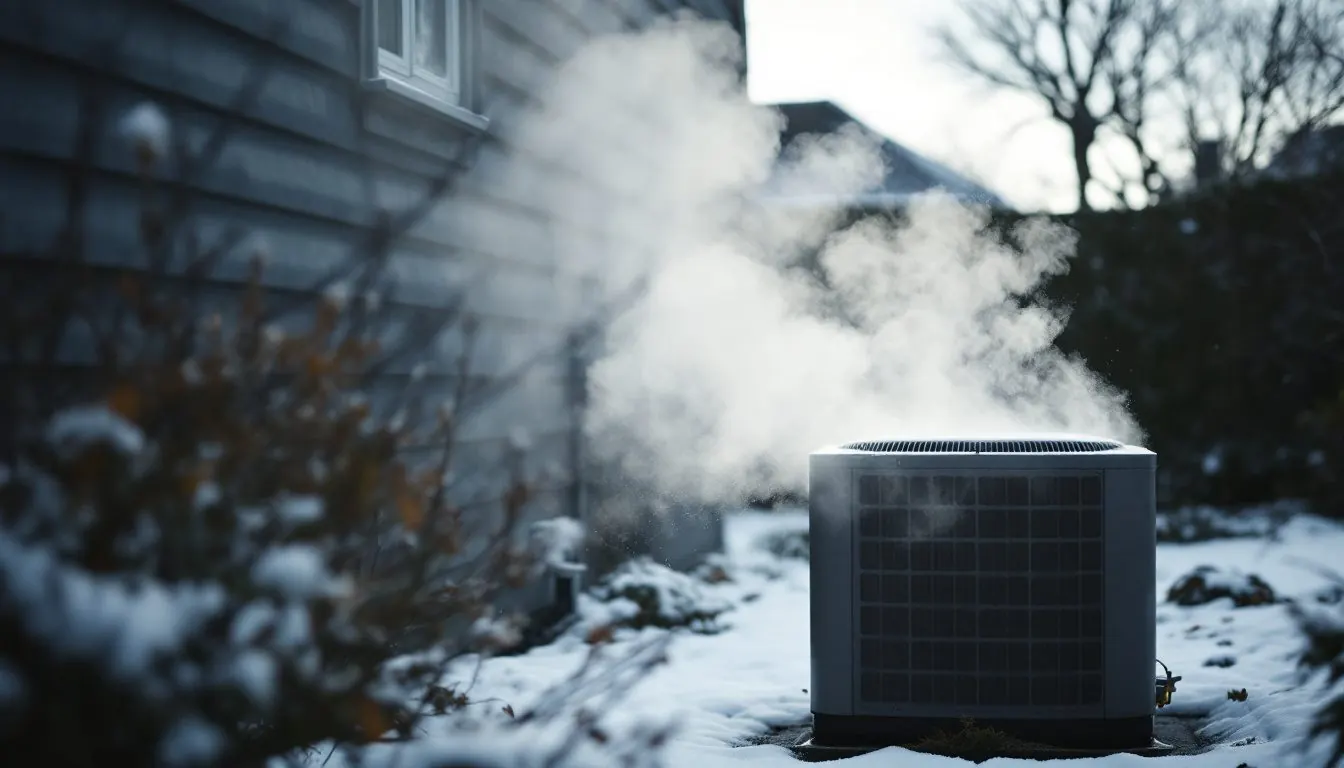
A heat pump making loud noise in cold weather is usually normal when the noise comes at a mode change: a whoosh plus a few seconds of harsh compressor growl as the reversing valve shifts into or out of defrost, often with steam and a stopped fan. Grinding, banging or screeching while it runs is not normal: switch to emergency heat.
Which winter heat pump noises are normal, and which mean stop?
Sounds tied to a mode change that last seconds are normal. Sounds that follow the fan, repeat at every start, or come with tripped breakers or dimming lights are faults. The table sorts 10 winter sounds by the moment you hear them.
| When you hear it | What it sounds like | Normal? | What the maker document says | What to do |
|---|---|---|---|---|
| Going into defrost | Whoosh, then a compressor growl for seconds | Normal | Copeland: the sound in the transition “is normal” | Nothing; ask about the delay jumper |
| During defrost | Fan silent, compressor running, steam | Normal | Rheem: the outdoor fan “will stop” and steam may rise | Leave the ice and steam alone |
| Coming out of defrost | Second whoosh; fan restarts after a pause | Normal | Carrier 25HNB6: defrost ends near 65°F coil, fan waits 20 seconds | Nothing |
| At shut-off | Brief whir, rattle or clunk | Usually normal | Copeland: backward rotation “does not affect compressor durability” | Mention it if it lasts many seconds |
| First start after a long, cold off cycle | Knocking or gargling, lights dim, may retry | Not normal if it repeats | Copeland: liquid in the compressor causes “excessive start-up clearing noise” | Crankcase heater check |
| At every start | Hum or buzz, nothing turns, then a click | Not normal | Start-circuit fault; no figure in the documents read | Off; capacitor and contactor test |
| Right after a power flicker | Compressor runs loud, then stops by itself | Harmless | Copeland: reverse rotation “will not cause any damage” | Wait for the overload to reset |
| While running, after snow or ice | Scraping or thumping that follows the fan | Not normal | Goodman: raise the unit so defrost water and ice drain | Off, emergency heat, let it thaw |
| While running, from the top | Steady screech or squeal | Not normal | No maker figure; typical of fan motor bearings | Off; fan motor check |
| While running, new this winter | Rattle that changes when you press a panel | Low urgency | Goodman: the pad must not shift or settle | Power off, tighten panel screws |
Why does my heat pump whoosh and roar when it goes into defrost?
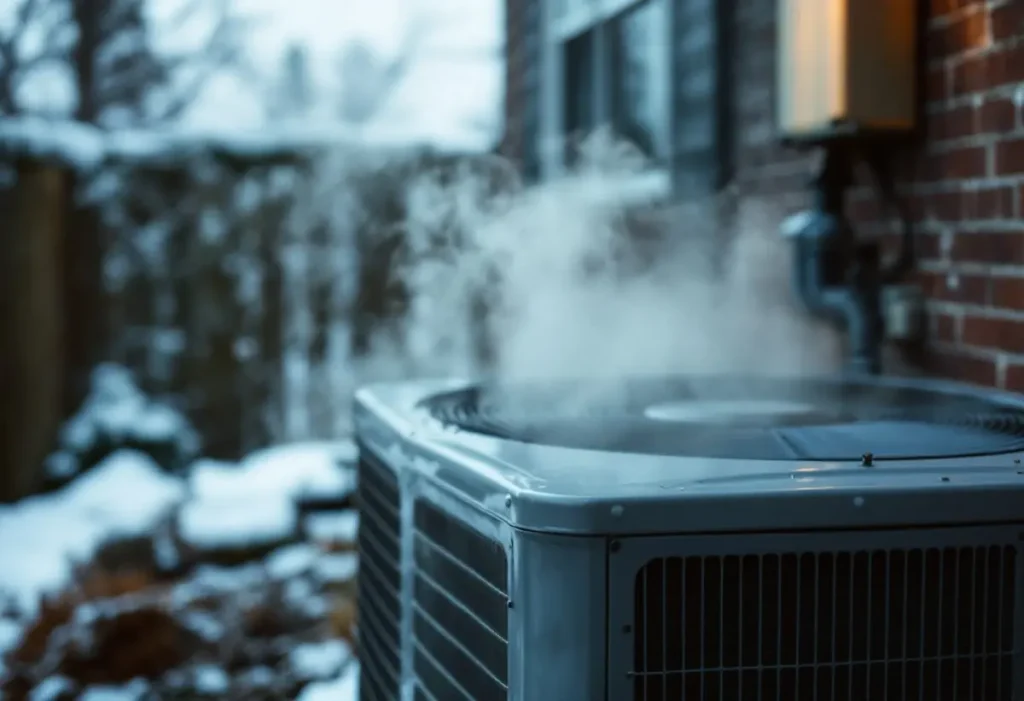
The whoosh is the reversing valve moving; the roar is the compressor reacting. Copeland’s bulletin AE4-1331 R9 explains that when the valve “abruptly changes the refrigerant flow direction,” pressures go outside the normal operating envelope, and the sound lasts according to “the coil volume, outdoor ambient, and system charge.” What starts a defrost is covered in the heat pump defrost cycle guide.
Makers ship a fix. Copeland’s preferred method is to stop the compressor for 20 to 30 seconds as the valve shifts in and out of defrost. The Lennox XP17 instructions describe a DELAY jumper (E37) that cycles the compressor off for 30 seconds, installed at the factory, and Goodman’s version is called SmartShift.
The Rheem 708163B manual says scroll compressors with defrost noise “should use this 30 second delay,” while reciprocating compressors should use it only with an approved hard start kit. A unit that roars at every defrost may simply have its jumper in the no-delay position.
A valve that hangs partway sounds different. Copeland notes that in low ambient heating with little pressure drop, the valve can fail to shift and compressor sound rises; the solenoid and valve body checks are on the reversing valve page.
Why is my heat pump so loud when it turns on in cold weather?
A loud first start after a long, cold off cycle usually means liquid refrigerant has collected in the compressor. Copeland’s AE4-1331 R9 writes that this “may cause excessive start-up clearing noise,” or the compressor may trip its internal overload several times before it runs, and that a crankcase heater “will reduce customer noise and dimming light complaints.”
On the Carrier 25HNB6, the wiring notes say the crankcase heater is energized in the off cycle below 65°F, and the board holds a five minute delay between compressor off and on cycles. A heater that has failed lets the knocking return every cold morning.
A hum with nothing turning, then a click, is the start circuit: a weak run capacitor or pitted contactor, explained in the HVAC capacitor guide. If the compressor runs but the blade sits still outside defrost, follow the branches for a heat pump outdoor fan not running.
What is the noise when a heat pump shuts off?
A short whir or clunk at shut-off is usually gas equalizing through the scroll. Copeland says this “can cause the compressor to slowly rotate backwards,” which “does not affect compressor durability but can cause unexpected sound.” Its ZP*K3 and ZP*K5 scrolls use a cam device, a fluid brake or a discharge port check valve that “nearly eliminate shut down noise.”
A power flicker gives a louder version. Copeland states that interruptions of less than half a second (0.5 s) can drive a single-phase scroll in reverse until its internal overload trips, after which it restarts normally. Ice storms that blink the lights trigger exactly this.
Why does my heat pump grind or bang while running in snow and ice?
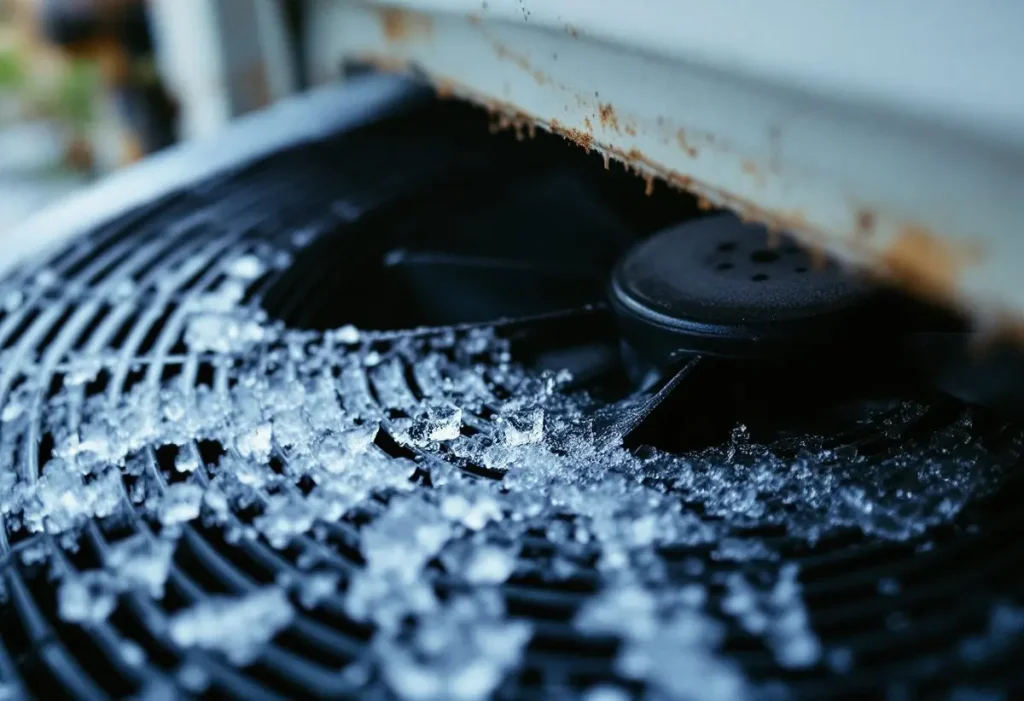
Grinding or a rhythmic thump that follows the fan almost always means the blade is striking ice or packed snow. Turn the heat pump off at the thermostat, use emergency heat, and let it melt; do not chip at it. Where each kind of ice forms is mapped in ice on the outside unit.
Height prevents most of it. Goodman’s IOG-4002A manual recommends minimum elevations by design temperature: 2 1/2 inches at +15°F and above, 8 inches from -5°F to +14°F, and 12 inches below -5°F. Lower than that, meltwater refreezes around the coil and fan.
A steady screech from the top points at fan motor bearings, covered on the condenser fan motor page. Goodman also says the slab should not touch the building foundation, to limit sound transmission, so check the pad when a rattle arrives with frozen ground.
Why does my heat pump sound louder at night in winter?
Usually it is the same sound with less around it. The DOE Energy Saver page (archived copy) says “Fans and compressors make noise” and advises siting the outdoor unit away from windows; Lennox adds that glass has “a very high level of sound transmission.”
Cold nights also mean more of it. Carrier’s 25HNB6 notes say defrost runs only below 50°F outdoors, so the whoosh repeats overnight, and below its balance point a heat pump runs without stopping, as the page on a heat pump running constantly works out.
When should you switch to emergency heat, and what will the technician test?
Switch to emergency heat and book service when the noise is metallic, repeats at every start, trips a breaker, or when ice survives several defrosts. Emergency heat runs only the backup, and what that costs is in auxiliary heat vs emergency heat.
The technician will read the run capacitor’s microfarads against its label, check the contactor, compare compressor amps to the nameplate RLA, confirm the crankcase heater draws current, check the defrost delay jumper, and watch one forced defrost. Copeland warns to get away at once if a compressor sizzles, sputters or pops, because terminal pin ejection may be imminent.
Stop there yourself: capacitors hold a charge, the cabinet carries line voltage, and refrigerant work belongs to a certified technician. For furnace, duct or air handler sounds, use the HVAC noises chart.
Frequently asked questions
Is it normal for a heat pump to make a loud bang?
One thump or whoosh at the start or end of defrost, or a short clunk at shut-off, is normal: Copeland bulletin AE4-1331 R9 calls the compressor sound in the defrost transition normal. A bang at every start with dimming lights is not; Copeland ties that to liquid refrigerant in the compressor, which a working crankcase heater prevents.
Why is my heat pump making noise but the fan is not running?
During defrost that is by design. The Rheem 708163B manual says the outdoor fan will stop while the compressor keeps running to melt the ice, and steam may rise. On the Carrier 25HNB6 the fan restarts 20 seconds after defrost ends. A fan that stays still in heat mode with no steam or frost, while the unit hums, needs a capacitor and motor check.
How long should the loud noise last during defrost?
Seconds, not minutes. Copeland says the length of the compressor sound at the valve shift depends on coil volume, outdoor temperature and charge, and recommends a compressor pause of 20 to 30 seconds at each shift to avoid it. Lennox and Rheem boards offer a 30 second delay, and Goodman’s SmartShift also delays the compressor. A roar through the whole defrost is worth a service call.
What are the signs that my heat pump is going bad?
The noise signs are a compressor that trips its internal overload several times before running, which Copeland AE4-1331 R9 links to liquid refrigerant, a hum with nothing turning, grinding from the fan, and sizzling or popping from the compressor, which Copeland says means get away at once. Ice that survives repeated defrosts and tripping breakers are the other warnings.
How we researched this
On November 17, 2026 we read Copeland bulletin AE4-1331 R9 (September 2024), Lennox XP17 instructions 506586-01, Rheem form 708163B, Goodman IOG-4002A (2017), the Carrier 25HNB6 notes (2012) and the archived DOE Energy Saver page, plus the three top-ranking articles, none of which cited a maker document. We excluded forum and video answers, and gave no cold-weather decibel figure because no document we opened publishes one. Delay settings differ by board.
Sources
- Copeland. “Application Engineering Bulletin AE4-1331 R9: ZP16 to ZP44K3E and ZP14 to ZP61K5E R-410A 1.5 to 5 Ton Copeland Scroll Compressors.” September 2024. https://apps.copeland.com/Publications/AEB/AE4_1331_R9.pdf. Accessed November 2026.
- Lennox Industries. “Dave Lennox Signature Collection XP17 System Heat Pumps Installation Instructions, 506586-01.” https://www.lennox.com/lib/legacy-res/pdfs/installation_maintenance/lennox_xp17_iom.pdf. Accessed November 2026.
- Rheem. “Outdoor Heat Pump User’s Information/Installation Instructions, 13 SEER Split System, form 708163B.” https://files.rheem.com/LiteratureArchive/708163b.pdf. Accessed November 2026.
- Goodman Manufacturing. “Condensing Unit, Heat Pump Installation and Service Reference, IOG-4002A.” January 2017. https://cdn.shopify.com/s/files/1/0253/0852/8730/files/Goodman_GSZ16_Installation_Manual__1.pdf. Accessed November 2026.
- Carrier. “25HNB6 Heat Pump Wiring Diagram and Unit Operation Notes.” 2012. https://www.partstown.com/modelManual/CRR-25HNB6-English_wd.pdf. Accessed November 2026.
- U.S. Department of Energy. “Air-Source Heat Pumps,” Energy Saver (archived copy). https://web.archive.org/web/2025/https://www.energy.gov/energysaver/air-source-heat-pumps. Accessed November 2026.
Leave a Reply