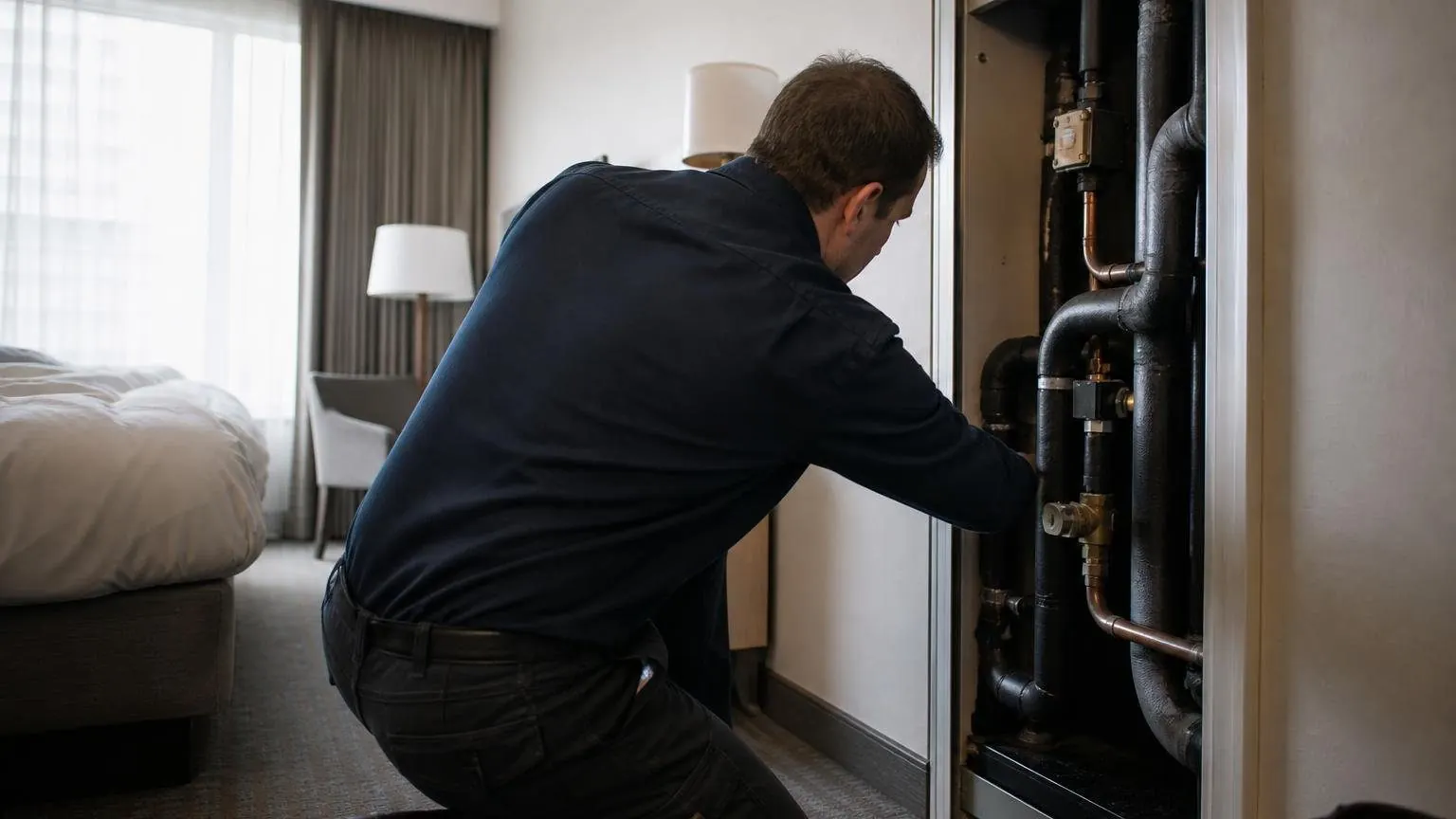
What is a fan coil unit? A fan coil unit is a small room-level HVAC terminal: a fan blows room air across a coil fed with chilled or hot water from a central plant. It heats or cools one space, has no compressor of its own, and is common in hotels, hospitals, schools and high-rise apartments.
Key Takeaways
- DOE defines it as “a small terminal air handling unit with a fan and coil(s),” per the DOE FEMP O&M Best Practices Guide.
- Buildings using fan coil or induction units were 4.7% of US commercial buildings in 2018 but held 21.0% of the floorspace, by our tabulation of EIA’s 2018 CBECS microdata.
- 44.9% of buildings with central chillers fed fan coil or induction units in 2018, in the same CBECS tabulation.
- Two-pipe changeover needs a 15°F outdoor dead band and 4 hours per mode under WAC 51-11C-40343.
- Fan motors of 1/12 hp to under 1 hp must be ECM or at least 70 percent efficient under WAC 51-11C-40508.
- Maker data: Enviro-Tec lists its vertical high-rise fan coil at 350 to 1,200 CFM per unit.
What is a fan coil unit?
A fan coil unit (FCU) is a terminal unit, the last equipment between a central plant and the room. It holds a fan, one or two water coils, a filter, a condensate drain pan and a control valve.
In the 2018 CBECS codebook, fan coil units, “including unit ventilators, contain a cooling coil and fan to circulate air within a room,” while induction units connect to the duct system and “use nozzles to induce airflow” across the coil. CBECS counts the two together, so our figures do too.
One name, two machines. In commercial work, a fan coil runs on water from a chiller plant or boiler. In home catalogs it means the indoor half of a split heat pump or air conditioner. Carrier’s residential site says that “the terms air handling unit and fan coil unit are often used interchangeably.” This article covers the hydronic kind.
How does a fan coil unit work?
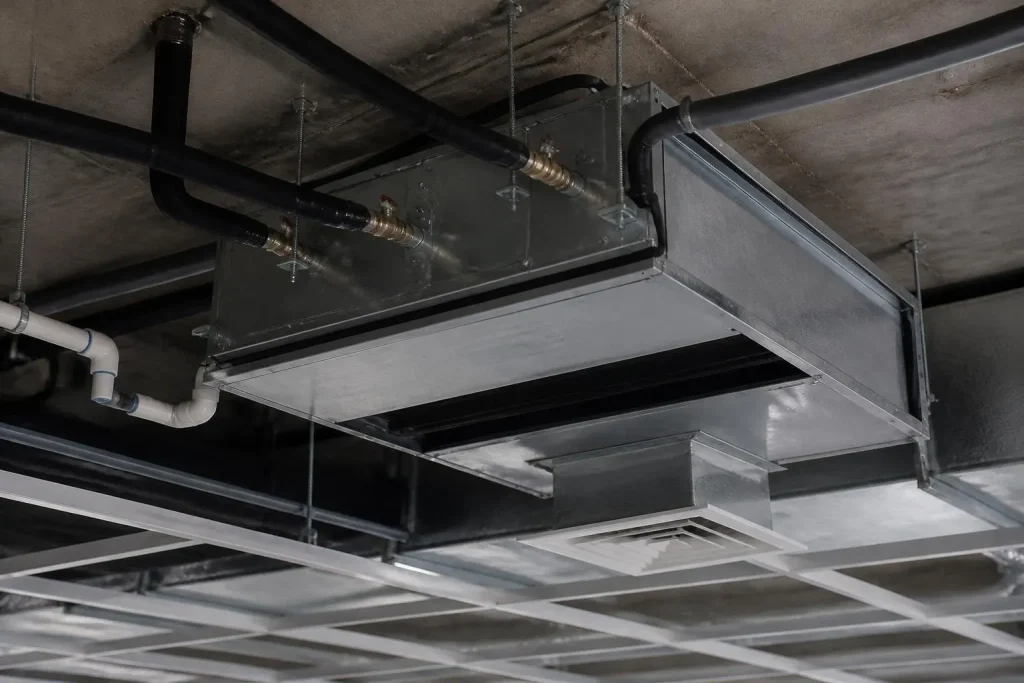
A fan coil unit works by moving room air across a water coil supplied by a central chiller, boiler or heat pump, with pumps carrying the water, as in any hydronic heating system.
- A room thermostat or a building automation system calls for heating or cooling.
- A control valve opens. Enviro-Tec sells factory packages with 2-way or 3-way valves in on/off, modulating or proportional versions.
- The fan pulls room air through the filter and across the coil.
- In cooling, the coil runs below the air’s dew point, so condensate drips into the pan and leaves by gravity or a condensate pump.
- Water returns to the plant through the return pipe.
Most fan coils only recirculate room air; outdoor air often comes from a separate ventilation system. Check your building’s drawings.
2 pipe vs 4 pipe fan coil: what is the difference?
A 2 pipe fan coil has one supply and one return pipe, so the whole building gets either chilled water or hot water at any moment. A 4 pipe fan coil has separate chilled water and hot water circuits, so each room heats or cools on its own.
The weak point of 2-pipe is the shoulder season, when a sunny south room wants cooling and a north room wants heat. Switching the plant over, called changeover, swings the whole loop between cold and hot.
Codes limit that swing. Washington’s section C403.4.3.2 requires a dead band of at least 15°F of outdoor temperature between modes, at least 4 hours in one mode before switching, and heating and cooling supply temperatures no more than 30°F apart at the changeover point. Worked example: a plant that switches to cooling at 65°F outdoors should not return to heating until 50°F. The same section bans three-pipe systems that share one return between hot and chilled water.
| Piping | Water in the coil | Heat one room, cool another? | Main catch |
|---|---|---|---|
| 2-pipe | Chilled or hot, building-wide | No | Changeover limits in spring and fall |
| 2-pipe plus electric heat | Chilled water; electric coil for heat | Yes, per room | Electric resistance heating cost; some states restrict it |
| 4-pipe | Chilled and hot, both always available | Yes | Double piping, valves and insulation |
| 3-pipe (shared return) | Separate supplies, one mixed return | Yes | Prohibited by C403.4.3.1 in Washington |
Which fan coil unit configurations are there?
Fan coil units come in five main configurations: horizontal concealed above a ceiling, horizontal exposed, vertical floor console under a window, vertical stack in a wall chase, and ceiling cassette.
Daikin Applied lists its ThinLine horizontal units at 200 to 1,200 CFM and its OptiLine vertical stacked units at 300 to 1,200 CFM. Enviro-Tec’s low-profile horizontal line runs 250 to 1,200 CFM. These are maker claims.
Vertical stack units dominate high-rise housing: units on every floor line up on shared risers. Enviro-Tec ships these “with risers installed,” so riser work in one unit can affect neighbors on the same stack.
Our CBECS tabulation finds fan coil or induction units in buildings holding 78.7% of inpatient health care floorspace, 42.5% of education floorspace, 33.7% of lodging floorspace and 28.5% of office floorspace in 2018. CBECS excludes residential buildings, so apartment towers are not counted.
Fan coil vs air handler, VAV box and PTAC: how do they compare?
A fan coil serves one room with its own fan and water coil. An air handling unit conditions air for many rooms through ducts. A VAV box meters air from that central unit. A PTAC carries its own compressor.
| Equipment | Serves | Heating and cooling source | Moves air with |
|---|---|---|---|
| Fan coil unit (FCU) | One room or small zone | Chilled and hot water from a central plant | Its own small fan |
| Air handling unit (AHU) | A floor or whole building | Large water or refrigerant coils | Large central fan and ducts |
| VAV box | One zone | Cool air from an AHU, often a reheat coil | The AHU fan; fan-powered models add one |
| PTAC | One room | Its own compressor, electric or heat pump heat | Its own fan, through the wall |
| Water source heat pump | One room or zone | Its own compressor on a shared water loop | Its own fan |
A VAV box system centralizes filters and outdoor air in one machine; fan coils spread fans, filters and drain pans across every room. In 2018, VAV systems were in buildings holding 30.3% of US commercial floorspace, against 21.0% for fan coil or induction units, in our CBECS tabulation.
A through-wall PTAC skips the water plant, and a water source heat pump shares one water loop.
What do energy codes require of fan coils?
Energy codes regulate fan coil piping, fan speed and motors. We read Washington’s commercial code; other states adopt IECC or ASHRAE 90.1 editions with different numbering, so check your local edition.
- Fan speed. Under C403.8.5.1, chilled-water units with fan motors of 1/4 hp or more must vary airflow with load. Units controlled from space temperature need two fan stages, low speed no more than 66 percent of full speed, drawing no more than 40 percent of full fan power.
- The small-unit exception. Modulating fan control is not required for chilled-water units under 1 hp that supply no ventilation air and cycle the fan with the load.
- Motor type. Fan motors from 1/12 hp to under 1 hp must be electronically commutated or at least 70 percent efficient, with a way to adjust speed, under C405.8. Motors in fan coils that run only for heating are exempt.
The motor rule mirrors the ECM shift in residential blower motors. Washington’s piping-insulation section refers to room fan-coils “tested and rated according to AHRI 440,” and Enviro-Tec labels its low-profile line “AHRI-440 certified,” a maker claim.
How do you maintain a fan coil unit in an apartment or condo?
Fan coil maintenance means the filter, the coil and the drain pan. The DOE FEMP guide says filter intervals “should be between 1 and 6 months,” depending on dirt loading.
- Filter. Swap it on the schedule your building sets, sooner if the grille looks dusty. See our HVAC filter guide.
- Coil. FEMP notes that dirty water coils lose heat transfer; set cleaning by inspection.
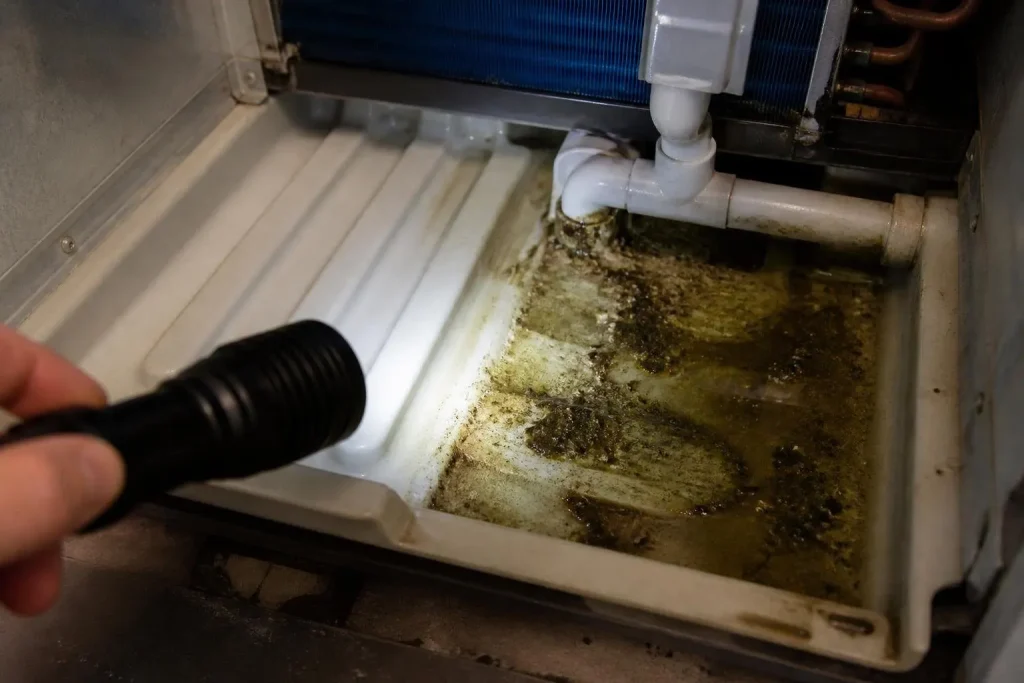
- Drain pan and line. The EPA HVAC checklist asks whether condensate drip pans are clean, free of standing water and visible growth, with drains and traps “clear, working.” If water shows up below a unit, check the pan first, then look for a clogged drain line.
- Valves and fan. A sticking control valve or a fan stuck on one speed shows up as a room that never reaches setpoint.
In a condo, the unit, valves and risers may belong to different parties. Read your association’s documents before touching a valve on a shared riser.
How we researched this
Researched October 2026: 14 sources opened, 10 cited. Building-share figures are our own weighted tabulation of EIA’s 2018 CBECS public microdata (6,436 sampled buildings, weight FINALWT), counting a building if any plant distribution question reported “fan coil or induction units.” Shares are survey estimates. Code text is from the current Washington Administrative Code. Maker figures are labelled. Installed price ranges were excluded because no federal series publishes fan coil prices. Reddit was not used.
Frequently asked questions
What does a fan coil unit do?
A fan coil unit heats or cools a single room by blowing room air across a coil filled with chilled or hot water from a central plant. DOE’s FEMP guide calls it a small terminal air handling unit. In cooling it also removes moisture, which drains from its pan.
Is a fan coil unit the same as an AC unit?
No. A commercial fan coil has no compressor; the cooling comes from a chiller plant. In home equipment the word is used differently: Carrier’s residential site says air handler and fan coil are “often used interchangeably” for the indoor unit of a split air conditioner or heat pump, which does work with refrigerant.
What is the difference between an AHU and an FCU?
Scale and ducts. An air handling unit conditions air for many rooms through ducts, while a fan coil serves one room with its own small fan. Daikin Applied lists its ThinLine fan coils at 200 to 1,200 CFM.
How much does it cost to replace a fan coil unit?
No federal or national-lab source publishes fan coil replacement prices, so we do not quote a range. Cost depends on configuration, valve package and access. Enviro-Tec ships stack units with risers installed, which can widen the job.
Do fan coil units provide fresh air?
Usually not. Most recirculate room air, and outdoor air arrives through a separate ventilation system. Washington’s fan-control code treats units that supply ventilation air differently: the small-unit exception for chilled-water fan coils under 1 hp applies only when they do not.
Is a fan coil system better than VAV?
Neither wins everywhere. Fan coils give room-by-room control without large ducts; VAV centralizes filters and outdoor air. In EIA’s 2018 CBECS, VAV systems served buildings holding 30.3% of commercial floorspace and fan coil or induction units 21.0%, by our tabulation.
Sources
- US Energy Information Administration. “2018 CBECS microdata and codebook.” https://www.eia.gov/consumption/commercial/data/2018/index.php?view=microdata. Accessed October 2026.
- US Energy Information Administration. “About the CBECS.” https://www.eia.gov/consumption/commercial/about.php. Accessed October 2026.
- DOE Federal Energy Management Program. “O&M Best Practices, Release 3.0.” https://www.energy.gov/sites/default/files/2020/04/f74/omguide_complete_w-eo-disclaimer.pdf. Accessed October 2026.
- US Environmental Protection Agency. “HVAC Checklist, Long Form.” https://www.epa.gov/sites/default/files/2014-08/documents/hvaclong.pdf. Accessed October 2026.
- Washington State Legislature. “WAC 51-11C-40343.” https://app.leg.wa.gov/wac/default.aspx?cite=51-11C-40343. Accessed October 2026.
- Washington State Legislature. “WAC 51-11C-4038.” https://app.leg.wa.gov/wac/default.aspx?cite=51-11C-4038. Accessed October 2026.
- Washington State Legislature. “WAC 51-11C-40508.” https://app.leg.wa.gov/wac/default.aspx?cite=51-11C-40508. Accessed October 2026.
- Daikin Applied. “Fan Coils” (maker data). https://www.daikinapplied.com/products/fan-coils. Accessed October 2026.
- Enviro-Tec. “VH and HL Fan Coil Units” (maker data). https://www.enviro-tec.com/products-and-solutions/fan-coil-units/vh_ad/vh-vertical-high-rise-fan-coil-units. Accessed October 2026.
- Carrier. “Fan Coils” (residential, maker data). https://www.carrier.com/residential/en/us/products/fan-coils/. Accessed October 2026.
Leave a Reply