Last reviewed: September 2026 · By the HVAC Brief Editorial Team · Our sourcing and editorial standards
Commercial HVAC service differs from residential in four ways: the equipment is usually a packaged rooftop unit rather than a split system, the refrigerant charge is often large enough to trigger federal leak repair rules, downtime has a direct cost, and the work is governed by a contract rather than a call-out.
The scale is substantial. EIA’s commercial buildings survey counted 5,918 thousand commercial buildings in 2018, of which 4,901 thousand used energy for space heating and 4,631 thousand for cooling.
What the equipment usually is
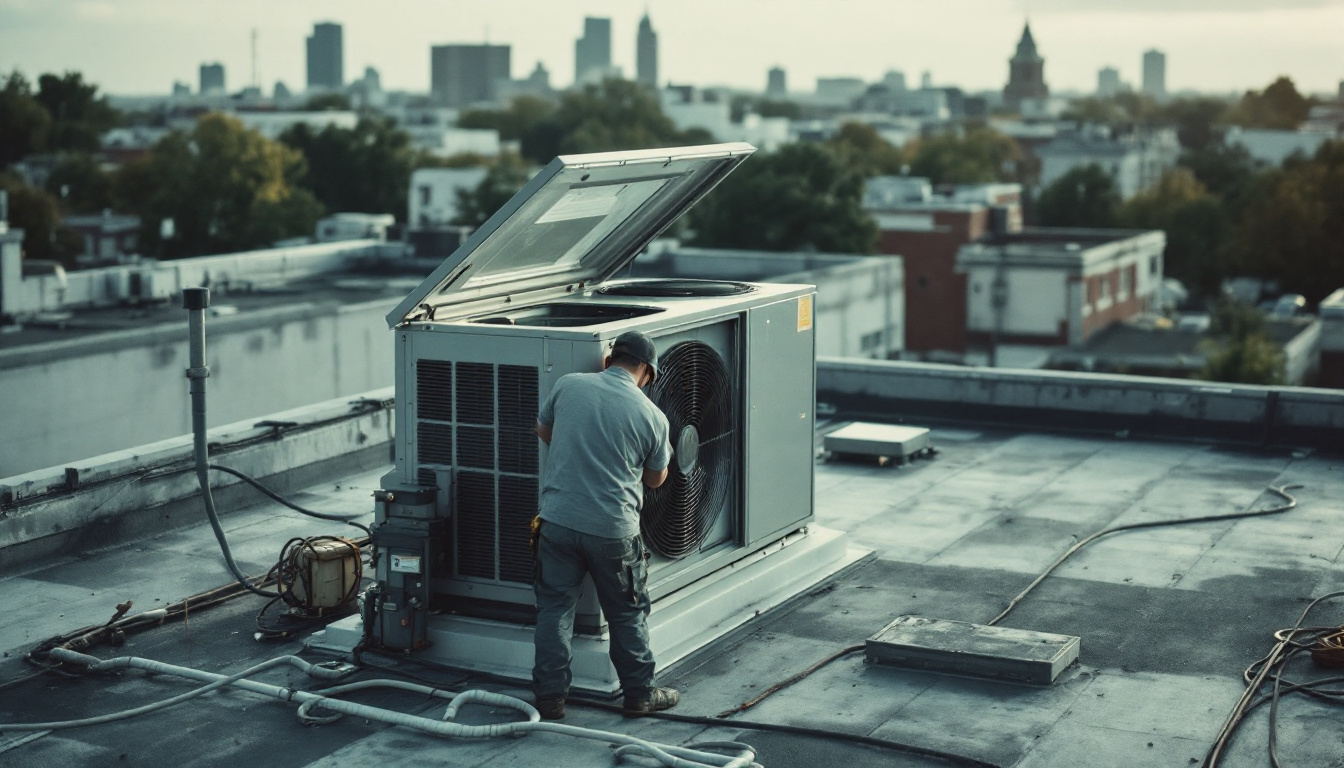
Most commercial buildings are small, and small commercial buildings are mostly served by packaged rooftop units: heating, cooling and the blower in one cabinet on the roof, ducted straight down into the space.
| Equipment | Typically found in | Service implication |
|---|---|---|
| Packaged rooftop unit | Retail, restaurants, offices, small commercial | Roof access, weather exposure, filters and belts on a schedule |
| Split system | Small offices and suites | Closest to residential practice |
| Variable refrigerant flow | Multi-tenant and hospitality | Controls expertise, larger refrigerant charge |
| Chiller and air handler | Large buildings, campuses, hospitals | Water treatment, larger charges, planned shutdowns |
| Boilers | Older and northern buildings | Combustion testing, controls, annual inspection |
For the underlying differences in equipment and duty, see commercial versus residential HVAC.
What actually fails on a rooftop unit
Rooftop units live outdoors, run long hours and are usually out of sight, so failures are found later than in a house.
- Filters and belts. The routine items, and the ones neglect shows up in first.
- Economizer dampers and actuators. A stuck economizer either wastes energy or brings in hot outdoor air during cooling. It is among the most common faults and one of the least noticed.
- Contactors and capacitors. The same electrical wear parts as residential equipment.
- Condenser coils. Exposed to weather and grease from kitchen exhaust in food service.
- Refrigerant leaks. Larger systems hold larger charges, which brings federal rules into play.
- Controls. Schedules, sensors and building automation faults that leave equipment running when the building is empty.
EPA’s leak repair requirements at 40 CFR 84.106 apply to appliances containing 15 or more pounds of regulated refrigerant, and they explicitly exclude residential and light commercial air conditioning and heat pumps. Plenty of commercial equipment sits above that threshold, which means leak inspections, repair deadlines and records. See what the leak repair rules require and the phasedown schedule that is tightening supply.
Service contracts
Commercial work is usually contracted rather than called in. The contract type decides who carries the risk.
| Contract | Covers | Watch for |
|---|---|---|
| Inspection only | Scheduled visits, findings reported | Repairs billed separately at listed rates |
| Preventive maintenance | Scheduled tasks, filters and belts included | What counts as a repair versus maintenance |
| Full coverage | Parts and labour, sometimes including compressors | Exclusions, caps, and condition surveys before coverage starts |
Ask for the task list per visit, the response time commitment, whether after-hours calls are included, and how refrigerant is billed. Refrigerant cost is the line most likely to move under the phasedown.
Why downtime is the real cost
In a house, a failed system is uncomfortable. In a restaurant, a shop or a server room it stops trade or threatens stock, which is why commercial agreements are written around response times rather than around price alone.
That also changes the maintenance calculation: scheduled visits are bought to reduce unplanned failures, not primarily to save energy. The tasks themselves are the same ones in a proper tune-up, performed to a schedule.
Frequently asked questions
How is commercial HVAC service different from residential?
The equipment is usually a packaged rooftop unit rather than a split system, refrigerant charges are often above the 15 pound threshold that triggers federal leak repair rules, downtime carries a direct business cost, and the work is governed by a service contract with response times rather than by individual call-outs.
What fails most on commercial rooftop units?
Filters and belts through neglect, economizer dampers and actuators, contactors and capacitors, condenser coils fouled by weather or kitchen grease, refrigerant leaks, and control faults that leave equipment running out of hours.
Do federal refrigerant rules apply to commercial systems?
Yes, above a threshold. EPA’s leak repair requirements at 40 CFR 84.106 apply to appliances with 15 or more pounds of regulated refrigerant and exclude residential and light commercial air conditioning and heat pumps. Larger commercial equipment is commonly above that line.
Is a commercial HVAC service contract worth it?
The case rests on avoided downtime rather than on measured energy savings, which no federal source quantifies. Compare contracts on the task list per visit, response time, after-hours inclusion, exclusions and how refrigerant is billed.
Methodology and limitations
Building counts are EIA Commercial Buildings Energy Consumption Survey 2018, table B21, the current vintage. Refrigerant rules are quoted from 40 CFR 84.106.
- CBECS counts buildings, not HVAC systems, and a building may hold many units.
- We publish no service contract prices, because no federal source measures them.
- Equipment mix by building type is described in general terms.
Sources
- US Energy Information Administration, Commercial Buildings Energy Consumption Survey 2018, table B21.
- Code of Federal Regulations, 40 CFR 84.106, refrigerant leak repair requirements.
The HVAC Brief is an independent trade publication. We do not sell equipment, take manufacturer advertising, or accept payment for placement in our research. Corrections welcome.
Leave a Reply