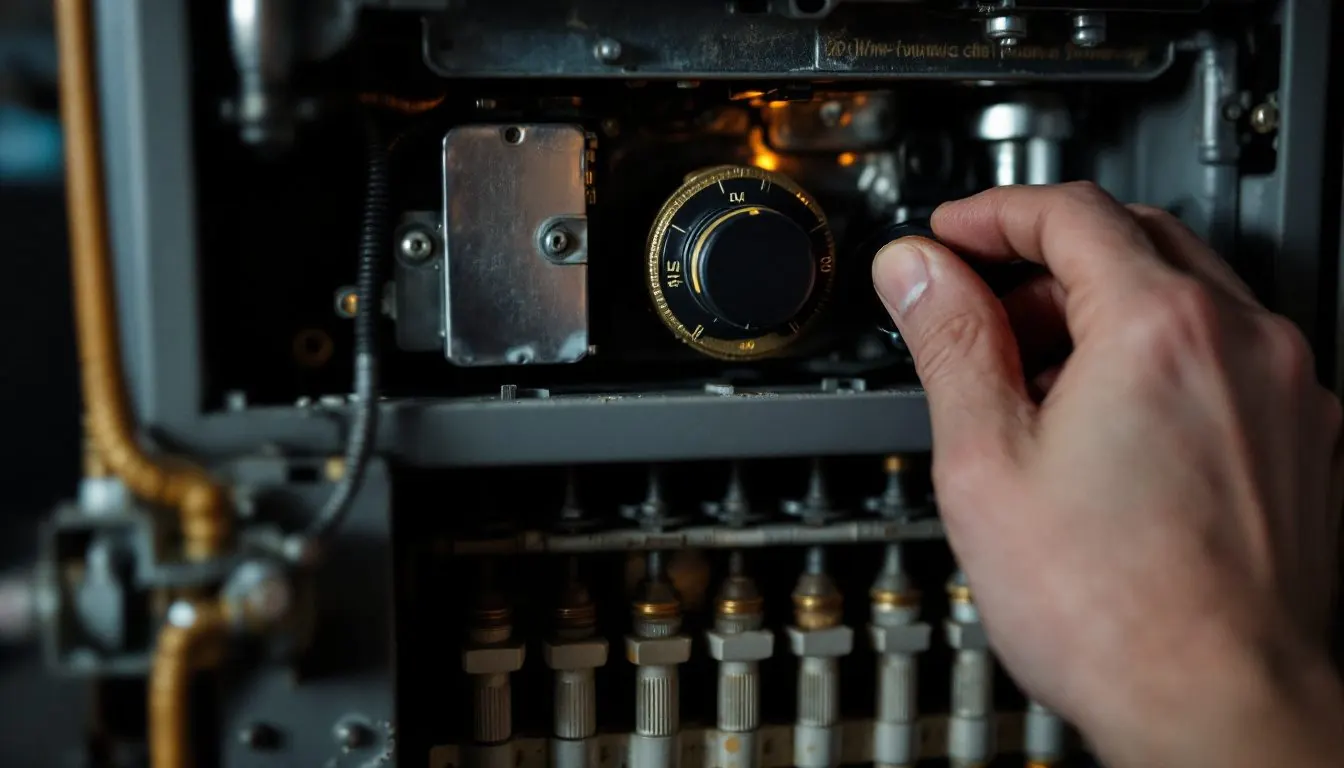
How to turn on a furnace for the first time: put the gas valve knob on ON, close the blower door, switch the furnace power on, then set the thermostat to HEAT above room temperature. Expect the inducer, then the igniter glow, then flame, and warm air roughly 1 to 2 minutes after the call for heat.
One rule from the label overrides every step: if you smell gas, stop, touch no electric switches, and call the gas supplier from a neighbor’s phone, per the Goodman operating label says.
What should you check before turning on the furnace for the first time this winter?
Check three things before the first heat call: the filter, the CO alarms, and the vent outlet. Goodman’s GM9S80 manual says circulating air filters “must be inspected monthly” and calls a blocked or dirty filter one of the most common causes of a problem in a forced air system; the same manual asks for a qualified inspection at least once per year, at the beginning of the heating season.
The U.S. Consumer Product Safety Commission recommends battery or battery-backup CO alarms on every level of the home and outside sleeping areas, and notes that the test button checks the alarm’s circuitry, “not the accuracy of the sensor” (CPSC, archived copy). Our page on where CO detectors belong has the placement rules, and the heating season checklist covers the rest of the fall list. Walk outside to where the vent leaves the house as well: Goodman’s annual inspection list starts with the flue system and says to check for blockage, including “the outside termination.”
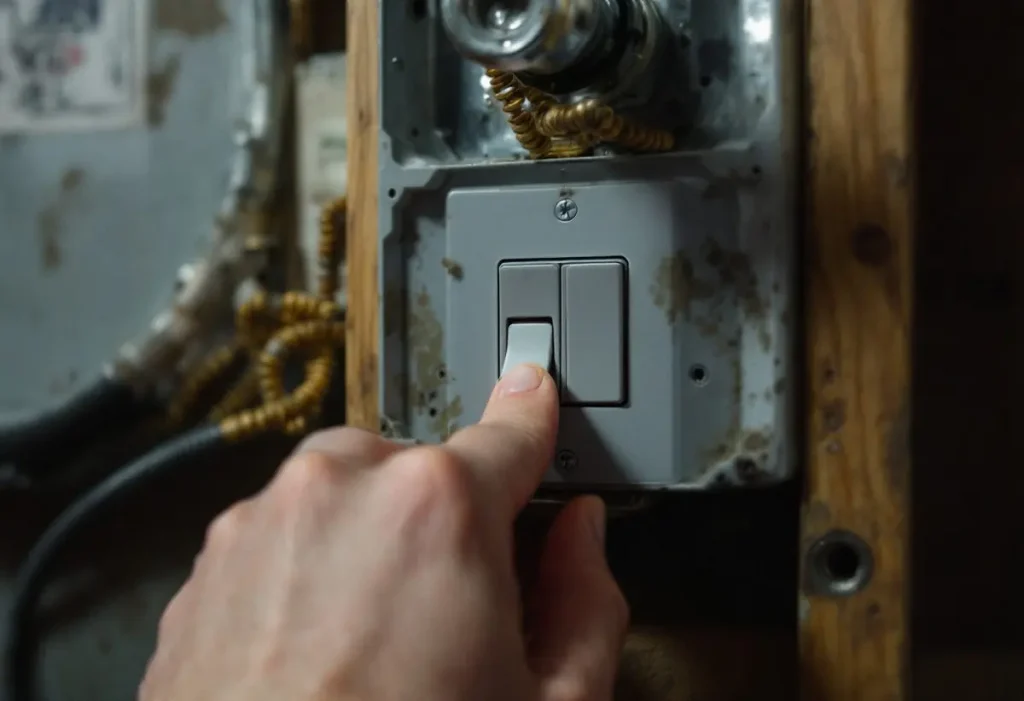
How do you turn on a gas furnace, switch by switch?
Work from the gas side to the thermostat, in this order. The table compresses Goodman’s 11-step “Furnace Startup” sequence.
| Step | What you do | What you should see or hear | If you do not |
|---|---|---|---|
| 1. Thermostat low | Set the thermostat to its lowest setting before touching the furnace | No heat call while you work | Leave it low until step 6 |
| 2. Gas valve knob | Power off, open the burner door, turn the gas valve control to OFF, wait five minutes, smell near the floor, then turn it to ON by hand | No gas odor after 5 minutes | Gas odor: stop and follow the label. Knob will not turn by hand: do not force it or use tools |
| 3. Doors back on | Refit the burner door and press the blower door fully into place | Door sits flat; the interlock switch is pressed | An open blower door switch cuts unit voltage, so the furnace stays dead |
| 4. Outside gas valve | Open the manual gas shutoff valve outside the furnace cabinet | Handle open | Propane: check the tank level first |
| 5. Power on | Switch on the furnace service switch and breaker | Control board LED lights | No LED: breaker, service switch, door switch or board fuse |
| 6. Heat call | Set the thermostat to HEAT, above room temperature | A click at the furnace, then the inducer hum | Nothing at all: the call is not reaching the board |
| 7. Ignition | Watch through the sight window | Igniter glows, burners light blue | Glow but no flame, or flame that drops out: count the tries |
| 8. Warm air | Wait at a supply register | Blower starts 30 to 66 seconds after ignition | Flame but no blower: blower circuit or limit |
Compiled by The HVAC Brief from Goodman’s GM9S80 installation instructions (Furnace Startup, steps 1 to 11, and the blower door interlock note), the Goodman RS6610004 operating label, and the board timings in the next section.
Step 3 is the one that looks done when it is not. Goodman states the blower door interlock switch “interrupts unit voltage when the blower door is opened” and tells installers not to defeat it; a panel that is not fully home on its tabs can look closed and still leave the furnace with no power. Our explainer on the furnace door safety switch shows how to seat it and test it with the power off.
What should you hear in the first two minutes, and in what order?
You should hear the small inducer fan first, see the igniter glow next, then see flame, and only then hear the big blower. The order is the same in all five board documents we read; the chart shows the Copeland White-Rodgers 50M56D-751 at its default setting.
The pause before the blower is deliberate, and so is the run-on: Goodman’s RS6612022R1 manual starts the blower 30 seconds after flame and keeps it running 90 seconds by default after the burners stop.
How long does it take for the furnace to turn on after you raise the thermostat?
On the boards we could time end to end, warm air arrives 68 to 120 seconds after the heat call. If you have just switched the power on, add up to about 20 seconds: Resideo says its S9200U1000 board can “accept a W request after approximately 20 seconds.”
| Control board (document) | Pre-purge | Igniter warm-up | Blower-on delay | Call to warm air |
|---|---|---|---|---|
| Copeland White-Rodgers 50M56D-751, default | 15 s | 5 to 21 s, plus 3 s ignition | 45 s | 68 to 84 seconds |
| Copeland White-Rodgers 50M56D-751, 66 s setting | 15 s | 5 to 21 s, plus 3 s ignition | 66 s | 89 to 105 seconds |
| Resideo S9200U1000, default | 30 s | 17 s (first trial) | 30 s from trial for ignition | 77 seconds |
| Resideo S9200U1000, longest settings | 30 s | 30 s | 60 s | 120 seconds |
| Goodman GM9S single stage (RS6612022R1) | Not timed | 17 s | 30 s default, 5 to 30 s adjustable | 47 s plus pre-purge |
HVAC Brief calculation: sum of the stage times each document states, excluding self-check and pressure-switch proving, which none of them times. So a start that runs well past 2 minutes with no warm air is a failed step, not a slow furnace.
Does your furnace have a standing pilot, and how do you light it the first time?
Read the operating label first: a Goodman label on an electronic-ignition furnace states “This appliance does not have a pilot” and warns “Do not try to light the burners by hand.” On those furnaces, steps 1 to 8 above are the whole job.
Older furnaces with a three-position knob (OFF, PILOT, ON) such as the Honeywell VR8200 have a pilot to light. Honeywell’s VR8200 instructions say to turn the knob to OFF, wait five minutes, turn to PILOT, hold the knob down while lighting, and hold it “about one minute” before releasing; if the flame stays lit, turn the knob to ON and raise the thermostat. Our furnace pilot light guide covers a pilot that will not stay lit.
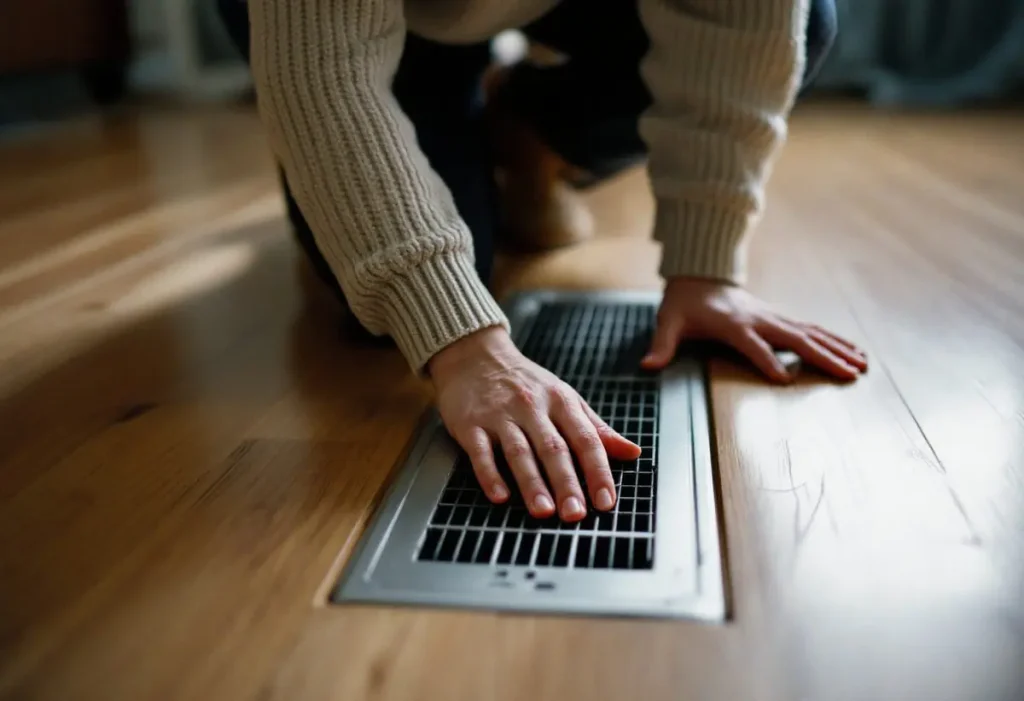
Is a burning smell normal the first time the furnace runs?
A dusty, scorched smell during the first few cycles of the season is normal; gas, sulfur or a hot-plastic electrical smell is not. Goodman’s GM9S80 manual expects dust on the first firing: it tells technicians to allow several minutes for flames to stabilize “since any dislodged dust will alter the flames normal appearance,” and says dust may cause orange tips on the flame “but they must not be yellow.”
A smell that grows instead of fading, or any CO alarm, ends the start-up; CPSC says to move outside to fresh air and not try to find the source. Our page on what each HVAC smell means sorts the rest.
Nothing happens when you turn on the heat: which step failed?
Match the last thing you heard to the step that stopped. Goodman’s RS6610004 service manual describes a control that tries ignition three times, purging 30 seconds and preheating the igniter 20 seconds between tries, then locks out; the board “will automatically reset one hour after lockout occurs,” or you can reset it by turning the thermostat off for more than 5 and less than 20 seconds.
- No sound and no board LED: power is not reaching the furnace; check the breaker, the service switch and the blower door, then read heat on but no heat for the thermostat side.
- Click, inducer hum, no glow, or glow and no flame: the pressure switch or igniter step; our clicking but not turning on page maps each click count.
- Flame for a few seconds, then out, three times: the flame sensor is not proving flame; Goodman’s RS6612022R1 gives a 4-second trial for ignition.
Reset once, following how to reset a furnace safely. Goodman’s own note is that a furnace that “frequently has to be reset” has a problem that needs correcting; that is the stop line. A technician will read the board’s flash code, check gas pressure at the valve and measure flame current, which the Copeland 50M56D-751 sheet sets at a 0.25 μA minimum.
Electric furnace or heat pump: what changes on day one?
There is no gas valve, pilot or inducer, so steps 2, 4 and 7 drop out: breaker on, door on, thermostat to HEAT. On a heat pump, leave the thermostat on HEAT rather than EM HEAT; our comparison of auxiliary heat vs emergency heat explains what EM HEAT switches off.
Frequently asked questions
How do you turn on the heat on a thermostat?
Set the system mode to HEAT (on Nest, ecobee and Honeywell models it is a mode menu, not the temperature), then raise the setpoint above the room temperature. Goodman’s start-up procedure ends with that same step: “Adjust the thermostat to a setting above room temperature.” The furnace sees the call when the thermostat closes R to W.
How do you turn on HVAC without a thermostat?
The heat call is a 24 V connection: Goodman’s sequence begins when “R and W thermostat contacts close.” Goodman’s RS6612022R1 manual has technicians jumper R to W at the board; if the furnace then lights, “the trouble is in the thermostat or wiring.” The jumper bypasses all temperature control, so treat it as a short test, then fix the thermostat.
How often should my furnace turn on in the winter?
Cycle count tracks outdoor temperature, but each cycle should look the same: inducer, flame, blower, then the blower running on after the flame. Goodman’s GM9S board keeps the blower on 90 seconds by default after the burners stop. Our page on how long a furnace should run covers run time by weather.
How do I get a furnace to turn on after it locks out?
Turn the thermostat off for more than 5 and less than 20 seconds and back on, or switch off the furnace power for at least 5 seconds; both reset the Goodman board described in RS6610004. If it locks out again, the same failed step is repeating and needs a technician’s flame current and gas pressure readings.
How we researched this
We read the start-up procedure, operating label and sequence of operation in two Goodman service manuals and one Goodman installation manual, the heat-mode timing charts in the Copeland White-Rodgers 50M56D-751 and Resideo S9200U1000 board instructions, the Honeywell VR8200 lighting procedure, and an archived CPSC carbon monoxide Q&A, in November 2026. Four top-ranking guides (Fox Family Heating, Air Concepts, CS HVAC, wikiHow) cite no maker document; we excluded their unsourced igniter temperature and timing claims, and Carrier and Lennox board timings we could not open.
Sources
- Goodman Manufacturing. “Service Instructions: 80%, 90%, 95% Gas Furnaces and Accessories (RS6610004 Rev. 9).” https://s3.amazonaws.com/s3.supplyhouse.com/product_files/Goodman-GMS951155DXA-Install-Instructions.pdf. Accessed November 2026.
- Goodman Manufacturing. “Service and Troubleshooting: GM9S92 / GM9S96 Single Stage Gas Furnaces (RS6612022R1).” https://mobile.goodmanmfg.com/mobileapp/stellent/pdf/infoPdf/Lit/RS6612022R1.pdf. Accessed November 2026.
- Goodman Manufacturing. “Installation Instructions for *M9S80 and *C9S80 Gas Furnace.” https://documents.alpinehomeair.com/product/goodmangm9s8gc9s8installationmanual.pdf. Accessed November 2026.
- Copeland (White-Rodgers). “50M56D-751 Carrier Integrated Single Stage 120V Hot Surface Ignition Control Kit, Installation Instructions.” media.copeland.com 50M56D-751 instruction sheet. Accessed November 2026.
- Resideo. “S9200U1000 Universal Hot Surface Ignition Integrated Furnace Control, Installation Instructions (69-2075EF).” https://www.cochranesupply.com/media/assets/product/documents/Honeywell/S9200U1000.pdf. Accessed November 2026.
- Honeywell. “VR8200, VR4200 Continuous Pilot Dual Automatic Combination Gas Controls (68-0046).” https://www.cochranesupply.com/media/assets/product/documents/Honeywell/VR8200.pdf. Accessed November 2026.
- U.S. Consumer Product Safety Commission. “Carbon Monoxide Questions and Answers” (archived copy). https://web.archive.org/web/2025id_/https://www.cpsc.gov/Safety-Education/Safety-Education-Centers/Carbon-Monoxide-Information-Center/Carbon-Monoxide-Questions-and-Answers. Accessed November 2026.
Leave a Reply