Mitsubishi mini split error codes show up three ways: a blink count on the indoor unit’s operation lamp, a 2-character check code such as P5 or E6 on a wired controller, and a 4-digit code such as 2502 or 6840. Each Mitsubishi series prints its own table, so identify the series before reading any code.
Is your Mitsubishi showing blinks, a P or E code, or a 4-digit number?
MSZ and MSY wall units (M-Series) blink the upper OPERATION INDICATOR lamp, per service manual OBH732. P-Series (Mr. Slim) heads such as the PKA-M show 2-character check codes on a wired controller and beep them out for a wireless remote, per OCH883. City Multi units such as the PKFY-MS use 4-digit numbers, per OCH926.
The PUZ-M outdoor manual OCH773 prints both forms together: E6 beside 6840, E9 beside 6841, U1 beside 1302. Letter codes are brand-specific, so do not borrow meanings from our MRCOOL code tables or the Daikin mini split codes.
What do 5, 6, 7 and 14 blinks mean on an MSZ or MSY wall unit?
On an MSZ-GL or MSY-GL head, 5 blinks of the upper lamp is an outdoor power system fault, 6 an outdoor thermistor, 7 the outdoor board memory and 14 or more some other outdoor abnormality. OBH732 says the indoor fan stops when the blinking starts. Fujitsu wall units use two lamps instead, with OPERATION blinks giving the first character and TIMER blinks the second, per the Fujitsu mini split error codes.
| Upper lamp | Abnormal point | Condition in the manual |
|---|---|---|
| Nonstop, 0.5 s on, 0.5 s off | Miswiring or serial signal | No serial signal from outdoor unit for 6 minutes |
| 2 blinks | Indoor coil or room thermistor | Short or open circuit |
| 3 blinks | Indoor fan motor | No speed feedback while running |
| 4 blinks | Indoor control system | Board cannot read its memory |
| 5 blinks | Outdoor power system | Compressor trips on overcurrent or startup failure 3 times within 1 minute of startup |
| 6 blinks | Outdoor thermistors | Short or open while compressor runs |
| 7 blinks | Outdoor control system | Outdoor board cannot read its memory |
| 14 or more blinks | Other abnormality | Check stop valve and 4-way valve |
| Upper lit, lower blinks (MXZ) | Operation mode setting | Heads set to COOL and HEAT at once |
Compiled by The HVAC Brief from Mitsubishi Electric service manual OBH732, revised edition D, section 9-4, for MSZ-GL06NA to GL24NA and MSY-GL09NA to GL24NA.
OBH732’s failure mode recall table numbers differ (11 for the indoor fan motor, 12 for the indoor control system), and P-Series remotes use a third scheme.
How many beeps and blinks equal P5, E6, U1 or E9 on a P-Series unit?
On P-Series units, 5 beeps and blinks after a pause is P5, 3 is E6, and a 3 second steady glow before 6 blinks is U1. That glow is how OCH773 and OCH883 separate outdoor faults (output pattern B) from indoor ones (pattern A).
| Pattern, count | Wired code (4-digit) | Mitsubishi’s wording | Who acts first |
|---|---|---|---|
| A, 1 | P1 | Intake sensor error | Technician: 6.3 kΩ at 20°C |
| A, 2 | P2, P9 | Pipe (TH2) or (TH5) sensor error | Technician |
| A, 3 | E6 (6840), E7 | Indoor/outdoor unit communication error | Technician: S1, S2, S3 |
| A, 4 | P4 | Drain sensor error/Float switch connector (CN4F) open | Technician |
| A, 5 | P5, PA | Drain pump error; forced compressor stop (water leakage) | Owner: drain outlet |
| A, 6 | P6 | Freezing/Overheating protection operation | Owner: filter |
| A, 14 | PL | Abnormality of refrigerant circuit | Stop: refrigerant |
| B, 1 | E9 (6841) | Indoor/outdoor unit communication error (Transmitting error) (Outdoor unit) | Technician |
| B, 2 | UP (4210) | Compressor overcurrent interruption | Technician |
| B, 5 | U2 (1102, 1132) | Abnormal high discharging temperature/49C operated/insufficient refrigerant | Stop: refrigerant |
| B, 6 | U1 (1302), Ud (1504) | Abnormal high pressure (63H operated)/Overheating protection operation | Owner: filters, coil |
| B, 7 | U5 (4230) | Abnormal temperature of heat sink | Owner: outdoor airflow |
| B, 8 | U8 (4400) | Outdoor unit fan protection stop | Technician |
| B, 11 | U9 (4220), UH (5300) | Overvoltage or undervoltage; current sensor error | Technician |
Compiled by The HVAC Brief from Mitsubishi Electric service manuals OCH773A (PUZ-M outdoor, sections 9-2 and 9-3) and OCH883 (PKA-M indoor, section 9). 4-digit codes appear only where OCH773 prints them. 6.3 kΩ is OCH883’s room thermistor value at 20°C (68°F).
City Multi lists skip the letters: OCH926 defines 2502 as “Drain overflow protection” and 2503 as “Drain sensor abnormality”. OCH883 heads its P5 row “Drain overflow protection operation”, but no document we opened pairs P5 with 2502, so treat them as one fault family, not a confirmed alias.
How do you read the code before a power cycle hides it?
Count the blinks before you touch the breaker; OBH732 tells technicians to count them before starting service work. If power was already cycled, an MSZ-GL still stores its last fault, and the failure mode recall function in section 9-2 brings it back:
- With power on, hold OPERATION SELECT and TEMP (TOO COOL) on the remote and press RESET.
- Release RESET first; hold the other 2 buttons 3 more seconds until every LCD indicator shows.
- Aim at the head and press OFF/ON. A short beep confirms the signal.
- Upper lamp blinking at 0.5 second intervals with beeps means a stored fault. A 3 second glow without a beep first means the outdoor unit.
- Count 2 full cycles, then cycle the power or press RESET to leave recall mode, which OBH732 says must not be left on.
P-Series wired controllers keep a log: OCH773 says present and past check codes are logged on the wired remote and outdoor control board.
What do P5 and 2502 mean, and can you clear the drain line yourself?
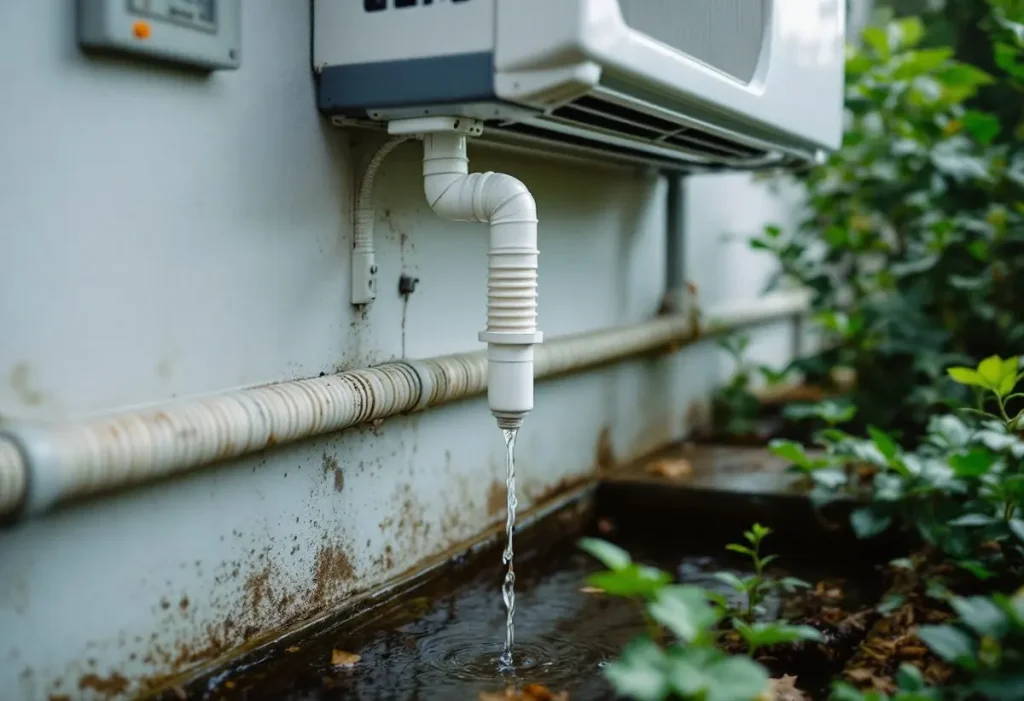
P5 means the drain float switch stayed under water: per OCH883, the float was submerged for 1 minute 30 seconds continuously with the drain pump running, so the unit turned off the compressor and indoor fan. P4 is an unplugged float switch connector (CN4F). Causes: a failed or clogged pump, a clogged pipe, a stuck float.
An owner can check the outside end of the drain hose for a kink or buried outlet, and any separate pump reservoir. Clearing the line works like any AC drain, covered in our page on a clogged AC drain line; lifting pumps are in the condensate pump guide.
An MSZ-GL has a 5/8 in. O.D. drain connection per OBH732; the parts behind it are a cabinet job, covered with full head cleaning on our mini split repair and cleaning page.
Why can E6 or 6840 trace to a fan motor instead of the wiring?
E6 means the indoor board heard nothing valid from the outdoor board for 3 minutes. Besides wiring, noise and either board, OCH773 lists a defective outdoor fan motor and, on VKA2 models, a disconnected 52C relay. Its test: power off, unplug fan connectors CNF1, 2, power on; if E6 stays away, replace the fan motor.
E9 (6841) is the outdoor board’s transmitting error. On an MSZ-GL, OBH732 has technicians confirm rated voltage between S1 and S2 and a 10 to 20 V DC swing between S2 and S3. Those terminals are live, the owner’s stop line; note whether the breaker tripped or an outage came first, as covered in AC not working after a power outage.
Do P6, U1, U2 or 14 blinks mean the refrigerant charge is wrong?
Sometimes, but Mitsubishi lists airflow first. P6 is freeze protection in cooling (indoor pipe below −15°C, or 5°F, for 3 minutes) or overheat protection in heating (above 70°C, or 158°F); OCH883 lists a clogged filter before overcharge.
U1 is the 63H high pressure switch opening at 4.15 MPa, about 602 psi at 145.04 psi per MPa. OCH773’s U1 causes start with indoor short cycling, a clogged filter and a dirty coil, then a stop valve not fully open. U2 names “insufficient refrigerant” outright, and PL is not cancelled until the power source is reset. Gree has its own trap here, because its low refrigerant code looks almost identical to its pump down display, a pair the Gree mini split error codes separate.
Filters and outdoor coil debris are owner work; opening the circuit is not. Under 40 CFR 82.161, anyone who could violate the integrity of the refrigerant circuit must pass an EPA certification exam. Our refrigerant leak detection page covers the technician’s search; compare heating-only codes with the heat pump defrost cycle first.
How do you reset a Mitsubishi mini split, and when should you stop?
On the wired remote in OCH773 section 14, the error screen resets with F4, except while ON/OFF operation is prohibited. On an M-Series head, OBH732 deletes a stored fault only with the emergency operation switch in recall mode; RESET on the hand remote resets the remote, as after a battery change. Not every blinking lamp is a stored fault, though, and the guide to a mini split blinking lists the normal reasons, such as defrost or a restart after a power cut.
OCH773’s fault actions repeat one rule: turn the power off and on again to check, and if the abnormality returns, move to parts. Treat that as one reset. A breaker that trips when you try is its own fault, covered in why an AC keeps tripping the breaker.
Frequently asked questions
Why is my Mitsubishi AC blinking 17 times?
No indoor lamp table we opened defines 17 blinks; OBH732 groups 14 and up as other abnormality. Seventeen is defined on the outdoor inverter board LED of MUZ-GS units, where Mitsubishi’s OBH875 manual calls it an outdoor refrigerant system abnormality: a closed valve and air trapped in the circuit. That is a technician call.
What does a blinking green light on a Mitsubishi AC mean?
OBH732 describes the MSZ-GL indicator by position and state, not color. Both lamps lit means the room is about 4°F (2°C) or more from the set point; only the upper lamp lit means about 2 to 4°F away. Upper lit with the lower lamp blinking is multi zone standby, or heads asking for COOL and HEAT at once. A blinking upper lamp is a fault.
What does L9 mean on a Mitsubishi mini split?
None of the five Mitsubishi Electric service manuals we opened (OBH732, OBH875, OCH773, OCH883, OCH926) defines L9. Their letter codes run through the E, P, U and F families plus EA, Eb, EC, Ed, EE and PL, and the City Multi list in OCH926 is numeric. Check the brand and model on the nameplate before trusting any L9 meaning.
How do I clean the drain pan on a Mitsubishi mini split?
On MSZ-GL heads, OBH732 reaches the drain parts only after removing the panel, corner box, indoor/outdoor connecting wire and control board holder, then pulling the drain hose from the nozzle assembly. That wire carries rated voltage between S1 and S2, so owners should stop at the filter and hose outlet.
How we researched this
On November 6, 2026 we read five Mitsubishi Electric service manuals: US editions OBH732D and OBH875B, and UK library editions OCH773A, OCH883 and OCH926. Every table row comes from these. US P-Series manuals on retailer sites were behind bot protection, so confirm P-Series rows against your own model’s manual. We excluded contractor and aggregator code lists; one top-ranking list calls 2502 a communication fault, which OCH926 contradicts.
Sources
- Mitsubishi Electric. “Service Manual OBH732D: MSZ-GL, MSY-GL indoor.” https://resource.bakerdist.com/is/content/Watscocom/Gemaire/mitsubishi_msz-gl06na-u1_article_1458549065594_en_sm.pdf. Accessed November 2026.
- Mitsubishi Electric. “Service Manual OBH875B: MUZ-GS outdoor.” https://meiersupply.com/customer/docs/skudocs/Document_Links/Vendors/106835%20%2D%20Mitsubishi/MUZ%20GSNAHZ%20DOCS/GS24NAHZMANUAL.pdf. Accessed November 2026.
- Mitsubishi Electric UK. “Service Manual OCH773A: PUZ-M outdoor.” https://library.mitsubishielectric.co.uk/pdf/book/PUZM100140VYKA2ServiceManual. Accessed November 2026.
- Mitsubishi Electric UK. “Service Manual OCH883: PKA-M indoor.” https://library.mitsubishielectric.co.uk/pdf/book/PKAM60100KA2ServiceManualOCH883. Accessed November 2026.
- Mitsubishi Electric UK. “Service Manual OCH926: PKFY-MS indoor.” https://library.mitsubishielectric.co.uk/pdf/book/PKFY-MS10-50VLM2_Service_Manual_OCH926. Accessed November 2026.
- eCFR. “40 CFR 82.161 Technician certification.” https://www.ecfr.gov/current/title-40/chapter-I/subchapter-C/part-82/subpart-F/section-82.161. Accessed November 2026.
Leave a Reply