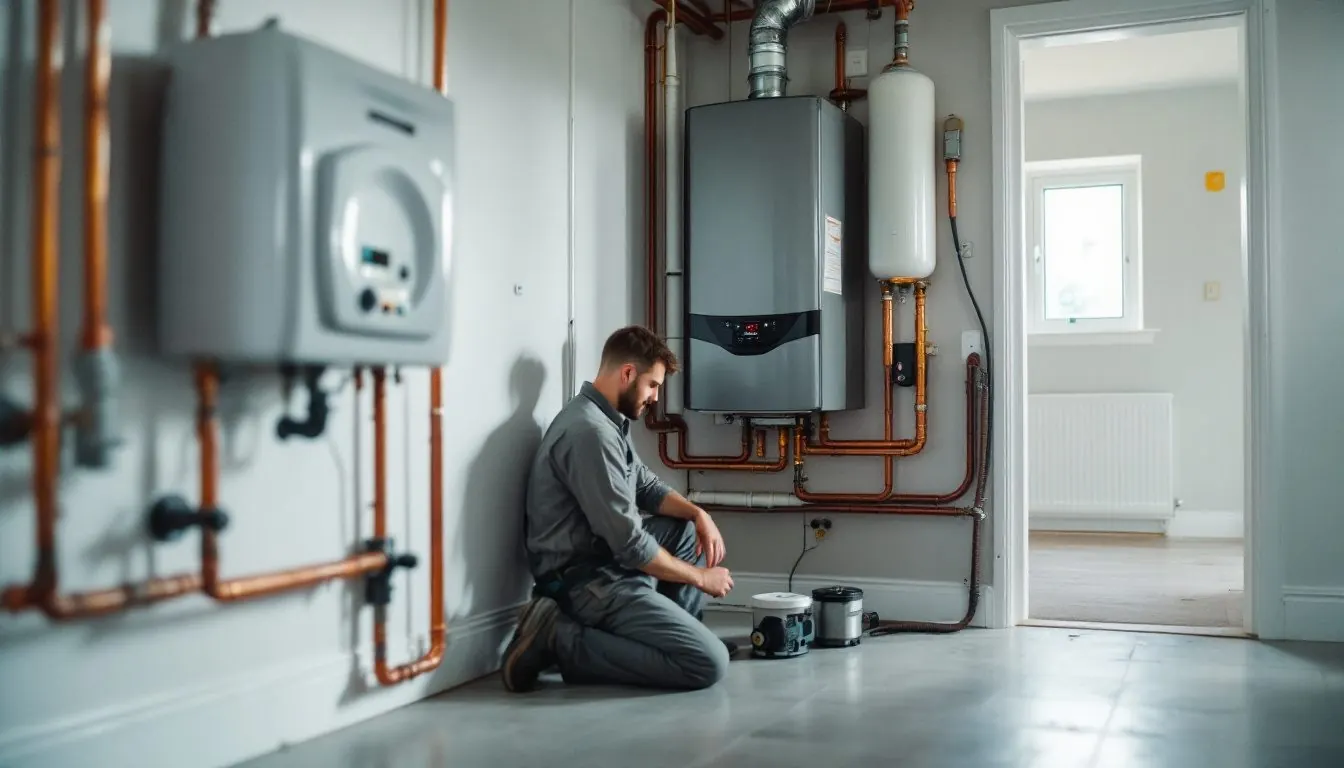
A hydronic heating system heats a home with water. A boiler or air-to-water heat pump warms it, a circulator pump pushes it through a sealed loop to baseboards, radiators, floor tubing or fan coils, and cooler water returns to be reheated. DOE’s analysis gives a gas hot water boiler an average life of 26.9 years.
Key Takeaways
- 9.29 million US homes used steam or hot water as main heat in 2020, 7.5% of all homes (EIA RECS 2020).
- The Northeast holds 6.01 million of them, about 27% of its homes (EIA RECS 2020, HC6.7).
- DOE’s boiler analysis puts average life at 26.9 years for gas hot water boilers and 25.6 years for oil, with a first-year operating cost of $1,344 and $2,783 in 2022 dollars (88 FR 55128).
- Federal floors: 84% AFUE for gas hot water boilers, 86% for oil (10 CFR 430.32).
- A condensing boiler needs return water at or below 130°F, per a DOE Building America guide (Arena, 2014).
- The “DOE says up to 30% savings” claim is not on DOE’s radiant page, which gives no percentage (DOE Energy Saver, archived copy).
- Circulator pumps built from May 22, 2028 face a federal efficiency standard (10 CFR 431.465).
What is a hydronic heating system?
A hydronic heating system carries heat in water instead of air. In DOE’s words, boiler hot water “can be distributed via baseboard radiators or radiant floor systems, or can heat air via a coil” (DOE Energy Saver, archived copy).
Steam systems also use a boiler but move vapor instead of pumping water, run hotter and need their own controls, as our guide to steam boilers explains. Our overview of home heating system types shows where hydronic fits.
How does a hydronic heating system work?
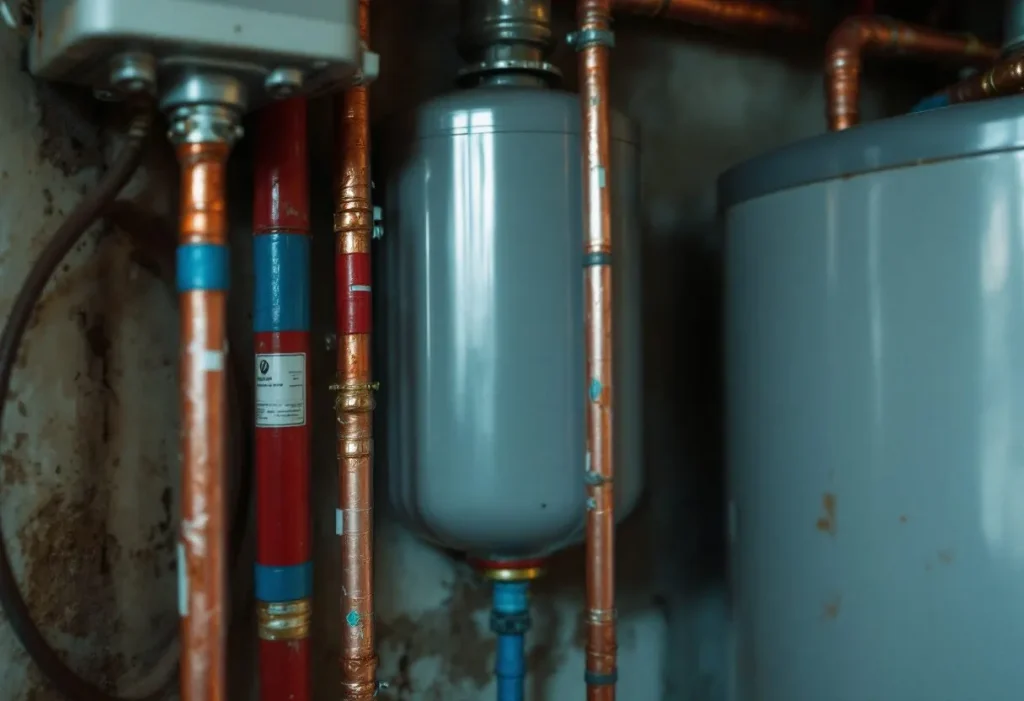
It works as a closed loop: heat goes into water at one point, a pump pushes it to the rooms, and cooled water comes back. Old radiator houses and new heated slabs run the same cycle. So does a snowmelt slab, where a boiler pumps warm glycol through tubing under a heated driveway. Splitting the house into zones takes zone valves on one pump, or a separate circulator per zone.
- The thermostat calls for heat; the heat source fires.
- The circulator pushes hot supply water into the piping.
- Zone valves or zone pumps feed only the zones calling.
- Emitters pass the heat into the room.
- Cooler return water flows back to be reheated.
| Component | What it does | Owner or service note |
|---|---|---|
| Circulator pump | Moves water around the loop | Some systems zone with pumps |
| Air separator | Removes air bubbles from the supply water | Weil-McLain: install in the supply piping |
| Expansion (pressure) tank | Air cushion absorbs expanding water | Should be “filled with air,” not water |
| Pressure relief valve | Opens on excess pressure | Test it at service visits |
| Aquastat or outdoor reset | Sets the supply water temperature | Adjust for efficiency and comfort |
| Zone valves or zone pumps | Feed only zones calling for heat | Pair each zone with a thermostat |
DOE’s hot water service list: test the pressure relief valve and high limit, and inspect the pressure tank “to verify that it’s not filled with water” (DOE Energy Saver). Zoned loops are the hydronic version of what zoning does for ducted systems.
Weil-McLain’s EG manual sets the piping order the diagram follows: “Install an air separator in the supply piping,” “Install expansion tank on suction side of system circulator,” and “Always connect fill line only at the expansion tank.” It adds that “Residential systems are often designed for 12 PSIG of cold fill pressure,” and its water boilers ship with a 30 psi relief valve (Weil-McLain manual 550-142-303).
What are the types of hydronic heating systems?
Hydronic systems are told apart mainly by the emitter, and each emitter wants a different water temperature. Weil-McLain’s ECO Tec boiler control ships with a factory preset for each one, which gives a clean side-by-side comparison (Weil-McLain manual 550-100-272, Figure 25).
| Type | How it heats the room | Preset water target, max / min |
|---|---|---|
| Finned-tube baseboard | Convection from a finned pipe along the wall | 180°F / 130°F |
| Cast-iron baseboard | Convection and radiation from a cast-iron strip | 180°F / 120°F |
| Cast-iron radiators | Radiation and convection; the same radiators serve steam systems | 180°F / 120°F |
| Radiant floor, slab on grade | Tubing in a concrete slab warms the floor | 120°F / 80°F |
| Radiant floor, thin slab | Tubing in a thin concrete or gypsum pour | 140°F / 80°F |
| Radiant floor, staple-up | Tubing fixed under the subfloor | 160°F / 90°F |
| Radiant floor, above-floor sleepers | Tubing laid between sleepers on the subfloor | 140°F / 90°F |
| Fan coil or hydro-air | A fan blows room air across a hot water coil | 180°F / 140°F |
| Combi boiler system | Any emitter above, plus domestic hot water from the same boiler | Domestic hot water preset 180°F |
| Air-to-water heat pump | Any emitter above, at lower water temperatures | 120°F to 130°F output (DOE, 2024) |
Compiled by The HVAC Brief from Weil-McLain ECO Tec series 2 Advanced Manual 550-100-272/1023, Figure 25 (factory presets, adjustable by the installer), and DOE’s April 2024 boiler electrification guidance for the heat pump row.
The temperature column explains most of the practical differences. A slab floor at 120°F suits a condensing boiler or a heat pump, while finned-tube baseboard was laid out for water near 180°F. A combi boiler adds domestic hot water to the same appliance, and a hydro-air system puts the hot water coil in an air handler and moves the heat through ducts. DOE’s 2024 guidance puts current air-to-water heat pump output at 120 to 130°F against about 180°F from a boiler (DOE, 2024).
Is hydronic heating gas or electric?
Most hydronic heating is gas-fired. Of the 9.29 million US homes heated mainly by steam or hot water in 2020, 6.51 million burned natural gas and 1.62 million fuel oil or kerosene, so 87.5% used one of those two fuels (EIA RECS 2020, HC6.1); the table has no separate electric row for this equipment. Electric options exist: electric boilers, condensing water heaters and air-to-water heat pumps can also heat the loop, and the choice decides which federal rating applies.
| Heat source | Federal floor (built since Jan 15, 2021) | ENERGY STAR or DOE note |
|---|---|---|
| Gas hot water boiler | 84% AFUE, no standing pilot | ENERGY STAR: 90% AFUE or higher |
| Oil hot water boiler | 86% AFUE | ENERGY STAR: 87% AFUE or higher |
| Electric hot water boiler | No AFUE minimum | DOE: AFUE between 95% and 100% |
| Condensing water heater | Rated as a water heater, not a boiler | DOE guide: tank at or below 130°F |
| Air-to-water heat pump | No AFUE; not a boiler class | Can also make chilled water |
The boiler rows come from 10 CFR 430.32(e)(2), which also requires automatic water temperature controls that hold an idle boiler to “not more than 140 degrees Fahrenheit.” Our boiler replacement guide weighs condensing choices; what a boiler installation involves covers the job.
Electric boilers lose nothing up a chimney, but DOE calls them “an uneconomic choice” in most of the country because of power prices.
How hot does the water need to be for each emitter?
It depends on the emitter and the weather. DOE says an aquastat typically holds boiler water at 160°F to 180°F, while an outdoor reset control drops it to 120°F to 140°F in mild weather (DOE Energy Saver). A DOE guide sizes fin-tube baseboard at a 170°F average water temperature. The heat source can also sit outside the house, as an outdoor wood boiler burns wood in a shed and pipes hot water underground to the same kind of heating system.
The lower rungs matter for condensing. That guide sizes condensing systems so “the return temperature does not exceed 130°F,” which with a 20°F loop drop means “a 150°F boiler supply temperature” (Arena, 2014). Its sample reset curve supplies 180°F at 5°F outdoors and 120°F at 50°F.
Fan coils add a catch: some will not start below 140°F supply water, leaving that room cold on a low reset curve. DOE calls hydronic floors “the most popular and cost-effective radiant heating systems for heating-dominated climates.” Floor systems get their own radiant floor heating breakdown.
Is hydronic heat more efficient than forced air?
Often, but the gain comes from distribution. DOE says radiant heat is “usually more efficient than forced-air heating because it eliminates duct losses” (DOE Energy Saver, archived copy). DOE adds that duct losses, which AFUE ignores, “can be as much as 35%” of furnace output with ducts in an attic or garage. Radiant warmth does not need water either, since an electric infrared heater warms the people and objects in its line of sight rather than the room air.
The best federal measurement is small. A DOE Building America case study monitored two homes in Tucson, Arizona and Chico, California in 2011 to 2012: radiant floor delivery averaged 94% distribution efficiency against 76% for tight attic ducts, with projected HVAC savings of 3% to 31% (DOE/GO-102013-4045).
Correction: the “DOE says 30%” claim
Ranking explainers say DOE found radiant hydronic systems “can reduce heating costs by up to 30%.” DOE’s radiant heating page gives no percentage. The closest federal figure is the case study above: up to 31% of HVAC energy versus an air-to-air heat pump with attic ducts, and up to 28% versus ducts in conditioned space. That is a ceiling from two houses, not a national average.
How many US homes have hydronic heating systems?
About 9.29 million US homes heated mainly with steam or hot water in 2020, 7.5% of all 123.53 million homes (EIA RECS 2020, Table HC6.1). EIA counts steam and hot water together, so the hydronic share alone is somewhat lower. Forced air dominates instead, and the central heating overview shows a central warm air furnace is the main heating equipment in most American homes that heat.
It is regional. The Northeast had 6.01 million of them, about 65%, and about 27% of its 21.92 million homes use it (EIA RECS 2020, Table HC6.7). Our analysis of the full US fuel and equipment mix puts that in context, and who still heats with boilers and baseboard goes deeper.
Can a heat pump run a hydronic heating system?
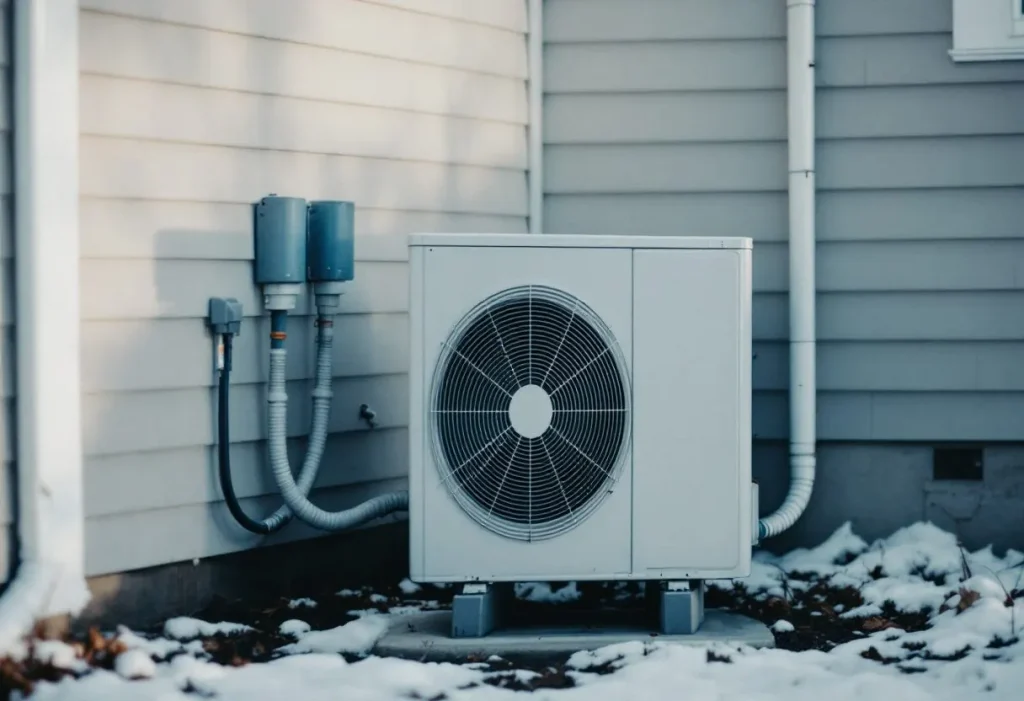
Yes, with an air-to-water heat pump, but the emitters decide how well it works. DOE says these units “employ a refrigerant-to-water heat exchanger and generate hot or chilled water” for “a radiant floor, fan coils, or radiators” (DOE Building America).
The obstacle is water temperature: the hotter the water, the harder the compressor works, as explained in how a heat pump moves heat. NREL notes that “more than 3.8 million multifamily housing units rely on gas-driven steam or hot water systems” whose “high-temperature radiators” are hard to electrify (NREL, BTO Peer Review 2023).
NREL’s fixes lower the water temperature the house needs:
- Replace emitters with larger devices.
- Cut the load with envelope retrofits.
- Swap some emitters for fan coils.
- Add radiant panels.
The same changes help a condensing boiler, which needs return water at or below 130°F.
Burnham’s Heating Helper puts numbers on the radiator problem. A square foot of cast-iron radiation gives 170 BTU/h at 180°F water, 90 BTU/h at 140°F and 50 BTU/h at 120°F (70°F room, 20°F drop), so at 120°F a radiator delivers about 29% of its 180°F output, by our arithmetic. A house that heated fine on 180°F water needs about 3.4 times the radiation (170 ÷ 50), or a much smaller heat loss, to stay warm on 120°F water. Metallic top coats make a marginal radiator worse, and can you paint radiators explains why repainting an aluminum-finished radiator in any non-metallic color recovers its radiant share without stripping the old coat.
What are the pros and cons of hydronic heating?
The main advantages are no duct losses, very little electricity use and long boiler life. The main negatives are no built-in cooling, slow response in thick slabs, freeze risk, air in the loop and radiators that lose output at heat pump water temperatures. Noise on a radiator loop has more than one source too, since a thermostatic radiator valve that is not working can whistle or hum when water runs through it backwards or the pump has no bypass. Air in the loop is also the usual source of gurgling, and hot water baseboard noise separates that sound from the ticking of copper tube expanding on its cradles.
| Pros of hydronic heating | Cons of hydronic heating |
|---|---|
| No duct losses, which DOE says can reach 35% of furnace output with ducts in an attic or garage | No cooling: needs a separate system or chilled water through fan coils |
| DOE: “Hydronic (liquid-based) systems use little electricity” | Thick slabs respond slowly; DOE calls setbacks “difficult if not impossible” |
| DOE: people with allergies often prefer radiant heat because it “doesn’t distribute allergens like forced air systems can” | Freeze risk: DOE advises keeping cooler zones above 50°F |
| Room-by-room zoning with a valve or pump per zone | Air collects; DOE says to bleed radiators at the start of each season |
| Average boiler life of 26.9 years (gas) and 25.6 years (oil) in DOE’s analysis | Radiators sized for 180°F water give 50 BTU/h per sq ft at 120°F, against 170 at 180°F (Burnham) |
| Low-temperature floors suit condensing boilers, which need return water at or below 130°F | DOE’s average installed cost for a baseline gas boiler was $6,214 in 2022 dollars, boiler only |
Compiled by The HVAC Brief from DOE Energy Saver “Radiant Heating,” “Furnaces and Boilers” and “Heat Distribution Systems” (archived copies; radiant page), DOE Building America, 88 FR 55128 and Burnham Heating Helper 2024-2025.
Cooling needs a separate system or chilled water through fan coils; DOE’s case study warns that “radiant cooling is not recommended in humid climates.” Thick slabs respond so slowly that DOE calls setbacks “difficult if not impossible.”
DOE advises keeping cooler zones “above 50°F to prevent pipe freezing” and bleeding radiators at the start of each heating season (DOE Energy Saver, “Heat Distribution Systems,” archived copy). Our radiator repair walkthrough covers bleeding, and a yearly boiler service visit should test the relief valve and expansion tank.
Under 10 CFR 431.465(i), each circulator pump manufactured starting May 22, 2028 must have a circulator energy index of not more than 1.00.
How long does a hydronic heating system last?
A gas hot water boiler lasts 26.9 years on average and an oil one 25.6 years, according to the lifetime analysis behind DOE’s 2023 consumer boiler proposal (88 FR 55128). DOE built those averages from a survival curve fitted to RECS surveys from 1990 to 2020, the Census American Housing Survey from 1974 to 2021 and historical boiler shipments; across all consumer boilers the mean was 24.6 years.
Condensing boilers are the open question. AHRI and PB Heat told DOE that condensing boilers have shorter lives, and DOE answered that there is “not enough data available to accurately distinguish the lifetime of non-condensing and condensing gas-fired boilers,” so it used one figure for both. DOE withdrew the proposed standard on January 17, 2025 (90 FR 5746), so these lifetimes are analysis inputs, not rules. For context on how long US heating equipment actually stays in service, see how old America’s HVAC equipment is.
Is hydronic heating expensive to run?
A hydronic system costs about what its fuel costs: DOE’s average first-year operating cost, covering energy, maintenance and repair, was $1,344 for a baseline 84% AFUE gas hot water boiler and $2,783 for an 86% oil boiler, in 2022 dollars (88 FR 55128, Tables V.2 and V.6).
| Boiler class | AFUE level | Average installed cost | First-year operating cost | Average life |
|---|---|---|---|---|
| Gas hot water | 84% (federal minimum) | $6,214 | $1,344 | 26.9 years |
| Gas hot water | 90% (condensing) | $6,482 | $1,265 | 26.9 years |
| Gas hot water | 95% (condensing) | $6,543 | $1,221 | 26.9 years |
| Oil hot water | 86% (federal minimum) | $6,945 | $2,783 | 25.6 years |
| Gas steam | 82% (federal minimum) | $6,008 | $1,078 | 23.7 years |
| Oil steam | 85% (federal minimum) | $6,977 | $2,726 | 19.6 years |
Compiled by The HVAC Brief from DOE, 88 FR 55128 (August 14, 2023), Tables IV.5, V.2, V.4, V.6 and V.8, in 2022 dollars. Averages over DOE’s sample of households and buildings. The steam and hot water samples are different homes, so compare rows within a class, not steam against hot water.
Two numbers fall out of that table. Moving from an 84% to a 95% gas boiler cuts fuel per unit of delivered heat by 11.6% (1 minus 84 ÷ 95, our arithmetic), and DOE’s first-year operating cost falls by $123. Oil cost about twice as much to run as gas in DOE’s sample. To plug in your own prices, use our cost of heat by fuel comparison; steam boilers sit lower, at 82% to 85% AFUE, because none of them condense.
What are common hydronic heating problems?
Most hydronic service calls trace to five causes: air in the loop, the wrong pressure, a waterlogged or undersized expansion tank, a circulator or zone valve that does not open, and return water cold enough to condense inside a cast-iron boiler. Air is the cause owners can clear themselves, and how to bleed baseboard heaters covers both the vent at each unit and the zone purge at the boiler. If one room stays cold after bleeding, hot water baseboard heat not working in one room checks whether its zone valve or zone circulator is opening, or whether a closed damper or blocked fins are holding the heat back.
| Symptom | Likely cause | What to check |
|---|---|---|
| Gurgling; radiators cold at the top | Air in the loop | Bleed radiators at the start of the season (DOE); check the air separator’s vent |
| Gauge reads low, or the boiler keeps taking water | Leak or wrong fill pressure | Weil-McLain: residential systems are often designed for 12 psig cold fill |
| Relief valve opens as the water heats | Expansion tank undersized or full of water | DOE: the tank “should be filled with air”; Weil-McLain: undersized tanks dump water through the relief valve |
| Boiler fires but rooms stay cold | Circulator not running or zone valve not opening | Does the circulator run on a call for heat; does the zone valve end switch close |
| Corrosion inside a cast-iron boiler | Return water below 130°F, common with radiant and converted gravity systems | Weil-McLain: install bypass piping to protect the boiler |
Compiled by The HVAC Brief from DOE Energy Saver (archived copies) and Weil-McLain EG manual 550-142-303.
The expansion tank row is the one that does damage over time. Weil-McLain warns that an undersized tank lets system water escape through the relief valve and fresh makeup water come in through the fill valve, and “Eventual section failure can result” (Weil-McLain manual 550-142-303). Normal readings for each boiler type are in our boiler pressure guide, and the pump side is covered in our circulator pump explainer. Low return temperature matters most on old cast-iron boilers: the same manual says that without a bypass, cold return water “could cause corrosion of the boiler sections or burners.”
How we researched this
November 2026 update: we added DOE’s 2023 consumer boiler analysis (88 FR 55128) for lifetimes, installed costs and operating costs, noting that DOE withdrew that proposal in January 2025 (90 FR 5746); Weil-McLain’s ECO Tec series 2 and EG/PEG series 6 manuals for emitter temperature presets, piping order and fill pressure; and Burnham’s Heating Helper 2024-2025 for radiator output by water temperature. Contractor and lead-generation pages with installed prices were excluded.
Original research date: October 8, 2026. Cited: EIA RECS 2020 tables HC6.1 and HC6.7; 10 CFR 430.32 and 431.465 on eCFR; four DOE Energy Saver pages, now 404 and read as archived copies; a DOE Building America case study and measure guideline; an NREL project summary from DOE’s 2023 peer review; and ENERGY STAR boiler criteria.
Excluded: competitor savings claims of 20% to 40%, which trace to no federal source, and installed prices, which no federal series publishes. We found no federal figure for air-to-water heat pump maximum water temperature, so we give none. Reddit was not mined: boilers burn fuel, a safety-topic exclusion.
Frequently asked questions
Is hydronic heating the same as radiant heating?
Not exactly. DOE defines radiant heating as heat supplied directly to floors or to wall or ceiling panels, and names three radiant floor types: air, electric and hot water. Hydronic floors are one of them. Hydronic baseboard and fan coils also use hot water but heat mostly by warming air.
Can a hydronic heating system provide air conditioning?
Only with added equipment. An air-to-water heat pump can make chilled water for fan coils or a floor, as in DOE’s Building America case study homes. That study warns that “radiant cooling is not recommended in humid climates,” so most hydronic homes add a separate cooling system.
What does an expansion tank do in a hydronic system?
Water expands as it heats, and the expansion tank holds an air cushion that absorbs the extra volume so loop pressure stays in range. DOE’s hot water checklist says to inspect the pressure tank, “which should be filled with air,” and confirm it is not filled with water.
How hot should the water in a hydronic heating system be?
DOE says an aquastat typically keeps boiler water at 160°F to 180°F. Outdoor reset lowers it in mild weather to 120°F to 140°F, which DOE, citing the Smarter House guide, says cuts fuel use by 5% to 10%. Condensing boilers need return water at or below 130°F.
What efficiency must a new hydronic boiler meet?
Gas-fired hot water boilers made since January 15, 2021 must reach 84% AFUE and oil-fired ones 86%, under 10 CFR 430.32. Electric hot water boilers have no AFUE minimum. ENERGY STAR requires 90% AFUE or more for gas boilers and 87% or more for oil.
Is hydronic heating worth it?
Usually, in a home that mostly needs heat. DOE calls hydronic floors the most popular and cost-effective radiant heating systems for heating-dominated climates, and its boiler analysis gives a gas hot water boiler an average life of 26.9 years. Homes that also need cooling must add a separate system, since DOE warns that radiant cooling is not recommended in humid climates.
What pressure should a hydronic heating system be at?
Weil-McLain’s EG boiler manual says residential systems “are often designed for 12 PSIG of cold fill pressure,” and its water boilers ship with a 30 psi relief valve. Pressure rises as the water heats and the expansion tank absorbs it. A gauge that climbs toward the relief setting on every cycle points to a waterlogged or undersized expansion tank.
Is a steam system a hydronic heating system?
Steam uses a boiler too, but it moves vapor rather than circulating liquid water, so most references treat it separately. DOE says steam boilers run hotter and “are inherently less efficient.” Federal floors are lower for steam: 82% AFUE for gas and 85% for oil.
Sources
- EIA. “RECS 2020 Table HC6.1, Space heating in U.S. homes, by housing unit type.” https://www.eia.gov/consumption/residential/data/2020/hc/pdf/HC%206.1.pdf. Accessed November 2026.
- EIA. “RECS 2020 Table HC6.7, Space heating in homes in the Northeast and Midwest regions.” https://www.eia.gov/consumption/residential/data/2020/hc/pdf/HC%206.7.pdf. Accessed October 2026.
- eCFR. “10 CFR 430.32, Energy and water conservation standards and their compliance dates.” https://www.ecfr.gov/current/title-10/chapter-II/subchapter-D/part-430/subpart-C/section-430.32. Accessed October 2026.
- eCFR. “10 CFR 431.465, Pumps energy conservation standards and their compliance dates.” https://www.ecfr.gov/current/title-10/chapter-II/subchapter-D/part-431/subpart-Y/section-431.465. Accessed October 2026.
- DOE Energy Saver. “Radiant Heating (archived copy).” https://web.archive.org/web/2025id_/https://www.energy.gov/energysaver/radiant-heating. Accessed November 2026.
- DOE Energy Saver. “Furnaces and Boilers (archived copy).” https://web.archive.org/web/2025id_/https://www.energy.gov/energysaver/furnaces-and-boilers. Accessed October 2026.
- DOE Energy Saver. “Gas-Fired Boilers and Furnaces (archived copy).” https://web.archive.org/web/2025id_/https://www.energy.gov/energysaver/gas-fired-boilers-and-furnaces. Accessed October 2026.
- DOE Energy Saver. “Heat Distribution Systems (archived copy).” https://web.archive.org/web/2025id_/https://www.energy.gov/energysaver/heat-distribution-systems. Accessed October 2026.
- DOE Building America. “Air-to-Water Heat Pumps With Radiant Delivery in Low Load Homes, DOE/GO-102013-4045.” https://www.energy.gov/sites/prod/files/2014/01/f7/case_study_airtowater_heatpumps.pdf. Accessed October 2026.
- L. Arena, CARB, DOE Building America. “Measure Guideline: Condensing Boilers, Optimizing Efficiency and Response Time During Setback Operation.” https://www1.eere.energy.gov/buildings/publications/pdfs/building_america/measure_guide_condensing_boilers.pdf. Accessed October 2026.
- NREL, DOE BTO Peer Review 2023. “High-Temperature Combination Heat Pumps for Low-Cost Electrification.” https://www.energy.gov/documents/bto-peer-2023-32260b-high-nrel-jamespdf. Accessed October 2026.
- ENERGY STAR. “Boilers.” https://www.energystar.gov/products/boilers. Accessed October 2026.
- U.S. Department of Energy. “Energy Conservation Program: Energy Conservation Standards for Consumer Boilers,” notice of proposed rulemaking, 88 FR 55128, August 14, 2023. https://www.federalregister.gov/documents/2023/08/14/2023-16476/energy-conservation-program-energy-conservation-standards-for-consumer-boilers. Accessed November 2026.
- U.S. Department of Energy. “Energy Conservation Standards for Consumer Boilers,” withdrawal of proposed rule, 90 FR 5746, January 17, 2025. https://www.federalregister.gov/documents/2025/01/17/2025-00964/energy-conservation-program-energy-conservation-standards-for-consumer-boilers. Accessed November 2026.
- Weil-McLain. “ECO Tec Series 2 Advanced Manual,” part number 550-100-272/1023. https://www.weil-mclain.com/wp-content/uploads/ECO-Tec-Series-2-Advanced-Manual-1023.pdf. Accessed November 2026.
- Weil-McLain. “EG/PEG Series 6, EGH Series 5 Gas-Fired Boilers, Boiler Manual,” part number 550-142-303/1120. https://www.weil-mclain.com/wp-content/uploads/EG-PEG-Series-6-Boiler-Manual-Web-Version.pdf. Accessed November 2026.
- Burnham Holdings. “The Heating Helper,” 2024-2025 edition. https://s3-us-west-2.amazonaws.com/catsy.782/Heating+Helper.pdf. Accessed November 2026.
- U.S. Department of Energy. “Guidance Document on Space Heating Electrification for Large Commercial Buildings with Boilers.” April 2024. https://www.energy.gov/sites/default/files/2024-04/Large%20Building%20Boiler%20Electrification%20Guidance.pdf. Accessed November 2026.
Leave a Reply